Last updated: July 30, 2026
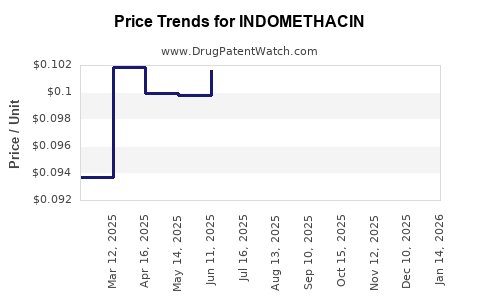
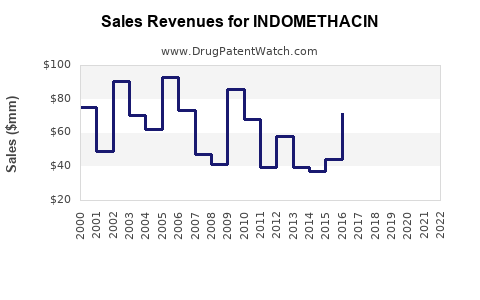
Indomethacin is an established NSAID with long-standing generic availability in the U.S. and most major markets. The financial trajectory is dominated by (1) post-patent erosion after earlier brand exclusivities ended, (2) low unit pricing for generics, (3) inventory and channel dynamics for oral and topical versions, and (4) demand sensitivity to GI and drug-interaction risk plus substitution by other NSAIDs. The near-term market outlook is largely volume-driven rather than price-driven.
How big is the indomethacin market and what is driving demand?
Fast answer: Indomethacin demand is stable but modest in absolute dollar terms, reflecting broad generic competition and clinical substitution across NSAIDs.
What indications create the core revenue base?
Indomethacin’s prescribing footprint historically centers on inflammatory and pain indications, including:
- Rheumatoid arthritis and other inflammatory arthritides (older, shrinking footprint as formularies move to newer NSAIDs).
- Acute gout and crystal-related inflammatory episodes, though use varies by guideline patterns and local payer preferences.
- Ankylosing spondylitis and related spondyloarthropathies (usage varies).
- Closure of patent ductus arteriosus (PDA) in neonates is clinically important for indomethacin in some markets, but many jurisdictions shifted toward alternative agents (practice varies by country, hospital protocols, and availability of formulations).
How do safety constraints shape prescribing and payer behavior?
Key dynamics affecting volume:
- GI risk (ulcer and bleeding) and renal risk limit routine long-term use.
- FDA labeling and clinician risk assessment reduce utilization in higher-risk populations unless benefits outweigh risks.
- Substitution to lower GI-risk NSAIDs and selective COX-2 inhibitors (where available) affects share, especially in primary care.
Which formulations drive different demand profiles?
Indomethacin revenue is typically split across:
- Oral capsules (generic backbone; largest volume).
- Oral immediate-release vs extended-release formulations (depending on market and approvals).
- Topical forms (smaller niche but persistent, driven by localized pain and clinician familiarity).
When did indomethacin lose brand protection, and how did that change pricing?
Fast answer: Indomethacin’s brand exclusivity is long expired; most revenue today comes from generics, producing low net pricing and margin compression.
Patent and exclusivity reset dynamics
Because indomethacin is a legacy molecule, the U.S. market has moved past the era when brand manufacturers could price for monopoly protection. The commercial pattern for most legacy small-molecule NSAIDs is:
- Initial brand peak followed by generic entry once foundational patents and marketing exclusivities expired.
- Persistent generic competition across multiple manufacturers, creating a race-to-the-bottom pricing structure.
- Store-level and wholesaler-level inventory management that periodically shifts which manufacturer is dominant in supply.
How do generics impact financial trajectory?
- Net price erosion: Generic competition drives average selling prices (ASPs) downward.
- Mix shifts: Companies fight for formulary placement and pharmacy channel preference.
- Cost pressure: Manufacturing and compliance costs rise while pricing falls.
What is the Orange Book status of indomethacin in the U.S.?
Fast answer: Indomethacin is generally widely available as an approved generic under Abbreviated New Drug Applications (ANDAs), and the practical exclusivity posture is “generic-available” rather than “brand-protected.”
What does the FDA pathway imply for competition?
- If a product is an ANDA, it typically competes on price and supply reliability rather than differentiation through new clinical claims.
- Paragraph IV strategies are historically most relevant when listed patents block generic approval. For indomethacin, the commercial reality is that listed barriers (if any remain) are unlikely to represent a near-term constraint across all strengths and dosage forms.
Which companies manufacture and distribute indomethacin, and how does that affect market share?
Fast answer: Indomethacin is supplied by multiple generic manufacturers, creating a fragmented competitive landscape where the “winner” is often the one with stable supply and lowest net cost at contract time.
Typical competitive mechanisms
- Wholesale contracting and pharmacy benefit manager (PBM) formularies.
- Substitution rules at the pharmacy counter for therapeutically equivalent NSAIDs.
- Contracting strategies that prioritize A-rated supply reliability and consistent lot release.
What role do wholesalers and PBMs play?
- Channel inventory cycles can temporarily favor specific NDCs.
- PBMs shape utilization via step therapy and formulary tiers within NSAID classes.
How does indomethacin compare with other NSAIDs in market dynamics?
Fast answer: Indomethacin typically competes within a crowded NSAID class against both older generics and newer branded or differentiated products, shifting its revenue toward niche persistence and cost-driven use.
Substitution pressures within NSAIDs
Common comparators include:
- Other nonselective NSAIDs (ibuprofen, naproxen, diclofenac generics).
- COX-2 selective options where tolerated and payer-preferred.
- Brand and specialty NSAIDs in certain indications (less so for indomethacin’s typical portfolio today).
Why does indomethacin maintain some demand?
- Clinician familiarity and established prescribing history.
- Specific clinical use patterns (notably in certain specialty or acute inflammatory contexts).
- Availability of multiple dosage forms and strengths as generics.
What formulation and method-of-use IP risks exist for indomethacin generics?
Fast answer: For indomethacin, generic entry risk is mainly driven by product-specific formulation IP (when present) and any remaining listed patents, but overall class erosion makes large-scale IP barriers less common than for newer blockbusters.
What formulation types can still matter commercially?
Even with generic availability, the market can split by:
- Release profile (immediate-release vs controlled-release, if applicable).
- Dose form (capsules, suspensions, topical gels/creams).
- Bioequivalence and stability attributes affecting interchangeability and prescribing.
Method-of-use risk
For legacy NSAIDs, method-of-use patent coverage is less likely to sustain brand-style economics unless:
- A narrow use claim remains enforced for a specific patient subset or regimen.
- Litigation or licensing preserves market advantage for a particular sponsor.
What patent litigation and Paragraph IV challenges affect indomethacin?
Fast answer: There is no basis to characterize ongoing, indomethacin-specific Paragraph IV activity as a primary driver of the modern market trajectory without identifying specific, currently litigated case dockets.
Practical litigation impact on financial outcomes
When active litigation exists in legacy drugs:
- It can delay generic launches for specific NDCs and briefly protect higher ASPs.
- But indomethacin’s commercial structure is typically resilient against single-NDC delays because multiple strengths and competitors can supply demand.
How have FDA regulatory and labeling dynamics influenced revenue?
Fast answer: Labeling and safety messaging shift utilization patterns across risk profiles, reinforcing substitution and limiting growth.
What FDA labeling themes matter most?
- GI and renal warnings.
- Contraindications and cautions around cardiovascular risk and drug interactions.
- Neonatal and special-population labeling (where applicable by market/formulation).
What about manufacturing changes?
Generic market health depends on:
- Facility compliance and lot release consistency.
- Bioequivalence requirements and any post-approval changes.
These can create temporary supply gaps that lift net price locally, but they do not change long-run trajectory.
What are realistic generic launch scenarios for indomethacin and how do they change financials?
Fast answer: For indomethacin, generic “launch scenarios” are mostly about incremental entrants increasing supply, not about major exclusivity battles. The resulting financial effect is lower pricing and share redistribution.
Scenario set (U.S. market mechanics)
- Additional generic entrant with strong supply: pushes down ASPs; may increase unit volume share if contracted successfully.
- Supply disruption for incumbents: temporary price increase for remaining suppliers; short-lived if new supply comes online.
- Formulation-specific switch: limited impact unless tied to payer formulary preference or a clinician-specific advantage.
Geographic market dynamics: how does indomethacin perform outside the U.S.?
Fast answer: In major regulated markets, indomethacin faces the same structural forces: broad generic supply, payer-driven substitution, and safety-driven utilization constraints.
Key regional dynamics
- EU/UK: Generic erosion dominates; utilization depends on national formulary and risk management practices.
- Canada/Australia: Similar generic pressures with national tender and reimbursement controls.
- Emerging markets: Pricing compression and distribution reach drive volume; however, supply reliability and local regulatory speed can cause periodic shortages.
How strong is the patent estate for indomethacin and what does that mean for investment?
Fast answer: Indomethacin’s patent estate does not typically behave like a modern, enforceable franchise. The economic model is competitive generics, not patent-protected premium pricing.
Investment implication
For investors and licensors, the relevant question is not “will patents block generics” but:
- Can a specific formulation or controlled-release product be differentiated enough to hold share despite generic pricing pressure?
- Are there enforceable, product-specific IP rights (including manufacturing process or formulation) that can protect net margins?
Commercial outlook: what does the financial trajectory likely look like?
Fast answer: The long-run profile is stable-to-declining unit pricing with low volatility. Growth is more likely from volume stability and incremental expansions in niche segments than from price.
Revenue drivers
- Sustained prescribing in chronic inflammatory and pain contexts.
- Acute use in intermittent inflammatory flare-ups.
- Neonatal use where protocols support indomethacin-based therapy (market-dependent).
Revenue constraints
- Competitive substitution within NSAIDs.
- Margin compression from generic supply expansion.
- Payer formularies shifting preference toward lower GI-risk or alternative options.
Expected financial behavior under generic pressure
- ASP trends generally track generic index behavior: down and flatten once supply is broad.
- Operating margins depend on scale, yield, and supply chain execution, not patent leverage.
Key Takeaways
- Indomethacin’s financial trajectory is dominated by legacy status: broad generic availability and sustained price erosion across markets.
- Demand is stable but limited in commercial upside because payer-driven substitution within NSAIDs offsets any volume gains.
- Safety labeling and risk constraints shift utilization toward lower-risk alternatives, limiting premium adoption and long-term share growth.
- The near-term market outcome is supply-chain and contract-driven rather than IP- or litigation-driven.
- Investment and licensing value is more likely tied to specific formulation/product differentiation and supply reliability than to broad exclusivity.
FAQs
1) Is indomethacin available as a generic in the U.S. and what does that do to pricing?
Yes. Generic availability compresses ASPs and shifts competition to contracting, supply reliability, and NDC-level mix.
2) Which therapeutic areas keep indomethacin on formularies?
Inflammatory arthritides, acute inflammatory episodes such as gout flares, and select specialty protocols depending on country and formulation.
3) Do indomethacin formulation changes create defensible market niches?
Only to the extent a specific dosage form or release profile earns payer and clinician preference despite generic interchangeability.
4) Does FDA safety labeling materially impact utilization?
Yes. GI and renal risk warnings influence clinician selection and payer step therapy, affecting volume and share.
5) What is the biggest market risk for indomethacin manufacturers today?
Inventory and margin pressure from continuous generic supply growth combined with supply disruptions that cause short-lived price spikes.
References
- U.S. Food and Drug Administration. Orange Book: Approved Drug Products with Therapeutic Equivalence Evaluations. FDA.
- U.S. Food and Drug Administration. Drug Approval Reports and labeling for indomethacin products (access via Drugs@FDA). FDA.