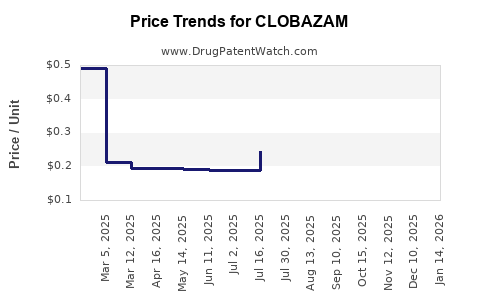
Last updated: September 7, 2026
Clobazam is a mature, low-cost benzodiazepine with durable demand in Lennox-Gastaut syndrome (LGS), but its branded revenue base has weakened because U.S. tablet and oral-suspension competition is established. The commercial opportunity has shifted from broad brand growth to formulation differentiation, controlled-release delivery, pediatric dosing, and geographic expansion.
Onfi, the branded U.S. product, remains the primary commercial reference for clobazam. Generic clobazam creates substantial price pressure in conventional tablets, while Sympazan oral film and other formulation-based products retain narrower opportunities. Clobazam is not a biologic, so biosimilar competition is not relevant. Its principal risks are generic substitution, reimbursement pressure, controlled-substance regulation, and dependence on a relatively concentrated LGS patient population.
What is clobazam approved for and how large is its addressable market?
Clobazam is a 1,5-benzodiazepine used as adjunctive therapy for seizures associated with LGS. The FDA approved Onfi in the United States in October 2011 for patients aged 2 years and older. The approved product includes tablets and an oral suspension.[1]
LGS is a severe developmental epileptic encephalopathy with a small patient population, often estimated at tens of thousands of U.S. patients. The commercial market is therefore driven by chronic treatment duration and high persistence rather than large prescription volume.
Core demand drivers
| Demand factor |
Effect on clobazam |
| LGS prevalence |
Limits total volume but supports specialty pricing |
| Chronic adjunctive use |
Supports recurring prescriptions |
| Pediatric use |
Favors liquid and film dosage forms |
| Refractory seizures |
Reduces rapid switching when treatment is effective |
| Generic availability |
Lowers price and accelerates substitution |
| Benzodiazepine class |
Creates dependence, sedation and abuse-monitoring concerns |
| Drug interactions |
May complicate use with cannabidiol and other antiseizure medicines |
Clobazam is often used with other antiseizure medicines. The product’s pharmacology creates interaction-management requirements, particularly because its active metabolite, N-desmethylclobazam, is affected by CYP2C19 metabolism. Cannabidiol can increase exposure to clobazam and its active metabolite, requiring dose monitoring and adjustment.[2]
How has the clobazam market developed financially?
The financial trajectory has followed a conventional orphan-drug pattern: rapid branded growth after U.S. approval, peak or near-peak performance under specialty commercialization, then erosion from generic entry and payer substitution.
Shire acquired ViroPharma in 2014, bringing Onfi into its portfolio. Takeda completed its acquisition of Shire in January 2019. Onfi was subsequently managed within Takeda’s gastrointestinal, neuroscience and specialty portfolio rather than as a stand-alone growth asset.[3][4]
Branded revenue trajectory
Public-company reporting confirms that Onfi became a material specialty product for ViroPharma and Shire before generic pressure intensified. Financial reporting after the Shire acquisition became less transparent because Onfi was included within broader portfolio disclosures and later absorbed into Takeda’s consolidated reporting.
| Period |
Commercial position |
Financial implication |
| 2011-2013 |
U.S. launch and physician adoption |
Rapid increase from a small base |
| 2014-2016 |
Orphan-brand expansion under ViroPharma and Shire |
Strong branded revenue growth |
| 2017-2018 |
Mature Onfi franchise |
Revenue remained material but faced approaching generic risk |
| 2019-2021 |
Post-Shire integration and generic substitution |
Lower growth and increased pricing pressure |
| 2022 onward |
Mature generic market with formulation niches |
Value concentrated in manufacturing, supply and differentiated dosage forms |
Onfi’s economics were supported by specialty pricing and chronic use rather than high unit volume. Once generic clobazam became available, the value of conventional tablets and suspension shifted from brand pricing to manufacturing efficiency, supply reliability and formulary access.
Revenue exposure for manufacturers
The largest exposure was historically associated with the branded Onfi franchise. That exposure declined after generic launch, but it did not disappear immediately because:
- Some patients remain on the branded product.
- Pediatric patients may require a specific liquid formulation.
- Physicians may resist switching stable patients.
- Payers may impose different substitution rules for tablets, suspension and oral film.
- Generic supply interruptions can temporarily support branded demand.
A company with a differentiated formulation can earn higher revenue per patient than a conventional generic manufacturer, but the addressable population remains limited by the LGS indication.
When did clobazam lose U.S. exclusivity?
Clobazam’s principal U.S. orphan-drug exclusivity period began with the 2011 Onfi approval and generally extended for seven years, subject to applicable pediatric exclusivity. The orphan exclusivity period therefore expired around 2018, allowing competing applications to reach the market if they satisfied FDA requirements.[1][5]
The commercial loss of exclusivity occurred in stages:
- Orphan exclusivity protected the LGS indication and supported branded pricing.
- Patent and regulatory barriers limited immediate generic competition.
- FDA-approved generic clobazam products entered the U.S. market after the relevant exclusivity and patent barriers expired or were resolved.
- Formulation-specific products retained separate commercial protection where their delivery technology or patents differed from conventional tablets.
FDA regulatory status
Clobazam remains an FDA-approved prescription antiseizure medicine. Onfi is a Schedule IV controlled substance in the United States because of benzodiazepine-class abuse, dependence and withdrawal risks.[2]
The principal FDA-approved dosage forms include:
- Oral tablets
- Oral suspension
- Oral film, marketed as Sympazan
FDA approval of a generic tablet does not automatically create a substitutable equivalent for every other dosage form. Oral suspension, oral film and tablet products can have different approval pathways, labeling, bioequivalence requirements and substitution practices.
What patents protect clobazam products?
The original clobazam compound is an old molecule, and its basic composition-of-matter protection is no longer commercially relevant in the United States. Current protection has focused on product-specific formulations, methods of use, dosage forms and delivery technologies.
Formulation patents
Conventional tablet and suspension products are exposed to generic competition once the relevant exclusivity and patent barriers expire. Later-stage protection is more likely to attach to:
- Oral-film composition
- Film thickness and dissolution characteristics
- Taste masking
- Pediatric administration
- Dose uniformity
- Packaging and stability
- Specific combinations of clobazam with delivery excipients
Sympazan, an oral film designed to dissolve on the tongue, illustrates this strategy. Aquestive Therapeutics received FDA approval for Sympazan in 2018 for LGS patients aged 2 years and older.[6]
Method-of-use patents
Method-of-use claims can cover treatment of LGS or a defined patient population, but their commercial value depends on:
- Whether the indication is listed in the FDA Orange Book
- Whether generic applicants must file a Paragraph IV certification
- Whether the approved generic label includes or carves out the protected use
- Whether physicians and payers treat the use as separable from the broader product market
For clobazam, method-of-use protection has less leverage than it would for a drug with a new chemical entity because the molecule is old and generic manufacturers can target the core indication after regulatory exclusivity expires.
Orange Book status
The FDA Orange Book is the controlling source for current listed patents, exclusivity, therapeutic-equivalence ratings and approved products. The key commercial point is that the conventional clobazam market is no longer protected by a meaningful new-molecule exclusivity period. Any remaining protection is product-specific and must be assessed by dosage form, listed patent and applicant certification.[5]
Which companies compete in the clobazam market?
Competition is divided among the branded reference product, generic manufacturers and differentiated-delivery companies.
| Competitor type |
Product or position |
Competitive advantage |
| Takeda |
Onfi tablets and oral suspension |
Brand recognition, legacy patient base |
| Generic manufacturers |
Clobazam tablets and other approved forms |
Low price and pharmacy substitution |
| Aquestive Therapeutics |
Sympazan oral film |
Differentiated administration and pediatric convenience |
| Regional manufacturers |
National-market clobazam products |
Local registration, distribution and pricing |
| Specialty pharmacies |
Dispensing and adherence support |
Patient retention and controlled-substance management |
Generic competition is strongest in tablets. The oral-suspension segment may have fewer suppliers because of formulation complexity, stability requirements and lower volume. Oral film occupies a differentiated niche but must justify its price against inexpensive tablets and suspension.
Which companies are challenging clobazam exclusivity?
Generic applicants challenge clobazam commercial protection through abbreviated new drug applications, often using Paragraph IV certifications where they contend that listed patents are invalid, unenforceable or not infringed. Public FDA records and court dockets must be reviewed by product and filing date to identify each applicant and litigation outcome.
The commercial impact of a Paragraph IV challenge depends on the applicant’s ability to obtain final approval and launch. A challenge can produce:
- A 30-month stay of FDA approval in qualifying circumstances
- Settlement-based delayed entry
- At-risk launch exposure
- Patent litigation costs
- Early erosion of branded prescriptions before final judgment
For a mature drug such as clobazam, Paragraph IV activity is usually more important as a timing mechanism than as a long-term defense of brand pricing.
What patent litigation and settlement issues affect clobazam?
Clobazam litigation risk is concentrated in three areas:
- Conventional product patents protecting tablets or suspension.
- Formulation patents covering oral film or modified delivery.
- Orange Book listing disputes involving the scope or validity of asserted patents.
A settlement can preserve branded revenue by delaying generic launch, but the value of that delay declines as the market shifts toward low-cost alternatives. A settlement involving Onfi tablets would have a different economic effect from a settlement involving Sympazan because the products have different dosage forms, patients and substitution dynamics.
No broad biosimilar litigation applies. Clobazam is a small-molecule drug regulated through the generic-drug pathway, not the biologics pathway under the Public Health Service Act.
How strong is the clobazam patent estate?
The patent estate is weak for the underlying molecule and mature conventional dosage forms, but stronger for differentiated delivery systems.
Relative strength by protection category
| Protection category |
Relative strength |
Commercial assessment |
| Clobazam composition of matter |
Low |
Long expired or commercially irrelevant |
| Original LGS approval exclusivity |
Expired |
No continuing barrier |
| Conventional tablet patents |
Low to moderate |
Generic competition is established |
| Oral-suspension formulation |
Moderate |
Manufacturing and supply barriers may matter |
| Oral-film formulation |
Moderate to strong |
Depends on enforceable claims and remaining term |
| Pediatric method of use |
Moderate |
Value depends on listing and label structure |
| Manufacturing know-how |
Moderate |
Can restrict new entrants without blocking approval |
| Regulatory exclusivity |
Low |
Original orphan period has expired |
The strongest remaining barriers are likely operational rather than molecule-based. These include validated manufacturing, controlled-substance handling, product stability, taste masking, pediatric usability and reliable supply.
What generic entry risks exist for clobazam?
Generic entry creates four distinct risks for branded and differentiated products.
Price erosion
Tablet prices can decline sharply after multiple generic suppliers enter. The magnitude depends on the number of approved manufacturers, pharmacy-benefit-manager contracting and supply concentration.
Volume substitution
Stable patients may be switched through pharmacy substitution, especially where the generic has an AB therapeutic-equivalence rating. New prescriptions are particularly vulnerable because physicians may have less attachment to the brand.
Formulation substitution
Generic tablets are not always direct substitutes for oral suspension or oral film. Patients with swallowing difficulties, pediatric dosing needs or administration barriers may remain on a differentiated product.
Channel pressure
Specialty pharmacies and payers can favor lower-cost generic tablets even where a branded product offers convenience. This puts pressure on copay support, patient-assistance programs and net pricing.
How does clobazam compare with competing antiseizure medicines?
Clobazam competes with other LGS therapies, including valproate, lamotrigine, topiramate, rufinamide, cannabidiol, fenfluramine and ketogenic-diet therapy. The relevant comparison is clinical positioning rather than simple prescription volume.
| Therapy |
Market position versus clobazam |
| Cannabidiol |
Competes directly in LGS; interaction with clobazam can be clinically relevant |
| Fenfluramine |
Competes as a branded LGS option with differentiated efficacy and monitoring |
| Rufinamide |
Established LGS therapy with generic exposure in some markets |
| Valproate |
Broad antiseizure use and lower-cost competition |
| Lamotrigine |
Broad epilepsy use; different tolerability and titration profile |
| Topiramate |
Broad indication and generic pricing |
| Ketogenic diet |
Non-drug alternative for selected refractory patients |
Clobazam’s advantage is familiarity, long clinical experience and persistent use in combination regimens. Its disadvantage is benzodiazepine-related sedation, tolerance, dependence concerns and strong generic price pressure.
What licensing deals affect the clobazam market?
Clobazam’s major commercial history has been shaped more by acquisitions than by a large number of active licensing transactions. ViroPharma’s acquisition by Shire and Shire’s acquisition by Takeda transferred commercial rights and portfolio economics.[3][4]
Sympazan added a formulation-based commercial asset through Aquestive’s product portfolio. The strategic value of the product is its delivery format rather than a new clobazam molecule. Licensing or distribution agreements in individual countries can matter because clobazam commercialization is fragmented outside the United States, but no single global deal determines the market’s economics.
What is the likely financial trajectory for clobazam?
The base-case trajectory is mature and declining for branded tablets, stable to declining for conventional generics, and selectively positive for differentiated formulations.
Near-term outlook
- Generic tablets remain the principal volume product.
- Brand Onfi revenue remains exposed to substitution and payer pressure.
- Oral suspension retains a pediatric and administration-driven niche.
- Sympazan has a higher-value positioning but a limited patient pool.
- Supply reliability can temporarily influence market share.
- Clinical use with cannabidiol supports continued relevance in LGS.
Medium-term outlook
The market is likely to divide into three economic tiers:
- Low-margin commodity tablets.
- Moderately defensible suspension products.
- Higher-net-price delivery systems with limited volume and formulation-specific protection.
Revenue growth from clobazam itself is unlikely to come from broad market expansion. Growth would require new delivery technology, improved adherence, international penetration, an expanded indication or a commercial transaction that consolidates supply.
Key Takeaways
- Clobazam is a mature small-molecule antiseizure drug centered on LGS treatment.
- Onfi drove the principal branded opportunity after its 2011 FDA approval.
- Orphan exclusivity ended around 2018, and generic competition now defines the U.S. tablet market.
- Conventional clobazam products face substantial price and substitution pressure.
- Oral suspension and oral-film products have stronger commercial differentiation than tablets.
- Sympazan’s opportunity depends on pediatric convenience, swallowing limitations and adherence rather than molecule-level exclusivity.
- Biosimilar risk is irrelevant because clobazam is a small molecule.
- The strongest remaining barriers are formulation patents, manufacturing capability, controlled-substance compliance and supply reliability.
- The financial market is shifting from branded specialty growth to generic volume and formulation-specific niches.
- Long-term upside requires differentiated delivery, geographic expansion or portfolio consolidation.
FAQs About Clobazam Market Dynamics
Is clobazam still commercially attractive after generic entry?
Yes, but mainly in differentiated dosage forms, pediatric formulations, oral suspension and markets with limited generic competition. Conventional tablets are more exposed to commodity pricing.
Does cannabidiol increase demand for clobazam?
Cannabidiol is used in some LGS patients who also receive clobazam. The combination can increase clobazam and active-metabolite exposure, creating clinical-management complexity rather than automatically increasing clobazam revenue.[2]
Is Sympazan therapeutically equivalent to clobazam tablets?
Sympazan contains clobazam but uses an oral-film delivery system. Substitution depends on FDA product ratings, prescription requirements, payer policy and clinical circumstances. It should not be treated as automatically interchangeable with every tablet product.
Can a generic manufacturer launch clobazam without challenging every patent?
A generic applicant can use different certification and labeling strategies depending on the listed patent, its expiration date and whether the patent claims an approved use or formulation. The regulatory strategy must be evaluated patent by patent.
What would improve the financial outlook for clobazam?
The most credible growth drivers are a differentiated pediatric delivery system, stronger international distribution, improved adherence, manufacturing consolidation and new evidence supporting use in additional seizure populations.
References
- U.S. Food and Drug Administration. (2011). ONFI (clobazam) prescribing information. FDA.
- U.S. Food and Drug Administration. (2022). ONFI (clobazam) prescribing information. FDA.
- Shire plc. (2014). Annual report and accounts 2014. Shire plc.
- Takeda Pharmaceutical Company Limited. (2019). Annual report 2019. Takeda Pharmaceutical Company Limited.
- U.S. Food and Drug Administration. (2024). Approved drug products with therapeutic equivalence evaluations: Orange Book. FDA.
- Aquestive Therapeutics, Inc. (2018). Sympazan FDA approval announcement and product information. Aquestive Therapeutics.