Last updated: February 19, 2026
Clobazam, an anxiolytic and anticonvulsant medication in the benzodiazepine class, generated approximately $700 million in global sales in 2023. Its market trajectory is shaped by patent expirations, generic competition, and the emergence of new therapeutic applications. Key patents protecting original formulations have expired, opening the door for biosimilar market entry.
What is the patent status of Clobazam?
The primary patents for the original Clobazam formulation, exemplified by the brand name Onfi (Lundbeck), have expired in major markets. For instance, the compound patent for Clobazam expired in the United States in 2007 and in Europe in 2008 [1]. However, secondary patents related to specific formulations, methods of use, or manufacturing processes may still be in effect or have recently expired.
| Patent Type |
Expiration Date (U.S.) |
Expiration Date (Europe) |
Status |
| Compound Patent |
2007 |
2008 |
Expired |
| Formulation Patents |
Varying (e.g., 2020-2025 for specific dosage forms) |
Varying (e.g., 2020-2025 for specific dosage forms) |
Expiring / Expired |
| Method of Use Patents |
Varying (e.g., for specific indications like Lennox-Gastaut Syndrome) |
Varying (e.g., for specific indications like Lennox-Gastaut Syndrome) |
Expiring / Expired |
The expiration of these patents has allowed generic manufacturers to enter the market. This competition has typically led to a significant price reduction for the active pharmaceutical ingredient (API) and the finished dosage form.
How has generic competition impacted Clobazam pricing and market share?
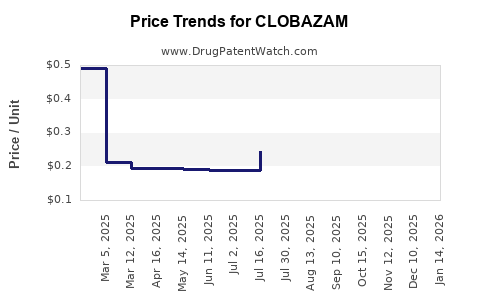
The introduction of generic Clobazam has demonstrably decreased the average selling price (ASP) of the drug. Following patent expirations, generic versions of Clobazam became available from multiple manufacturers, intensifying price competition.
- U.S. Market: In the U.S., after the expiry of key patents, the price of branded Onfi has faced downward pressure. Generic Clobazam prices can be 70% to 80% lower than the branded equivalent, depending on the specific dosage and manufacturer [2]. Market share for branded Onfi has consequently declined as payers and patients opt for more cost-effective generic alternatives.
- European Markets: Similar trends are observed across European countries. Regulatory bodies in the EU often have established pathways for generic drug approval and reimbursement, accelerating the adoption of generics post-patent expiry. The availability of multiple generic suppliers has resulted in competitive pricing and a fragmented market share for the originator product.
Data from market research firms indicates that the generic segment now holds the dominant share of the Clobazam market volume in most developed economies. This shift directly impacts the revenue attributable to the original innovator.
What are the primary therapeutic indications for Clobazam?
Clobazam is primarily prescribed for its anxiolytic and anticonvulsant properties. Its main approved indications include:
- Adjunctive therapy for seizures associated with Lennox-Gastaut Syndrome (LGS): This is a severe form of epilepsy that begins in early childhood. Clobazam, particularly the branded formulation Onfi, gained significant traction and market exclusivity for this specific indication. The U.S. Food and Drug Administration (FDA) approved Onfi for LGS in 2011 [3].
- Management of Anxiety Disorders: Clobazam is also used for the short-term management of anxiety symptoms. Its efficacy in reducing anxiety is a key driver of its use, though often prescribed for limited durations to mitigate dependence risks.
- Other Seizure Disorders: In some regions and under specific clinical circumstances, Clobazam may be used as an adjunct treatment for other types of epilepsy or seizure disorders, although LGS remains its most prominent approved indication.
The success in obtaining and maintaining market exclusivity for the LGS indication provided a significant revenue stream for Lundbeck for an extended period, even as primary compound patents expired.
What is the projected financial trajectory for Clobazam?
The financial trajectory of Clobazam is characterized by a mature market with established generic competition.
- 2023-2025: Global sales are expected to remain stable, with growth driven by increased access in emerging markets and continued use in established markets for LGS and anxiety. Generic penetration will limit significant upside for branded products. Total market revenue is projected to hover around the $650 million to $750 million range annually.
- 2026-2030: Sales are anticipated to see a gradual decline. This is primarily due to ongoing price erosion from generic competition and the potential introduction of newer, more targeted therapies for epilepsy and anxiety disorders that may offer improved efficacy or safety profiles. The market may contract to $500 million to $600 million annually by the end of this period.
Innovator companies that held patents for specific formulations or methods of use for LGS may continue to see some revenue from these niche areas, but overall market growth is constrained. Companies with strong generic portfolios are positioned to capture the bulk of Clobazam sales through volume and cost competitiveness.
Who are the key market players in the Clobazam market?
The Clobazam market comprises both originator and generic manufacturers.
- Originator/Brand:
- H. Lundbeck A/S: The primary originator of Clobazam in many markets, particularly with its branded product Onfi (and its European equivalent Frisium). Lundbeck has focused on its indication for Lennox-Gastaut Syndrome.
- Generic Manufacturers: A significant number of generic pharmaceutical companies compete in the Clobazam market. These include:
- Teva Pharmaceuticals: A major global generic drug manufacturer with Clobazam offerings.
- Sun Pharmaceutical Industries: An Indian multinational pharmaceutical company that produces generic versions of Clobazam.
- Mylan N.V. (now Viatris): Another large player in the generic pharmaceutical space with Clobazam products.
- Hikma Pharmaceuticals: A multinational pharmaceutical group that manufactures and distributes generic Clobazam.
- Various other regional and global generic producers.
The landscape is highly competitive, with an emphasis on cost-effective manufacturing and efficient distribution channels to capture market share.
What are the potential future growth drivers or challenges for Clobazam?
Future market dynamics for Clobazam will be influenced by several factors:
- Growth Drivers:
- Emerging Market Penetration: Increased healthcare access and the demand for affordable epilepsy and anxiety treatments in developing economies could drive modest volume growth.
- Pediatric Use Expansion: Further research and potential regulatory approvals for broader pediatric epilepsy indications could expand the patient population.
- Combination Therapies: Potential use in novel combination therapies for specific seizure types, if supported by clinical data and regulatory approval.
- Challenges:
- Therapeutic Alternatives: Development and adoption of newer antiepileptic drugs (AEDs) or anxiolytics with better efficacy, fewer side effects, or novel mechanisms of action could displace Clobazam.
- Regulatory Scrutiny: Like other benzodiazepines, Clobazam carries risks of dependence, tolerance, and withdrawal. Increased regulatory oversight regarding prescribing patterns or marketing could arise.
- Pricing Pressures: Persistent downward pressure on pricing from payers and generic competition will continue to limit revenue growth for both branded and generic products.
- Cannabidiol (CBD) Therapies: The approval and growing use of CBD-based medications (like Epidiolex) for LGS present a significant competitive challenge, particularly in the pediatric epilepsy segment. Epidiolex, developed by GW Pharmaceuticals (now AstraZeneca), directly competes with Clobazam for LGS patients.
The long-term outlook for Clobazam is likely to be characterized by a steady, albeit declining, revenue stream driven by its established role in treating LGS and anxiety, countered by increasing competition from generics and novel therapeutics.
Key Takeaways
- The foundational patents for Clobazam have expired, leading to widespread generic competition.
- Generic Clobazam is available at significantly lower prices, impacting the revenue of the originator brand.
- Lennox-Gastaut Syndrome (LGS) remains a key indication, providing a segment of sustained revenue for the branded product.
- The global Clobazam market is projected to stabilize in the short term before experiencing a gradual decline due to ongoing price erosion and the emergence of alternative therapies.
- Key market players include originator Lundbeck and a multitude of generic manufacturers.
- Future growth is limited, while challenges include pricing pressures, regulatory scrutiny, and competition from newer drugs like CBD-based therapies.
FAQs
-
Has Clobazam been approved for indications beyond epilepsy and anxiety?
While primarily known for its anticonvulsant properties in Lennox-Gastaut Syndrome and its anxiolytic effects, clinical research has explored its utility in other seizure types and psychological conditions. However, widespread regulatory approvals for additional distinct indications remain limited.
-
What is the typical shelf-life of Clobazam API and finished products?
The shelf-life for Clobazam Active Pharmaceutical Ingredient (API) and finished pharmaceutical products generally adheres to industry standards, typically ranging from 2 to 5 years, contingent upon the specific formulation, packaging, and storage conditions as determined by the manufacturer and regulatory agencies.
-
Are there any specific manufacturing challenges for Clobazam that differentiate it from other benzodiazepines?
Clobazam's synthesis involves multi-step chemical processes. While not uniquely challenging compared to some complex molecules, manufacturers must adhere to strict Good Manufacturing Practices (GMP) to ensure purity, potency, and consistency, common to all pharmaceutical API production. Process optimization for cost-effectiveness is a key focus for generic producers.
-
How does Clobazam's mechanism of action compare to newer anticonvulsant drugs?
Clobazam is a 1,5-benzodiazepine that acts as a positive allosteric modulator of GABA-A receptors, enhancing inhibitory neurotransmission. Newer AEDs often target different ion channels (e.g., sodium, calcium) or neurotransmitter systems, offering varied efficacy and side effect profiles. This diversification provides alternative treatment options for patients who do not respond well to or tolerate benzodiazepines.
-
What regulatory hurdles might a generic manufacturer face when seeking approval for Clobazam in the U.S. or EU?
Generic manufacturers must demonstrate bioequivalence to the reference listed drug (RLD), typically through pharmacokinetic studies. They must also provide comprehensive data on the manufacturing process, quality control, stability, and impurity profiles, meeting the stringent requirements of agencies like the FDA and the European Medicines Agency (EMA).
Citations
[1] U.S. Food & Drug Administration. (n.d.). Orange Book: Approved Drug Products with Therapeutic Equivalence Evaluations. Retrieved from [FDA Website] (Specific patent data typically accessed via patent databases and FDA's Orange Book).
[2] Market Research Reports (e.g., IQVIA, GlobalData). (Various Years). Pharmaceutical Market Analysis Reports on Clobazam. (Proprietary data and analyses).
[3] U.S. Food & Drug Administration. (2011, October 26). FDA approves Onfi (Clobazam) as adjunctive therapy for seizures associated with Lennox-Gastaut syndrome. [Press Release].