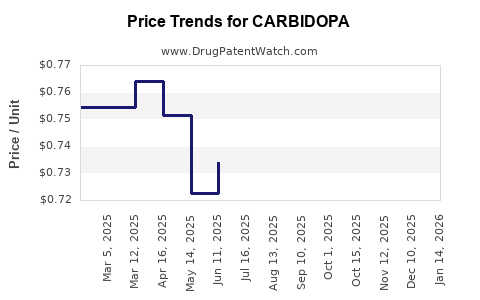
Last updated: June 24, 2026
Carbidopa is an established small-molecule adjunct to levodopa therapy, with commercial performance driven by (1) Parkinson’s disease prevalence and levodopa utilization, (2) fixed-dose combination (FDC) competition versus stand-alone carbidopa, and (3) generic penetration after earlier brand exclusivities. Financial trajectory in the near term is shaped by volume stability, pricing pressure from generics, and periodic supply and regulatory events tied to manufacturing and labeling.
What are the main market dynamics for carbidopa in Parkinson’s treatment?
Carbidopa is used to inhibit peripheral decarboxylation of levodopa, improving levodopa bioavailability and reducing peripheral side effects. In practice, market demand tracks levodopa regimens used in Parkinson’s disease management. Carbidopa is widely supplied as:
- Stand-alone carbidopa tablets (historically branded as Lodosyn; now mostly generic)
- Fixed-dose levodopa/carbidopa combinations (synthetic substitutes for stand-alone carbidopa in many treatment regimens)
How do fixed-dose levodopa/carbidopa combinations change carbidopa standalone pricing?
Most prescribing is for FDC products such as carbidopa-levodopa tablets and extended-release formulations. Stand-alone carbidopa competes on dosing flexibility, but it is structurally disadvantaged because clinicians can often adjust total daily levodopa and carbidopa exposure through FDC dose selection. That dynamic compresses brand-like pricing for standalone carbidopa and pushes the market toward generics and low net pricing.
What drives demand at the payer level?
- Chronic therapy durability: Parkinson’s disease is long-term, so stable treatment duration supports baseline volume.
- Formularies and substitution: generics capture share rapidly, especially for older, low-margin multi-source products.
- Patient adherence and regimen complexity: extended-release and controlled dosing can shift product mix without changing the underlying carbidopa demand.
How is the carbidopa market split between brands and generics?
Carbidopa is widely generic. Lodosyn brand presence has diminished versus generics and FDC products. The commercial shape is typical of an older adjunct where:
- Brand pricing is constrained by substitution
- Net price declines continue after generic entry cycles
- Market share concentrates among large generic manufacturers and vertically integrated API-to-finished-dose producers where available
Which product types capture the bulk of carbidopa spend?
Even if carbidopa is the adjunct, economic spend often reflects the overall levodopa/carbidopa regimen. As a result:
- FDC spend dominates total category economics
- Stand-alone carbidopa captures a smaller, more dosing-specific slice
What is the typical competitive landscape?
- Multi-source generics for stand-alone carbidopa
- Multi-source levodopa/carbidopa tablets and ER capsules
- Patent-driven differentiation is minimal today; practical differentiation shifts to manufacturing scale, product availability, and labeling/dosing strengths
When does carbidopa lose exclusivity, and what does that mean for revenue?
Carbidopa is not a “new” molecular entity with ongoing exclusivity windows in the way modern branded specialty drugs are. Instead, its revenue trajectory is governed by:
- Earlier discontinuation of brand-like exclusivity for the standalone adjunct
- Generic entry that saturates the market
- Periodic changes in product-level exclusivity tied to formulation-specific rights (when applicable) rather than the underlying API
Is there any ongoing exclusivity for carbidopa itself?
For carbidopa, commercial dynamics are primarily post-exclusivity. The revenue outcome is dominated by generic competition and product availability rather than life-cycle brand switching.
What patent estate and generic-entry risks apply to carbidopa?
Carbidopa is a long-established active ingredient. Patent risk is concentrated in:
- Specific formulation patents (rare relative to the breadth of generic filings)
- Method-of-use claims (less common for an adjunct with entrenched standard-of-care use)
- Manufacturing process and polymorph/crystal form claims, where any exist for certain generic products or line extensions
What does that imply for Paragraph IV strategy?
Paragraph IV challenges are usually a tactic for products with meaningful remaining exclusivity or brand premiums. For carbidopa, the economic incentive typically follows where a particular marketed product has less competition or where a branded or pseudo-branded product commands pricing. For the standalone adjunct, the main risk to branded or higher-priced SKUs comes from routine generic competition rather than high-value patent thickets.
What is the Orange Book status of carbidopa products?
Carbidopa is typically represented in the US Orange Book as an approved drug with multiple generic listings. However, Orange Book coverage is product-specific: carbidopa API is not protected in the same way as an active ingredient with current, enforceable new chemical entity (NCE) exclusivities. The practical outcome is that most market entry risk is already resolved at the API level.
What matters more than “Orange Book status” for market timing?
For carbidopa, the gating variable is usually:
- Product-level approval posture and facility readiness for consistent supply
- Any remaining exclusivity or blocking patents tied to specific strengths, formulations, or controlled-release approaches
How do FDA approvals and regulatory events affect carbidopa financial performance?
Carbidopa revenue depends less on clinical regulation and more on operational regulatory compliance:
- FDA inspections and cGMP status affecting manufacturing continuity
- Recalls or label updates that can temporarily disrupt supply
- Changes in product distribution due to wholesaler contracting and formulary shifts
How does the FDA abbreviated approval framework influence pricing?
Because generics rely on the FDA’s abbreviated approval pathway for equivalent products, competitive entry tends to occur quickly once regulatory and patent barriers are cleared. That compresses net revenue through:
- Rapid price erosion at the moment of entry
- Increased buyer leverage in tendering and contract pharmacy arrangements
Which companies are key players for carbidopa and what is the commercial impact?
Carbidopa demand is served by the US generic ecosystem and large suppliers of levodopa/carbidopa products. The commercial impact is concentrated in:
- Companies with scale manufacturing and reliable supply
- Companies with strong distribution reach and low landed cost
- Firms that can compete on multiple strengths to maximize shelf positions
What does “winner-take-most” look like in carbidopa?
In an established generic market, the winners typically:
- Maintain continuity of supply
- Offer broad SKU coverage
- Price aggressively without losing distribution access
How does carbidopa compare with other Parkinson adjuncts in market trajectory?
Carbidopa’s economic role is distinct because it is not a symptom-modifying biologic or a niche mechanism. It is a foundational adjunct to levodopa. Compared with other Parkinson’s drug classes, carbidopa’s trajectory is:
- More stable in volume terms due to integration into standard regimens
- More exposed to pricing compression due to multi-source generics
What are likely near-term financial drivers for carbidopa category revenue?
Near-term category performance is mainly driven by three forces:
-
Mix shifts within levodopa regimens
Extended-release and different dosing schedules can change total units of carbidopa used per patient, shifting spend across SKUs.
-
Generic penetration and contract pricing
Even when unit volume is stable, net revenue declines as contracts re-price after competitor entry or re-tender cycles.
-
Supply continuity
Carbidopa is a small molecule, but finished-dose availability still affects wholesaler stocking and pharmacy fulfillment. Any manufacturing disruptions can create short-term price spikes but longer disruptions reduce contracted volumes.
How does revenue risk differ for stand-alone carbidopa versus levodopa/carbidopa FDCs?
Stand-alone carbidopa:
- Typically smaller total market
- More sensitive to niche prescribing patterns
- More exposed to substitute switching into FDC dose adjustments
FDC levodopa/carbidopa:
- Larger addressable market
- Stronger structural integration into standard prescribing
- Revenue is tied to overall levodopa utilization and patient adherence
What litigation or settlement dynamics affect carbidopa?
For entrenched generic products like carbidopa, litigation tends to be episodic and often resolves into:
- Routine patent disputes tied to specific product listings
- Settlements that establish “design-around” paths for competitors
Carbidopa’s market trajectory is more consistently influenced by generic supply entry and contract pricing than by landmark litigation outcomes at the molecular level.
Key Takeaways
- Carbidopa revenue is structurally linked to Parkinson’s treatment patterns because it is an adjunct to levodopa and appears predominantly through levodopa/carbidopa fixed-dose regimens.
- The financial trajectory is dominated by generic competition and contract-driven net price erosion rather than by ongoing brand exclusivity.
- Stand-alone carbidopa faces substitution into FDCs, which limits pricing power and concentrates market share among scaled generic suppliers.
- Near-term economics hinge on product mix across levodopa/carbidopa formulations, regulatory compliance for manufacturing continuity, and periodic re-tendering.
FAQs
1) What is the typical US market behavior for stand-alone carbidopa after generic entry?
Rapid net price erosion with share concentration among multi-source suppliers; stability thereafter depends on manufacturing continuity and SKU breadth.
2) How does carbidopa demand change when levodopa usage patterns shift in Parkinson’s disease?
It tracks levodopa regimen utilization and adherence, with mix shifts across immediate-release versus extended-release affecting carbidopa units indirectly.
3) Are there biosimilar risks for carbidopa?
No. Carbidopa is a small molecule, so biosimilar frameworks do not apply.
4) What regulatory events most commonly disrupt carbidopa supply?
cGMP inspection outcomes, facility issues, and product-level recalls or labeling changes.
5) What is the main strategic lever for a new supplier entering carbidopa?
Reliable large-scale manufacturing and broad strength coverage to maintain pharmacy and wholesaler placement under contract pricing.
References
- U.S. Food and Drug Administration. Orange Book: Approved Drug Products with Therapeutic Equivalence Evaluations. https://www.accessdata.fda.gov/scripts/cder/daf/index.cfm
- U.S. FDA. Drug Approval Reports (Drug and Biologic Approval Reports). https://www.fda.gov/drugs/drug-approvals-and-databases/drug-approvals-and-databases-drug-and-biologic-approval-reports
- FDA. Abbreviated New Drug Applications (ANDA). https://www.fda.gov/drugs/abbreviated-new-drug-application-anda