Avion Pharms Company Profile
✉ Email this page to a colleague
What is the competitive landscape for AVION PHARMS
AVION PHARMS has four approved drugs.
There are four US patents protecting AVION PHARMS drugs.
There are ten patent family members on AVION PHARMS drugs in seven countries and sixteen supplementary protection certificates in nine countries.
Summary for Avion Pharms
| International Patents: | 10 |
| US Patents: | 4 |
| Tradenames: | 4 |
| Ingredients: | 4 |
| NDAs: | 4 |
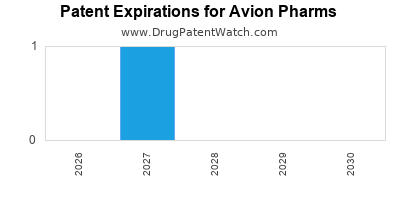
Drugs and US Patents for Avion Pharms
| Applicant | Tradename | Generic Name | Dosage | NDA | Approval Date | TE | Type | RLD | RS | Patent No. | Patent Expiration | Product | Substance | Delist Req. | Exclusivity Expiration |
|---|---|---|---|---|---|---|---|---|---|---|---|---|---|---|---|
| Avion Pharms | PONSTEL | mefenamic acid | CAPSULE;ORAL | 015034-003 | Approved Prior to Jan 1, 1982 | AB | RX | Yes | Yes | ⤷ Start Trial | ⤷ Start Trial | ||||
| Avion Pharms | DHIVY | carbidopa; levodopa | TABLET;ORAL | 214869-001 | Nov 12, 2021 | RX | Yes | Yes | 11,439,613 | ⤷ Start Trial | ⤷ Start Trial | ||||
| Avion Pharms | DHIVY | carbidopa; levodopa | TABLET;ORAL | 214869-001 | Nov 12, 2021 | RX | Yes | Yes | 11,819,485 | ⤷ Start Trial | ⤷ Start Trial | ||||
| Avion Pharms | DHIVY | carbidopa; levodopa | TABLET;ORAL | 214869-001 | Nov 12, 2021 | RX | Yes | Yes | 11,033,521 | ⤷ Start Trial | Y | ⤷ Start Trial | |||
| Avion Pharms | AVERI | desogestrel; ethinyl estradiol | TABLET;ORAL-28 | 218933-002 | May 2, 2025 | AB | RX | No | No | ⤷ Start Trial | ⤷ Start Trial | ||||
| Avion Pharms | BALCOLTRA | ethinyl estradiol; levonorgestrel | TABLET;ORAL | 208612-001 | Jan 9, 2018 | AB3 | RX | Yes | Yes | 7,838,042 | ⤷ Start Trial | Y | ⤷ Start Trial | ||
| >Applicant | >Tradename | >Generic Name | >Dosage | >NDA | >Approval Date | >TE | >Type | >RLD | >RS | >Patent No. | >Patent Expiration | >Product | >Substance | >Delist Req. | >Exclusivity Expiration |
Expired US Patents for Avion Pharms
| Applicant | Tradename | Generic Name | Dosage | NDA | Approval Date | Patent No. | Patent Expiration |
|---|---|---|---|---|---|---|---|
| Avion Pharms | BALCOLTRA | ethinyl estradiol; levonorgestrel | TABLET;ORAL | 208612-001 | Jan 9, 2018 | 6,716,814 | ⤷ Start Trial |
| >Applicant | >Tradename | >Generic Name | >Dosage | >NDA | >Approval Date | >Patent No. | >Patent Expiration |
International Patents for Avion Pharms Drugs
| Country | Patent Number | Estimated Expiration |
|---|---|---|
| Japan | 2021517128 | ⤷ Start Trial |
| Brazil | 112020017422 | ⤷ Start Trial |
| World Intellectual Property Organization (WIPO) | 2005105112 | ⤷ Start Trial |
| European Patent Office | 3773532 | ⤷ Start Trial |
| China | 111954523 | ⤷ Start Trial |
| European Patent Office | 1737470 | ⤷ Start Trial |
| >Country | >Patent Number | >Estimated Expiration |
Supplementary Protection Certificates for Avion Pharms Drugs
| Patent Number | Supplementary Protection Certificate | SPC Country | SPC Expiration | SPC Description |
|---|---|---|---|---|
| 1214076 | SZ 49/2008 | Austria | ⤷ Start Trial | PRODUCT NAME: WIRKSTOFFKOMBINATION VON ETHINYLESTRADIOL UND DROSPIRENON |
| 1453521 | 15C0050 | France | ⤷ Start Trial | PRODUCT NAME: ETHINYLESTRADIOL ET MELANGE DE LEVONORGESTREL ET ETHINYLESTRADIOL; NAT. REGISTRATION NO/DATE: NL 42237 20150320; FIRST REGISTRATION: SK - 17/0017/15-S 20150129 |
| 1453521 | 300814 | Netherlands | ⤷ Start Trial | PRODUCT NAME: LEVONORGESTREL EN ETHINYLESTRADIOL; NATIONAL REGISTRATION NO/DATE: RVG 117453 20151211; FIRST REGISTRATION: SK 17/0017/15-S 20150211 |
| 0771217 | CA 2006 00038 | Denmark | ⤷ Start Trial | PRODUCT NAME: ETHINYLESTRADIOL (SOM BETA-CYCLODEXTRIN-CLATHRAT) OG DROSPIRENON; NAT. REG. NO/DATE: 38687 20060627; FIRST REG. NO/DATE: EU RVG 31781 20050804 |
| 0136011 | 2000C/027 | Belgium | ⤷ Start Trial | PRODUCT NAME: ETHINYLESTRADIOLUM / NORETHISTERONI ACETAS; NAT. REGISTRATION NO/DATE: 19 IS 106 F3 20000911; FIRST REGISTRATION: NL RVG 23909 19991124 |
| 1453521 | 39/2015 | Austria | ⤷ Start Trial | PRODUCT NAME: ETHINYLESTRADIOL UND EINE KOMBINATION VON LEVONORGESTREL UND ETHINYLESTRADIOL; NAT. REGISTRATION NO/DATE: 136021 20150224; FIRST REGISTRATION: SK 17/0017/15-S 20150211 |
| >Patent Number | >Supplementary Protection Certificate | >SPC Country | >SPC Expiration | >SPC Description |
Similar Applicant Names
Applicants may be listed under multiple names.
Here is a list of applicants with similar names.
Here is a list of applicants with similar names.
