Teva Company Profile
✉ Email this page to a colleague
What is the competitive landscape for TEVA
TEVA has seven hundred and thirty-six approved drugs.
There are sixty-one US patents protecting TEVA drugs. There are fifty-six tentative approvals on TEVA drugs.
There are eight hundred and eighty-five patent family members on TEVA drugs in forty-seven countries and one thousand one hundred and thirty-four supplementary protection certificates in eighteen countries.
Summary for Teva
| International Patents: | 885 |
| US Patents: | 61 |
| Tradenames: | 510 |
| Ingredients: | 445 |
| NDAs: | 736 |
| Patent Litigation for Teva: | See patent lawsuits for Teva |
| PTAB Cases with Teva as petitioner: | See PTAB cases with Teva as petitioner |
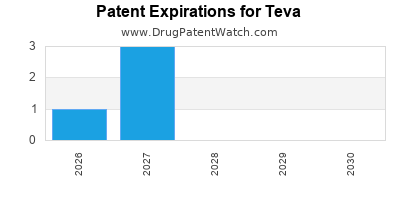
Drugs and US Patents for Teva
Expired US Patents for Teva
Paragraph IV (Patent) Challenges for TEVA drugs
| Drugname | Dosage | Strength | Tradename | Submissiondate |
|---|---|---|---|---|
| ➤ Subscribe | Tablets | 0.1 mg/0.02 mg and 0.01 mg | ➤ Subscribe | 2009-11-16 |
| ➤ Subscribe | for Injection | 3.5 mg/vial | ➤ Subscribe | 2016-10-26 |
| ➤ Subscribe | Tablets | 0.5 mg and 1 mg | ➤ Subscribe | 2010-05-17 |
| ➤ Subscribe | Extended-release Capsule | 15 mg and 30 mg | ➤ Subscribe | 2008-08-11 |
| ➤ Subscribe | Injection | 40 mg/mL, 1 mL pre-filled syringe | ➤ Subscribe | 2014-01-29 |
| ➤ Subscribe | Tablets | 0.15 mg/0.03 mg | ➤ Subscribe | 2004-03-29 |
| ➤ Subscribe | Tablets | 0.15 mg/0.02 mg, 0.15 mg/0.025 mg, 0.15 mg/0.03 mg and 0.01 mg | ➤ Subscribe | 2013-07-10 |
| ➤ Subscribe | Tablets | 1 mg/0.02 mg and 75 mg | ➤ Subscribe | 2006-04-17 |
| ➤ Subscribe | Delayed-release Tablets | 20 mg | ➤ Subscribe | 2015-06-03 |
| ➤ Subscribe | Tablets | 5 mg, 10 mg, 20 mg, 30 mg | ➤ Subscribe | 2009-11-18 |
| ➤ Subscribe | Injection | 40 mg/mL, 1 mL pre-filled syringe | ➤ Subscribe | 2014-02-26 |
| ➤ Subscribe | Tablets | 0.15 mg/0.03 mg/0.01 mg | ➤ Subscribe | 2008-01-22 |
International Patents for Teva Drugs
| Country | Patent Number | Estimated Expiration |
|---|---|---|
| Japan | 6302983 | ⤷ Get Started Free |
| European Patent Office | 3501584 | ⤷ Get Started Free |
| European Patent Office | 3471805 | ⤷ Get Started Free |
| Japan | 2017039758 | ⤷ Get Started Free |
| Japan | 6138322 | ⤷ Get Started Free |
| European Patent Office | 2987523 | ⤷ Get Started Free |
| Israel | 223116 | ⤷ Get Started Free |
| >Country | >Patent Number | >Estimated Expiration |
Supplementary Protection Certificates for Teva Drugs
| Patent Number | Supplementary Protection Certificate | SPC Country | SPC Expiration | SPC Description |
|---|---|---|---|---|
| 1301519 | C 2016 011 | Romania | ⤷ Get Started Free | PRODUCT NAME: TENOFOVIR ALAFENAMIDA SAU O SARE SAU SOLVAT AL ACESTUIA, IN SPECIAL FUMARAT DE TENOFOVIR ALAFENAMIDA; NATIONAL AUTHORISATION NUMBER: EU/1/15/1061/001-002; DATE OF NATIONAL AUTHORISATION: 20151119; NUMBER OF FIRST AUTHORISATION IN EUROPEAN ECONOMIC AREA (EEA): EU/1/15/1061/001-002; DATE OF FIRST AUTHORISATION IN EEA: 20151119 |
| 0325571 | C980020 | Netherlands | ⤷ Get Started Free | PRODUCT NAME: TOLTERODINE, DESGEWENST IN DE VORM VAN EEN ZOUT MET EEN FYSIOLO GISCH ACCEPTABEL ZUUR, IN HET BIJZONDER TOLTERODINE L-TARTRAAT; NAT. REGISTRATION NO/DATE: RVG 22148, RVG 22149 19980217; FIRST REGISTRATION: SE 13475, 13476 19970905 |
| 2768484 | 2019C/545 | Belgium | ⤷ Get Started Free | PRODUCT NAME: COMBINATIE VAN DAUNORUBICINE EN CYTARABINE; AUTHORISATION NUMBER AND DATE: EU/1/18/1308 20180827 |
| 2203462 | C201430078 | Spain | ⤷ Get Started Free | PRODUCT NAME: SOFOSBUVIR; NATIONAL AUTHORISATION NUMBER: EU/1/13/894; DATE OF AUTHORISATION: 20140116; NUMBER OF FIRST AUTHORISATION IN EUROPEAN ECONOMIC AREA (EEA): EU/1/13/894; DATE OF FIRST AUTHORISATION IN EEA: 20140116 |
| 0817775 | 06C0010 | France | ⤷ Get Started Free | PRODUCT NAME: ERLOTINIB HYDROCHLORIDE; NAT. REGISTRATION NO/DATE: EU/1/05/311/001 20050919; FIRST REGISTRATION: LI - 57266 20050321 |
| 0245997 | C300002 | Netherlands | ⤷ Get Started Free | PRODUCT NAME: DOFETILIDE, DESGEWENST IN DE VORM VAN EEN FARMACEUTISCH AANVAARDBAAR ZOUT; REGISTRATION NO/DATE: EU/1/99/121/001 - EU/1/99/121/015 19991129 |
| 0564409 | SPC/GB02/016 | United Kingdom | ⤷ Get Started Free | PRODUCT NAME: IMATINIB (INN I.E. NON INTELLECTUAL PROPRIETARY NAME) OR ONE OF ITS PHARMACEUTICALLY ACCEPTABLE ACID ADDITION SALTS, ESPECIALLY THE MONOMETHANESULFONATE SALT; REGISTERED: CH IKS-NR: 55807 20010621; UK SG(2001) D/292083 20011108 |
| >Patent Number | >Supplementary Protection Certificate | >SPC Country | >SPC Expiration | >SPC Description |
Similar Applicant Names
Applicants may be listed under multiple names.
Here is a list of applicants with similar names.
Here is a list of applicants with similar names.
