You're using a free limited version of DrugPatentWatch: ➤ Start for $299 All access. No Commitment.

Last Updated: December 31, 2025

AIRDUO DIGIHALER Drug Patent Profile


✉ Email this page to a colleague

« Back to Dashboard


Which patents cover Airduo Digihaler, and when can generic versions of Airduo Digihaler launch?

Airduo Digihaler is a drug marketed by Teva Pharm and is included in one NDA. There are nine patents protecting this drug.

This drug has two hundred and forty-eight patent family members in thirty-seven countries.

The generic ingredient in AIRDUO DIGIHALER is fluticasone propionate; salmeterol xinafoate. There are twenty-nine drug master file entries for this compound. Eleven suppliers are listed for this compound. Additional details are available on the fluticasone propionate; salmeterol xinafoate profile page.

AI Deep Research
Questions you can ask:
  • What is the 5 year forecast for AIRDUO DIGIHALER?
  • What are the global sales for AIRDUO DIGIHALER?
  • What is Average Wholesale Price for AIRDUO DIGIHALER?
Summary for AIRDUO DIGIHALER
Drug patent expirations by year for AIRDUO DIGIHALER
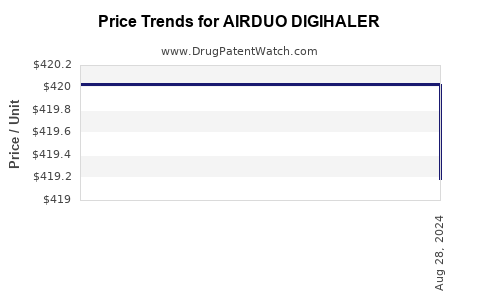
Drug Prices for AIRDUO DIGIHALER

See drug prices for AIRDUO DIGIHALER

US Patents and Regulatory Information for AIRDUO DIGIHALER

AIRDUO DIGIHALER is protected by nine US patents and two FDA Regulatory Exclusivities.

Applicant Tradename Generic Name Dosage NDA Approval Date TE Type RLD RS Patent No. Patent Expiration Product Substance Delist Req. Exclusivity Expiration
Teva Pharm AIRDUO DIGIHALER fluticasone propionate; salmeterol xinafoate POWDER;INHALATION 208799-004 Jul 12, 2019 DISCN Yes No ⤷  Get Started Free ⤷  Get Started Free Y ⤷  Get Started Free
Teva Pharm AIRDUO DIGIHALER fluticasone propionate; salmeterol xinafoate POWDER;INHALATION 208799-005 Jul 12, 2019 DISCN Yes No ⤷  Get Started Free ⤷  Get Started Free Y ⤷  Get Started Free
Teva Pharm AIRDUO DIGIHALER fluticasone propionate; salmeterol xinafoate POWDER;INHALATION 208799-006 Jul 12, 2019 DISCN Yes No ⤷  Get Started Free ⤷  Get Started Free Y ⤷  Get Started Free
Teva Pharm AIRDUO DIGIHALER fluticasone propionate; salmeterol xinafoate POWDER;INHALATION 208799-004 Jul 12, 2019 DISCN Yes No ⤷  Get Started Free ⤷  Get Started Free Y ⤷  Get Started Free
>Applicant >Tradename >Generic Name >Dosage >NDA >Approval Date >TE >Type >RLD >RS >Patent No. >Patent Expiration >Product >Substance >Delist Req. >Exclusivity Expiration

Expired US Patents for AIRDUO DIGIHALER

EU/EMA Drug Approvals for AIRDUO DIGIHALER

Company Drugname Inn Product Number / Indication Status Generic Biosimilar Orphan Marketing Authorisation Marketing Refusal
Teva B.V. Airexar Spiromax salmeterol xinafoate, fluticasone propionate EMEA/H/C/004267Airexar Spiromax is indicated for use in adults aged 18 years and older only.AsthmaAirexar Spiromax is indicated for the regular treatment of patients with severe asthma where use of a combination product (inhaled corticosteroid and long-acting β2 agonist) is appropriate:- patients not adequately controlled on a lower strength corticosteroid combination productor- patients already controlled on a high dose inhaled corticosteroid and long-acting β2 agonist.Chronic Obstructive Pulmonary Disease (COPD)Airexar Spiromax is indicated for the symptomatic treatment of patients with COPD, with a FEV1 Withdrawn no no no 2016-08-18
>Company >Drugname >Inn >Product Number / Indication >Status >Generic >Biosimilar >Orphan >Marketing Authorisation >Marketing Refusal

Supplementary Protection Certificates for AIRDUO DIGIHALER

Patent Number Supplementary Protection Certificate SPC Country SPC Expiration SPC Description
2506844 18C1022 France ⤷  Get Started Free PRODUCT NAME: COMBINAISON COMPRENANT UN SEL PHARMACEUTIQUEMENT ACCEPTABLE D'UMECLIDINIUM (EN PARTICULIER LE BROMURE D'UMECLIDINIUM), DU VILANTEROL OU UN SEL PHARMACEUTIQUEMENT ACCEPTABLE DE CELUI-CI (EN PARTICULIER LE TRIFENATATE DE VILANTEROL), ET DU FUROATE DE FLUTICASONE; REGISTRATION NO/DATE: EU/1/17/1236 20171117
2506844 SPC/GB18/020 United Kingdom ⤷  Get Started Free PRODUCT NAME: A PHARMACEUTICAL COMBINATION PRODUCT COMPRISING A PHARMACEUTICALLY ACCEPTABLE SALT OF UMECLIDINIUM (E.G. UMECLIDINIUM BROMIDE), VILANTEROL OR A PHARMACEUTICALLY ACCETPABLE SALT THEREOF (E.G. VILANTEROL TRIFENATATE), AND FLUTICASONE FUROATE; REGISTERED: UK EU/1/17/1236/001(NI) 20171117; UK EU/1/17/1236/002(NI) 20171117; UK EU/1/17/1236/003(NI) 20171117; UK PLGB 19494/0287 20171117
1519731 13C0067 France ⤷  Get Started Free PRODUCT NAME: AZELASTINE OU SES SELS PHARMACEUTIQUEMENT ACCEPTABLES ET UN ESTER PHARMACEUTIQUEMENT ACCEPTABLE DE FLUTICASONE; NAT. REGISTRATION NO/DATE: NL41755 20130925; FIRST REGISTRATION: SK - 24/0055/13-S 20130215
1305329 08C0014 France ⤷  Get Started Free PRODUCT NAME: FLUTICASONE FUROATE; REGISTRATION NO/DATE: EU/1/07/434/001 20080111
2506844 132018000000341 Italy ⤷  Get Started Free PRODUCT NAME: UN PRODOTTO DI COMBINAZIONE FARMACEUTICA COMPRENDENTE UN SALE FARMACEUTICAMENTE ACCETTABILE DI UMECLIDINIO (AD ESEMPIO BROMURO DI UMECLIDINIO), VILANTEROLO O UN SUO SALE FARMACEUTICAMENTE ACCETTABILE (AD ESEMPIO VILANTEROLO TRIFENATATO) E UN FUROATO(TRELEGY ELLIPTA - FLUTICASONE FUROATO/UMECLIDINIO/VILANTEROLO); AUTHORISATION NUMBER(S) AND DATE(S): EU/1/17/1236, 20171117
>Patent Number >Supplementary Protection Certificate >SPC Country >SPC Expiration >SPC Description

Market Dynamics and Financial Trajectory for the Pharmaceutical Drug: AirDuo Digihaler

Last updated: July 27, 2025


Introduction

The pharmaceutical landscape is continually evolving, driven by innovations in drug delivery systems, technological integrations, and regulatory frameworks. The AirDuo Digihaler, an inhaled combination therapy employing digital health features, stands at the convergence of these trends. As a combination product comprising fluticasone propionate and salmeterol xinafoate, primarily indicated for asthma and chronic obstructive pulmonary disease (COPD), AirDuo Digihaler exemplifies the integration of digital monitoring with traditional inhalation therapy. This article examines the current market dynamics and project the financial trajectory of AirDuo Digihaler, considering regulatory pathways, competitive positioning, technological advances, and market demand.


Market Overview: Inhaled Therapies for Respiratory Diseases

Respiratory diseases, notably asthma and COPD, represent significant global health burdens, with prevalence expected to rise due to environmental factors and aging populations. The inhaler market is projected to reach USD 22 billion by 2027, growing at a compound annual growth rate (CAGR) of approximately 4.5% (Research and Markets, 2022). The increasing adoption of inhaled corticosteroids (ICS) and long-acting beta-agonists (LABA) combinations fuels this expansion.

While traditional inhalers dominate, digital inhalers—integrating sensors for adherence tracking and data transmission—are gaining prominence. The shift aligns with personalized medicine and digital health initiatives, which aim to improve disease management and reduce hospitalization rates.


Market Dynamics: Drivers and Restraints

Key Drivers

  • Digital Health Integration: The digital component of AirDuo Digihaler enhances adherence and inhalation technique monitoring—factors linked to improved clinical outcomes (Global Data, 2021). The FDA’s recent encouragement of digital health tools further accelerates adoption.

  • Regulatory Support: The U.S. FDA's approval framework for digital inhalers fosters market entry for integrated devices like AirDuo Digihaler. The agency's Digital Health Software Precertification Program streamlines approval pathways for connected drug-device combos.

  • Epidemiological Trends: Rising incidence of asthma and COPD, coupled with aging populations, sustains demand. According to WHO, COPD affects over 200 million globally, with substantial morbidity and mortality (WHO, 2021).

  • Medication Adherence: Non-adherence remains a leading cause of poor disease outcomes. Digital inhalers address this by providing usage data, thus appealing to payers and providers aiming to improve treatment efficacy.

  • Competitive Innovation: The market features several digital inhalers, including Propeller Health and Philips’ Astral inhalers. AirDuo Digihaler's integration within a well-established therapeutic class positions it competitively.

Key Restraints

  • Cost and Reimbursement Challenges: Digital inhalers often entail higher costs, potentially limiting access, especially in low- and middle-income regions. Reimbursement policies are still evolving, impeding widespread adoption.

  • Complexity of Integration: Incorporation of digital features increases manufacturing complexity and regulatory scrutiny, potentially delaying market entry or scaling.

  • Patient Acceptance: Older patients or those unfamiliar with digital technology may resist transitioning to digital inhalers, impacting market potential.


Regulatory Landscape

The Food and Drug Administration (FDA) approved the AirDuo Digihaler in 2019 as a combination product with digital capabilities. Its approval hinged on demonstrating safety, efficacy, and the digital system’s performance in adherence tracking. The FDA encourages digital health integrations through initiatives like the premarket submission program tailored for software-enabled devices. Additionally, the European Medicines Agency (EMA) has shown interest in digital health but remains less prescriptive, potentially influencing global market strategies.


Financial Trajectory and Revenue Potential

Market Penetration and Adoption

Given the current asthma and COPD prescription volumes globally, the potential for AirDuo Digihaler is substantial. With an initial focus on the US, where digital inhalers are gaining momentum, estimates suggest capturing 10-15% of the digital inhaler market segment within 5 years post-launch.

Revenue Projections

Assuming an average wholesale price (AWP) of USD 200 per inhaler and a conservative penetration of 10% of the projected digital inhaler market (USD 4 billion), revenues could reach USD 400 million over five years for the specific product. Growth may be augmented through:

  • Expansion into international markets, especially Europe and Asia-Pacific.
  • Increased adoption driven by digital health reimbursement policies.
  • Brand recognition and clinician acceptance.

Cost Considerations

Manufacturing costs include the integration of digital sensors, software development, regulatory compliance, and post-market surveillance. Ongoing expenses involve reimbursement negotiations and infrastructure for data management. These costs can be offset by premium pricing enabled by the added digital functionalities.

Investment Outlook

Pharmaceutical companies developing or adopting AirDuo Digihaler can expect a phased revenue ramp-up, with initial investments in regulatory approval, clinician education, and patient engagement. As digital health reimbursement frameworks solidify, profitability prospects improve. Strategic partnerships with technology firms or digital health platforms may further boost financial prospects.


Competitive Positioning and Market Share Strategy

Major competitors include traditional inhaler manufacturers and digital health startups. Companies like GlaxoSmithKline and Boehringer Ingelheim have launched similar digital devices, intensifying competition. To maintain a competitive edge, strategic focus should be on:

  • Building a robust digital data platform.
  • Demonstrating tangible clinical benefits through real-world evidence.
  • Engaging payers to obtain reimbursement coverage.
  • Educating clinicians and patients for acceptance.

A differentiated value proposition emphasizing improved adherence, personalized therapy adjustments, and proactive disease management will support market penetration.


Regulatory and Policy Implications

Regulatory agencies emphasize privacy, data security, and interoperability in digital health devices. Ensuring compliance not only facilitates approval but also influences reimbursement approval and clinician confidence. The evolving regulatory environment dictates continuous adaptation and alignment with digital health policies, impacting future financial outcomes.


Innovations Driving Future Growth

  • Enhanced Data Analytics: Combining inhaler data with biometric sensors (e.g., pulse oximetry, spirometry) to enable comprehensive remote patient monitoring.
  • AI Integration: Utilizing artificial intelligence to predict exacerbations or optimize therapy regimens.
  • Global Expansion: Tailoring digital inhalers for emerging markets with adaptations for lower-cost manufacturing and connectivity solutions.

Conclusion

The AirDuo Digihaler's market dynamics are shaped by technological innovation, regulatory encouragement, and a growing demand for personalized, adherence-focused respiratory therapies. While challenges persist—cost, acceptance, and regulatory complexity—the potential for substantial financial gains remains strong, driven by rising prevalence of respiratory conditions and digital health integration. Companies investing strategically in education, reimbursement pathways, and technological advancements can position themselves for lucrative growth trajectories.


Key Takeaways

  • The digital inhaler market is poised for rapid growth, with AirDuo Digihaler positioned as a leading innovator.
  • Regulatory support and evolving reimbursement policies are critical enablers of commercial success.
  • Market expansion hinges on demonstrating improved clinical outcomes and cost-efficiency.
  • Competitive differentiation involves integrating advanced analytics, AI, and seamless data management.
  • Early engagement with payers, clinicians, and patients will influence long-term adoption and profitability.

FAQs

1. What distinguishes AirDuo Digihaler from traditional inhalers?
AirDuo Digihaler incorporates sensors that track inhaler usage and synchronize with mobile apps, allowing healthcare providers and patients to monitor adherence and technique, ultimately aiming to improve clinical outcomes.

2. How does digital health regulation impact the market for digital inhalers?
Regulatory agencies like the FDA provide pathways that encourage innovation while ensuring safety and efficacy. Approval processes for connected devices involve demonstrating data security, performance, and interoperability, which influence market entry timelines and costs.

3. What are the main barriers to widespread adoption of digital inhalers like AirDuo Digihaler?
Cost considerations, reimbursement challenges, patient technological literacy, and data privacy concerns are significant barriers influencing adoption rates across markets.

4. How does AirDuo Digihaler fit into the broader respiratory disease treatment landscape?
It offers an integrated approach combining proven pharmacotherapy with digital monitoring, aligning with trends toward personalized medicine and proactive disease management, potentially reducing hospitalizations and improving quality of life.

5. What future technological developments could enhance the financial prospects of AirDuo Digihaler?
Integrating AI analytics, expanding remote monitoring capabilities, and developing lower-cost versions for emerging markets could significantly boost adoption and revenue potential.


References

[1] Research and Markets. (2022). Global Inhaler Market: Growth, Trends, and Forecasts.
[2] Global Data. (2021). Digital inhalers in respiratory disease management.
[3] World Health Organization. (2021). Chronic obstructive pulmonary disease (COPD).
[4] U.S. Food and Drug Administration. (2019). Approval of AirDuo Digihaler and digital health initiatives.

More… ↓

⤷  Get Started Free

Make Better Decisions: Try a trial or see plans & pricing

Drugs may be covered by multiple patents or regulatory protections. All trademarks and applicant names are the property of their respective owners or licensors. Although great care is taken in the proper and correct provision of this service, thinkBiotech LLC does not accept any responsibility for possible consequences of errors or omissions in the provided data. The data presented herein is for information purposes only. There is no warranty that the data contained herein is error free. We do not provide individual investment advice. This service is not registered with any financial regulatory agency. The information we publish is educational only and based on our opinions plus our models. By using DrugPatentWatch you acknowledge that we do not provide personalized recommendations or advice. thinkBiotech performs no independent verification of facts as provided by public sources nor are attempts made to provide legal or investing advice. Any reliance on data provided herein is done solely at the discretion of the user. Users of this service are advised to seek professional advice and independent confirmation before considering acting on any of the provided information. thinkBiotech LLC reserves the right to amend, extend or withdraw any part or all of the offered service without notice.