Last updated: August 10, 2026
Vantrela ER is an extended-release hydrocodone bitartrate opioid developed by Teva Pharmaceuticals and approved by the U.S. Food and Drug Administration in January 2017. Its commercial rationale depended on abuse-deterrent technology, premium pricing and demand for extended-release analgesia. The product did not develop into a material revenue contributor for Teva. Public filings do not disclose standalone Vantrela ER sales, and the product has had limited commercial visibility compared with competing abuse-deterrent opioids such as Hysingla ER and Xtampza ER.
What is Vantrela ER and how does it work?
Vantrela ER is an oral, extended-release formulation of hydrocodone bitartrate indicated for the management of pain severe enough to require daily, around-the-clock, long-term opioid treatment when alternatives are inadequate.
The product was designed with abuse-deterrent properties intended to make certain forms of manipulation more difficult, including crushing for intranasal or intravenous administration. The FDA classified Vantrela ER as an abuse-deterrent opioid based on its labeling and supporting laboratory and clinical studies. The designation does not eliminate the risk of abuse, addiction, overdose or diversion.
| Product attribute |
Vantrela ER |
| Active ingredient |
Hydrocodone bitartrate |
| Dosage form |
Extended-release tablets |
| Controlled-substance schedule |
Schedule II |
| Developer and sponsor |
Teva Pharmaceuticals |
| FDA approval |
January 26, 2017 |
| Indication |
Severe, continuous pain requiring around-the-clock opioid therapy |
| Abuse-deterrent category |
Physical and chemical properties intended to deter manipulation |
| Available strengths |
15 mg, 30 mg, 45 mg, 60 mg and 90 mg |
| Primary market |
U.S. specialty and pain-management market |
The FDA approval was based on the product’s pharmacokinetics, abuse-deterrence studies and clinical efficacy data. Vantrela ER was not approved because it was safer than non-abuse-deterrent opioids in real-world use. The FDA specifically states that abuse-deterrent formulations have not been shown to prevent addiction, overdose or death when used as prescribed or otherwise abused.[1]
What was the commercial strategy for Vantrela ER?
Teva’s strategy relied on a differentiated formulation in a market increasingly shaped by opioid litigation, prescribing restrictions and payer controls. The product was positioned against conventional extended-release hydrocodone and other abuse-deterrent opioids.
The commercial thesis had four elements:
- Hydrocodone was a familiar and widely prescribed opioid molecule.
- Extended-release dosing addressed continuous pain.
- Abuse-deterrent properties could support physician and institutional adoption.
- A differentiated formulation could command a premium over conventional generic opioids.
The market conditions worked against that strategy. U.S. opioid prescribing was declining, state-level restrictions were expanding, and health plans were increasingly using prior authorization, quantity limits and step therapy. Hospitals and large purchasers also faced pressure to reduce opioid exposure.
Teva’s broader U.S. business was heavily exposed to generic-drug price erosion and restructuring. Vantrela ER was unlikely to offset those pressures because the product operated in a narrow, highly regulated segment with limited prescriber demand.
How large was the Vantrela ER market?
Vantrela ER entered a small market rather than a growing mass-market category. Extended-release opioids had substantial historical revenue, but the addressable market contracted materially after 2010 as regulators, payers and prescribers responded to opioid-related morbidity and mortality.
The main competitive products included:
| Product |
Ingredient |
Company |
Commercial position |
| Vantrela ER |
Hydrocodone bitartrate |
Teva |
Abuse-deterrent extended-release opioid |
| Hysingla ER |
Hydrocodone bitartrate |
Purdue Pharma |
Direct hydrocodone-based competitor |
| Xtampza ER |
Oxycodone |
Collegium Pharmaceutical |
Abuse-deterrent oxycodone formulation |
| OxyContin |
Oxycodone |
Purdue Pharma |
Large historical franchise with major legal and regulatory exposure |
| Exalgo |
Hydromorphone |
Various rights holders |
Extended-release opioid with narrower use |
| Generic ER opioids |
Multiple ingredients |
Generic manufacturers |
Lower-cost alternatives |
Vantrela ER also competed with non-opioid pain treatments, immediate-release opioids, transdermal systems and multimodal pain-management protocols. The relevant commercial comparison was therefore broader than other extended-release opioid tablets.
What were the key market dynamics affecting Vantrela ER?
Opioid prescribing contraction
The number of opioid prescriptions and the volume of opioid units dispensed in the U.S. declined from prior peaks. The Centers for Disease Control and Prevention reported a long-term reduction in opioid prescribing after 2012, although prescribing remained substantial in some patient populations.[2]
This reduced demand for all extended-release opioid products. A premium abuse-deterrent formulation required sufficient clinical and payer value to overcome lower utilization.
Limited payer willingness to pay
Abuse-deterrent labeling does not automatically produce preferred formulary status. Payers evaluate acquisition cost, comparative outcomes, utilization controls and total medical costs. If the formulation is materially more expensive than a generic opioid without a demonstrated reduction in abuse-related costs for the relevant population, coverage may remain restricted.
Prescriber caution
Extended-release opioids carry strong boxed warnings and are generally reserved for patients with persistent, severe pain. Physicians also face state prescribing rules, opioid monitoring requirements and professional scrutiny. These factors limit new-patient starts and encourage reassessment of existing therapy.
Product differentiation limits
Vantrela ER’s abuse-deterrent design differentiated the tablet from conventional formulations, but Hysingla ER offered a direct hydrocodone competitor. Xtampza ER provided another abuse-deterrent extended-release option. The formulation advantage therefore did not create a monopoly over the abuse-deterrent opioid segment.
What is the financial trajectory of Vantrela ER?
Vantrela ER has no publicly reported standalone revenue series in Teva’s annual reports. Teva reports revenue by broad business categories and major products rather than disclosing a separate Vantrela ER line item. The product’s financial trajectory must therefore be assessed through launch timing, portfolio disclosures and market visibility rather than audited product-level sales.
| Financial indicator |
Publicly observable position |
| Standalone annual revenue |
Not separately disclosed by Teva |
| Material product contribution |
No evidence in Teva reporting that Vantrela ER became material |
| Launch timing |
2017 |
| Revenue-growth profile |
Limited commercial uptake relative to major Teva products |
| Key cost pressures |
Commercial launch expense, regulatory compliance and controlled-substance distribution |
| Main downside drivers |
Declining opioid demand, payer restrictions and litigation-related market pressure |
Teva’s 2017 annual report listed the company’s major product and business drivers, but Vantrela ER was not identified as a material revenue contributor.[3] Later filings focused on cost reduction, debt reduction, generic price erosion and portfolio restructuring. Vantrela ER did not emerge as a named growth platform.
The likely financial pattern was an initial launch investment followed by low-volume commercialization. The product’s economics would have been constrained by:
- limited eligible patients;
- high compliance and pharmacovigilance requirements;
- controlled-substance distribution controls;
- payer restrictions;
- competition from other abuse-deterrent formulations;
- declining physician willingness to initiate extended-release opioids.
The absence of separately reported sales does not prove that Vantrela ER generated no revenue. It indicates that revenue was below Teva’s public disclosure threshold or included within broader categories.
When did Vantrela ER lose exclusivity?
Vantrela ER did not receive the commercial benefit of a conventional new chemical entity exclusivity period because hydrocodone was an established active ingredient. Any regulatory exclusivity would have been tied to the formulation and supporting clinical investigations rather than a newly discovered molecule.
The FDA approval date was January 26, 2017. Three-year clinical-investigation exclusivity, if applicable to the qualifying formulation approval, would have expired in January 2020. That exclusivity would not necessarily block every hydrocodone product. It would primarily restrict approval of certain applications relying on Vantrela ER’s clinical investigations.
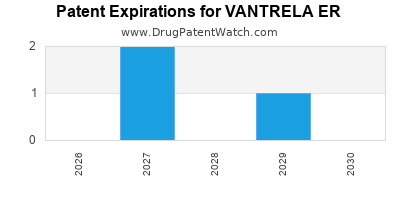
Patent protection was separate from FDA regulatory exclusivity. Teva’s Vantrela ER intellectual-property position included patents covering extended-release opioid formulations and abuse-deterrent technology. Patent term, listed claims and enforceability must be evaluated from the current FDA Orange Book and USPTO records rather than inferred from the approval date.[4][5]
What patents protect Vantrela ER?
The Vantrela ER patent estate was directed primarily to formulation technology rather than the hydrocodone molecule itself. Relevant claim categories include:
- extended-release matrices containing hydrocodone;
- physical and chemical properties that deter crushing or extraction;
- abuse-deterrent dosage forms;
- release profiles and tablet composition;
- manufacturing parameters that preserve the intended release and deterrence characteristics.
The commercial value of those patents depended on whether an ANDA applicant could design around the claims while maintaining an equivalent extended-release product. Formulation patents can create meaningful barriers when the claims cover the core release mechanism, but they are generally more vulnerable than composition-of-matter patents covering a new chemical entity.
How strong was the Vantrela ER patent estate?
Vantrela ER had a narrower patent moat than a new molecular entity. Its strengths were:
- claims directed to a differentiated dosage form;
- technical complexity in reproducing controlled release and abuse-deterrent characteristics;
- potential Orange Book listing leverage against ANDA applicants.
Its weaknesses were:
- no new-molecule exclusivity;
- possible design-around routes;
- dependence on formulation claim scope;
- a declining commercial market that reduced the expected return from patent litigation.
A patent may remain legally enforceable while having limited economic value if the protected product has weak demand.
Were there Paragraph IV challenges to Vantrela ER?
Public commercial records do not show Vantrela ER developing into a major Paragraph IV litigation battleground comparable with blockbuster products. A generic applicant could challenge listed patents under Paragraph IV of the Hatch-Waxman Act or wait for patent expiry and file with a Paragraph III certification.
The absence of prominent litigation is commercially consistent with a product that had limited sales potential. Generic manufacturers generally prioritize products with substantial volume, durable reimbursement and a clear path to market share. A low-volume Schedule II opioid with abuse-deterrent formulation requirements offers a less attractive target.
No material generic Vantrela ER launch has become a recognized market event. The competitive threat therefore came less from a rapid generic launch and more from the broader contraction of the extended-release opioid category.
What is the FDA and Orange Book status of Vantrela ER?
The FDA approved Vantrela ER under NDA 208090. The product’s regulatory status is separate from its commercial availability. An approved NDA can remain in FDA records even if the sponsor reduces or stops active commercialization.
The FDA’s Orange Book is the controlling source for current listed patents, patent use codes and marketing status. The regulatory record should be read together with Teva’s product disclosures because Orange Book listing does not establish that a product has meaningful market share.
Vantrela ER’s FDA status also carries standard extended-release opioid warnings, including risks of respiratory depression, misuse, abuse, addiction, overdose and death. Those warnings materially affect prescribing, payer management and institutional procurement.[1]
What generic entry risks exist for Vantrela ER?
The probability of near-term generic entry has historically been limited by the product’s small market and formulation complexity. The principal generic pathways are:
- an ANDA applicant certifies that relevant patents are expired or will not be infringed;
- the applicant files a Paragraph IV certification and challenges listed patents;
- the applicant develops a formulation with equivalent extended-release performance while avoiding asserted claims;
- the applicant waits for patent and exclusivity barriers to expire.
Even without generic entry, Vantrela ER faces substitution from other opioids and non-opioid therapies. That substitution risk is commercially more significant than patent expiry alone.
Which companies challenged or competed with Vantrela ER?
The most relevant competitive pressure came from Purdue Pharma’s Hysingla ER and Collegium’s Xtampza ER. Both products sought to capture the abuse-deterrent extended-release opioid segment.
Teva also competed against its own portfolio constraints. The company’s generic business emphasized scale and cost efficiency, while Vantrela ER required specialty commercialization in a shrinking and highly scrutinized therapeutic category. That mismatch reduced the likelihood that Vantrela ER would receive sustained commercial investment.
How does Vantrela ER compare with Hysingla ER and Xtampza ER?
| Factor |
Vantrela ER |
Hysingla ER |
Xtampza ER |
| Opioid |
Hydrocodone |
Hydrocodone |
Oxycodone |
| Abuse-deterrent approach |
Physical and chemical properties |
Physical and chemical properties |
DETERx microsphere technology |
| Sponsor |
Teva |
Purdue |
Collegium |
| Market challenge |
Limited scale and opioid contraction |
Litigation and opioid-market pressure |
Specialty commercialization and payer access |
| Differentiation |
Hydrocodone-based abuse-deterrent ER tablet |
Hydrocodone-based abuse-deterrent ER tablet |
Oxycodone formulation with food-effect considerations |
| Commercial visibility |
Low |
Greater historical visibility |
Greater specialty-market visibility |
Vantrela ER’s direct hydrocodone positioning was clinically familiar, but it did not provide a sufficient commercial advantage over Hysingla ER. Xtampza ER competed from a different opioid base and used a formulation platform that supported a distinct product narrative.
What is the investment outlook for Vantrela ER?
Vantrela ER is best viewed as a limited-value legacy asset rather than a growth product. The main residual value drivers are:
- any continuing prescription demand;
- potential licensing or divestiture value for the formulation patents;
- portfolio-level controlled-substance infrastructure;
- possible use of the technology in future abuse-deterrent products.
The main value constraints are more significant:
- no disclosed standalone revenue scale;
- reduced extended-release opioid utilization;
- payer and prescriber restrictions;
- regulatory and litigation exposure associated with opioids;
- competition from established abuse-deterrent formulations;
- limited incentive for generic manufacturers to enter a small market.
There is no public basis for assigning Vantrela ER a material contribution to Teva’s consolidated revenue or earnings. Its financial trajectory is consistent with a product that achieved FDA approval but failed to establish a significant commercial franchise.
Key Takeaways
- Vantrela ER is an FDA-approved abuse-deterrent extended-release hydrocodone product developed by Teva.
- FDA approval occurred on January 26, 2017.
- The product entered a shrinking U.S. opioid market with strong regulatory and payer constraints.
- Teva has not disclosed standalone Vantrela ER revenue.
- Vantrela ER did not become a material named growth product in Teva’s public financial reporting.
- Its intellectual-property position centered on formulation and abuse-deterrence technology, not a new chemical entity.
- Hysingla ER was the closest direct hydrocodone competitor; Xtampza ER was a major alternative in the abuse-deterrent segment.
- Generic-entry risk was moderated by limited market size and formulation complexity, but declining demand reduced the product’s economic value independently of patent status.
- The asset’s residual value is more likely to come from formulation rights or portfolio transactions than from organic prescription growth.
FAQs About Vantrela ER
Is Vantrela ER still sold in the United States?
Vantrela ER remains an FDA-approved product in the regulatory record, but it has had limited commercial visibility and no disclosed material sales contribution in Teva’s public filings.
Did Vantrela ER have new-drug exclusivity?
Vantrela ER did not receive new chemical entity exclusivity because hydrocodone was already known. Any applicable exclusivity was associated with the approved formulation and clinical investigations.
Is Vantrela ER an abuse-proof opioid?
No. Vantrela ER has abuse-deterrent properties, but the FDA does not consider abuse-deterrent labeling to eliminate misuse, addiction, overdose or death risk.
Did Vantrela ER generate blockbuster revenue?
No public evidence indicates blockbuster revenue. Teva did not report Vantrela ER as a material standalone product, and its market conditions were unfavorable for blockbuster-scale sales.
What is the main commercial risk for Vantrela ER?
The primary risk is sustained market contraction in extended-release opioids, compounded by payer restrictions, prescriber caution, regulatory controls and competition from other abuse-deterrent formulations.
References
- U.S. Food and Drug Administration. (2017). Vantrela ER prescribing information. https://www.accessdata.fda.gov/drugsatfda_docs/label/2017/208090s000lbl.pdf
- Centers for Disease Control and Prevention. (2024). U.S. opioid dispensing rate maps. https://www.cdc.gov/overdose-prevention/data-research/facts-stats/opioid-dispensing-rate-maps.html
- Teva Pharmaceutical Industries Ltd. (2018). 2017 annual report. https://www.tevapharm.com/globalassets/tevapharm.com/investors/financial-results/2017/teva-2017-annual-report.pdf
- U.S. Food and Drug Administration. (2024). Approved drug products with therapeutic equivalence evaluations: Orange Book. https://www.fda.gov/drugs/drug-approvals-and-databases/approved-drug-products-therapeutic-equivalence-evaluations-orange-book
- United States Patent and Trademark Office. (2024). Patent Center. https://patentcenter.uspto.gov/