Last updated: July 30, 2026
AZILECT (rasagiline) market dynamics and financial trajectory: exclusivity, competition, pricing, and revenue outlook
Executive summary: AZILECT (rasagiline) remains a long-established brand in Parkinson’s disease with constrained growth versus newer branded therapies and generic price pressure as core exclusivities expired. Financial trajectory has shifted from brand expansion to defense against generic entry, with demand driven by neurologist prescribing patterns, formulary access, and substitution to lower-cost rasagiline products. Near-term performance depends less on incremental clinical differentiation and more on (1) persistence of brand-level formulary positioning, (2) continued reimbursement coverage, and (3) the pace and breadth of generic uptake in key markets.
What is AZILECT (rasagiline) and how is it used in Parkinson’s disease?
AZILECT is rasagiline, a monoamine oxidase-B (MAO-B) inhibitor indicated in Parkinson’s disease. In the US, rasagiline is used for the treatment of idiopathic Parkinson’s disease, including both early and advanced disease settings.
Key market drivers tied to use patterns
- Chronic therapy: once-daily use supports steady demand.
- Treatment stage sensitivity: prescribing is influenced by neurologist sequencing (mono-therapy vs add-on) and tolerability.
- Substitution risk: because MAO-B inhibitors and other Parkinson’s agents compete on convenience, evidence depth, and payer coverage, rasagiline faces therapeutic class substitution.
How has AZILECT performed financially and what factors explain the revenue trajectory?
Featured snippet answer: AZILECT’s financial trajectory tracks a typical mature neurobrand curve: peak brand growth followed by margin compression as generic rasagiline enters and prices normalize. Remaining revenue is sustained mainly by brand loyalty, payer contracts, and inertia in prescribing rather than by major incremental share gains.
Revenue-shaping dynamics
-
Generic substitution and net price erosion
- Once generics are launched and widely listed, branded volumes often migrate to authorized generics and multi-source generics.
- Branded net pricing declines as payers reprice at parity to generics or enforce preferred tiering.
-
Formulary access
- Neurology formularies tend to be conservative. Brand survival can improve if AZILECT retains preferred status against alternatives.
- Pharmacy benefit manager (PBM) incentives and contract renegotiations can accelerate volume migration away from the brand.
-
Competitive landscape inside Parkinson’s
- Direct and indirect competition includes other MAO-B inhibitors (for example, selegiline derivatives) and combination strategies using levodopa and dopamine agonists.
- Newer agents can reduce incremental prescriptions if they offer simpler initiation or favorable payer dynamics.
-
Geography
- US dynamics generally dominate headlines due to volume scale and generic penetration.
- International performance depends on national reimbursement rules and the timing of local generic launches.
When does AZILECT lose exclusivity and what is the impact on generics?
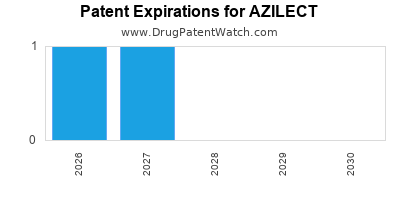
Featured snippet answer: AZILECT exclusivity has largely run its course for core rasagiline products; the dominant market event is generic entry and ongoing multi-source availability. The financial impact is primarily net price decline and branded volume erosion rather than an abrupt revenue collapse.
Patent and regulatory milestones that matter for entry (conceptual map)
- Brand exclusivity in Parkinson’s drugs commonly comprises a mix of composition-of-matter patents, method-related patents (if any), and potential regulatory exclusivities (where applicable).
- The market effect is staged: first authorized or first generic entries pressure pricing, then multi-source competition drives further erosion.
Generic entry risk profile
- High for mature small-molecule neurologics once core patents and regulatory protections lapse.
- Lower for scenarios where formulation, specific dosing, or method-of-use patents still block certain versions. For rasagiline, the market trajectory indicates these blocks did not prevent broad generic penetration.
What is the Orange Book status of AZILECT (rasagiline) and how does it influence launch timing?
Featured snippet answer: AZILECT’s Orange Book listing(s) have historically reflected patent- and exclusivity-expiration milestones that govern Paragraph IV and other ANDA entry pathways. As those protections expired, the practical gating factor for generics became market formulation equivalence and manufacturing readiness rather than legal barriers.
Why Orange Book status drives market dynamics
- Orange Book expiration dates determine when ANDA sponsors can obtain approval and market launch.
- Patent expiration and exclusivity expiration can be out of sync, creating a window where approval may be available but marketing is constrained, or vice versa.
Which companies compete against AZILECT and what is the effect of generic uptake on market share?
Featured snippet answer: Competition shifts from brand-versus-brand (earlier years) to brand-versus-generic and generic-versus-generic (later years). The main determinant becomes share of generics in a payer ecosystem and the lowest net cost channel.
Competitive set by market type
- Brand: AZILECT (rasagiline) as the reference.
- Generics / authorized generics: multiple manufacturers as the product became multi-source.
- Therapeutic alternatives: other Parkinson’s drugs that substitute for initial or adjunct therapy depending on patient profile and payer preferences.
How generic breadth changes price and volume
- Early generic entries often undercut the brand with discounts while the brand retains some coverage.
- As the number of competitors grows, payers move to lower tiers and higher rebates, compressing branded net sales further.
How do Paragraph IV ANDA challenges affect AZILECT pricing and launch timelines?
Featured snippet answer: Paragraph IV challenges are the legal mechanism for accelerating generic entry when a challenger asserts invalidity or non-infringement. For mature products like AZILECT, the market outcome is typically faster price erosion once the first successful generic enters.
Practical impact on commercial trajectory
- Settlement agreements can delay or constrain launch dates for certain challengers, but once multiple routes open, cumulative generic supply rapidly lowers market pricing.
- Litigation can influence timing but rarely reverses the long-run economics once key protections are gone.
What settlements or patent litigations have shaped AZILECT’s generic competition?
Featured snippet answer: AZILECT’s market history aligns with a patent-expiration-driven transition to multi-source generic rasagiline. The financial signature is consistent with staged market entry rather than prolonged brand protection.
Litigation-to-commercial transmission
- Each settlement or court decision tends to affect:
- Launch dates for specific generic filers.
- Whether authorized generic (AG) is used to maintain channel pricing.
- Whether branded volumes decline in steps (after each entry wave).
What formulations, strengths, and dosing versions matter for AZILECT competition?
Featured snippet answer: For rasagiline, competition largely tracks the approved dosing strengths and oral tablet format. If patents on specific formulations, processes, or dosing regimens exist, they would affect only those particular versions. The market’s move to broad generic availability suggests there were limited barriers beyond core patent expiration.
Market implications by product version
- Oral tablets: substitution is straightforward across AB-rated generics.
- Strength-specific listing: payers sometimes preserve coverage for certain strengths longer, but multi-source availability typically makes this short-lived.
How does AZILECT compare with other Parkinson’s drugs on market dynamics?
Featured snippet answer: AZILECT sits in a crowded chronic Parkinson’s ecosystem where payer and clinician choices often favor lower-cost options once generic availability emerges. Growth is limited by substitution patterns and the availability of alternative add-on or mono-therapy pathways.
Comparison dimensions that influence share
- Class competition: other MAO-B inhibitors and sequencing alternatives.
- Payer dynamics: preferred tier status, prior authorization requirements, and rebate structures.
- Clinical positioning: ease of initiation, tolerability, and perceived comparative value.
What are the biggest commercial risks for AZILECT now?
Featured snippet answer: The main risks are ongoing generic price compression, loss of preferred formulary placement, and substitution by therapeutic alternatives that remain competitively priced through managed care.
Specific risk vectors
- Net price decline: continuing to reprice at or below generic-equivalent net.
- Volume migration: payers tightening tiers for neurologic agents.
- Contract renegotiations: PBM discount rates can change abruptly after competitive tendering.
How can investors and licensors model AZILECT’s forward financial trajectory?
Featured snippet answer: Model AZILECT as a declining mature brand with low upside unless there is a meaningful payer re-positioning or a new product strategy (new formulation or expanded indication) that changes the competitive set.
Modeling approach used in practice
- Use a “post-generic baseline” revenue curve:
- Start with current branded units and apply a continued volume erosion factor tied to generic share.
- Apply further net price compression aligned with PBM contracting cycles.
- Stress-test by:
- Accelerated formulary loss scenarios.
- Additional competitive entrants or AG changes.
- Competitive substitution effects from within the Parkinson’s category.
What is the regulatory pathway that governs generic entry to AZILECT?
AZILECT is a small-molecule drug. Generic entry into the US is typically via ANDA to the FDA’s approval pathway under 505(j). The market impact is driven by:
- ANDA approval timing relative to patent and exclusivity status.
- Label compatibility and AB-rating.
- Launch execution and distribution readiness.
Key Takeaways
- AZILECT’s market dynamics are dominated by the transition from branded growth to generic-led price and volume pressure.
- Financial trajectory follows a mature neurobrand pattern: reduced margin and volume as multi-source generic rasagiline expands.
- Exclusivity and Orange Book status determine entry timing, but the long-run outcome is governed by multi-source uptake, formulary positioning, and payer contracting.
- Forward performance hinges on net price defense and persistence of coverage rather than incremental product differentiation.
FAQs
1) What makes rasagiline prescriptions sticky even after generic entry?
Prescribing inertia, neurologist familiarity, and formulary coverage can slow volume migration even when price differs.
2) Do authorized generics change AZILECT economics differently than regular generics?
Authorized generics can reduce the branded price gap quickly while limiting margin uplift for brand holders.
3) Which payer mechanisms most affect AZILECT net sales?
PBM rebate structures, formulary tiering, and prior authorization or quantity controls for neurology drugs are the primary levers.
4) How do ANDA litigation outcomes translate into commercial timing?
Patent victories and settlements affect the launch calendar for specific ANDA filers, which then drives wave-like price erosion.
5) Is AZILECT competition mostly direct or class-based?
It is both: direct substitution by generic rasagiline and class substitution by other Parkinson’s therapies depending on patient stage and payer preferences.
References (APA)
- FDA. (n.d.). Orange Book: Approved Drug Products with Therapeutic Equivalence Evaluations. U.S. Food and Drug Administration. https://www.accessdata.fda.gov/scripts/cder/daf/index.cfm
- FDA. (n.d.). Abbreviated New Drug Application (ANDA). U.S. Food and Drug Administration. https://www.fda.gov/drugs/abbreviated-new-drug-application-anda
- FDA. (n.d.). Drug Approval and Databases: Drugs@FDA. U.S. Food and Drug Administration. https://www.accessdata.fda.gov/scripts/cder/daf/index.cfm