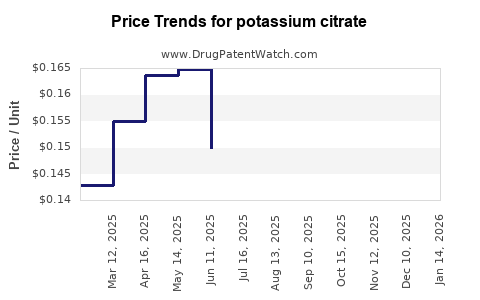
Last updated: September 8, 2026
Potassium citrate is a mature, low-growth pharmaceutical market dominated by generic extended-release tablets, liquid formulations, and nonprescription supplement products. The principal branded product, Urocit-K, competes with multiple ANDA-approved generic products. The market has no meaningful biologic or biosimilar exposure, limited patent protection, low clinical differentiation, and modest revenue potential per manufacturer.
Financial performance depends primarily on volume, reimbursement, API costs, manufacturing reliability, and distribution access. The market is more attractive as a stable specialty-generic business than as a high-growth branded pharmaceutical opportunity.
What is potassium citrate used for, and which products compete?
Potassium citrate is an alkalinizing salt used to increase urinary citrate and urinary pH. FDA-approved prescription uses include treatment of hypocitraturic calcium oxalate nephrolithiasis, uric acid lithiasis, and renal tubular acidosis associated with calcium stones or hypocitraturia. The drug is administered mainly as extended-release tablets or oral liquid formulations (FDA, 2023a).
The main commercial segments are:
| Segment |
Typical product |
Commercial role |
| Branded prescription |
Urocit-K extended-release tablets |
Originator and reference-listed drug |
| Generic prescription |
Potassium citrate extended-release tablets |
Mainstream volume market |
| Oral liquid |
Potassium citrate and citric acid solutions |
Pediatric, dysphagia, and compounding use |
| Dietary supplements |
Potassium citrate capsules, powders, and tablets |
Consumer market with lower regulatory barriers |
| Bulk/API |
Potassium citrate pharmaceutical ingredient |
Input for finished dosage manufacturers |
Urocit-K is marketed by Mission Pharmacal. The product is available in 10 mEq and 15 mEq tablet strengths, with dosing adjusted to urinary citrate and pH measurements. Generic products generally compete on price, formulary placement, wholesaler access, and supply continuity rather than on clinical differentiation.
How large is the potassium citrate pharmaceutical market?
The pharmaceutical market is fragmented and does not have a single transparent revenue pool. Public company filings generally do not report potassium citrate sales separately, and Mission Pharmacal is privately held. Commercial market reports often combine prescription potassium citrate with supplements, urinary alkalinizers, potassium salts, or broader kidney-stone therapies, producing materially different market estimates.
The economic profile is more important than any single market-size estimate:
| Market characteristic |
Assessment |
| Demand growth |
Low to moderate, tied to kidney-stone incidence and diagnosis |
| Product maturity |
Mature |
| Prescription concentration |
Generic-heavy |
| Brand pricing power |
Limited but present where substitution is restricted |
| Clinical differentiation |
Low |
| Switching costs |
Moderate for patients requiring a specific dosage form or strength |
| API complexity |
Low to moderate |
| Manufacturing barriers |
Formulation consistency, tablet performance, packaging, and quality compliance |
| Regulatory exclusivity |
Effectively expired for the core molecule |
| Biosimilar exposure |
None |
| Litigation intensity |
Low relative to patented specialty medicines |
Kidney-stone prevalence has increased in several developed markets, supporting underlying demand. Epidemiologic growth does not translate directly into pharmaceutical revenue because potassium citrate is an inexpensive, chronic or intermittent therapy and many patients receive dietary counseling, thiazide therapy, allopurinol, or no preventive medication. The American Urological Association identifies potassium citrate as an established preventive option for selected recurrent stone formers, supporting continued prescription demand (American Urological Association, 2019).
What is the financial trajectory for potassium citrate?
The likely financial trajectory is stable volume with declining or flat real pricing.
Revenue drivers
Prescription demand is supported by:
- Recurrent calcium oxalate and uric acid stone disease
- Greater use of metabolic evaluation after recurrent stones
- Increased diagnosis of hypocitraturia
- Chronic management of renal tubular acidosis
- Continued use in patients unable to tolerate or adhere to liquid formulations
Revenue constraints
Revenue growth is limited by:
- Generic substitution
- Low active-ingredient cost
- Multiple approved manufacturers
- Limited prescriber sensitivity to brand differences
- Payer pressure on low-cost oral solids
- Substitution with dietary alkalinization or other preventive strategies
- Competition from supplement products outside the prescription channel
A manufacturer with a reliable generic supply chain can maintain revenue through recurring prescriptions, but price increases are vulnerable to payer intervention and competitor response. The highest-value commercial positions are usually the brand, authorized generic, shortage-resilient supplier, or differentiated liquid product rather than an undifferentiated tablet manufacturer.
Scenario analysis
| Scenario |
Market effect |
Financial implication |
| Base case |
Stable prescription volume and continued generic competition |
Low-single-digit nominal growth at best |
| Downside |
Additional price competition or supply oversupply |
Revenue and gross-margin compression |
| Upside |
Manufacturing disruption among competitors or stronger stone-prevention diagnosis |
Temporary volume and pricing improvement |
| Specialty upside |
Successful premium liquid, adherence, or pediatric positioning |
Higher margin but limited addressable population |
| Long-term structural risk |
Greater supplement substitution and formulary commoditization |
Lower prescription value per patient |
The market is therefore defensive rather than developmental. A company evaluating acquisition or licensing should underwrite manufacturing economics, channel access, and supply reliability rather than assume pharmaceutical-style lifecycle growth.
What patents protect potassium citrate products?
The active ingredient, potassium citrate, is an old, well-characterized compound. Core molecule protection has expired. The principal branded product, Urocit-K, received FDA approval decades ago, eliminating any meaningful period of new chemical entity exclusivity.
Potentially relevant protection can involve:
- Extended-release tablet formulation
- Matrix or coating technology
- Dosage-form design
- Manufacturing processes
- Packaging and stability
- Combination products
- Method-of-use claims tied to a specific patient population or dosing regimen
The practical strength of these categories is limited. Formulation patents must distinguish the product through enforceable release characteristics, composition, or manufacturing limitations. Method-of-use patents face narrower commercial value because physicians can prescribe potassium citrate for established stone-prevention indications under several dosing approaches.
Patent-estate assessment
| Patent category |
Status for potassium citrate |
Commercial strength |
| Composition-of-matter patent |
Expired or unavailable for the old molecule |
None |
| New chemical entity exclusivity |
Expired |
None |
| Extended-release formulation |
Potentially relevant historically |
Low to moderate if active and claim scope is narrow |
| Method of use |
Possible for specific dosing or populations |
Low to moderate |
| Manufacturing process |
May protect process details |
Usually limited against alternative processes |
| Packaging or stability |
Possible |
Low |
| Supplement formulation |
May have trade-secret or design protection |
Low patent leverage |
What is the Orange Book status of Urocit-K and generic potassium citrate?
Urocit-K is the reference product associated with an FDA-approved NDA, while generic potassium citrate extended-release tablets are approved through ANDAs that reference the branded product or its relevant FDA standard.
The Orange Book is the controlling source for current reference-listed drug, patent, and exclusivity information. The product’s commercial history indicates that the core regulatory exclusivity period has long expired. Generic entry is therefore governed mainly by ANDA approval, labeling conformity, manufacturing capacity, and any product-specific patent certifications rather than by remaining exclusivity for the active ingredient (FDA, 2024a).
An Orange Book review should distinguish:
- The Urocit-K NDA and its listed strengths.
- Generic extended-release tablets approved under ANDAs.
- Any currently listed patents associated with the reference product.
- Patent certifications submitted by generic applicants.
- Whether a listed patent covers the proposed dosage form or only a separate formulation.
For a mature product such as potassium citrate, the existence of an Orange Book-listed patent would not by itself establish a high litigation risk. Claim scope, enforceability, remaining term, and the design of the generic product are determinative.
When does potassium citrate lose exclusivity?
Potassium citrate lost practical market exclusivity long ago. The relevant dates are:
| Event |
Timing |
| Original Urocit-K development and approval |
1980s-era product history |
| Core molecule exclusivity |
Expired decades ago |
| Generic pathway |
ANDA competition established |
| Current market structure |
Multiple generic and branded suppliers |
| Future exclusivity risk |
Limited to new formulation, combination, or method patents |
There is no biosimilar-style exclusivity period because potassium citrate is a small-molecule drug, not a biologic. FDA approval of a new liquid, extended-release technology, or combination product could create product-specific regulatory exclusivity, but it would not restore exclusivity for ordinary potassium citrate tablets.
Which companies are challenging the potassium citrate market?
The market is challenged primarily by generic manufacturers and distributors rather than by a single branded rival. Generic competition can arise from:
- ANDA holders selling potassium citrate extended-release tablets
- Authorized-generic arrangements
- Contract manufacturers supplying pharmacy-label products
- Specialty pharmacies and compounding pharmacies
- Supplement brands selling nonprescription potassium citrate
- Liquid-product manufacturers serving patients who cannot use tablets
Competitive advantage depends on FDA-compliant manufacturing, product availability, wholesaler contracts, National Drug Code maintenance, and payer coverage. A supplier with only one manufacturing site has greater interruption risk than a company using redundant API and finished-dose sources.
Generic competition is especially strong for commonly prescribed tablet strengths. Liquid formulations can retain more differentiation because they have higher packaging, taste, stability, and handling requirements.
What formulations are protected by potassium citrate patents?
The most commercially relevant formulation issue is extended release. Potassium citrate tablets must deliver the salt in a manner that reduces gastrointestinal exposure and supports sustained urinary alkalinization. Labeling warns that extended-release tablets should be taken with meals and swallowed whole, reflecting dosage-form performance requirements (FDA, 2023a).
Formulation-related protection may cover:
- Hydrophilic or wax-based matrix systems
- Tablet coating and release-control layers
- Particle-size or granulation parameters
- Excipient ratios
- Reduced gastrointestinal irritation
- Improved stability under moisture exposure
- Liquid formulations with improved palatability or shelf life
These features may support differentiation, but they are difficult to monetize unless they produce a meaningful clinical, adherence, or manufacturing benefit. A generic manufacturer can often design around a narrow formulation claim while delivering the same labeled strength and therapeutic purpose.
Are there Paragraph IV challenges involving potassium citrate?
Paragraph IV risk is structurally lower than for high-value patented drugs. Generic manufacturers may certify that relevant Orange Book patents are invalid, unenforceable, or not infringed, but the economic incentive to litigate is limited by the low market value of potassium citrate.
Potential litigation would be most plausible if:
- A listed formulation patent blocked a large generic market.
- A brand maintained substantial price premiums.
- A new product introduced a differentiated release profile.
- A generic applicant sought first-filer economics.
- A patent owner asserted a broad manufacturing or dosage-form claim.
For ordinary potassium citrate extended-release tablets, market entry is more likely to occur through routine ANDA approval and commercial launch than through prolonged patent litigation. Publicly material litigation and settlement activity is limited compared with products in oncology, immunology, diabetes, or rare disease.
What generic entry risks exist for Urocit-K?
Urocit-K faces four principal entry risks:
- Price erosion: Generic substitution limits the brand’s ability to maintain a premium.
- Formulary exclusion: Payers can place generic potassium citrate on preferred tiers.
- Supply-based switching: Pharmacies may substitute among manufacturers when inventory changes.
- Therapeutic substitution: Some patients may use dietary measures, other alkalinizing products, or alternative preventive therapies.
The brand can retain patients through physician familiarity, consistent tablet performance, patient assistance, and availability across strengths. These defenses are commercial rather than patent-based.
How does potassium citrate compare with competing stone-prevention drugs?
| Therapy |
Primary role |
Differentiation |
Commercial position |
| Potassium citrate |
Raises urinary citrate and pH |
Established, generic |
Low-cost chronic therapy |
| Sodium citrate or bicarbonate |
Urinary alkalinization |
Sodium burden limits use in some patients |
Alternative, often lower-cost |
| Thiazide diuretics |
Reduces urinary calcium |
Different mechanism |
Generic and widely available |
| Allopurinol |
Reduces uric-acid production |
Useful in selected hyperuricosuric patients |
Generic |
| Dietary intervention |
Reduces risk through fluid and diet changes |
Nonpharmaceutical |
No drug revenue |
| Specialty stone therapies |
Target selected metabolic or genetic conditions |
Higher clinical specificity |
Smaller populations and higher prices |
Potassium citrate has a durable role because it directly addresses hypocitraturia and urinary acidity. It does not have the pricing power of newer specialty therapies because its mechanism, ingredient, and dosage form are well established.
What FDA regulatory issues affect potassium citrate manufacturers?
FDA risk is concentrated in product quality rather than clinical development. Key compliance areas include:
- Content uniformity
- Extended-release dissolution
- Potency and assay
- Moisture and stability control
- Tablet integrity
- Container-closure performance
- Labeling consistency
- Manufacturing-process validation
- cGMP compliance
- Accurate NDC and product reporting
An extended-release tablet failure can cause regulatory action or product recall even when the active ingredient is inexpensive. The dosage form therefore creates more operational risk than the molecule itself.
Liquid products carry additional risks involving microbial control, preservative systems, dosing-device accuracy, taste masking, and stability after opening.
What manufacturing and intellectual-property barriers exist?
Potassium citrate API production is not generally a high barrier. The more important barriers are:
- Reliable pharmaceutical-grade API sourcing
- Validated granulation and compression
- Consistent extended-release performance
- Moisture-resistant packaging
- FDA-compliant quality systems
- Scale economics
- Stable wholesaler and pharmacy distribution
A new entrant can usually access the molecule, but achieving consistent commercial supply at acceptable cost is more difficult. Manufacturing interruptions can temporarily shift share to suppliers with available inventory.
The strongest defensible position is usually a combination of regulatory approvals, validated manufacturing, reliable supply, and customer contracts. Patent exclusivity alone is unlikely to support a durable moat.
What is the geographic coverage and international outlook?
Potassium citrate is sold globally through prescription, hospital, compounding, and supplement channels. Regulatory treatment varies by country. Some markets classify products as prescription medicines, while others permit broader pharmacy or supplement distribution.
International revenue depends on:
- Local registration requirements
- Reimbursement of stone-prevention therapy
- Availability of generic manufacturers
- Import controls for pharmaceutical salts
- Local stability and packaging rules
- Physician use of metabolic stone evaluation
The United States is commercially important because of its established urology market and prescription infrastructure. Europe and other developed markets have comparable therapeutic use but often show stronger generic price pressure. Emerging markets can have greater volume potential but lower realized prices and more fragmented distribution.
What is the litigation and settlement outlook?
The litigation outlook is low. No major recurring patent-settlement framework is central to the potassium citrate market. The most likely disputes involve:
- Product quality and manufacturing
- Supply contracts
- Trademark or trade dress
- Generic labeling
- Narrow formulation claims
- Distribution and channel access
Large reverse-payment settlements are economically less likely because the market lacks the revenue pool that supports high-value patent settlements in blockbuster drugs.
Key Takeaways
- Potassium citrate is a mature, generic-heavy pharmaceutical market.
- Urocit-K remains the principal branded reference product, but core molecule exclusivity is long expired.
- Generic extended-release tablets determine market pricing and volume.
- Formulation and manufacturing patents may exist, but they provide limited commercial leverage unless claims are broad and enforceable.
- Paragraph IV and patent litigation risk is low relative to high-value specialty drugs.
- There is no biosimilar risk because potassium citrate is a small-molecule drug.
- Revenue is likely to remain stable or grow slowly, with periodic price erosion.
- The strongest commercial assets are reliable manufacturing, liquid-formulation capability, supply continuity, and payer access.
- Market upside is limited unless a company creates a differentiated dosage form or captures a supply-constrained segment.
- Investment underwriting should focus on gross margin, API sourcing, FDA compliance, and channel concentration rather than patent duration.
FAQs About Potassium Citrate Market and Patent Risk
Is potassium citrate a profitable pharmaceutical product?
It can be profitable as a scaled generic or specialty-generic product, but ordinary tablets generally have limited pricing power. Profitability depends on manufacturing cost, supply reliability, and distribution scale.
Does Urocit-K have patent protection today?
The active ingredient is not protected by current composition-of-matter exclusivity. Any relevant protection would depend on product-specific formulation or other listed patents identified in the current FDA Orange Book.
Can a new company launch generic potassium citrate?
Yes, subject to FDA approval, applicable ANDA requirements, manufacturing compliance, bioequivalence or product-specific requirements, and any enforceable patent obligations associated with the selected dosage form.
Is potassium citrate covered by Medicare and commercial insurance?
Prescription potassium citrate products may be covered under Medicare Part D and commercial formularies, but coverage, preferred status, copayments, and prior authorization vary by product and payer.
Will kidney-stone growth materially increase potassium citrate revenue?
Higher kidney-stone prevalence supports demand, but revenue growth is moderated by generic pricing, low treatment cost, dietary management, and substitution with other preventive therapies.
References
-
American Urological Association. (2019). Medical management of kidney stones: AUA guideline. https://www.auanet.org/guidelines-and-quality/guidelines/medical-management-of-kidney-stones
-
U.S. Food and Drug Administration. (2023a). Urocit-K potassium citrate extended-release tablets prescribing information. Mission Pharmacal Company. https://www.accessdata.fda.gov
-
U.S. Food and Drug Administration. (2024a). Approved drug products with therapeutic equivalence evaluations: Orange Book. https://www.accessdata.fda.gov/scripts/cder/ob/
-
U.S. Food and Drug Administration. (2024b). Drugs@FDA: FDA-approved drugs database. https://www.accessdata.fda.gov/scripts/cder/daf/
-
U.S. National Library of Medicine. (2024). DailyMed: Potassium citrate drug labeling. https://dailymed.nlm.nih.gov/dailymed/