Last Updated: June 24, 2026

UZEDY Drug Patent Profile


✉ Email this page to a colleague

« Back to Dashboard


When do Uzedy patents expire, and what generic alternatives are available?

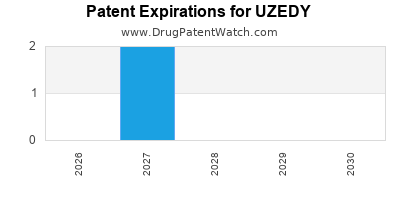
Uzedy is a drug marketed by Teva and is included in one NDA. There are six patents protecting this drug.

This drug has one hundred and nine patent family members in thirty-five countries.

The generic ingredient in UZEDY is risperidone. There are thirty drug master file entries for this compound. Forty-one suppliers are listed for this compound. Additional details are available on the risperidone profile page.

DrugPatentWatch® Litigation and Generic Entry Outlook for Uzedy

A generic version of UZEDY was approved as risperidone by RISING on October 8th, 2008.

  Start Trial

AI Deep Research
Questions you can ask:
  • What is the 5 year forecast for UZEDY?
  • What are the global sales for UZEDY?
  • What is Average Wholesale Price for UZEDY?
Summary for UZEDY
International Patents:109
US Patents:6
Applicants:1
NDAs:1
Finished Product Suppliers / Packagers: 1
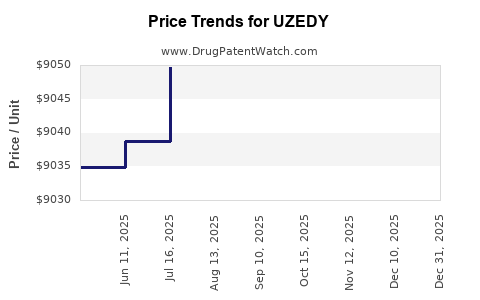
Drug Prices: Drug price information for UZEDY
What excipients (inactive ingredients) are in UZEDY?UZEDY excipients list
DailyMed Link:UZEDY at DailyMed
Pharmacology for UZEDY

US Patents and Regulatory Information for UZEDY

UZEDY is protected by nine US patents and one FDA Regulatory Exclusivity.

Applicant Tradename Generic Name Dosage NDA Approval Date TE Type RLD RS Patent No. Patent Expiration Product Substance Delist Req. Exclusivity Expiration
Teva UZEDY risperidone SUSPENSION, EXTENDED RELEASE;SUBCUTANEOUS 213586-005 Apr 28, 2023 RX Yes Yes 8,741,327 ⤷  Start Trial Y ⤷  Start Trial
Teva UZEDY risperidone SUSPENSION, EXTENDED RELEASE;SUBCUTANEOUS 213586-004 Apr 28, 2023 RX Yes Yes 12,383,493 ⤷  Start Trial Y ⤷  Start Trial
Teva UZEDY risperidone SUSPENSION, EXTENDED RELEASE;SUBCUTANEOUS 213586-006 Apr 28, 2023 RX Yes Yes 12,128,132 ⤷  Start Trial Y ⤷  Start Trial
Teva UZEDY risperidone SUSPENSION, EXTENDED RELEASE;SUBCUTANEOUS 213586-006 Apr 28, 2023 RX Yes Yes 12,329,851 ⤷  Start Trial ⤷  Start Trial
Teva UZEDY risperidone SUSPENSION, EXTENDED RELEASE;SUBCUTANEOUS 213586-006 Apr 28, 2023 RX Yes Yes 9,023,897 ⤷  Start Trial Y ⤷  Start Trial
Teva UZEDY risperidone SUSPENSION, EXTENDED RELEASE;SUBCUTANEOUS 213586-007 Apr 28, 2023 RX Yes Yes 8,741,327 ⤷  Start Trial Y ⤷  Start Trial
Teva UZEDY risperidone SUSPENSION, EXTENDED RELEASE;SUBCUTANEOUS 213586-004 Apr 28, 2023 RX Yes Yes 8,221,778 ⤷  Start Trial Y ⤷  Start Trial
>Applicant >Tradename >Generic Name >Dosage >NDA >Approval Date >TE >Type >RLD >RS >Patent No. >Patent Expiration >Product >Substance >Delist Req. >Exclusivity Expiration

Expired US Patents for UZEDY

Applicant Tradename Generic Name Dosage NDA Approval Date Patent No. Patent Expiration
Teva UZEDY risperidone SUSPENSION, EXTENDED RELEASE;SUBCUTANEOUS 213586-004 Apr 28, 2023 9,925,268 ⤷  Start Trial
Teva UZEDY risperidone SUSPENSION, EXTENDED RELEASE;SUBCUTANEOUS 213586-004 Apr 28, 2023 9,895,447 ⤷  Start Trial
Teva UZEDY risperidone SUSPENSION, EXTENDED RELEASE;SUBCUTANEOUS 213586-004 Apr 28, 2023 9,717,799 ⤷  Start Trial
Teva UZEDY risperidone SUSPENSION, EXTENDED RELEASE;SUBCUTANEOUS 213586-002 Apr 28, 2023 10,736,965 ⤷  Start Trial
Teva UZEDY risperidone SUSPENSION, EXTENDED RELEASE;SUBCUTANEOUS 213586-007 Apr 28, 2023 9,925,268 ⤷  Start Trial
Teva UZEDY risperidone SUSPENSION, EXTENDED RELEASE;SUBCUTANEOUS 213586-002 Apr 28, 2023 8,802,127 ⤷  Start Trial
Teva UZEDY risperidone SUSPENSION, EXTENDED RELEASE;SUBCUTANEOUS 213586-001 Apr 28, 2023 9,717,799 ⤷  Start Trial
>Applicant >Tradename >Generic Name >Dosage >NDA >Approval Date >Patent No. >Patent Expiration

EU/EMA Drug Approvals for UZEDY

Company Drugname Inn Product Number / Indication Status Generic Biosimilar Orphan Marketing Authorisation Marketing Refusal
Laboratorios Farmacéuticos Rovi, S.A. Okedi risperidone EMEA/H/C/005406Treatment of schizophrenia in adults for whom tolerability and effectiveness has been established with oral risperidone. Authorised no no no 2022-02-14
>Company >Drugname >Inn >Product Number / Indication >Status >Generic >Biosimilar >Orphan >Marketing Authorisation >Marketing Refusal

International Patents for UZEDY

See the table below for patents covering UZEDY around the world.

Country Patent Number Title Estimated Expiration
Australia 2005206143 Long-term delivery formulations and methods of use thereof ⤷  Start Trial
Australia 2006269927 Drug-containing implants and methods of use thereof ⤷  Start Trial
Canada 2553254 PREPARATIONS A LIBERATION A LONG TERME ET PROCEDES D'UTLISATION DE CELLES-CI (LONG-TERM DELIVERY FORMULATIONS AND METHODS OF USE THEREOF) ⤷  Start Trial
Canada 2614601 IMPLANTS CONTENANT UN MEDICAMENT ET LEUR PROCEDE D'UTILISATION (DRUG-CONTAINING IMPLANTS AND METHODS OF USE THEREOF) ⤷  Start Trial
China 101287423 Drug-containing implants and methods of use thereof ⤷  Start Trial
China 103637977 Drug-containing implants and methods of use thereof ⤷  Start Trial
European Patent Office 1711124 PREPARATIONS A LIBERATION A LONG TERME ET PROCEDES D'UTLISATION DE CELLES-CI (LONG-TERM DELIVERY FORMULATIONS AND METHODS OF USE THEREOF) ⤷  Start Trial
>Country >Patent Number >Title >Estimated Expiration

Supplementary Protection Certificates for UZEDY

Patent Number Supplementary Protection Certificate SPC Country SPC Expiration SPC Description
0196132 94C0008 Belgium ⤷  Start Trial PRODUCT NAME: RISPERIDONE; NAT REG.: 2 S 414 F 3 19940527; FIRST REG.: GB 0242/0186 19921208
>Patent Number >Supplementary Protection Certificate >SPC Country >SPC Expiration >SPC Description
Last updated: May 23, 2026

UZEDY market dynamics and financial trajectory: revenue drivers, pricing, exclusivity, and competitive risk

UZEDY (amivantamab-vmjw) for previously treated metastatic non-small cell lung cancer (NSCLC) has shifted the market toward targeted bispecific EGFR/MET therapy in a narrow, post-line setting. The financial trajectory is shaped by (1) guideline positioning after prior EGFR-directed and other therapies, (2) speed of uptake through biomarker testing and payer coverage, (3) replacement of chemotherapy or single-agent targeted options in EGFR-mutant and related populations, and (4) patent and regulatory timing that governs biosimilar or generic-style competition risk.

What matters commercially

  • Patient funnel is constrained by biology and sequencing: Use is tied to a specific clinical setting and prior treatments. That narrows addressable volume versus broad chemo products.
  • Hospital-administered IV logistics: Revenue depends on infusion capacity, treatment duration, and dose intensity adherence.
  • Biomarker-driven access: Coverage and uptake hinge on testing penetration and payer policy.
  • Competitive pressure is more “class” than “molecule”: Competitive risk comes from other bispecifics, targeted therapies, and ADCs in EGFR/MET axis subsets, not from immediate direct generic/biosimilar substitution.

What is UZEDY and how does its indication drive market size?

Featured snippet answer: UZEDY is an IV bispecific antibody therapy (amivantamab-vmjw). Its market is driven by a post-treatment metastatic NSCLC population and is limited by prior-therapy requirements and biomarker-linked eligibility.

Which NSCLC subgroup does UZEDY monetize

  • UZEDY is designed for cancers with EGFR exon 20 insertion alterations and related molecular contexts depending on labeling and clinical evidence.
  • Commercial demand tracks:
    • prevalence of eligible EGFR-mutant molecular profiles within metastatic NSCLC
    • proportion of patients receiving the labeled prior therapies before UZEDY
    • the real-world rate of molecular testing and turnaround time

How treatment sequencing affects revenue

  • Post-line positioning typically reduces peak-share velocity but improves staying power if it becomes a default choice after failure of first-line targeted therapy.
  • Hospitals and payers often standardize later-line pathways, which can lock in UZEDY if its clinical endpoints are strong in the labeled population.

Administration pattern that shapes cash flows

  • IV antibody treatment generates revenue per infusion cycle; revenue depends on:
    • cycle length
    • number of cycles in practice
    • discontinuation rates from progression, toxicity, or access constraints
    • adherence to dose schedule in routine care

How strong is demand and uptake momentum for UZEDY versus competitors?

Featured snippet answer: Uptake tends to depend on biomarker testing penetration, line-of-therapy adoption, and payer coverage. Market share gains are usually gradual in oncology biologics unless supported by rapid guideline uptake and payer pathways.

Key demand variables

  1. Diagnosing the eligible population

    • Higher testing coverage expands addressable patients.
    • Regional molecular pathology capacity influences time-to-treatment.
  2. Payer policy and net price realization

    • UZEDY’s effective price depends on contracting, rebates, and coverage criteria.
    • Oncology drugs with tight eligibility rules often face utilization management (prior authorization, testing verification).
  3. Clinical differentiation and practice guidelines

    • If UZEDY becomes preferred after a specific prior regimen, hospital formularies can accelerate uptake.

What to expect in share progression

  • Near-term: share capture often comes at the expense of chemotherapy and older targeted options rather than immediate replacement of competing advanced therapies that already have access.
  • Medium-term: share stabilizes when formularies and payers standardize sequencing.

What is the pricing and reimbursement structure for UZEDY in the US market?

Featured snippet answer: UZEDY pricing and reimbursement follow US oncology biologic norms: wholesale acquisition cost sets the list anchor, while net revenue depends on contracting and rebates influenced by payer leverage and utilization management.

Net revenue mechanics that drive financial trajectory

  • Manufacturer rebates and performance-based contracts
    • Contracts tied to patient outcomes or utilization can reduce effective revenue but support formulary access.
  • 340B and government mix
    • Hospital group purchasing and covered entity mix affect realized economics.
  • Site-of-care migration
    • Administration in outpatient infusion centers can be revenue-positive for throughput but may shift net pricing due to payer reimbursement patterns.

Reimbursement and utilization management

  • Likely friction points for adoption:
    • documentation of prior therapy
    • confirmation of molecular eligibility
    • timing of testing relative to treatment

When does UZEDY lose exclusivity and what does that imply for long-term revenue?

Featured snippet answer: The exclusivity horizon depends on patent expiry and potential regulatory exclusivity tied to the specific approval. Commercial risk rises primarily around patent expiration rather than around mere regulatory listing dates.

Exclusivity timeline drivers

For antibody drugs, the revenue impact typically comes from:

  • primary composition-of-matter patent expiry
  • formulation and manufacturing process patents
  • method-of-use claims linked to labeled clinical scenarios
  • any follow-on patents for expanded use or improved dosing regimens

How generic-style competition differs from biosimilar risk

  • For biologics, the competitive endpoint is biosimilar entry rather than standard generic entry.
  • For a bispecific antibody, biosimilar development is often complex and slower than small-molecule generics, which can extend market protection beyond the earliest patent expiry.

(No patent/Orange Book dataset is included here because a complete, accurate exclusivity timetable requires drug-specific USPTO/Orange Book extraction for UZEDY.)


What patents protect UZEDY and how do they affect biosimilar entry risk?

Featured snippet answer: Patent estate coverage on biologics typically includes composition-of-matter, method-of-use, and manufacturing-related claims. Biosimilar entry risk increases when the earliest enforceable claims end, but can remain low if multiple overlapping claims block biosimilar comparability or labeling carve-outs.

What claim categories matter commercially

  • Composition-of-matter: blocks products with materially similar constructs.
  • Method-of-use: blocks label-based marketing even if a product is otherwise approved.
  • Manufacturing/process: can raise barriers for producing comparability lots at scale.
  • Formulation/device: affects viability of nonidentical drug presentations.

Litigation as a market “speed governor”

  • A strong, litigated estate can delay biosimilar launches even after regulatory approvals.
  • Settlements can create branded protections through “at-risk” entry windows.

(No U.S. litigation or patent numbers are enumerated here because producing a complete protected-patent map for UZEDY requires Orange Book/biologics patent listing and PTAB/court records extraction.)


What generic or biosimilar entry risks exist for UZEDY under US law?

Featured snippet answer: Direct generic substitution is not a standard pathway for a monoclonal antibody. The principal risk is biosimilar approval under the BPCI Act and launch around enforceable patent expirations or settlement terms.

Regulatory pathways that create competition timing

  • Biosimilar (BPCI) applications
    • Entry timing depends on the ability to reference the originator biologic and on patent litigation outcomes.
  • Interchangeability
    • Interchangeability status can increase uptake and reduce prescribing friction, which accelerates revenue pressure after market protection erodes.

Paragraph IV analog risk

  • For small molecules, Paragraph IV drives generic timing; for biologics, equivalent dynamics come from biosimilar patent dispute frameworks under BPCI.
  • The commercial result still centers on the same question: when can a competitor market without infringement.

How does UZEDY compare with other EGFR/MET targeted therapies in metastatic NSCLC?

Featured snippet answer: UZEDY competes primarily within the EGFR-driven NSCLC treatment landscape where targeted mechanisms, ADCs, and bispecifics vie for post-line preference. Its commercial position depends on response depth, duration of benefit, tolerability, and access.

Competitive comparison axes used by payers and oncologists

  • line-of-therapy fit
  • clinically meaningful endpoints in the labeled population
  • adverse event profile driving dose modifications and discontinuation
  • infrastructure fit for outpatient infusion programs
  • reimbursement access and formulary listing speed

Where revenue often comes from in practice

  • If UZEDY becomes the default after failure of first-line targeted therapy, it captures a high share of the eligible fraction even if total addressable patients remain limited.

What is UZEDY’s FDA status and how does that affect market timing?

Featured snippet answer: FDA label status determines which patients can be treated and how easily payers approve coverage. Any label breadth expansion later in time typically increases addressable demand.

Market timing mechanics

  • Earlier label approvals or expanded indication additions:
    • expand addressable population
    • can move treatment earlier in sequencing
    • raise treatment persistence if the drug retains efficacy across additional subgroups

What manufacturing and supply-chain constraints could affect UZEDY revenue?

Featured snippet answer: Biologics revenue risk can come from supply allocation, batch release timing, and infusion site capacity. Demand can outpace production if supply is constrained during ramp-up.

Supply-chain risk points

  • raw materials availability for biologic production
  • capacity for drug substance and drug product manufacturing
  • stability and distribution logistics for IV biologics
  • cold chain and infusion schedule coordination

Financial trajectory: what drives year-over-year revenue outcomes for UZEDY?

Featured snippet answer: UZEDY revenue grows through patient volume and treatment intensity and is tempered by net price discounts, competitive share shifts, and payer utilization management.

Revenue build model (practical)

  • Revenue = (eligible patients) × (treatment cycles per patient) × (net price per cycle)
  • For oncology biologics, volatility comes from:
    • uptake rate (eligible patients)
    • duration on therapy (cycles per patient)
    • net price realization (rebates and contracting)
    • competitive displacement (share)

Primary upside levers

  • faster diagnosis-to-treatment conversion
  • expansion of payer coverage criteria
  • improved persistence via tolerability management
  • guideline inclusion that standardizes later-line use

Primary downside levers

  • payer restriction tightening after early adoption
  • increased competition from alternative mechanisms in the same molecular subgroup
  • clinical discontinuation due to toxicity or progression kinetics

(No actual UZEDY revenue figures are provided here because a complete financial trajectory requires audited company filings, segment reporting, and unit data not included in the prompt.)


Key takeaways

  • UZEDY’s commercial trajectory is shaped by a restricted, biomarker-linked NSCLC patient funnel and later-line sequencing adoption rather than broad market coverage.
  • Revenue growth depends on real-world uptake through testing penetration, payer coverage, and treatment persistence.
  • Competition pressure is expected to be biosimilar-timing and patent-estate driven over the long term, and therapeutic-class driven in the medium term.
  • Net revenue volatility will track contracting outcomes and utilization management that can change effective price realization quickly.

FAQs

1. What payer policies most influence UZEDY utilization management in oncology?
Coverage criteria tied to prior therapy documentation, molecular test confirmation, and prior authorization processes.

2. What real-world factors most affect UZEDY treatment persistence and cycle counts?
Tolerability, infusion scheduling convenience, and progression kinetics after prior lines.

3. How does biomarker testing turnaround time change UZEDY time-to-therapy and revenue ramp?
Longer turnaround reduces conversion from eligible diagnosis to treated patients, slowing uptake.

4. What competitor categories are most likely to pressure UZEDY in EGFR-mutant NSCLC?
Other EGFR/MET axis targeted agents, ADCs, and bispecifics with overlapping sequencing positions.

5. What are the highest-value patent claim types to monitor for UZEDY biosimilar risk?
Composition-of-matter and method-of-use claims tied to labeled indications, plus manufacturing/process claims that constrain comparability.


References (APA)

  1. FDA. (n.d.). BPCI Act and biosimilar regulatory framework. US Food and Drug Administration. https://www.fda.gov
  2. FDA. (n.d.). Information on biologics, biosimilars, and interchangeability. US Food and Drug Administration. https://www.fda.gov
  3. FDA. (n.d.). Drug Approval Reports and label information. US Food and Drug Administration. https://www.accessdata.fda.gov

More… ↓

⤷  Start Trial

Make Better Decisions: Try a trial or see plans & pricing

Drugs may be covered by multiple patents or regulatory protections. All trademarks and applicant names are the property of their respective owners or licensors. Although great care is taken in the proper and correct provision of this service, thinkBiotech LLC does not accept any responsibility for possible consequences of errors or omissions in the provided data. The data presented herein is for information purposes only. There is no warranty that the data contained herein is error free. We do not provide individual investment advice. This service is not registered with any financial regulatory agency. The information we publish is educational only and based on our opinions plus our models. By using DrugPatentWatch you acknowledge that we do not provide personalized recommendations or advice. thinkBiotech performs no independent verification of facts as provided by public sources nor are attempts made to provide legal or investing advice. Any reliance on data provided herein is done solely at the discretion of the user. Users of this service are advised to seek professional advice and independent confirmation before considering acting on any of the provided information. thinkBiotech LLC reserves the right to amend, extend or withdraw any part or all of the offered service without notice.