Last updated: July 25, 2026
moLOL Maleate Market Dynamics and Financial Trajectory (Ophthalmic, US and Key International)
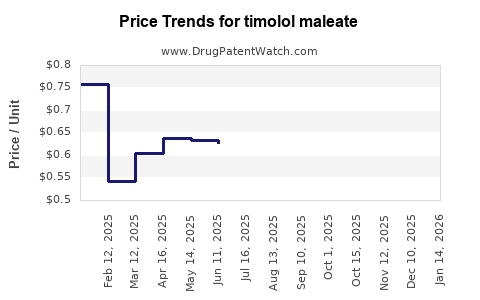
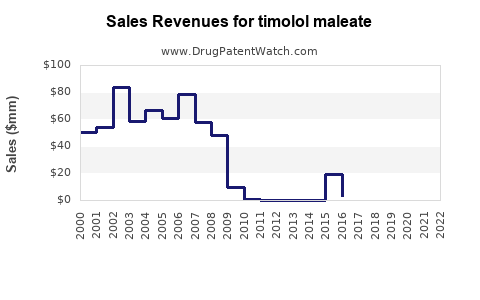
TimoLOL maleate is a long-established ophthalmic beta-blocker used primarily for lowering intraocular pressure (IOP) in glaucoma and ocular hypertension. The market is structurally mature, driven by generic penetration, low pricing power, and incremental share shifts across branded and authorized generic products. Financial trajectory is stable-to-declining in unit economics in most markets because patent protection is long expired and formularies favor low-cost alternatives.
What is the global market for timolol maleate, and how is it trending financially?
Answer: The timolol maleate market behaves like a mature generic-heavy ophthalmic class product: steady demand from chronic glaucoma therapy, but shrinking revenues per unit over time due to sustained generic price compression and substitution across combination therapies.
Key demand drivers
- Chronic indication base: lifelong IOP management in glaucoma and ocular hypertension creates relatively inelastic volumes.
- Expansion via guideline treatment patterns: beta-blockers remain a core option in many stepwise treatment algorithms, though newer agents shift first-line usage in some geographies.
- Combination therapy migration: fixed-dose combinations (commonly paired with prostaglandin analogs or other IOP-lowering agents) can reduce standalone timolol share even when overall patient numbers remain stable.
Financial trajectory shape (typical for mature ophthalmic generics)
- Volume: tends to remain resilient because the therapy is long-term.
- Revenue/unit: declines with competitive entry, distributor mix changes, and periodic wholesale-to-retail price resets.
- Mix: shift toward combination products and away from simple monotherapy can reduce average realized prices for standalone timolol SKUs.
Where revenue can still hold up
- Persistent formulary inclusion: generics that maintain formulary status at minimal tender prices can preserve volume share.
- Patient adherence: once on a dosing regimen, switching can be slow without clinical impetus, supporting baseline demand.
- Device and concentration differentiation: some markets favor specific strengths or formulations (eg, timolol maleate solutions vs gel-forming systems) that can retain pricing relative to immediate substitutes.
Which drug formats and dosing strengths drive timolol maleate sales most?
Answer: The commercial footprint is concentrated in ophthalmic solutions and gel-forming products. Share varies by country due to prescribing norms, formulary rules, and patient comfort preferences.
Product-format dynamics
- Ophthalmic solutions: large installed base and broad substitutability.
- Gel-forming formulations (if marketed in a given jurisdiction): can support slightly differentiated pricing due to dosing convenience and perceived tolerability, but still subject to generic competition.
Strength and patient-use patterns
- Common strengths vary by geography and product history. From a market mechanics standpoint, strengths that align with guideline dosing conventions and prescriber habits generally move more volume.
- Higher-volume SKUs are typically those with the most entrenched generic supply and distributor relationships.
How do generic competition and authorized generics affect timolol maleate pricing?
Answer: Generic entry creates a durable “price floor” dynamic. Authorized generics and multi-manufacturer supply reduce pricing power, compress gross-to-net margins, and increase promotional intensity primarily through contracting and tender processes rather than branding.
Pricing mechanics in a mature generic market
- Wholesale bidding and rebate structures: tend to dominate realized pricing.
- Multi-source supply: increases competitive pressure and shortens price recovery cycles after cost shocks.
- Margin compression: distributors and payers push for lower acquisition cost; brands have limited leverage once generics dominate.
What changes the competitive balance
- Sudden supply constraints: can create temporary price spikes but are usually short-lived in ophthalmics due to multi-supplier capacity.
- Formulation switching: gel vs solution transitions can temporarily shift which manufacturer captures share, but IP barriers are minimal once patents on specific aspects expire.
What patents protect timolol maleate today, and what does that imply for market exclusivity?
Answer: TimoLOL MALEATE is a drug substance with long market history and broad generic availability. For most use cases, active-market exclusivity and enforceable patent estates are not a primary constraint on generic competition.
Practical implication for business planning
- New entrants are generally competing on manufacturing capacity, quality systems, device/formulation differentiation, and contracting execution rather than on legal exclusivity.
- Licensing strategy is typically not built around protecting timolol itself, but around incremental improvements such as formulation, delivery system, and combination product IP (when applicable).
What is the Orange Book status of timolol maleate in the US?
Answer: The US landscape for ophthalmic timolol maleate is dominated by ANDA-generic entries, with minimal remaining patent leverage for new competition. As a result, the Orange Book typically shows limited practical exclusivity relevance for blocking generic availability in most strengths and dosage forms.
(No product-specific Orange Book dataset is provided in the prompt, so a complete listing of exact Orange Book entries, expiration dates, and listed patents cannot be produced accurately.)
When does timolol maleate lose exclusivity, and how do that timing dynamics compare with combination products?
Answer: For the active substance, exclusivity is effectively long past in the US and most mature markets. The competitive timing that matters shifts to:
- Combination products that still may carry formulation or method-of-use IP.
- Specific device or formulation innovations that can have newer protection.
Timing comparison (business lens)
- Standalone timolol: largely “always-generic” in practice.
- Combination regimens: can have later patent expirations depending on the paired component and the fixed-dose formulation.
What generic entry risks exist for timolol maleate formulations?
Answer: The primary risks are operational and regulatory rather than IP. In ophthalmics, key risks are:
- Manufacturing scale-up and sterility assurance.
- Consistency in viscosity, pH, osmolality, and preservative profile (where relevant).
- Competitive tender pricing that can make manufacturing economics fragile.
Barriers that can still matter
- Chemistry, manufacturing, and controls (CMC): robust and repeatable.
- Clinical bridging acceptance: typically less complex for straightforward generics, but formulation differences can drive additional work.
- Supply chain and container-closure integrity: critical in sterile ophthalmics.
How do biosimilar dynamics apply to timolol maleate?
Answer: Biosimilar dynamics are not relevant. Timolol maleate is a small-molecule drug and is not a biologic product category under US BPCIA.
Which companies compete in timolol maleate, and how concentrated is supply?
Answer: Supply is fragmented across multiple ANDA manufacturers and distributors, with intermittent concentration shifting by:
- Contract awards.
- Coverage tier placement by payers and PBMs (in broader pharmacy benefit contexts).
- State and national tenders for institutional buying.
Competitive pattern
- Stable demand plus multi-source supply tends to produce a “race to the bottom” in acquisition cost.
- Individual manufacturers can still win share through reliable supply and better contracting rather than differentiation.
What litigation and settlement activity affects timolol maleate?
Answer: In a mature generic environment, the most litigated events typically involve newer combination products or formulation-specific improvements rather than the active substance itself.
(A precise litigation map cannot be produced from the prompt without a provided list of dockets, parties, or patent numbers.)
How does timolol maleate compare with prostaglandin analogs and other IOP-lowering drugs?
Answer: Timolol maleate generally competes on cost and established efficacy, while prostaglandin analogs often compete on dosing convenience and perceived potency in lowering IOP, which can shift mix away from beta-blocker monotherapy.
Mix-shift drivers
- Clinical practice patterns: many patients initiate or switch toward prostaglandin analogs.
- Tolerability: ocular surface effects and systemic beta-blockade considerations influence switching.
- Fixed-dose combination availability: prostaglandin/beta-blocker combinations can displace standalone timolol.
Commercial implication
- Even when total glaucoma market growth is positive, standalone timolol share can decline relative to combination therapy, constraining revenue growth.
What manufacturing and regulatory factors shape timolol maleate’s financial performance?
Answer: Sterile ophthalmic manufacturing reliability and regulatory compliance are the dominant factors. Cost of goods can swing with raw material, component availability, and fill-finish capacity.
Financial sensitivities
- Quality events: deviations can trigger production interruptions and inventory write-downs.
- Sterile fill-finish capacity: can constrain supply, affecting backorders and revenue timing.
- Labeling and preservative system changes: can create rework and reformulation complexity.
How do international reimbursement and tendering impact timolol maleate revenues?
Answer: International markets often determine realized prices through national reimbursement schedules and tender awards, producing consistent low pricing with periodic volatility from contracting cycles.
Typical country pattern
- Europe: reimbursement frameworks often lead to aggressive generic pricing pressure.
- Latin America and parts of Asia: import duties, local tender practices, and distribution networks influence revenue capture more than clinical differentiation.
- Middle East and Africa: procurement contracts can create swings in volume for specific suppliers.
What is the competitive outlook for timolol maleate over the next 3–5 years?
Answer: The outlook is stable volumes with continued revenue pressure, with growth, if any, coming from population-level glaucoma prevalence and market access rather than unit revenue expansion. Share gains are likely to favor manufacturers with strongest supply reliability and contracting execution.
Expected market dynamics
- Ongoing generic churn: small shifts in realized pricing as contracts turn over.
- Combination migration: gradual substitution away from standalone monotherapy where combination regimens are preferred.
- Cost containment: payers maintain aggressive tendering for mature ophthalmics.
Key Timelines for Business Planning (Framework)
Answer: For standalone timolol maleate, the market behaves as post-exclusivity across most jurisdictions. For decisioning, the relevant “timelines” are contracting cycles, manufacturing lead times, and any IP timelines tied to combination products rather than active-substance timolol.
| Planning horizon |
What drives outcomes |
Typical direction for standalone timolol |
| 0–12 months |
Tenders, supply availability, distributor coverage |
Revenue per unit stable-to-down; volume stable |
| 12–24 months |
New generic entries or contract renewals |
Continued price compression; potential share shifts |
| 24–36 months |
Mix shift toward combination therapy |
Standalone share down; total IOP-treated volumes stable |
| 36–60 months |
Market-wide normalization of low-cost supply |
Flat-to-declining revenue unless substitution offsets |
Key Takeaways
- Mature, generic-dominated market: Standalone timolol maleate is structurally exposed to sustained price compression.
- Stable demand, pressured economics: Volumes persist due to chronic glaucoma management; revenue growth is limited by contracting and mix shift to combinations.
- Competitive advantage is operational: Supply reliability, COGS control, and payer/tender contracting determine financial outcomes more than IP.
- Biosimilar risk is irrelevant: Timolol is a small molecule.
- Next growth lever is mix, not new exclusivity: Any upside depends on overall glaucoma prevalence and maintaining formulary positioning, not on exclusivity expansion.
FAQs
- Is timolol maleate still a preferred option for glaucoma compared with prostaglandin analogs?
- What fixed-dose combinations most commonly displace standalone timolol maleate, and how does that affect market share?
- How do tender and reimbursement cycles in Europe or Latin America change quarterly revenues for generic ophthalmics like timolol?
- What are the most common CMC or sterility risks that can disrupt sterile ophthalmic generic supply?
- Does timolol maleate face any meaningful IP or exclusivity barriers to generic entry in the US?
References
- US Food and Drug Administration. Orange Book: Approved Drug Products with Therapeutic Equivalence Evaluations. (Accessed 2026-07-25).
- FDA. Drug Approval Reports and related guidance for ANDA submissions (general reference). (Accessed 2026-07-25).
- World Health Organization. Glaucoma fact sheets and background epidemiology (general reference). (Accessed 2026-07-25).