TIMOLOL MALEATE Drug Patent Profile
✉ Email this page to a colleague
When do Timolol Maleate patents expire, and when can generic versions of Timolol Maleate launch?
Timolol Maleate is a drug marketed by Alembic, Amneal, Dr Reddys, Eugia Pharma, Gland, Sandoz, Somerset Theraps Llc, Apotex, Apotex Inc, Bausch And Lomb, Caplin, Epic Pharma Llc, Fdc Ltd, Fougera, Hikma, Ingenus Pharms Llc, J Molner, Mankind Pharma, Micro Labs, Pacific Pharma, Pharmobedient, Sentiss Pharma, Somerset, Ani Pharms, Chartwell Rx, Mylan, Quantum Pharmics, Rising, Teva, Usl Pharma, and Watson Labs. and is included in fifty-four NDAs.
The generic ingredient in TIMOLOL MALEATE is timolol maleate. There is one drug master file entry for this compound. Twenty-four suppliers are listed for this compound. Additional details are available on the timolol maleate profile page.
DrugPatentWatch® Litigation and Generic Entry Outlook for Timolol Maleate
A generic version of TIMOLOL MALEATE was approved as timolol maleate by MYLAN on June 8th, 1990.
AI Deep Research
Questions you can ask:
- What is the 5 year forecast for TIMOLOL MALEATE?
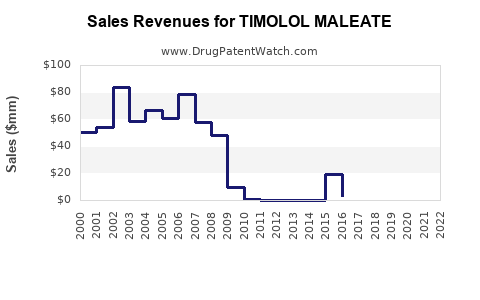
- What are the global sales for TIMOLOL MALEATE?
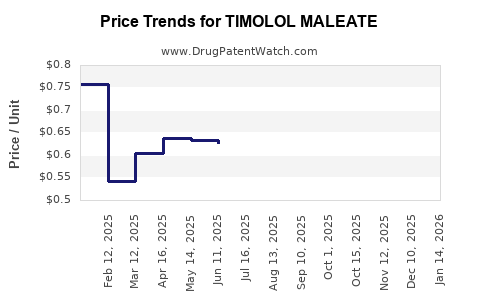
- What is Average Wholesale Price for TIMOLOL MALEATE?
Summary for TIMOLOL MALEATE
| US Patents: | 0 |
| Applicants: | 31 |
| NDAs: | 54 |
| Finished Product Suppliers / Packagers: | 22 |
| Raw Ingredient (Bulk) Api Vendors: | 1 |
| Clinical Trials: | 75 |
| Patent Applications: | 5,143 |
| Drug Prices: | Drug price information for TIMOLOL MALEATE |
| What excipients (inactive ingredients) are in TIMOLOL MALEATE? | TIMOLOL MALEATE excipients list |
| DailyMed Link: | TIMOLOL MALEATE at DailyMed |
Recent Clinical Trials for TIMOLOL MALEATE
Identify potential brand extensions & 505(b)(2) entrants
| Sponsor | Phase |
|---|---|
| SpyGlass Pharma, Inc. | PHASE3 |
| Auson Pharmaceuticals Inc. | PHASE1 |
| SpyGlass Pharma, Inc. | Phase 1/Phase 2 |
Pharmacology for TIMOLOL MALEATE
| Drug Class | beta-Adrenergic Blocker |
| Mechanism of Action | Adrenergic beta-Antagonists |
Anatomical Therapeutic Chemical (ATC) Classes for TIMOLOL MALEATE
Paragraph IV (Patent) Challenges for TIMOLOL MALEATE
| Tradename | Dosage | Ingredient | Strength | NDA | ANDAs Submitted | Submissiondate |
|---|---|---|---|---|---|---|
| ISTALOL | Ophthalmic Solution | timolol maleate | 0.5% | 021516 | 1 | 2012-10-19 |
US Patents and Regulatory Information for TIMOLOL MALEATE
| Applicant | Tradename | Generic Name | Dosage | NDA | Approval Date | TE | Type | RLD | RS | Patent No. | Patent Expiration | Product | Substance | Delist Req. | Exclusivity Expiration |
|---|---|---|---|---|---|---|---|---|---|---|---|---|---|---|---|
| Sandoz | TIMOLOL MALEATE | timolol maleate | SOLUTION/DROPS;OPHTHALMIC | 074261-001 | Apr 28, 1995 | AT1 | RX | No | Yes | ⤷ Start Trial | ⤷ Start Trial | ⤷ Start Trial | |||
| J Molner | TIMOLOL MALEATE | timolol maleate | SOLUTION/DROPS;OPHTHALMIC | 212592-002 | Dec 13, 2021 | AT3 | RX | No | No | ⤷ Start Trial | ⤷ Start Trial | ⤷ Start Trial | |||
| Ani Pharms | TIMOLOL MALEATE | timolol maleate | TABLET;ORAL | 072919-001 | Jul 31, 1991 | DISCN | No | No | ⤷ Start Trial | ⤷ Start Trial | ⤷ Start Trial | ||||
| Rising | TIMOLOL MALEATE | timolol maleate | TABLET;ORAL | 207556-002 | May 2, 2019 | AB | RX | No | No | ⤷ Start Trial | ⤷ Start Trial | ⤷ Start Trial | |||
| Somerset | TIMOLOL MALEATE | timolol maleate | SOLUTION/DROPS;OPHTHALMIC | 217764-001 | Jul 3, 2024 | AT1 | RX | No | No | ⤷ Start Trial | ⤷ Start Trial | ⤷ Start Trial | |||
| Chartwell Rx | TIMOLOL MALEATE | timolol maleate | TABLET;ORAL | 072550-001 | Apr 13, 1989 | DISCN | No | No | ⤷ Start Trial | ⤷ Start Trial | ⤷ Start Trial | ||||
| Mylan | TIMOLOL MALEATE | timolol maleate | TABLET;ORAL | 072668-001 | Jun 8, 1990 | DISCN | No | No | ⤷ Start Trial | ⤷ Start Trial | ⤷ Start Trial | ||||
| >Applicant | >Tradename | >Generic Name | >Dosage | >NDA | >Approval Date | >TE | >Type | >RLD | >RS | >Patent No. | >Patent Expiration | >Product | >Substance | >Delist Req. | >Exclusivity Expiration |
International Patents for TIMOLOL MALEATE
See the table below for patents covering TIMOLOL MALEATE around the world.
| Country | Patent Number | Title | Estimated Expiration |
|---|---|---|---|
| Argentina | 016460 | COMPOSICION OFTALMICA PARA SER ADMINISTRADA COMO UN LIQUIDO QUE SE GELIFICA LUEGO DE LA INSTILACION EN EL OJO | ⤷ Start Trial |
| Austria | 245451 | ⤷ Start Trial | |
| Australia | 3194799 | ⤷ Start Trial | |
| Australia | 740586 | ⤷ Start Trial | |
| Brazil | 9910113 | ⤷ Start Trial | |
| Canada | 2322579 | COMPOSITIONS OPHTALMIQUES GELIFIANTES, CONTENANT DE LA GOMME DE XANTHANNE (GELLING OPHTHALMIC COMPOSITIONS CONTAINING XANTHAN GUM) | ⤷ Start Trial |
| China | 1133466 | ⤷ Start Trial | |
| >Country | >Patent Number | >Title | >Estimated Expiration |
Supplementary Protection Certificates for TIMOLOL MALEATE
| Patent Number | Supplementary Protection Certificate | SPC Country | SPC Expiration | SPC Description |
|---|---|---|---|---|
| 0227494 | 95C0013 | Belgium | ⤷ Start Trial | PRODUCT NAME: TIMOLOLI MALEAS EQ. TIMOLOLUM; NATIONAL REGISTRATION/DATE: 922 IS 166 F 13 19950627; FIRST REGISTRATION: SE 11901 19930910 |
| 0509752 | C990041 | Netherlands | ⤷ Start Trial | PRODUCT NAME: DORZOLAMIDE, DESGEWENST IN DE VORM VAN EEN OFTALMOLOGISCH AAN- VAARDBAAR ZOUT, EN TIMOLOL, DESGEWENST IN DE VORM VAN EEN OFTAL -MOLOGISCH AANVAARDBAAR ZOUT, IN HET BIJZONDER DORZOLLAMIDEHY- DROCHLORIDE EN TIMOLOLMALEAAT, EEN EN ANDER ZODANIG DAT 0,05; NATL REGISTRATION NO/DATE: VG 22871 19980805; FIRST REGISTRATION: DK 19045 19980306 |
| 0509752 | SPC/GB99/043 | United Kingdom | ⤷ Start Trial | PRODUCT NAME: DORZOLAMIDE OR AN OPHTHALMOLOGICALLY ACCEPTABLE SALT THEREOF, PREFERABLY DORZOLAMIDE HYDROCHOLORIDE, PLUS TIMOLOL OR AN OPHTHAMOLOGICALLY ACCEPTABLE SALT THEREOF, PREFERABLY TIMOLOL MALEATE; REGISTERED: DK 19045 19980306; UK PL 00025/0373 19980804 |
| 0509752 | 2000C/001 | Belgium | ⤷ Start Trial | PRODUCT NAME: DORZOLAMIDI HYDROCHLORIDUM EQ. DORZOLAMIDUM, TIMOLOLI MALEAS EQ. TIMOLOLUM; NAT. REGISTRATION NO/DATE: 922 IS 180 F 13 19981110; FIRST REGISTRATION: DK 19045 19980306 |
| 0509752 | 49/1999 | Austria | ⤷ Start Trial | PRODUCT NAME: DORZOLAMID ODER EIN OPHTHALMOLOGISCH ANNEHMBARES SALZ DAVON, VORZUGSWEISE DORZOLAMIDHYDROCHLORID, UND TIMOLOL ODER EIN OPHTHALMOLOGISCH ANNEHMBARES SALZ DAVON, VORZUGSWEISE TIMOLOLMALEAT; NAT. REGISTRATION NO/DATE: 1-22701, 1-22702 19980828; FIRST REGISTRATION: DK 9794 19980306 |
| >Patent Number | >Supplementary Protection Certificate | >SPC Country | >SPC Expiration | >SPC Description |
More… ↓
Make Better Decisions: Try a trial or see plans & pricing
Drugs may be covered by multiple patents or regulatory protections. All trademarks and applicant names are the property of their respective owners or licensors. Although great care is taken in the proper and correct provision of this service, thinkBiotech LLC does not accept any responsibility for possible consequences of errors or omissions in the provided data. The data presented herein is for information purposes only. There is no warranty that the data contained herein is error free. We do not provide individual investment advice. This service is not registered with any financial regulatory agency. The information we publish is educational only and based on our opinions plus our models. By using DrugPatentWatch you acknowledge that we do not provide personalized recommendations or advice. thinkBiotech performs no independent verification of facts as provided by public sources nor are attempts made to provide legal or investing advice. Any reliance on data provided herein is done solely at the discretion of the user. Users of this service are advised to seek professional advice and independent confirmation before considering acting on any of the provided information. thinkBiotech LLC reserves the right to amend, extend or withdraw any part or all of the offered service without notice.
ISSN: 2162-2639

Privacy and Cookies
Terms & Conditions
Site Map
DrugPatentWatch Alternatives
LOE / Major Patent Expirations 2026 - 2027
NCE-1 Patent Challenge Dates 2026 - 2027
Friedman, Yali. "DrugPatentWatch" DrugPatentWatch, thinkBiotech, 2026, www.DrugPatentWatch.com.
See Primary Research Papers Citing DrugPatentWatch