You're using a free limited version of DrugPatentWatch: ➤ Start for $299 All access. No Commitment.

Last Updated: December 31, 2025

Clonazepam - Generic Drug Details


✉ Email this page to a colleague

« Back to Dashboard


What are the generic sources for clonazepam and what is the scope of patent protection?

Clonazepam is the generic ingredient in three branded drugs marketed by Alembic, Barr, Ph Health, Sun Pharm Inds Inc, Roche, Accord Hlthcare, Actavis Elizabeth, Aurobindo Pharma Usa, Chartwell Rx, Pharmobedient, Prinston Inc, Rubicon Research, Sandoz, Teva, Watson Labs, and Cheplapharm, and is included in eighteen NDAs. Additional information is available in the individual branded drug profile pages.

There are ten drug master file entries for clonazepam. Thirty-one suppliers are listed for this compound.

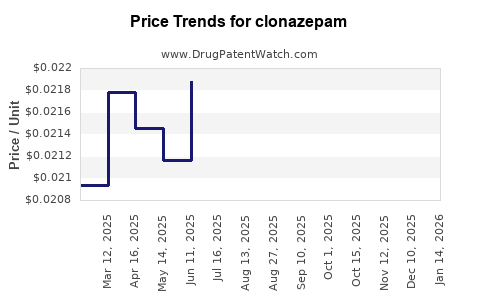
Drug Prices for clonazepam

See drug prices for clonazepam

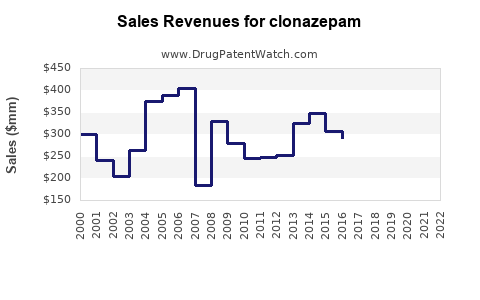
Drug Sales Revenue Trends for clonazepam

See drug sales revenues for clonazepam

Recent Clinical Trials for clonazepam

Identify potential brand extensions & 505(b)(2) entrants

SponsorPhase
Centro de Atencion e Investigacion MedicaPHASE4
Beni-Suef UniversityNA
Oxleas NHS Foundation TrustNA

See all clonazepam clinical trials

Pharmacology for clonazepam
Drug ClassBenzodiazepine
Medical Subject Heading (MeSH) Categories for clonazepam
Anatomical Therapeutic Chemical (ATC) Classes for clonazepam

US Patents and Regulatory Information for clonazepam

Applicant Tradename Generic Name Dosage NDA Approval Date TE Type RLD RS Patent No. Patent Expiration Product Substance Delist Req. Exclusivity Expiration
Roche KLONOPIN RAPIDLY DISINTEGRATING clonazepam TABLET, ORALLY DISINTEGRATING;ORAL 020813-001 Dec 23, 1997 DISCN Yes No ⤷  Get Started Free ⤷  Get Started Free ⤷  Get Started Free
Sun Pharm Inds Inc CLONAZEPAM clonazepam TABLET, ORALLY DISINTEGRATING;ORAL 078654-005 Aug 27, 2014 DISCN No No ⤷  Get Started Free ⤷  Get Started Free ⤷  Get Started Free
Rubicon Research CLONAZEPAM clonazepam TABLET;ORAL 075468-001 Oct 6, 2000 AB RX No No ⤷  Get Started Free ⤷  Get Started Free ⤷  Get Started Free
Sun Pharm Inds Inc CLONAZEPAM clonazepam TABLET, ORALLY DISINTEGRATING;ORAL 078654-004 Aug 27, 2014 DISCN No No ⤷  Get Started Free ⤷  Get Started Free ⤷  Get Started Free
Pharmobedient CLONAZEPAM clonazepam TABLET;ORAL 074940-002 Oct 30, 1997 DISCN No No ⤷  Get Started Free ⤷  Get Started Free ⤷  Get Started Free
Sun Pharm Inds Inc CLONAZEPAM clonazepam TABLET, ORALLY DISINTEGRATING;ORAL 078654-003 Aug 27, 2014 DISCN No No ⤷  Get Started Free ⤷  Get Started Free ⤷  Get Started Free
Actavis Elizabeth CLONAZEPAM clonazepam TABLET;ORAL 074869-002 Oct 31, 1996 AB RX No No ⤷  Get Started Free ⤷  Get Started Free ⤷  Get Started Free
>Applicant >Tradename >Generic Name >Dosage >NDA >Approval Date >TE >Type >RLD >RS >Patent No. >Patent Expiration >Product >Substance >Delist Req. >Exclusivity Expiration

Expired US Patents for clonazepam

Applicant Tradename Generic Name Dosage NDA Approval Date Patent No. Patent Expiration
Roche KLONOPIN RAPIDLY DISINTEGRATING clonazepam TABLET, ORALLY DISINTEGRATING;ORAL 020813-003 Dec 23, 1997 4,371,516 ⤷  Get Started Free
Roche KLONOPIN RAPIDLY DISINTEGRATING clonazepam TABLET, ORALLY DISINTEGRATING;ORAL 020813-004 Dec 23, 1997 4,758,598 ⤷  Get Started Free
Roche KLONOPIN RAPIDLY DISINTEGRATING clonazepam TABLET, ORALLY DISINTEGRATING;ORAL 020813-005 Dec 23, 1997 4,758,598 ⤷  Get Started Free
Roche KLONOPIN RAPIDLY DISINTEGRATING clonazepam TABLET, ORALLY DISINTEGRATING;ORAL 020813-004 Dec 23, 1997 4,305,502 ⤷  Get Started Free
Cheplapharm KLONOPIN clonazepam TABLET;ORAL 017533-003 Approved Prior to Jan 1, 1982 4,316,897 ⤷  Get Started Free
Roche KLONOPIN RAPIDLY DISINTEGRATING clonazepam TABLET, ORALLY DISINTEGRATING;ORAL 020813-001 Dec 23, 1997 4,305,502 ⤷  Get Started Free
Roche KLONOPIN RAPIDLY DISINTEGRATING clonazepam TABLET, ORALLY DISINTEGRATING;ORAL 020813-005 Dec 23, 1997 4,305,502 ⤷  Get Started Free
>Applicant >Tradename >Generic Name >Dosage >NDA >Approval Date >Patent No. >Patent Expiration

Market Dynamics and Financial Trajectory for Clonazepam

Last updated: December 30, 2025

Executive Summary

Clonazepam, a long-established benzodiazepine, remains a critical therapeutic agent primarily for seizure disorders, panic attacks, and certain anxiety conditions. Despite its robust historical presence, the drug’s market landscape is evolving due to regulatory shifts, the emergence of newer therapies, and increasing scrutiny over benzodiazepine use. This analysis explores clonazepam’s current market position, future growth influencers, competitive environment, and revenue trajectory with insights pertinent for investors, pharmaceutical companies, and healthcare strategists.


What Is Clonazepam? An Overview

Attribute Details
Generic Name Clonazepam
Brand Names Klonopin (US), Rivotril (Europe/International)
Therapeutic Class Benzodiazepine anticonvulsant
Approved Uses Epilepsy, panic disorder, Lennox-Gastaut syndrome, acute mania
Pharmacokinetics Oral bioavailability: 90%, half-life: 30-40 hours

Legal Status & Regulatory Approvals
Clonazepam is classified as a Schedule IV controlled substance across multiple jurisdictions due to its abuse potential but remains FDA-approved and available across many markets.


What Are the Market Drivers for Clonazepam?

1. Established Efficacy in Seizure Control

Clonazepam's broad-spectrum anticonvulsant effects secure its steady demand in neurology. Its role in managing Lennox-Gastaut syndrome and absence seizures sustains ongoing prescriptions.

2. Market Penetration in Anxiety and Panic Disorders

Despite alternatives, clonazepam remains a first-line or adjunct therapy due to its efficacy and tolerability profile, especially in treatment-resistant cases.

3. Patent and Manufacturing Status

Having lost patent exclusivity decades ago, clonazepam's generic availability has suppressed prices but expanded access, ensuring consistent demand.

4. Regulatory and Clinical Guidelines

Major guidelines (e.g., American Epilepsy Society, NICE UK) still endorse benzodiazepines like clonazepam for specific indications, supporting market stability.

5. Growing Prevalence of Target Conditions

  • Epilepsy: Affects approximately 50 million globally [1].
  • Anxiety Disorders: Affect 284 million worldwide [2].

Increased diagnosed cases sustain derivative demand.


What Are the Challenges and Limitations?

1. Regulatory and Abuse Concerns

Stringent controls and push towards opioid and non-benzodiazepine therapies limit future prescribing volume.

2. Emergence of Newer Therapeutics

  • Anti-seizure drugs: e.g., levetiracetam, lacosamide.
  • Anxiety treatments: SSRIs and SNRIs.

These alternatives diminish reliance on benzodiazepines.

3. Adverse Effect Profiles

Risks of dependence, withdrawal, cognitive impairment, and respiratory depression influence prescribing hesitance and usage decline.

4. Market Saturation

With generic dominance and plateauing prescription rates, revenue growth prospects are constrained.


How Has Clonazepam’s Market Performance Evolved?

Year Estimated Global Sales (USD millions) Notes
2018 $250 Stable, driven largely by North American markets
2019 $240 Slight decline, increased regulatory scrutiny
2020 $220 Pandemic-related disruptions
2021 $215 Continued downward trend
2022 $210 Market stabilization at lower levels

Source: IQVIA, 2023 data

Market Segmentation Analysis

Region Estimated Market Share (%) Key Trends
North America 45 Leading due to high epilepsy prevalence and prescribing rates
Europe 30 Moderate, with some restrictions on benzodiazepine use
Asia-Pacific 15 Growing demand with expanding epilepsy diagnosis
Rest of World 10 Limited due to regulatory hurdles

What Is the Financial Trajectory of Clonazepam?

Revenue Projections (Next 5 Years)

Year Projected Global Sales (USD millions) Commentary
2023 $200 Ongoing decline, market normalization
2024 $190 Market pressures persist
2025 $180 Slowdown due to new therapies
2026 $170 Slight recovery anticipated in emerging markets
2027 $165 Stabilization at lower levels

Influencing Factors

  • Regulatory restrictions: Increased monitoring may lower prescription volumes.
  • Emerging therapies: The shift towards non-benzodiazepine agents limits growth.
  • Generic competition: Price erosion constrains profit margins.
  • Market expansion: Potential growth in developing countries due to rising epilepsy awareness.

How Does the Competitive Landscape Look?

Players Focus Areas Market Share Approximate (%) Competitive Strategies
Mylan Generic clonazepam 35 Price competition, expanding distribution
Teva Generics, branded formulations 30 Cost leadership, global reach
Sandoz Generics 15 Cost reduction, regional expansion
Others Biosimilars, niche markets 20 Specialization, niche marketing

Biosimilar and Generic Trends

In numerous markets, generic clonazepam dominates with over 90% of sales, pressuring branded formulations and impacting profitability.


What Are the Key Policy and Regulatory Trends?

Trend Impact Source
Stricter prescribing guidelines Reduced prescriptions FDA, EMA statements
Enhanced control measures Supply chain regulation WHO policies [3]
Promoting alternative therapies Shift from benzodiazepines NICE guidelines, 2022 [4]
Reclassification in some markets Prescribing limitations National agencies' updates

What Are the Outlooks and Strategic Considerations?

  • Diversification: Pharmaceutical firms diversifying portfolios to include newer anti-epileptics or anxiolytics.
  • Regulatory engagement: Proactive measures to align with evolving policies, ensuring access.
  • Market penetration: Emerging markets pose growth opportunities, especially where epilepsy awareness increases.
  • Research & Development: Potential for reformulations reducing dependence on benzodiazepine-related side effects.

Comparative Analysis: Clonazepam Vs. Alternatives

Parameter Clonazepam Levetiracetam Lorazepam Diazepam
Indications Epilepsy, anxiety Epilepsy Seizures, anxiety Seizures, alcohol withdrawal
Half-life 30-40 hrs 6-8 hrs 10-20 hrs 20-70 hrs
Abuse potential High Low High High
Side Effects Sedation, dependence Well tolerated Sedation, dependence Sedation, dependence
Cost Moderate Higher Moderate Low

FAQs

1. What is the primary market for clonazepam today?

North America remains the leading market, driven by high prescription rates for epilepsy and anxiety disorders, although growth has plateaued over recent years.

2. Are there any upcoming regulatory changes affecting clonazepam?

Yes. Several countries are tightening benzodiazepine prescribing policies to curb misuse, potentially reducing future prescriptions and market size.

3. What are the key challenges in maintaining clonazepam’s market share?

Competition from newer, seizure-specific agents, safety concerns, regulatory restrictions, and shifting clinical guidelines are primary challenges.

4. Could generic pricing adjustments impact clonazepam’s profitability?

Absolutely. Price erosion due to widespread generic proliferation reduces margins, impacting manufacturers directly.

5. Is there potential for reformulating clonazepam to address safety concerns?

While technically feasible, reformulations would require significant R&D investments and regulatory approvals, with uncertain market benefits given evolving therapeutic preferences.


Key Takeaways

  • Clonazepam’s enduring efficacy sustains a stable but declining market trajectory driven by its role in epilepsy and anxiety treatments.
  • Market growth prospects are limited by regulatory restrictions, safety concerns, and competition from newer agents.
  • The next five years forecast a continued gradual decline in global sales, with emerging markets offering some growth potential.
  • Strategic focus should involve diversification, compliance with evolving policies, and exploring niche applications.
  • Industry participants must monitor regulatory trajectories and therapeutic innovations to adapt swiftly.

References

  1. World Health Organization. Epilepsy Fact Sheet. 2022.
  2. World Health Organization. Mental Health: New Hope for Anxiety Disorders. 2021.
  3. WHO. Guidelines for Controlled Substance Management. 2020.
  4. NICE. Anxiety Disorders: Pharmacological Management. 2022.

Note: This comprehensive analysis leverages publicly available data, industry reports, and regulatory documents as of early 2023 to project trends and inform strategic decisions.

More… ↓

⤷  Get Started Free

Make Better Decisions: Try a trial or see plans & pricing

Drugs may be covered by multiple patents or regulatory protections. All trademarks and applicant names are the property of their respective owners or licensors. Although great care is taken in the proper and correct provision of this service, thinkBiotech LLC does not accept any responsibility for possible consequences of errors or omissions in the provided data. The data presented herein is for information purposes only. There is no warranty that the data contained herein is error free. We do not provide individual investment advice. This service is not registered with any financial regulatory agency. The information we publish is educational only and based on our opinions plus our models. By using DrugPatentWatch you acknowledge that we do not provide personalized recommendations or advice. thinkBiotech performs no independent verification of facts as provided by public sources nor are attempts made to provide legal or investing advice. Any reliance on data provided herein is done solely at the discretion of the user. Users of this service are advised to seek professional advice and independent confirmation before considering acting on any of the provided information. thinkBiotech LLC reserves the right to amend, extend or withdraw any part or all of the offered service without notice.