Last updated: July 24, 2026
Clonazepam Market Dynamics and Financial Trajectory (Pricing, Volumes, Exclusivity, and Generic Risk)
Clonazepam is an established, off-patent benzodiazepine with long-term generic penetration in the US and multiple other markets. The financial trajectory is driven primarily by low-cost generic pricing, inventory cycle management by wholesalers and PBMs, and ongoing substitution for older solid oral dosage strengths where competitors maintain supply. From a patent-and-regulatory standpoint, there is no meaningful near-term “newness” upside; value is controlled by generic market structure, formulation/device-level differences, and access/contracting economics rather than brand exclusivity.
Why does clonzapam have weak pricing power and how do market dynamics work for generics?
Clonazepam’s market behaves like a mature generic CNS product. Market dynamics are shaped by (1) geographic generic density, (2) pharmacy benefit manager (PBM) tiering and rebates, (3) wholesaler buying patterns and supply continuity, and (4) periodic manufacturing or raw-material constraints that can temporarily lift net pricing even in otherwise competitive markets.
What drives demand for clonzapam tablets and how sticky is patient use?
Clonazepam demand tends to be stable at the population level because it is used chronically for approved indications such as seizure disorders and certain anxiety-spectrum conditions depending on label specifics by jurisdiction. Switching costs are lower than for many specialty drugs since clinicians can substitute within therapeutic class, but adherence and tolerance dynamics support continuation once patients are stabilized.
Key demand characteristics:
- Fixed-cost medical management, repeat fills, and long treatment horizons.
- High sensitivity to formulary placement and copay design.
- Lower elasticity to drug price changes than short-course therapies, but still constrained by PBM contracting.
How do PBM formularies and substitution impact net revenue?
In mature generics, gross-to-net pressure is typically driven by:
- Competitive rebate bids tied to tier placement.
- Pharmacy substitution and automatic generic switching rules.
- Contracting that favors suppliers with consistent availability and low total cost.
Net revenue outcomes are usually dominated by the supplier that wins PBM contracts in the relevant geography and strength (tablet strength and dosage form).
What supply constraints can temporarily move pricing?
Short-lived pricing rebounds often correlate with:
- Manufacturing line downtime.
- API availability disruptions.
- Regulatory actions at specific sites.
- Production scale changes or batch failures that reduce shipments.
These shocks usually do not create sustained premium unless shortages persist across multiple MAHs.
How big is the clonzapam revenue opportunity today and what are the main revenue “levers”?
For mature off-patent molecules, the revenue path depends on unit volume plus net price and the share of contracted distribution. The levers are:
- Strength-level volume mix (e.g., how much is 0.5 mg vs 1 mg vs 2 mg).
- Formulation mix (immediate-release tablets vs other oral dosage forms, if present in a given market).
- Channel mix (retail vs mail order vs institutional).
- Contracting and rebate intensity (PBM-driven).
- Availability reliability (stockout risk can reduce fill share even when pricing is low).
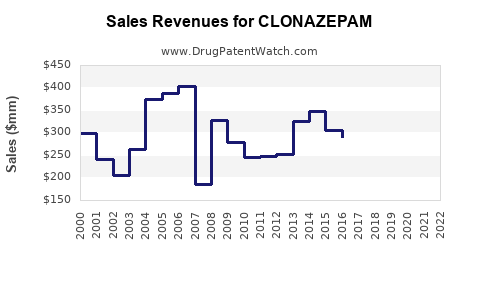
What does “financial trajectory” usually look like for clonzapam across cycles?
Typical pattern for legacy generic molecules:
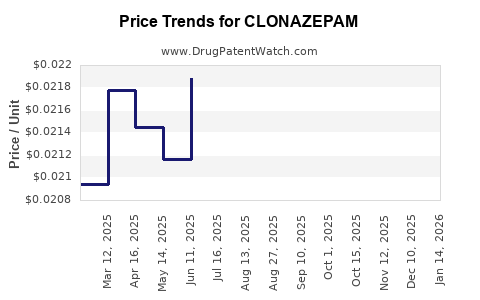
- Long period of stable volumes with falling list prices as new entrants compress net price floors.
- Occasional upticks tied to supply disruptions.
- Mid-cycle share shifts when one manufacturer is constrained or wins large contracts.
Because the drug is not a protected brand in the economic sense, the company-level trajectory is usually a story of market share, execution, and contracting rather than premium valuation.
What patents protect clonzapam and when does exclusivity end?
Clonazepam is an older small-molecule product. The drug’s core active is off the original patent estate in most major markets, which is why generic entry is widespread. Patent protection today, where relevant, typically exists in a narrower set of areas:
- Specific formulation/process patents by particular applicants for particular dosage forms or manufacturing methods.
- Secondary patents related to crystalline forms, polymorphs, or manufacturing refinements, if any remain in force for specific jurisdictions and product-specific filings.
- Potential method-of-use patents are less common for legacy benzodiazepines because broad label use tends to have been established earlier.
What does this mean for new investment or licensing?
For clonzapam, licensing attractiveness usually depends on:
- Whether any enforceable formulation/manufacturing claims exist for a specific product line and jurisdiction.
- Whether the applicant can clear regulatory and market access barriers faster than competitors.
- Whether distribution contracts provide entry or expansion leverage.
In practice, for clonzapam, the value proposition tends to be manufacturing and supply reliability rather than IP-driven pricing.
What is the Orange Book status of clonzapam in the US?
Orange Book visibility for clonazepam typically reflects generic listings across manufacturers and strengths. The “brand” portion is historically limited and the market is dominated by ANDA products.
Featured snippet answer:
- Clonazepam in the US is primarily represented by multiple ANDA/abbreviated approval products on the Orange Book, reflecting a heavily genericized market structure rather than an active brand exclusivity regime.
How to read Orange Book listings for generic value?
For a mature molecule, Orange Book analysis is less about “waiting out exclusivity” and more about:
- Whether any products carry unexpired patents for specific strengths.
- Whether the filing history shows recent patent challenges or settlements.
- Whether any listed patents are formulation/process patents tied to specific applicants.
From a business lens, unexpired patents can influence who can launch a copy product without a carve-out, but for clonzapam the market is usually already saturated, so launch timing effects are secondary to contracting.
What generic entry risks exist for clonzapam (ANDA, 505(b)(2), and litigation)?
Generic entry risk for clonzapam is structurally high in the sense that multiple ANDA filers and multiple suppliers already exist, which keeps pricing competitive. The risk profile shifts from “can a generic get approved” to “can a generic win share while meeting quality and supply requirements.”
Paragraph IV challenges: do they matter for clonzapam?
In mature legacy products, there can be episodic Paragraph IV activity, but clonzapam’s economic landscape is typically characterized by:
- High baseline generic presence.
- Limited room for sustained differentiation.
Even when Paragraph IV litigation occurs, outcomes rarely lead to sustained pricing premiums long enough to offset the generic compression cycle, unless a defendant product is constrained by supply.
What manufacturing/IP barriers can block a new launch?
The primary barriers are usually non-IP:
- Site qualification and quality systems.
- Batch reproducibility.
- Control of impurities and dissolution performance for tablets.
- Supply chain reliability for API and excipients.
If IP barriers exist for certain strengths, they tend to be product-specific and jurisdiction-specific, limiting broad exclusionary impact.
How does clonzapam compare with other benzodiazepines on market stability and financial trajectory?
Clonazepam sits in a class where multiple agents compete for similar indications or clinical niches. Compared with other benzodiazepines, clonzapam typically has:
- Established chronic use patterns.
- High generic availability.
- Less brand-driven premium economics.
Relative dynamics versus peers:
- Diazepam and lorazepam also trade in mature generics with similar PBM and pricing compression, though route and formulation availability can shift share.
- Alprazolam has sometimes shown sharper cycle effects due to contracting and supply, but it also faces generic saturation.
- Extended-release or specialty formulations can create temporary differentiation, but they usually cannot overcome the economics of dense generic competition.
Net result: clonzapam’s financial trajectory is likely to mirror a broad “mature generic CNS” trend more than a “product-specific brand lifecycle” trend.
What patent litigation affects clonzapam, and how do settlements typically influence market share?
For a generic-saturated molecule, litigation effects tend to show up as:
- Timing delays for a specific entrant in a specific strength or jurisdiction.
- Temporary reductions in competitive pressure when a launch is blocked.
- Post-settlement coexistence with carve-outs or at-risk periods.
However, the magnitude is often bounded because alternative suppliers can fill demand. In a saturated category, one blocked entrant rarely meaningfully lifts the entire market; it mostly shifts share across suppliers.
What does FDA regulatory status imply for ongoing manufacturing and supply?
FDA status for clonazepam is defined by:
- ANDA approvals for multiple manufacturers.
- Ongoing current good manufacturing practice (cGMP) requirements.
- Post-approval changes managed via CBE supplements and PAS filings as needed.
Regulatory friction is typically:
- Site-specific (inspection outcomes, warning letters, or consent decrees).
- Product-specific (stability, impurities, dissolution spec changes, or formulation changes).
Those risks determine whether a manufacturer can maintain contracted volumes, which is where net revenue outcomes are usually decided.
Which companies are positioned to win financially in clonzapam generics?
Because the market is mature and highly supply-driven, “winner” positioning usually maps to:
- Manufacturers with stable US supply across multiple strengths.
- Those with scale advantages that lower unit costs.
- Those able to meet PBM contract terms and avoid stockouts.
- Those with robust quality performance and regulatory track record.
Company-level winners in generics generally change over time due to contracting and supply execution, not due to patent exclusivity.
How do financial trajectories differ by geography for clonzapam?
Geographic variation tends to come from:
- Generic entry timing and number of competitors.
- National reimbursement and pricing regulation mechanisms.
- Local supply reliability and import dependence.
- PBM-like structures (or national formulary control).
High-level pattern:
- In highly liberalized pricing markets, net price compression is faster and earlier, leading to lower margins but higher unit volume shares for winners.
- In price-controlled markets, list price may remain higher but volume can be constrained, with margins influenced by reimbursement caps.
What is the outlook for revenue growth in clonzapam over the next 3–5 years?
Revenue growth outlook is generally limited by:
- Persistent generic competition.
- Ongoing substitution and PBM-driven rebate pressure.
- Lack of major exclusivity catalysts.
Potential upside channels:
- Contract wins and share gains due to supply reliability.
- Strength mix improvements (higher-margin strengths depending on local pricing).
- Temporary market dislocations from shortages that create short-term net price elevation.
The structural base case remains flat-to-declining net price with occasional cycle-driven volatility.
Key tables: market levers and risk map for clonzapam
Revenue drivers vs. what management can actually control
| Driver |
Typical direction in mature markets |
What matters operationally |
| Net price |
Down or flat |
Contracting, rebate intensity, competitor pricing |
| Unit volume |
Flat to slightly down |
Formulary placement, availability, allocation management |
| Strength mix |
Volatile |
Product portfolio breadth, local tender outcomes |
| Supply continuity |
The swing factor |
Batch release performance, supply planning, QA stability |
| Litigation impact |
Usually limited |
Strength-specific unexpired patents, launch timing |
Risk map for a clonzapam generic business
| Risk type |
Mechanism |
Financial impact |
| PBM contracting |
rebate pressure |
margin compression |
| Supply interruption |
production shortfalls |
lost fill share and penalties |
| Quality/regulatory |
inspection outcomes or recall |
volume loss, cost spikes |
| Patent entry barriers |
product-specific patents |
delayed launches for certain entrants |
| Generic saturation |
dense supplier base |
long-run price erosion |
Key Takeaways
- Clonazepam’s financial trajectory is governed by mature generic economics: net price compression, PBM tiering, and supply reliability.
- Patent-driven upside is limited at the class level; practical strategy hinges on strength-level execution and contracting.
- Short-term revenue variability is more likely to come from supply constraints and inventory cycles than from exclusivity or new product differentiation.
- Competitive winners are those that maintain consistent availability across strengths and meet the rebate and service terms of formulary channels.
FAQs
- What factors most impact clonzapam net pricing vs list pricing in US retail and mail order channels?
- How do clonzapam tablet strength mix and local formulary tenders change profitability for generic manufacturers?
- Do clonzapam generics face meaningful paragraph IV litigation barriers by strength, or is the market already saturated?
- How do FDA inspection findings typically translate into volume loss for generic benzodiazepines like clonzapam?
- Which competitive forces matter most for clonzapam outside the US, where pricing regulation and reimbursement structures differ?
References (APA)
- FDA. Orange Book: Approved Drug Products with Therapeutic Equivalence Evaluations. (US FDA database). https://www.accessdata.fda.gov/scripts/cder/daf/index.cfm
- FDA. ANDA Resources and Regulatory Guidance. (US FDA). https://www.fda.gov/drugs/abbreviated-new-drug-application-anda