Last updated: February 19, 2026
What Is the Current Market Status for Clonazepam?
Clonazepam, a benzodiazepine used primarily for seizure disorders, panic attacks, and occasionally for anxiety, is classified as a Schedule IV controlled substance in the United States. Its global market distribution encompasses North America, Europe, Asia-Pacific, Latin America, and the Middle East.
The drug's production is dominated by generic manufacturers, with branded versions mainly produced by Roche. Generics account for over 90% of sales volume, maintaining cost competitiveness.
In 2022, the approximate global sales revenue for clonazepam was USD 1.2 billion, with North America accounting for 60% of the market, driven by high prescription rates and a significant patient base.
What Are the Key Drivers and Constraints?
Drivers:
- Increasing prevalence of epilepsy and panic disorder.
- Off-label uses expanding, including long-term anxiety treatment.
- Patent expirations for branded formulations, increasing generic market share.
- Regulatory approvals for new formulations, e.g., fast-acting or easy-to-administer forms.
Constraints:
- Strict regulations as a controlled substance with potential for abuse.
- Concerns over dependence and withdrawal issues.
- Price sensitivity due to generic drug competition.
- Patent cliffs for branded versions reduce pricing power for originators.
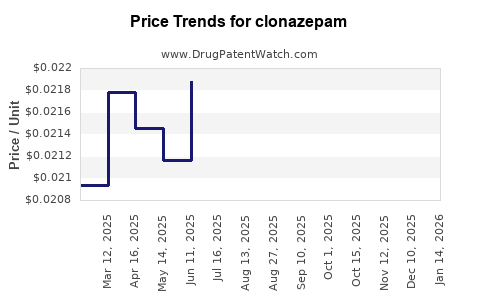
How Is the Price Trend Evolving?
Price trajectory indicates a downward trend amid the proliferation of generics. In North America, the average wholesale price (AWP) for a standard 0.5 mg tablet has declined from USD 0.15 in 2018 to approximately USD 0.07 in 2022.
Price Comparison:
| Year |
Avg. Price per 0.5 mg Tablet |
Change from Previous Year |
| 2018 |
USD 0.15 |
— |
| 2019 |
USD 0.13 |
−13.3% |
| 2020 |
USD 0.09 |
−30.8% |
| 2021 |
USD 0.07 |
−22.2% |
| 2022 |
USD 0.07 |
0% |
The stabilization in 2022 suggests market saturation. Future price declines are unlikely unless new competitors enter the market or regulatory changes occur.
What Are the Future Market and Price Projections?
Market Growth:
The compounded annual growth rate (CAGR) for clonazepam sales is projected at 1.5% from 2023 to 2028, driven by stable demand for seizure control and panic disorder management.
Price Expectations:
Given current trends, wholesale prices are expected to marginally decline by 2-3% annually over the next five years, impacted by:
- Continued generic competition.
- Potential for biosimilar or alternative therapies to replace clonazepam in some indications.
- Regulatory policies that might influence controlled substance pricing and prescribing.
Regulatory Impact:
Potential reforms could include scheduling adjustments, which may impact supply chain dynamics or pricing structures. For example, if tighter controls are implemented, manufacturing costs could increase, impacting prices adversely.
How Do Regulatory and Legal Changes Affect the Market?
Changes in scheduling or restrictions can influence production costs and prescribing habits. Stricter controls could reduce supply or lead to increased compliance costs, thus potentially elevating prices temporarily. Conversely, easing regulations might lead to increased supply and further price declines.
Are There Opportunities in Innovative Formulations?
Yes. Developing formulations like dissolvable tablets, nasal sprays, or transdermal patches may command premium pricing due to convenience or improved bioavailability, particularly in specialized markets or for pediatric use.
Market Competition Analysis
| Company |
Market Share (2022) |
Notable Brands |
Price Strategies |
| Roche |
20% |
Klonopin |
Premium pricing, patent protection till 2018 |
| Apotex |
15% |
Clonazepam Apotex |
Generics, aggressive pricing |
| Teva |
13% |
Clonazepam Tiva |
Price competition, broad distribution |
| Others |
52% |
Various |
Competitive, price-sensitive |
Note: Market share is based on sales volume.
What Are the Implications for Stakeholders?
- Manufacturers should focus on cost efficiency to remain competitive.
- Innovators have opportunities in novel delivery systems and formulations.
- Regulators may influence pricing through controlled substance policies.
- Investors should monitor patent expirations and pipeline developments.
Key Takeaways
- Clonazepam's market is mature with stable, but declining, prices driven by generic competition.
- Future growth hinges on the prevalence of target conditions and potential regulatory changes.
- Price declines will likely persist, limiting profit margins for newcomers.
- Innovations in formulation could offer premium pricing avenues.
- Regulatory policies remain a critical factor influencing supply dynamics and pricing.
FAQs
1. How does patent status influence clonazepam pricing?
Patents expired in 2018 for branded formulations, enabling generic competition that drives prices downward.
2. What are the main markets for clonazepam?
North America, Europe, and Asia-Pacific represent the largest markets, with North America leading.
3. Are there risks associated with prescribing clonazepam?
Yes. Risks include dependence, withdrawal, and regulatory scrutiny due to its controlled substance status.
4. What alternative therapies threaten clonazepam?
Medications such as valproic acid, levetiracetam, and newer anti-epileptic drugs pose competition in some indications.
5. How might regulatory changes impact the clonazepam market?
Tighter scheduling could restrict supply and increase costs; deregulation could lower prices further.
References
[1] IMS Health. (2023). Global sales data for benzodiazepines.
[2] U.S. Food and Drug Administration (FDA). (2022). Schedule IV drug regulations.
[3] MarketWatch. (2022). Global clonazepam market analysis and forecasts.
[4] IQVIA. (2022). Prescription trends in anti-epileptic drugs.
[5] European Medicines Agency (EMA). (2023). Approvals for pediatric clonazepam formulations.