Last updated: November 9, 2026
Nitroglycerin is a mature, multi-route cardiovascular drug with limited patent protection and low commercial differentiation. Demand is tied to chronic angina, acute coronary syndromes, perioperative blood-pressure management, and hospital use. Revenue is fragmented across sublingual tablets, lingual sprays, transdermal systems, ointments, and intravenous products. Generic competition controls most volume, while branded products retain selective pricing power through delivery convenience, supply reliability, and hospital contracting.
What is the current nitroglycerin market structure?
Nitroglycerin, also called glyceryl trinitrate, is sold in several dosage forms:
| Product category |
Primary use |
Commercial position |
| Sublingual tablets |
Rapid relief and prevention of angina |
Mature generic market |
| Lingual spray |
Rapid angina treatment |
Branded and generic competition |
| Transdermal patches |
Prophylaxis for chronic angina |
Generic and legacy branded products |
| Topical ointment |
Angina and selected hospital indications |
Small, specialized market |
| Intravenous injection |
Acute coronary syndromes, heart failure, perioperative hypertension |
Hospital and institutional market |
| Buccal and other systems |
Less common angina applications |
Limited commercial relevance |
The leading commercial demand driver is immediate-release sublingual treatment for episodic angina. Hospitals create a second demand pool through intravenous nitroglycerin. Transdermal products have a smaller role because tolerance develops with continuous exposure and because alternative antianginal therapies are widely available.
Nitroglycerin competes with beta blockers, calcium-channel blockers, long-acting nitrates, ranolazine, antiplatelet therapies, and revascularization procedures. For acute coronary syndromes, the drug is an adjunctive treatment rather than a disease-modifying therapy.
How large is the nitroglycerin market?
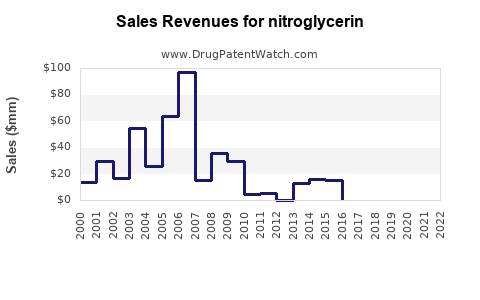
Public financial disclosures generally do not report nitroglycerin revenue as a separate line item. Manufacturers group products within broader hospital pharmaceuticals, cardiovascular generics, or branded prescription portfolios. Market-research estimates vary substantially because they differ in:
- Inclusion of hospital injectable products
- Treatment of combination products
- Geographic coverage
- Inclusion of over-the-counter or non-U.S. products
- Wholesale versus manufacturer revenue
- Whether nitroglycerin patches and ointments are included
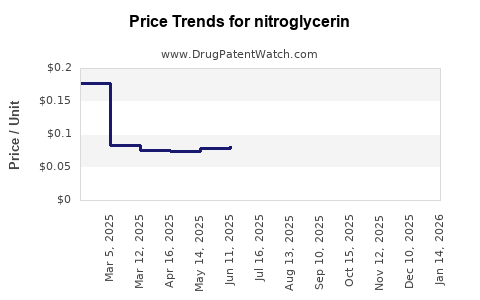
The commercial market is best characterized as a low-growth, mature generic market rather than a high-value specialty-drug segment. Unit demand is relatively stable, but revenue can move sharply when a manufacturer exits, a shortage develops, or a supplier raises prices.
What drives nitroglycerin demand?
Demand is linked to:
- The prevalence of coronary artery disease and chronic angina.
- Emergency-department and inpatient treatment of acute ischemic syndromes.
- Surgical and intensive-care use of intravenous products.
- Product availability, especially for sublingual tablets and injectable presentations.
- Changes in cardiovascular treatment guidelines and revascularization rates.
Long-term use has shifted toward preventive cardiovascular treatment, including statins, antiplatelet drugs, beta blockers, and revascularization. That limits volume growth for chronic nitroglycerin products. Acute-care demand remains more stable because hospitals continue to maintain nitrate products for defined clinical situations.
What are the main nitroglycerin products and manufacturers?
The United States market includes legacy branded products and multiple generic suppliers.
| Product or product type |
Known commercial positioning |
Regulatory status |
| Nitrostat sublingual tablets |
Legacy branded sublingual nitroglycerin |
FDA-approved NDA product |
| Nitro-Dur patches |
Legacy branded transdermal system |
FDA-approved NDA product, with generic competition |
| Nitrolingual Pumpspray |
Metered lingual spray |
FDA-approved prescription product |
| Generic sublingual tablets |
Multiple strengths and suppliers |
ANDA-driven generic market |
| Generic transdermal patches |
Multiple suppliers over time |
ANDA-driven market |
| Nitroglycerin injection |
Hospital and institutional use |
NDA and ANDA products |
Historical and current suppliers have included Pfizer-related branded portfolios, Viatris or legacy Mylan operations, Hikma Pharmaceuticals, Fresenius Kabi, Sagent Pharmaceuticals, and other generic manufacturers. Supplier participation changes because of manufacturing economics, product discontinuations, quality events, and hospital purchasing contracts.
The branded name Nitrostat has historically had the strongest recognition in sublingual tablets. That brand position does not create the same degree of pricing power found in newer cardiovascular therapies because pharmacists and hospitals can substitute generic products.
What is the FDA regulatory status of nitroglycerin?
Nitroglycerin has long-established FDA approval across several dosage forms. Key regulatory pathways include:
- New Drug Applications for original branded products.
- Abbreviated New Drug Applications for generic tablets, sprays, patches, ointments, and injections.
- Hospital purchasing through direct contracts, group purchasing organizations, and distributor channels.
- Product-specific labeling requirements for potency, stability, container closure, storage, and dose delivery.
Nitroglycerin is sensitive to light, heat, adsorption, evaporation, and container-material interactions. FDA-approved labeling therefore contains handling and storage requirements that differ by dosage form. Sublingual tablets require packaging that limits exposure to environmental conditions. Spray systems require validated metering performance. Injectable products require strict controls over concentration, compatibility, and administration equipment.
What is the Orange Book status of nitroglycerin?
The core nitroglycerin molecule has no meaningful remaining composition-of-matter exclusivity. It has been used medically for more than a century, and the basic active ingredient is outside any commercially relevant patent term.
Current Orange Book relevance is primarily product-specific:
- Legacy branded products may have listed patents or exclusivity histories, but those protections do not create a broad barrier to generic nitroglycerin.
- Generic entrants rely on ANDA approvals and, where applicable, paragraph IV certifications against listed patents.
- Older formulation or delivery patents may have expired or become commercially irrelevant.
- Regulatory exclusivity for legacy nitroglycerin products has expired.
FDA Orange Book records should be reviewed at the individual product level because listing status differs between Nitrostat, Nitro-Dur, Nitrolingual Pumpspray, and injectable formulations. The absence of broad active protection around nitroglycerin means that market access depends more on bioequivalence, manufacturing capability, supply continuity, and contracting than on patent exclusivity (FDA, 2024a).
When does nitroglycerin lose exclusivity?
Nitroglycerin lost meaningful molecule-level exclusivity long ago. There is no single modern loss-of-exclusivity date because the market developed through different products, dosage forms, and regulatory filings.
| Exclusivity type |
Current commercial position |
| Active ingredient patent |
Expired |
| Original branded product exclusivity |
Expired |
| Sublingual tablet protection |
Generic competition established |
| Transdermal patch protection |
Generic competition established |
| Injectable product protection |
Generic competition established |
| Delivery-system patents |
Generally expired or narrow |
| Pediatric exclusivity |
Not commercially relevant to the core market |
The practical loss of exclusivity occurred when generic versions of each dosage form entered the market. Generic competition is therefore route-specific rather than dependent on one single patent expiration event.
Are there paragraph IV challenges to nitroglycerin products?
Paragraph IV litigation is not a major current commercial issue for the core nitroglycerin market. The active ingredient is old, and the principal dosage forms have long faced generic competition.
A paragraph IV filing could still arise for a newly approved spray, patch, formulation, or device combination if a sponsor lists a later-expiring patent. Such a challenge would concern the delivery system or formulation rather than the nitroglycerin molecule. The relevant risk would depend on:
- Whether the patent is listed in the Orange Book.
- Whether the ANDA applicant makes a paragraph IV certification.
- Whether the patent owner brings suit within 45 days.
- Whether the court grants a 30-month stay.
- Whether the patent covers the entire product or only a narrow device feature.
No broad, market-blocking paragraph IV barrier defines the current nitroglycerin market.
What patents protect nitroglycerin products?
The strongest historical protection related to nitroglycerin has been associated with formulation, delivery, packaging, and controlled-release technology rather than the active ingredient.
Potentially relevant patent categories include:
- Transdermal delivery systems
- Controlled-release adhesive matrices
- Metered-dose lingual sprays
- Moisture-resistant tablet packaging
- Stabilized injectable formulations
- Container-closure systems
- Manufacturing processes for dosage-form uniformity
Most economically important early patents in these categories have expired. A later patent could still protect a specific patch architecture, spray actuator, excipient system, or manufacturing process, but such protection would normally be narrow. It would not prevent sale of all nitroglycerin dosage forms.
Patent strength is therefore low for the molecule and moderate at most for a differentiated delivery system. The strongest defensible position would arise from a combination of patent protection, FDA approval, device reliability, clinical familiarity, and supply contracts.
What formulations are protected by nitroglycerin patents?
Formulation protection is most relevant to products that solve technical problems created by nitroglycerin’s volatility and chemical sensitivity.
Sublingual tablets
Potential protection can involve tablet disintegration, dose uniformity, stability, and packaging. Generic competition is established, and substitutability limits the value of narrow formulation claims.
Transdermal patches
Patch patents may cover adhesive composition, membrane structure, drug loading, release rates, and skin delivery. The commercial importance of such patents has declined as legacy patch protections expired and multiple generic systems entered the market.
Lingual sprays
Spray products can have device-related protection involving dose metering, actuator design, droplet characteristics, and container compatibility. Device reliability can create commercial differentiation even when patent protection is weak.
Intravenous formulations
Hospital injections require concentration control, container compatibility, stability, sterility, and administration instructions. These requirements create manufacturing and regulatory barriers, but they are not equivalent to strong patent exclusivity.
What manufacturing and intellectual-property barriers affect nitroglycerin?
Manufacturing barriers are more important than molecule-level intellectual property.
Nitroglycerin manufacturers must control:
- Explosive and hazardous-material handling
- Low-dose content uniformity
- Stability under light and heat exposure
- Adsorption to tubing and containers
- Sterility for injectable products
- Device metering accuracy for sprays
- Packaging integrity for tablets and patches
- Validated cleaning and containment procedures
These requirements raise the cost of entry relative to a conventional tablet. They also make supply disruptions more likely when a small number of qualified facilities serve the market.
The hospital injectable segment has the highest operational barrier. A manufacturer must satisfy sterile manufacturing requirements, maintain reliable supply, and meet hospital contracting expectations. The sublingual tablet segment has lower technical complexity but greater price competition.
What patent litigation affects nitroglycerin?
Nitroglycerin has no widely recognized current patent dispute that controls the overall U.S. market. Litigation risk is more likely to arise from:
- Product liability
- Manufacturing defects
- Shortage-related commercial disputes
- ANDA challenges involving a later-generation delivery system
- Contract disputes between manufacturers and distributors
The absence of major current patent litigation reflects the maturity of the active ingredient and the long history of generic substitution. Any litigation involving a specific product should be analyzed separately from the broader nitroglycerin market.
Which companies are challenging nitroglycerin market leaders?
Competition is primarily supplier-based rather than patent-based. Generic manufacturers compete through:
- Wholesale acquisition price
- Guaranteed supply
- FDA inspection history
- Manufacturing capacity
- Product breadth across dosage forms
- Group purchasing organization contracts
- Ability to respond to shortages
Hospital products are particularly sensitive to supplier concentration. A company with a small market share can gain temporary pricing power if competitors experience quality problems or production interruptions. That advantage usually declines after alternate suppliers return.
How does nitroglycerin compare with competing antianginal drugs?
| Drug class |
Main advantage |
Limitation versus nitroglycerin |
| Nitroglycerin |
Rapid symptom relief and flexible routes |
Short duration and tolerance |
| Isosorbide mononitrate |
Longer prophylactic effect |
Not designed for immediate rescue |
| Isosorbide dinitrate |
Oral and sublingual options |
More complex dosing |
| Beta blockers |
Useful for chronic ischemic control |
Not appropriate for every patient |
| Calcium-channel blockers |
Alternative antianginal mechanism |
Hemodynamic and drug-specific limitations |
| Ranolazine |
Less effect on heart rate and blood pressure |
Higher cost and narrower positioning |
| Revascularization |
Treats anatomic coronary disease |
Procedural risk and cost |
Nitroglycerin remains difficult to replace in rapid-relief applications. It is easier to replace in chronic prophylaxis, where long-acting nitrates and non-nitrate therapies compete directly.
What is the financial trajectory for nitroglycerin?
The base-case financial trajectory is stable to declining in real terms, with episodic price increases caused by shortages.
Revenue outlook
- Volume: broadly stable, with gradual shifts between dosage forms.
- Price: low for generic tablets; more variable for hospital injections and branded sprays.
- Gross margin: compressed in common generic presentations.
- Growth: limited without a differentiated delivery system.
- Cash-flow risk: driven by manufacturing interruptions, regulatory remediation, and low-volume product economics.
- Commercial upside: concentrated in supply-constrained injectables and convenient spray systems.
Branded revenue is vulnerable to generic substitution. Generic manufacturers can earn attractive temporary margins during shortages, but durable pricing power is difficult to sustain because buyers actively seek alternate sources.
Revenue exposure by business type
| Business model |
Nitroglycerin exposure |
| Large diversified pharmaceutical company |
Usually immaterial to total revenue |
| Generic manufacturer |
Small product-line contribution, with possible shortage-driven spikes |
| Hospital injectable supplier |
More meaningful if the company has limited competitors |
| Specialty-device company |
Potentially meaningful for proprietary spray or patch systems |
| Contract manufacturer |
Dependent on capacity and regulatory compliance |
Nitroglycerin is unlikely to materially affect the valuation of a diversified pharmaceutical company unless it is part of a concentrated hospital portfolio or is involved in a shortage-sensitive product line.
What generic launch scenarios exist for nitroglycerin?
Immediate substitution
A new ANDA-approved sublingual tablet can enter a market with established generic substitution. Commercial success depends on pharmacy contracts, pricing, and reliable supply.
Shortage-driven launch
A supplier can gain rapid share when an incumbent experiences manufacturing problems or discontinues a product. This scenario offers the strongest near-term revenue opportunity but may attract competing entrants.
Differentiated delivery launch
A new spray, patch, or device may command better pricing if it improves dose consistency, portability, adherence, or storage stability. The sponsor would need to support the product with clinical, device, regulatory, and commercial evidence.
Hospital-contract launch
An injectable manufacturer can win share through group purchasing organization agreements and supply guarantees. FDA compliance and manufacturing continuity are decisive.
What is the geographic coverage of nitroglycerin patents and products?
Nitroglycerin products are marketed globally, but patent protection is largely historical. Geographic commercial differences arise from:
- National registration requirements
- Local manufacturing capacity
- Hospital procurement systems
- Pharmacist substitution rules
- Drug-shortage policies
- Differing treatment guidelines
- Product availability by dosage form
The United States has a highly genericized market with strong distributor and group-purchasing influence. European markets also rely heavily on generic supply, but national reimbursement and procurement rules affect pricing. Emerging markets may have wider variability in product quality, registration status, and access to transdermal or injectable presentations.
Key Takeaways
- Nitroglycerin is a mature cardiovascular drug with no meaningful molecule-level patent barrier.
- The market is fragmented across sublingual tablets, sprays, patches, ointments, and injections.
- Generic competition controls most volume and limits durable pricing power.
- Hospital injectable products have greater manufacturing and shortage risk than standard tablets.
- Formulation and device patents can protect individual products but do not protect the overall nitroglycerin market.
- Paragraph IV litigation is not a central current market issue.
- Financial performance is generally stable to declining, with temporary revenue and margin increases during shortages.
- Commercial upside is concentrated in reliable hospital supply, differentiated delivery systems, and products with limited qualified competition.
- Nitroglycerin is unlikely to produce material revenue growth for diversified pharmaceutical companies without a proprietary delivery or supply advantage.
FAQs
Is nitroglycerin still a profitable pharmaceutical product?
It can be profitable in shortage-sensitive injectable products and differentiated spray systems. Commodity tablets generally have limited margins because of generic competition.
Does nitroglycerin have biosimilar risk?
No. Nitroglycerin is a small-molecule drug, not a biologic. It faces generic-drug competition rather than biosimilar competition.
Can a company obtain a new patent on nitroglycerin?
A company cannot obtain a new patent on the old active ingredient merely by claiming nitroglycerin. It may obtain narrower protection for a novel formulation, device, manufacturing process, or delivery system that satisfies patentability requirements.
Which nitroglycerin dosage form has the strongest commercial position?
Sublingual products have the broadest clinical recognition and demand. Intravenous products can have stronger supplier economics because of sterile manufacturing requirements and fewer qualified suppliers.
Is nitroglycerin subject to FDA drug shortages?
Availability can vary by dosage form and manufacturer. The greatest risk generally occurs in hospital injectable products and low-volume generic presentations, where production interruptions can materially affect supply (FDA, 2024b).
References
-
U.S. Food and Drug Administration. (2024a). Approved drug products with therapeutic equivalence evaluations: Orange Book. FDA.
-
U.S. Food and Drug Administration. (2024b). Drug shortages database. FDA.
-
U.S. Food and Drug Administration. (2024c). Drugs@FDA: FDA-approved drugs. FDA.
-
National Library of Medicine. (2024). DailyMed: Nitroglycerin product labeling. U.S. National Library of Medicine.
-
American College of Cardiology and American Heart Association. (2023). Guideline for the management of patients with chronic coronary disease. ACC/AHA.