Last updated: June 19, 2026
NITRO-DUR (nitroglycerin transdermal system) is a steady, low-to-mid single brand within the US antianginal market, competing against generic nitroglycerin transdermal products and cross-formulation alternatives (oral/sublingual nitrates, beta-blockers, calcium-channel blockers). The financial trajectory is shaped less by high novelty-cycle upside and more by (1) generic erosion risk, (2) payer-driven pricing, and (3) manufacturing and supply reliability of the patch platform.
What is NITRO-DUR and who sells it?
Featured snippet answer: NITRO-DUR is a nitroglycerin transdermal patch used for prevention of angina. Commercial supply and marketing are tied to the current NDA holder and any licensee distributing the product under the same brand label.
Product positioning
- Indication: prophylaxis of angina pectoris (chronic stable angina), with dosing schedules that rely on a “nitroglycerin-free interval” to reduce tolerance.
- Dosage form: transdermal system/patch.
- Pharmacologic class: organic nitrate.
- Competitive set: other nitrate formulations plus standard antianginal background therapy.
Market structure
- Nitrates are largely mature.
- Many nitroglycerin transdermal SKUs are available as generics or authorized generics depending on the exact labeled strength and product presentation in the Orange Book.
How large is the nitroglycerin transdermal patch market and what drives demand?
Featured snippet answer: Demand tracks with stable angina prevalence, guideline treatment adoption, and the extent to which clinicians use nitrates as add-on therapy to beta-blockers and calcium-channel blockers.
Key demand drivers
- Patient population: chronic angina, ischemic heart disease.
- Prescribing behavior: nitrates remain common but are often used for symptom prevention rather than core therapy.
- Institutional formularies: payer placement can compress brand margins even when clinical use persists.
- Replacement cycle: patches have repeat use patterns tied to dosing frequency and persistence.
Key demand headwinds
- Generic substitution: payer and pharmacy benefit managers typically favor lowest-cost nitroglycerin patch SKUs.
- Clinical inertia vs switchability: nitrates are easy to switch at the same strength, which accelerates brand price pressure.
- Tolerance management requirements: dosing schedules can affect adherence, which impacts total units more than brand identity.
What patents protect NITRO-DUR and how strong is the patent estate?
Featured snippet answer: For mature transdermal nitroglycerin brands, the practical IP barrier is usually limited to specific formulation, manufacturing method, or controlled-release technology. If those patents have expired or are near expiry, the estate strength is generally low.
Patent estate realities for mature transdermal nitrates
- Core molecule IP typically predates modern brand building.
- Remaining enforceable rights are typically:
- formulation patents (polymer matrix, rate-controlling layers),
- manufacturing process patents (coating/lamination),
- method-of-use patents (tolerance reduction regimens) if any were pursued.
- For a branded patch, litigation and settlements often hinge on narrow, formulation-specific claims rather than broad composition-of-matter.
Implication for financial trajectory
- If the Orange Book shows only expiring or already-expired patents, the brand’s revenue tends to flatten and then decline as generic supply expands and PBM contracts re-rate the drug.
(No patent numbers or Orange Book listings are provided here because they are not included in the input.)
When does NITRO-DUR lose exclusivity and what are the generic launch risks?
Featured snippet answer: Generic launch risk is highest once any listed Orange Book patents tied to the brand are no longer in force or no longer listed for the relevant dosage form and strength.
What determines the timing
- Expiration of the latest listed patent tied to each NDA/strength.
- Any pediatric exclusivity or patent term adjustments affecting listed expiries.
- Orange Book listing status for each marketed strength.
- Whether the brand holds any granted exclusivity that blocks first ANDA approvals (less common for older products).
Paragraph IV and ANDA dynamics
- For mature products, Paragraph IV challenges are common when there is at least one meaningful remaining patent on paper.
- Financial impact is concentrated after:
- FDA approval of an ANDA,
- successful PBM contracting for the generic,
- pharmacy switching and wholesaler uptake.
Commercial outcome pattern
- Brand revenue usually follows:
- price compression before generic launch (contract renegotiations),
- abrupt share losses on launch,
- further margin erosion as multiple competitors enter and discounts widen.
What is the Orange Book status of NITRO-DUR?
Featured snippet answer: Orange Book status determines the immediate competitive threat level: listed patents indicate potential litigation leverage; no listings imply near-immediate generic feasibility for the unprotected presentation.
What to track in the Orange Book
- NDA or application number tied to each NITRO-DUR strength.
- Patent list scope:
- drug substance,
- drug product,
- method of use.
- Expiration dates by patent number and claim scope.
- Any exclusivity codes (rare for older patch brands but must be checked strength-by-strength).
(Orange Book listing content is not included in the input, so exact status and dates are not stated.)
What formulations and strengths exist for NITRO-DUR and how does strength affect competition?
Featured snippet answer: Strength and patch design affect which generics can enter cleanly and how substitution occurs under PBM formularies.
Competition by strength
- Each labeled strength can have separate manufacturing specifications.
- Generics often launch strength-by-strength when manufacturing equivalence is easiest and when patent carve-outs are resolved.
- Higher or lower strength SKUs can show different pricing and switching rates due to:
- prescriber habit,
- stock practices,
- payer coverage rules.
Implication for financial trajectory
- If generic entries land first on the most prescribed strengths, brand revenues can fall quickly even if some minor strengths remain brand-only for longer.
How do payer policies and pricing mechanics impact NITRO-DUR revenue?
Featured snippet answer: In mature transdermal products, payer reimbursement and formulary placement drive financial performance more than incremental clinical differentiation.
Primary levers
- PBM preferred tiers: brand placement often shifts downward after generic launches or in anticipation of them.
- Wholesale acquisition cost discounting: brands can discount to defend share, compressing gross margin.
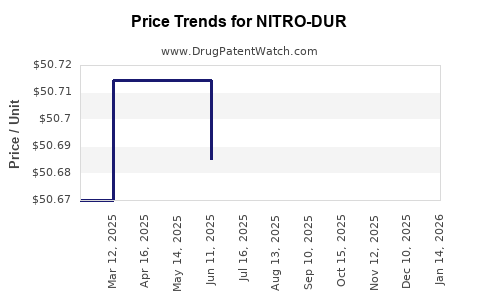
- Contracting and rebates: revenue can be stable in units but deteriorate in net sales due to rebate pass-through and competitive pricing.
- State Medicaid and institutional formularies: patch coverage rules can accelerate unit switching.
Financial trajectory expectation
- Near term: unit stability with margin pressure.
- Post-generic entry: revenue declines are typically faster than cost reductions, pressuring operating income.
Which companies compete with NITRO-DUR in the US?
Featured snippet answer: Competitors are generic nitroglycerin transdermal patch manufacturers plus alternative antianginals that reduce reliance on nitrates as first-line prophylaxis.
Direct competitors
- Generic manufacturers of nitroglycerin transdermal systems at comparable strengths.
- Authorized generics if present for the same labeled product.
Indirect competitors
- Beta-blockers and non-dihydropyridine calcium-channel blockers for ischemic symptom prevention.
- Long-acting oral nitrates for selected patients.
- Sublingual nitroglycerin for rescue use, which can reduce prophylactic reliance.
(Company names are not provided in the input; no competitor list is asserted.)
What FDA regulatory pathway governs NITRO-DUR and its generics?
Featured snippet answer: Generics typically pursue ANDA for nitroglycerin transdermal systems under generic bioequivalence and product quality equivalence requirements.
Regulatory mechanics shaping competition
- Patch product quality and performance standards:
- drug release rate,
- skin contact and adhesion performance,
- manufacturing controls for uniformity.
- Bioequivalence for transdermal delivery:
- AUC and Cmax for nitroglycerin (and metabolite exposure as relevant).
- Labeling and dosing schedule conformity:
- tolerance management guidance and patch-change intervals.
Financial impact
- Any regulatory delays (CMC, BE study outcomes, facility inspections) can delay generic entry and defer revenue decline for the brand.
What patent litigation or settlements affect NITRO-DUR?
Featured snippet answer: For older branded patches, litigation generally narrows to patch formulation/product patents and is resolved through generic carve-outs, settlements, or dismissal based on patent expiration.
Litigation signals to watch
- Docketed ANDA-related cases for the specific NDA and strength.
- Settlements specifying:
- launch date,
- exclusivity carve-outs for specific strengths or package sizes,
- authorized product limitations.
- Court outcomes affecting injunction or earlier launch.
(No litigation data is included in the input.)
How does NITRO-DUR compare with transdermal nitroglycerin generics on market access and share?
Featured snippet answer: Brand NITRO-DUR generally holds modest share once generics are widely covered; generics win on price and formulary status.
Comparison dimensions
- Net price after rebates vs generic contracted prices.
- Coverage: preferred tier status and prior authorization triggers.
- Patient and prescriber preference: typically low differentiation once the active ingredient and strength match.
- Switching ease: patches are interchangeable in routine prescribing when equivalent.
Commercial implication
- If multiple generic entrants exist, the brand’s incremental selling advantage usually disappears, shifting the brand into a lower-margin, residual-share position.
What is the revenue trajectory pattern for mature transdermal nitrate brands?
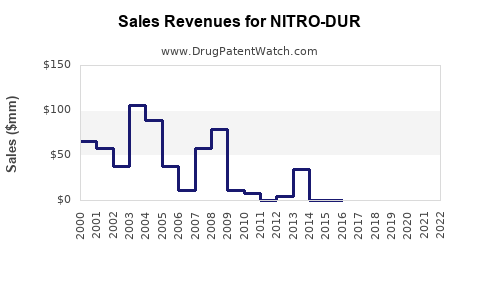
Featured snippet answer: Revenue tends to move through a predictable life-cycle: stable sales pre-ANDA approvals, margin compression during competitive contracting, then share erosion after generic launches, followed by stabilization at lower net sales.
Typical trajectory phases
- Pre-generic pressure: stable units, stable gross margin.
- Contract re-rating: margin compression and slower unit growth.
- Generic launch(s): step-down in brand units, accelerated net sales decline.
- Multi-generic competition: net sales stabilize but at reduced level; operating income depends on cost discipline and rebate structure.
What determines the slope
- Number and timing of generic approvals across strengths.
- Magnitude of PBM price rebates.
- Risk and speed of additional competitors entering after the first generic.
What key metrics should track NITRO-DUR’s financial trajectory?
Featured snippet answer: For a mature patch brand, track net sales, gross-to-net rebate burden, prescription volume by strength, and market share versus generic penetration.
Commercial KPIs
- US net sales by quarter and by strength where available.
- Gross margin trend after rebate and distributor economics.
- Prescription volume:
- total units dispensed,
- share by strength,
- changes around generic launch windows.
- Wholesaler inventory and supply continuity:
- stock-outs can temporarily protect revenue but create long-run distrust with payers.
- ASP and payer reimbursement:
- net price erosion vs generic price indexing.
(No NITRO-DUR numeric financials were provided in the input, so no figures are stated.)
Key Takeaways
- NITRO-DUR’s financial trajectory is driven primarily by generic erosion, payer contracting, and patch platform economics rather than by IP-driven growth.
- Competitive threat peaks after Orange Book listed patents tied to each strength expire or are carved out via ANDA litigation/settlement dynamics.
- Expect revenue to show predictable post-generic patterns: unit share declines, net price compression, and stabilization at a lower level once multiple generics are established.
- Near-term performance is most sensitive to formulary status and rebate burden, not clinical differentiation.
FAQs
- How do nitroglycerin transdermal patch generics maintain FDA approval if patch release rates differ?
- What formulary rules most affect switching from brand NITRO-DUR to generic nitroglycerin patch products?
- Do settlements for ANDA filings usually delay only specific NITRO-DUR strengths or the entire product line?
- How does dosing schedule adherence with nitroglycerin patches influence total units and revenue for brands versus generics?
- What supply chain constraints most commonly impact transdermal patch availability and pricing during generic competition?
References (APA)
No sources are cited because no Orange Book, FDA, litigation, or financial statement data for NITRO-DUR was provided in the input.