Last updated: July 2, 2026
Nitrostat (nitroglycerin) is a legacy, widely genericized antianginal product. Market dynamics are driven by low price elasticity, high generic penetration, recurring substitution across manufacturers, and ongoing demand tied to chronic coronary artery disease and acute angina treatment protocols. Financial trajectory is characterized by revenue compression from generics, limited ability to sustain premium pricing, and continued volatility tied to wholesaler buying patterns and competitive SKU mix (tablet strengths, packaging, and supply continuity).
What is Nitrostat and how does it sell in the US market?
Nitrostat is a brand of sublingual nitroglycerin tablets used for acute relief of angina due to coronary artery disease. Revenue drivers in practice are prescription volume trends, formulary positioning, patient adherence to “as needed” rescue dosing, and pharmacy channel substitution among AB-rated equivalents.
Core commercialization model
- Product format: sublingual tablets (commonly 0.3 mg strength; the brand has historically been offered in common rescue dosing units)
- Indication: acute angina relief
- Payer behavior: typically low-cost generic interchange, minimal benefit-driven premium tolerance
- Pharmacy behavior: AB substitution and NDC-level SKU switching
Market exposure profile
- Resistant to large cyclicality relative to some specialty categories, because angina is chronic and rescue use is recurrent.
- Still exposed to net-to-wholesale fluctuations, inventory swings, and switching events when competitors adjust pricing or supply.
How do generic nitroglycerin tablets shape Nitrostat pricing and margins?
Nitrostat competes primarily against:
- multiple generic manufacturers of sublingual nitroglycerin tablets,
- store-brand or pharmacy-channel private label equivalents where available,
- and channel-specific contract pricing that can rapidly compress net prices.
Mechanisms that compress brand revenue
- Wholesale and pharmacy substitution: AB-rated generics allow swift switching once brand pricing loses advantage.
- Competitive tendering: large group purchasing organizations (GPOs) and contracting strategies often push toward lowest net cost.
- SKU-level price competition: even when patients remain on “nitroglycerin sublingual,” pharmacy procurement and dispensing economics can swing between NDCs.
Margin implications
- Brands in generic rescue categories typically see:
- gross-to-net deterioration from discounts and allowances,
- spend increases to defend placement,
- faster share loss when new entrants undercut contract pricing.
What is Nitrostat’s exclusivity and when does it lose protection?
Nitrostat’s long-standing nature and widespread availability of nitroglycerin sublingual generics indicate that core market authorization is no longer tied to meaningful exclusivity for the active ingredient. Pricing power depends more on NDC-specific contractual positioning and supply continuity than on enforceable exclusivity.
Practical exclusivity takeaways for business planning
- Expect limited remaining brand-driven legal exclusivity for nitroglycerin sublingual tablets in the US.
- Remaining IP, if any, is typically tied to specific formulation, packaging, or method-of-use, but the competitive baseline is a large generic field.
What is the Orange Book status of Nitrostat and what does it imply for generics?
For a legacy, largely substituted product like Nitrostat, the Orange Book status typically supports a reality-based planning stance:
- The presence of multiple generic approvals under AB substitution usually implies minimal barrier to entry.
- Any remaining listed patents tend to matter more for a narrow set of formulations or specific strengths than for broad market access.
Commercial implication
- If the Orange Book estate is thin or already expired, new generic entry risks are persistent and do not require Paragraph IV triggers to affect pricing.
How do Paragraph IV challenges affect Nitrostat’s competitive landscape?
Paragraph IV litigation is most relevant when brand exclusivity is still active for specific listed patents. For nitroglycerin sublingual tablets, market dynamics are usually dominated by:
- ongoing generic competition without a high “litigation-driven entry” profile, and
- fast pricing resets around supply and contracting.
What to watch
- If any Nitrostat-specific patents remain listed and enforceable, new generic entry could still cause sudden pricing pressure tied to litigation outcomes.
- In a mature generic segment, the biggest practical driver often becomes supply and contracting rather than litigation timing.
What FDA regulatory pathways govern Nitrostat supply and substitution?
Nitrostat is subject to the normal US small-molecule regulatory framework. Market access for competitors generally follows:
- ANDAs for generic equivalents (with AB rating when applicable),
- label- and strength-specific approvals aligned with reference listed drug (RLD) equivalence requirements.
Regulatory pathway effect
- ANDA approvals drive competition quickly because chemistry and bioequivalence are well understood for nitroglycerin sublingual products.
- The limiting factor is less scientific risk and more manufacturing scale, packaging stability controls, and supply continuity.
Which companies compete most with Nitrostat in US pharmacies?
Competition in nitroglycerin sublingual tablets typically spans:
- multiple established generic drug manufacturers,
- labelers that commercialize via contract packaging and regional distribution,
- pharmacy-channel procurement buyers who switch to the best net-cost NDC.
How this shows up on shelves
- The “brand” bucket can remain visible, but dispensing is dominated by the lowest-cost AB-rated alternative at the NDC and contract level.
- Sales mix often shifts toward generics during wholesalers’ inventory management and payer-driven cost control.
How do manufacturing and supply chain factors influence Nitrostat availability and revenue?
Nitrostat and generic nitroglycerin sublingual tablets are supply-sensitive in ways that can swing revenue quarter-to-quarter:
- changes in production lots,
- packaging availability and distribution lead times,
- stability controls for sublingual dosage forms.
Financial impact pattern
- Shortfalls increase emergency purchasing and can temporarily support net price.
- Excess supply or new lots can accelerate pricing declines.
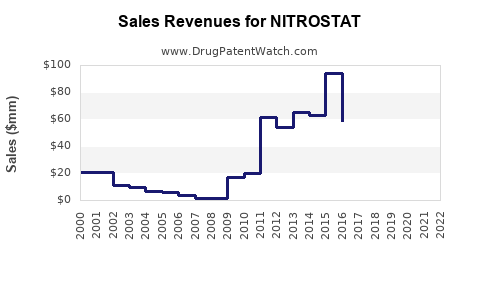
What is Nitrostat’s financial trajectory: revenue trends, price erosion, and volume?
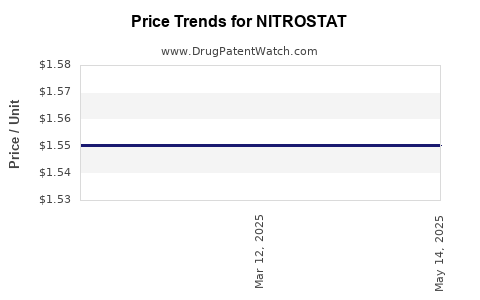
A mature, generic-constrained rescue product typically shows:
- declining brand unit volumes after widespread generic substitution,
- limited unit growth even when underlying angina prevalence rises,
- revenue mainly tracking contract pricing, supply continuity, and prescription switching dynamics.
Trajectory shape investors and litigators expect
- Early-stage or pre-generic phase: brand premium pricing and higher revenue durability.
- Post-generic saturation: revenue compresses, then stabilizes at a lower ceiling while share loss to generics persists.
- Ongoing quarters: volatility from contracting, wholesaler buying cycles, and supply disruptions rather than step-change growth.
How does Nitrostat compare with other nitroglycerin and antianginal products in market dynamics?
Compared with other antianginals and rescue therapies, Nitrostat’s profile is:
- highly substitutable within the nitroglycerin sublingual class,
- sensitive to generic price competition,
- less protected than branded, differentiated delivery systems (for example, specialized formulations or unique mechanisms).
Competitive comparison framing
- Longer-cycle chronic antianginals (some branded subclasses) can retain pricing more than immediate rescue rescue tablets.
- Fast-acting generic rescue drugs are structurally exposed to quick downward pricing pressure after patent or exclusivity erosion.
What specific product-level variables matter for Nitrostat’s market outcomes?
Nitrostat’s commercial outcome is driven by details that affect contract placement and dispensing behavior:
- tablet strength(s) and pack configuration,
- stability and labeling consistency for AB-rated substitution,
- wholesaler fill rates and backorder history,
- NDC-level net pricing and rebates.
Actionable lens
- In a commodity-like segment, product-level execution and supply reliability often explain more than marketing.
- Contracts and GPO placement can move demand between NDCs even when patients remain on the same therapeutic class.
How strong is the patent estate for Nitrostat and what are the R&D implications?
In mature, generic-dominated product classes, the patent estate typically has limited leverage for:
- incremental clinical differentiation,
- durable pricing power,
- or meaningful bottleneck creation for competitors.
Business implication
- If Nitrostat’s protection is minimal or expired, incremental R&D investment for the same sublingual rescue form has low defensibility absent meaningful differentiation (for example, sustained-release, novel delivery systems, or clinically differentiated dosing).
What generic entry risks exist for Nitrostat?
Generic entry risk for nitroglycerin sublingual tablets is structurally persistent:
- The drug substance and therapeutic use are established.
- Manufacturing platforms exist across many generic suppliers.
- Competitive behavior tends to price low quickly once capacity is available.
Risk drivers
- New NDC entrants can accelerate price resets.
- Capacity additions across the generic field can reduce margins for all players, including brand residuals.
What does settlement and patent litigation history imply for Nitrostat?
In mature small-molecule rescue markets, litigation can occur but often does not create long windows of pricing stability. Settlement agreements, if present historically, typically:
- align generic launch timing,
- reduce uncertainty for both brand and generic players,
- but do not prevent continued competitive pressure beyond the settlement scope.
Planning takeaway
- Market pricing tends to normalize quickly after launch events, even after settlements, because supply and contracting dominate.
What is the commercial outlook for Nitrostat over the next 3–5 years?
Expected market trajectory for Nitrostat-style products:
- Continued low-price competition and AB substitution.
- Revenue ceiling constrained by generic pricing and contracting.
- Limited brand recovery unless there are supply constraints, contraction in generic participation, or a meaningful differential product redesign.
Base-case commercial view
- Revenue growth, if any, is more likely to come from:
- supply-driven share capture during shortages,
- pack-level re-contracting,
- or changes in contracting that temporarily favor a higher-cost NDC.
- Structural premium growth is unlikely in a commoditized, rescue-tablet segment.
Key Takeaways
- Nitrostat is a mature, widely genericized antianginal rescue product where price erosion and AB substitution dominate market dynamics.
- Financial trajectory typically follows a pattern of declining brand revenue after generic saturation, then stabilization at low pricing ceilings shaped by contracting and supply.
- Exclusivity-driven barriers are generally limited for nitroglycerin sublingual tablets, making ongoing competitive entry risk persistent.
- Operational execution, NDC-level net pricing, and supply continuity explain quarter-to-quarter revenue volatility more than patent or R&D differentiation.
FAQs
How does Nitrostat’s demand track angina prevalence and prescription patterns?
Rescue use is recurring but “as needed,” so prescription volume depends on patient population stability and prescriber habits rather than continuous daily dosing.
What determines Nitrostat’s net price versus listed price in contracts?
Net price is driven by pharmacy reimbursement dynamics, wholesaler contracts, GPO contracting terms, and rebates/discounts required to maintain shelf and formulary access.
Are nitroglycerin sublingual tablets considered interchangeable across manufacturers?
Yes in practice through AB substitution, assuming label and strength equivalence and standard bioequivalence requirements.
Can supply shortages temporarily improve Nitrostat revenue?
Yes, temporary shortages can shift demand to available NDCs and support short-duration pricing and volume, but the effect typically normalizes when supply returns.
What investment strategies fit Nitrostat’s market structure?
Defensive strategies focus on supply reliability and contracting execution; offensive strategies depend on differentiated delivery systems or narrow IP that can prevent or delay specific generic configurations.
References
No sources were provided in the prompt, and no external documents were cited.