Viatris Company Profile
✉ Email this page to a colleague
What is the competitive landscape for VIATRIS
VIATRIS has twenty-eight approved drugs.
There are five US patents protecting VIATRIS drugs.
Summary for Viatris
| US Patents: | 5 |
| Tradenames: | 26 |
| Ingredients: | 20 |
| NDAs: | 28 |
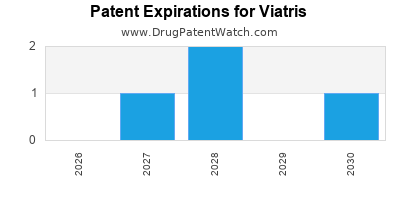
Drugs and US Patents for Viatris
| Applicant | Tradename | Generic Name | Dosage | NDA | Approval Date | TE | Type | RLD | RS | Patent No. | Patent Expiration | Product | Substance | Delist Req. | Exclusivity Expiration |
|---|---|---|---|---|---|---|---|---|---|---|---|---|---|---|---|
| Viatris | TOBI | tobramycin | SOLUTION;INHALATION | 050753-001 | Dec 22, 1997 | AN | RX | Yes | Yes | ⤷ Start Trial | ⤷ Start Trial | ||||
| Viatris | GEODON | ziprasidone mesylate | POWDER;INTRAMUSCULAR | 020919-001 | Jun 21, 2002 | AP | RX | Yes | Yes | ⤷ Start Trial | ⤷ Start Trial | ||||
| Viatris | DILANTIN | phenytoin sodium | CAPSULE;ORAL | 084349-001 | Approved Prior to Jan 1, 1982 | RX | Yes | Yes | ⤷ Start Trial | ⤷ Start Trial | |||||
| Viatris | DILANTIN-125 | phenytoin | SUSPENSION;ORAL | 008762-001 | Approved Prior to Jan 1, 1982 | AB | RX | Yes | Yes | ⤷ Start Trial | ⤷ Start Trial | ||||
| Viatris | NEURONTIN | gabapentin | TABLET;ORAL | 020882-002 | Oct 9, 1998 | AB1 | RX | Yes | Yes | ⤷ Start Trial | ⤷ Start Trial | ||||
| Viatris | ASTEPRO | azelastine hydrochloride | SPRAY, METERED;NASAL | 022203-002 | Aug 31, 2009 | DISCN | No | No | 8,071,073 | ⤷ Start Trial | Y | ⤷ Start Trial | |||
| Viatris | EDLUAR | zolpidem tartrate | TABLET;SUBLINGUAL | 021997-002 | Mar 13, 2009 | AB | RX | Yes | Yes | 9,597,281 | ⤷ Start Trial | ⤷ Start Trial | |||
| >Applicant | >Tradename | >Generic Name | >Dosage | >NDA | >Approval Date | >TE | >Type | >RLD | >RS | >Patent No. | >Patent Expiration | >Product | >Substance | >Delist Req. | >Exclusivity Expiration |
Expired US Patents for Viatris
| Applicant | Tradename | Generic Name | Dosage | NDA | Approval Date | Patent No. | Patent Expiration |
|---|---|---|---|---|---|---|---|
| Viatris | NITROSTAT | nitroglycerin | TABLET;SUBLINGUAL | 021134-003 | May 1, 2000 | 6,500,456 | ⤷ Start Trial |
| Viatris | GEODON | ziprasidone mesylate | POWDER;INTRAMUSCULAR | 020919-001 | Jun 21, 2002 | 6,232,304 | ⤷ Start Trial |
| Viatris | GEODON | ziprasidone mesylate | POWDER;INTRAMUSCULAR | 020919-001 | Jun 21, 2002 | 6,110,918 | ⤷ Start Trial |
| Viatris | NITROSTAT | nitroglycerin | TABLET;SUBLINGUAL | 021134-002 | May 1, 2000 | 6,500,456 | ⤷ Start Trial |
| Viatris | NITROSTAT | nitroglycerin | TABLET;SUBLINGUAL | 021134-001 | May 1, 2000 | 6,500,456 | ⤷ Start Trial |
| Viatris Specialty | PERFOROMIST | formoterol fumarate | SOLUTION;INHALATION | 022007-001 | May 11, 2007 | 8,623,922 | ⤷ Start Trial |
| Viatris | CARDURA | doxazosin mesylate | TABLET;ORAL | 019668-003 | Nov 2, 1990 | 4,188,390 | ⤷ Start Trial |
| >Applicant | >Tradename | >Generic Name | >Dosage | >NDA | >Approval Date | >Patent No. | >Patent Expiration |
Paragraph IV (Patent) Challenges for VIATRIS drugs
| Drugname | Dosage | Strength | Tradename | Submissiondate |
|---|---|---|---|---|
| ➤ Subscribe | Sublingual Tablets | 5 mg and 10 mg | ➤ Subscribe | 2010-04-29 |
| ➤ Subscribe | Sublingual Tablets | 0.6 mg | ➤ Subscribe | 2011-12-29 |
| ➤ Subscribe | Tablets | 150 mg and 200 mg | ➤ Subscribe | 2005-11-09 |
| ➤ Subscribe | Injection (Auto-injector) | 0.15 mg/0.3 mL and 0.3 mg/0.3 mL | ➤ Subscribe | 2008-11-21 |
| ➤ Subscribe | Nasal Spray | 205.5 mcg/spray | ➤ Subscribe | 2011-12-15 |
| ➤ Subscribe | Tablets | 100 mg | ➤ Subscribe | 2004-10-25 |
| ➤ Subscribe | Sublingual Tablets | 0.3 mg, 0.4 mg and 0.6 mg | ➤ Subscribe | 2005-10-19 |
| ➤ Subscribe | CapsulesInhalation Solution | 0.02 mg/2 mL | ➤ Subscribe | 2009-01-21 |
| ➤ Subscribe | Capsules | 20 mg, 40 mg, 60 mg and 80 mg | ➤ Subscribe | 2005-02-07 |
| ➤ Subscribe | Injection (Auto-injector) | 0.15 mg/0.3 mL and 0.3 mg/0.3 mL | ➤ Subscribe | 2008-11-21 |
| ➤ Subscribe | Inhalation Solution | 300 mg/5 mL | ➤ Subscribe | 2009-06-29 |
| ➤ Subscribe | Tablets | 25 mg and 50 mg | ➤ Subscribe | 2004-11-19 |
International Patents for Viatris Drugs
| Country | Patent Number | Estimated Expiration |
|---|---|---|
| Australia | 2012201428 | ⤷ Start Trial |
| Mexico | 344036 | ⤷ Start Trial |
| Slovenia | 2340872 | ⤷ Start Trial |
| Canada | 2520265 | ⤷ Start Trial |
| Cyprus | 1121330 | ⤷ Start Trial |
| European Patent Office | 2340872 | ⤷ Start Trial |
| European Patent Office | 2486942 | ⤷ Start Trial |
| >Country | >Patent Number | >Estimated Expiration |
Supplementary Protection Certificates for Viatris Drugs
| Patent Number | Supplementary Protection Certificate | SPC Country | SPC Expiration | SPC Description |
|---|---|---|---|---|
| 0502314 | SPC/GB11/010 | United Kingdom | ⤷ Start Trial | PRODUCT NAME: THE COMBINATION OF A) TELMISARTAN, OPTIONALLY IN THE FORM OF PHARMACEUTICALLY ACCEPTABLE SALTS, AND B) AMLODIPINE, OPTIONALLY IN THE FORM OF PHARMACEUTICALLY ACCEPTABLE SALTS, ESPECIALLY AMLODIPINE BESYLATE; REGISTERED: UK EU/1/10/648/001 20101007; UK EU/1/10/648/002 20101007; UK EU/1/10/648/003 20101007; UK EU/1/10/648/004 20101007; UK EU/1/10/648/005 20101007; UK EU/1/10/648/006 20101007; UK EU/1/10/648/007 20101007; UK EU/1/10/648/008 20101007; UK EU/1/10/648/009 20101007; UK EU/1/10/648/010 20101007; UK EU/1/10/648/011 20101007; UK EU/1/10/648/012 20101007; UK EU/1/10/648/013 20101007; UK EU/1/10/648/014 20101007; UK EU/1/10/648/015 20101007; UK EU/1/10/648/016 20101007; UK |
| 2435025 | 132019000000087 | Italy | ⤷ Start Trial | PRODUCT NAME: UNA COMBINAZIONE DI GLICOPIRROLATO (INCLUSI SUOI SALI, ESTERI, ENANTIOMERI O ALTRI DERIVATI FARMACEUTICAMENTE ACCETTABILI) E FORMOTEROLO (INCLUSI SUOI SALI, ESTERI, ENANTIOMERI O ALTRI DERIVATI FARMACEUTICAMENTE ACCETTABILI)(BEVESPI AEROSPHERE); AUTHORISATION NUMBER(S) AND DATE(S): EU/1/18/1339, 20181220 |
| 1915993 | 300625 | Netherlands | ⤷ Start Trial | PRODUCT NAME: COMBINATIE BEVATTENDE ALISKIREN, OF EEN FARMACEUTISCH AANVAARDBAAR ZOUT DAARVAN, EN AMLODIPINE, OF EEN FARMACEUATISCH AANVAARDBAAR ZOUT DAARVAN; REGISTRATION NO/DATE: EU/1/11/686/001-056 20110414 |
| 2782584 | LUC00245 | Luxembourg | ⤷ Start Trial | PRODUCT NAME: COMPOSITION CONTENANT A LA FOIS DE L'ESTRADIOL (17SS-ESTRADIOL), EVENTUELLEMENT SOUS FORME D'UN SEL, HYDRATE OU SOLVATE PHARMACEUTIQUEMENT ACCEPTABLE DE CELUI-CI (Y COMPRIS SOUS FORME HEMIHYDRATEE), ET DE LA PROGESTERONE; AUTHORISATION NUMBER AND DATE: BE582231 20210701 |
| 2435024 | 21C1020 | France | ⤷ Start Trial | PRODUCT NAME: COMBINAISON DE FORMOTEROL (Y COMPRIS LES SELS, ESTERS, SOLVATES OU ENANTIOMERES PHARMACEUTIQUEMENT ACCEPTABLES DE CELUI-CI), GLYCOPYRROLATE (Y COMPRIS LES SELS, ESTERS, SOLVATES OU ENANTIOMERES PHARMACEUTIQUEMENT ACCEPTABLES DE CELUI-CI) ET BUDESONIDE (Y COMPRIS LES SELS, ESTERS, SOLVATES OU ENANTIOMERES PHARMACEUTIQUEMENT ACCEPTABLES DE CELUI-CI); REGISTRATION NO/DATE: EU/1/20/1498 20201210 |
| 2435024 | 132021000000095 | Italy | ⤷ Start Trial | PRODUCT NAME: UNA COMBINAZIONE DI FORMOTEROLO (INCLUSI SUOI SALI, ESTERI, SOLVATI O ENANTIOMERI FARMACEUTICAMENTE ACCETTABILI), GLICOPIRROLATO (INCLUSI SUOI SALI, ESTERI, SOLVATI O ENANTIOMERI FARMACEUTICAMENTE ACCETTABILI) E BUDESONIDE (INCLUSI SUOI SALI, ESTERI, SOLVATI O ENANTIOMERI FARMACEUTICAMENTE ACCETTABILI)(TRIXEO AEROSPHERE); AUTHORISATION NUMBER(S) AND DATE(S): EU/1/20/1498, 20201210 |
| 0502314 | C300478 | Netherlands | ⤷ Start Trial | PRODUCT NAME: TELMISARTAN, DESGEWENST IN DE VORM VAN EEN FARMACEUTISCH AANVAARDBAAR ZOUT, EN AMLODIPINE, DESGEWENST IN DE VORM VAN EEN FARMACEUTISCH AANVAARDBAAR ZOUT, IN HET BIJZONDER AMLODIPINEBESILAAT; REGISTRATION NO/DATE: EU/1/10/648/001-028 20101007 |
| >Patent Number | >Supplementary Protection Certificate | >SPC Country | >SPC Expiration | >SPC Description |
Similar Applicant Names
Applicants may be listed under multiple names.
Here is a list of applicants with similar names.
Here is a list of applicants with similar names.
