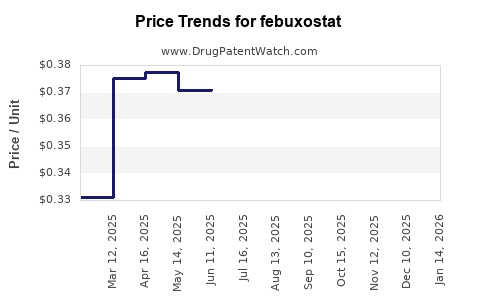
Last updated: November 25, 2026
Febuxostat is a mature, largely genericized oral gout medicine with declining branded economics and continued demand in markets where gout prevalence is rising. Takeda’s Uloric lost its core U.S. patent protection after 2018, generic febuxostat entered the U.S. market in 2019, and price competition has since shifted value from the originator to low-cost manufacturers. The principal commercial risks are cardiovascular safety restrictions, competition from allopurinol, limited differentiation between generic products, and low barriers to manufacturing the active pharmaceutical ingredient.
Febuxostat Market Dynamics, Patent Expiry, Generic Competition and Financial Trajectory
What is febuxostat and how is it used?
Febuxostat is an oral, non-purine selective xanthine oxidase inhibitor. It lowers uric acid and is used for the chronic management of hyperuricemia in adults with gout. The drug is marketed in 40 mg and 80 mg tablets in the United States, with additional strengths and formulations available in international markets.
Takeda Pharmaceuticals commercialized febuxostat in the United States under the brand name Uloric. The U.S. Food and Drug Administration approved Uloric on Feb. 13, 2009, for chronic management of hyperuricemia in patients with gout who have an inadequate response to or cannot tolerate allopurinol [1].
The drug competes primarily with:
- Allopurinol, the dominant first-line urate-lowering therapy.
- Probenecid, used in selected patients with underexcretion of uric acid.
- Pegloticase, a biologic treatment for refractory chronic gout.
- Other branded and generic febuxostat products outside the United States.
Febuxostat is generally positioned as an alternative to allopurinol, particularly for patients who cannot tolerate allopurinol or who do not achieve adequate urate control.
When did febuxostat lose market exclusivity?
Febuxostat lost meaningful U.S. market exclusivity after the expiry of the principal composition patent and the subsequent approval of abbreviated new drug applications.
| Milestone |
Date |
Commercial impact |
| U.S. Uloric approval |
Feb. 13, 2009 |
Takeda entered the U.S. market |
| New chemical entity exclusivity |
Approximately 2014 |
Blocked ANDA approval during the initial exclusivity period |
| Principal U.S. composition patent expiry |
2018, subject to patent-term calculations |
Removed the central composition barrier |
| First U.S. generic approvals |
2019 |
Enabled generic market entry |
| FDA cardiovascular boxed warning |
February 2019 |
Reduced prescribing attractiveness |
| Current market structure |
Generic-dominated |
Originator pricing power has materially declined |
The principal U.S. patent associated with febuxostat was U.S. Patent No. 6,225,474, covering febuxostat compounds and related use concepts. Its ordinary patent term was tied to an international filing priority dating to the late 1990s. The patent expired in 2018 after applicable patent-term adjustments and extensions were considered in the regulatory record [2].
The practical result was a short period in which Takeda retained commercial control of the U.S. product, followed by rapid generic substitution.
What patents protect febuxostat and Uloric?
The core febuxostat patent estate was built around the active pharmaceutical ingredient and its use as a xanthine oxidase inhibitor. The relevant protection was more valuable before approval than after generic entry because the drug had limited formulation complexity.
Core composition patent
U.S. Patent No. 6,225,474 was the principal U.S. patent associated with febuxostat. The patent covered febuxostat and related chemical subject matter. It formed the primary basis for Uloric’s early U.S. exclusivity position.
The patent estate did not create the type of durable protection associated with:
- Long-acting injectable products.
- Device-based delivery systems.
- Complex biologic manufacturing.
- Multiple differentiated extended-release formulations.
- A large family of late-expiring formulation patents.
Formulation patents
Febuxostat tablets are conventional immediate-release solid oral dosage forms. Formulation patents have not created a major post-expiry barrier comparable to those seen with modified-release products or drug-device combinations.
Generic manufacturers can generally develop standard tablet products using conventional pharmaceutical manufacturing processes. The commercial value of formulation patents is therefore limited unless they cover a clinically meaningful improvement, such as materially improved bioavailability, tolerability, or dosing convenience.
Method-of-use patents
Method-of-use protection has been commercially secondary. Febuxostat’s principal indication is chronic urate lowering in gout, a well-established therapeutic use. Broad use claims face substantial vulnerability where the mechanism, disease setting, and clinical endpoint were already disclosed.
The FDA’s boxed warning also makes new use-based patent strategies more difficult because the drug’s cardiovascular risk profile is now a central factor in prescribing and labeling decisions.
What is the FDA regulatory status of febuxostat?
Febuxostat remains FDA-approved, but the regulatory profile is less favorable than it was at launch.
The FDA added a boxed warning in 2019 after reviewing the CARES cardiovascular outcomes trial. In that study, patients receiving febuxostat had a higher risk of cardiovascular death and all-cause mortality than patients receiving allopurinol, although the primary composite cardiovascular endpoint did not show a statistically significant difference [3].
The FDA subsequently limited the indicated population. The current label states that febuxostat should generally be reserved for patients who have an inadequate response to the maximum medically appropriate dose of allopurinol, who are intolerant of allopurinol, or for whom allopurinol is not advisable [4].
Regulatory consequences
The boxed warning has several commercial effects:
- It restricts first-line use.
- It strengthens allopurinol’s position in treatment guidelines.
- It raises prescriber sensitivity to patient cardiovascular history.
- It reduces the potential value of premium branded pricing.
- It complicates efforts to reposition febuxostat into broader preventive or early-treatment populations.
The European Medicines Agency reached a more nuanced conclusion after reviewing available safety data, while continuing to monitor cardiovascular risk. Regulatory treatment therefore differs by jurisdiction, which affects international commercialization strategies [5].
How many patents cover febuxostat today?
The commercial patent barrier for standard febuxostat tablets is low.
The original composition patent has expired in the United States. Any remaining rights are more likely to involve specific jurisdictions, secondary formulations, manufacturing processes, or narrow clinical uses rather than broad control of the active ingredient.
| Protection category |
Current commercial significance |
| Core compound patent |
Expired in the United States |
| U.S. product exclusivity |
Ended |
| Standard immediate-release tablet |
Low barrier |
| Specialized formulations |
Potentially relevant only if clinically differentiated |
| Manufacturing processes |
Usually avoidable through alternative processes |
| Method-of-use claims |
Narrow and exposed to validity challenges |
| Biologic exclusivity |
Not applicable |
The number of patent documents in a worldwide search can be large because of national filings, continuations, divisionals, and family members. That count does not translate into meaningful market exclusivity. The important question is whether an unexpired, enforceable claim blocks a conventional febuxostat tablet. In the United States, the answer is generally no for the core product.
Which companies challenged Uloric patents?
Generic manufacturers pursued U.S. ANDA approvals after the core exclusivity period. Publicly identified applicants and commercial suppliers have included companies such as Teva, Mylan, Solco Healthcare, Zydus, and other generic manufacturers.
The relevant litigation model was a typical small-molecule Hatch-Waxman process:
- An ANDA applicant filed a Paragraph IV certification against listed Uloric patents.
- Takeda could sue for patent infringement.
- The lawsuit could trigger a 30-month stay of FDA approval.
- The parties could settle, allowing approval and a defined launch date.
- Multiple applicants could enter after the first market-opening agreement.
Paragraph IV activity was commercially important before 2019 but became less significant after expiry of the principal composition patent. Once multiple generic products obtained approval, the market shifted from patent litigation to price competition.
What is the Orange Book status of Uloric?
Uloric was listed in the FDA’s Orange Book under NDA 021856. The Orange Book historically identified patents associated with the product, including the core febuxostat patent.
For current diligence, the decisive issue is not the historical listing but whether any active listed patent remains capable of delaying an ANDA for a standard febuxostat tablet. The broad U.S. exclusivity position has ended, and generic febuxostat products have entered the market.
The originator’s Orange Book position should be reviewed against the current FDA edition and any active patent listing, because product-specific listings can change through delisting, expiration, or regulatory updates [6].
What generic entry risks exist for febuxostat?
Generic entry risk is high in the United States and in most markets where the principal compound patents have expired.
U.S. generic launch scenario
The likely U.S. market structure is:
- Multiple approved ANDA suppliers.
- Low switching costs for pharmacies and payers.
- Limited clinical differentiation among 40 mg and 80 mg tablets.
- High price erosion after several suppliers enter.
- Continued availability of branded Uloric only where payer restrictions or patient preference support it.
The first generic entrants may capture higher margins temporarily. Those margins generally decline as additional suppliers enter and pharmacy benefit managers impose substitution or preferred-tier requirements.
International launch scenario
Outside the United States, entry timing depends on national patent terms, local regulatory filings, and branded-market structure. India, China, Japan, South Korea, and European markets have substantial generic or locally branded competition.
International products include brands such as Feburic, Febustat, and other country-specific trade names. Pricing varies widely. Some markets retain branded generic premiums because physicians prescribe by trade name, while others rely heavily on tendering and substitution.
How does febuxostat compare with allopurinol?
Allopurinol remains the principal competitive constraint.
| Factor |
Febuxostat |
Allopurinol |
| Mechanism |
Selective xanthine oxidase inhibition |
Xanthine oxidase inhibition |
| U.S. positioning |
Generally second-line or alternative therapy |
Standard first-line therapy |
| Patent status |
Core protection expired |
Mature generic product |
| Cardiovascular label |
Boxed warning in the U.S. |
No equivalent boxed warning |
| Cost |
Generic and generally low |
Very low-cost generic |
| Use in renal impairment |
Often considered when allopurinol is unsuitable |
Requires dose management |
| Commercial differentiation |
Limited |
Strong guideline and cost position |
Febuxostat can deliver stronger urate-lowering effects for some patients, but this advantage has not created durable pricing power. The boxed warning materially weakens its ability to displace allopurinol in broad populations.
How strong is the febuxostat patent estate?
The estate is weak from a current commercial-exclusivity perspective.
Its strengths were:
- A chemically defined active ingredient.
- A clear mechanism of action.
- A strong initial composition patent.
- Regulatory approval in a chronic disease market.
Its weaknesses are:
- Expiry of the central composition patent.
- Conventional oral tablet formulation.
- Limited late-cycle formulation differentiation.
- Multiple generic manufacturers.
- A boxed cardiovascular warning.
- Strong competition from an inexpensive standard therapy.
- Low manufacturing complexity.
The patent estate can still have value in jurisdictions with later expiry dates or for narrowly claimed processes. It does not provide broad global control of febuxostat.
What licensing deals affect febuxostat?
Takeda was the principal global originator associated with Uloric, but regional commercialization has involved local marketing partners and distributors. In several countries, febuxostat is sold through local licensees or branded-generic companies rather than directly by the original innovator.
No major current licensing transaction has created a new global exclusivity platform for febuxostat. The commercial model is now primarily based on generic supply, local registration, and distribution. Any valuation of a regional febuxostat deal should focus on:
- Remaining patent life in the territory.
- Local brand recognition.
- Reimbursement status.
- Tender access.
- API sourcing.
- Cardiovascular labeling.
- Substitution rules.
What is the financial trajectory for febuxostat?
Febuxostat’s financial trajectory follows the standard small-molecule lifecycle:
| Period |
Financial profile |
| 2009-2013 |
Launch investment and market development |
| 2014-2018 |
Branded growth, wider physician adoption |
| 2019 |
Safety-label pressure and generic-entry preparation |
| 2020 onward |
Rapid U.S. price and share erosion |
| Current |
Mature generic revenue with regional brand pockets |
Uloric generated meaningful branded revenue for Takeda before generic entry, but it was not one of the company’s largest global products. After 2019, U.S. revenue exposure declined through a combination of generic substitution, lower prescribing after the boxed warning, and reduced payer willingness to reimburse a premium branded product.
Public company reports do not provide a single consolidated global revenue figure for all febuxostat products because generic sales are distributed across many manufacturers and private companies. Third-party market-size estimates also vary depending on whether they include active pharmaceutical ingredient sales, branded generics, hospital procurement, and over-the-counter-like retail channels.
The economically relevant trend is clear:
- Originator revenue has contracted sharply.
- Generic volume has increased.
- Average selling prices have declined.
- Manufacturing and distribution economics have replaced patent rents.
- Growth is more likely to come from volume expansion in emerging markets than from premium pricing.
What is the competitive landscape for febuxostat manufacturers?
The competitive landscape is fragmented.
Originator
Takeda retains the historical originator position through Uloric, but its strategic relevance is limited by patent expiry and generic competition.
Generic manufacturers
Generic participation includes large multinational manufacturers and regional pharmaceutical companies. Competitive advantages are based on:
- API cost.
- Regulatory approvals.
- Manufacturing scale.
- Pharmacy and hospital contracts.
- Local physician promotion.
- Supply reliability.
- Tender pricing.
API and manufacturing barriers
Manufacturing barriers are moderate to low. Febuxostat is a synthetic small molecule and does not require biologic cell culture, aseptic filling, or a complex delivery device.
Potential barriers include:
- Process validation.
- Impurity control.
- Consistent particle and polymorph characteristics.
- Regulatory documentation.
- Bioequivalence.
- Reliable API supply.
- Local GMP compliance.
These are operational barriers, not durable exclusivity barriers.
Does febuxostat face biosimilar risk?
No. Febuxostat is a synthetic small-molecule drug, not a biologic. It is regulated through the generic drug pathway, principally ANDA-based approval in the United States, rather than through the biosimilar pathway under the Public Health Service Act.
The relevant competitive risk is generic substitution, not biosimilar interchangeability.
What revenue exposure remains for febuxostat?
Revenue exposure remains concentrated in three areas:
- Branded generics in markets with strong physician prescribing by trade name.
- Countries where patent or regulatory entry occurred later.
- Patients who cannot tolerate allopurinol or do not achieve adequate urate control.
The U.S. branded opportunity is limited. Generic volume can remain substantial because gout is chronic, treatment duration is long, and global prevalence is increasing. Volume growth, however, does not necessarily translate into revenue growth because price erosion is severe.
Key Takeaways
- Febuxostat is a mature oral gout medicine with an expired core U.S. patent estate.
- Takeda’s Uloric lost meaningful U.S. exclusivity after the 2018 expiry of the principal composition patent.
- Generic febuxostat entered the U.S. market in 2019.
- The 2019 FDA boxed warning for cardiovascular death reduced the drug’s first-line commercial potential.
- Allopurinol remains the dominant clinical and economic competitor.
- Febuxostat has no biosimilar exposure because it is a small molecule.
- Standard immediate-release tablets have low manufacturing and formulation barriers.
- Current value is concentrated in generic volume, regional brands, and markets with local prescribing or reimbursement advantages.
- Patent-based pricing power is weak, and future revenue growth depends more on geographic expansion and supply economics than on innovation exclusivity.
FAQs About Febuxostat Market and Patent Strategy
Is febuxostat still commercially attractive for generic manufacturers?
Yes, but primarily as a volume product. Commercial attractiveness depends on low API cost, reliable supply, regulatory coverage, and access to large retail or institutional channels.
Can a new febuxostat formulation obtain market exclusivity?
A differentiated formulation could receive patent protection if it provides a non-obvious technical benefit. Regulatory exclusivity would depend on the approval pathway and the nature of the innovation. A routine reformulation would face significant validity and commercial challenges.
Will febuxostat replace allopurinol in the United States?
A broad replacement is unlikely. The FDA boxed warning and allopurinol’s low cost and first-line position limit febuxostat adoption to selected patients.
Does febuxostat have patent protection in India and China?
Patent status is jurisdiction-specific. Core compound protection has expired or is no longer commercially decisive in many countries, but local patent registers and national filing histories must be reviewed for any remaining formulation, process, or use claims.
What is the largest investment risk in febuxostat?
The largest risk is margin compression from generic competition combined with restricted prescribing after the cardiovascular safety warning. A company relying on premium pricing without a differentiated formulation or protected market is exposed to rapid revenue erosion.
References
- U.S. Food and Drug Administration. (2009). Uloric (febuxostat) approval letter and prescribing information.
- United States Patent and Trademark Office. (2001). U.S. Patent No. 6,225,474, 2-(3-cyano-4-isobutoxyphenyl)-4-methylthiazole-5-carboxylic acid.
- U.S. Food and Drug Administration. (2019, February 21). FDA adds boxed warning for increased risk of death with gout medicine Uloric (febuxostat).
- U.S. Food and Drug Administration. (2024). Uloric and febuxostat prescribing information.
- European Medicines Agency. (2019). Febuxostat-containing medicines: review of cardiovascular risk.
- U.S. Food and Drug Administration. (2024). Approved drug products with therapeutic equivalence evaluations, Orange Book.