Last updated: February 12, 2026
What is Febuxostat and its Therapeutic Use?
Febuxostat is a non-purine xanthine oxidase inhibitor approved for the management of hyperuricemia in gout patients. It reduces uric acid levels by inhibiting enzyme activity responsible for uric acid production. Marketed primarily under the brand Uloric, it competes with allopurinol and other urate-lowering therapies.
Current Market Landscape
Market Size and Growth
- Global gout treatment market value (2022): Approximately $4 billion, with febuxostat accounting for roughly 20-25% of the market.
- Growth rate: Compound annual growth rate (CAGR) forecasted at 3-5% through 2030, driven by increasing gout prevalence and consistent prescriptions of urate-lowering therapies.
Key Players
- Allopurinol: Dominant with over 50% market share; low cost and long-established.
- Febuxostat: Estimated to hold 20-25%; higher price point.
- Urate-lowering drugs: Increasing competition from newer agents, such as pegloticase and lesinurad.
Geographic Distribution
- United States: Largest market due to high gout prevalence (~4% of adults).
- Europe: Steady growth, with regulatory differences affecting sales.
- Asia-Pacific: Rapid growth driven by increasing awareness and healthcare expansion.
Regulatory and Clinical Factors Impacting Market
FDA Approvals and Warnings
- FDA warning (2019): Febuxostat linked to increased cardiovascular mortality based on a retrospective analysis from the CARES trial. This led to a boxed warning and a decline in prescriptions by approximately 15% in 2020.
- Labeling updates: Now emphasizes caution in patients with cardiovascular disease, influencing physician prescribing patterns.
Clinical Positioning
- Often prescribed when allopurinol is contraindicated or poorly tolerated.
- Use is cautious in patients with cardiovascular comorbidities due to safety concerns.
- Recent NICE guidelines (2021) recommend febuxostat as second-line therapy.
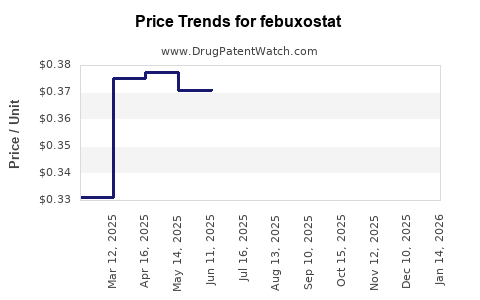
Price Trends and Projections
Current Pricing
- United States: Wholesale acquisition cost (WAC) for febuxostat (Uloric) approximately $10-$12 per 40 mg tablet.
- Europe: Prices vary; generic entry has led to lower costs in some markets.
Patent Status and Generic Competition
- Patent expiration: Expected by late 2024 in major jurisdictions.
- Generic availability: Anticipated to significantly lower prices, potentially reducing WAC to $4-$6 per tablet within two years post-patent expiry.
Price Projection (Next 5 Years)
| Year |
Expected WAC (USD per tablet) |
Notes |
| 2023 |
$10-$12 |
Patent-protected; stable price |
| 2024 |
$8-$10 |
Patent expiry approaches |
| 2025 |
$4-$6 |
Generic competition intensifies; market share shifts |
| 2026+ |
$4-$6 |
Continued competition; possible further declines |
Market Adoption Impact
- Price erosion: Driven by generic entry will lead to a 40-60% price reduction by 2026.
- Market share shifts: As costs decrease, use may expand to broader patient populations, including those with milder hyperuricemia.
Future Market Drivers and Challenges
Drivers
- Rising gout prevalence globally.
- Expansion into emerging markets.
- Increasing physician awareness and formal treatment guidelines.
Challenges
- Safety concerns impacting prescribing behavior.
- Competition from alternative therapies, including biologics.
- Regulatory restrictions and post-marketing safety updates.
Investment and R&D Outlook
- Companies investing in combination therapies and improved safety profiles.
- Potential pipeline candidates aiming for better cardiovascular safety.
- US and European regulatory initiatives to enhance treatment guidelines.
Key Takeaways
- Febuxostat occupies a niche in gout treatment, primarily for patients intolerant to allopurinol.
- Market growth remains steady, with significant potential for price reduction post-patent expiry.
- Patent expiration by 2024 will catalyze generic entry, reducing prices by 50% or more.
- Safety concerns influence prescribing patterns and market dynamics.
- The global gout market is expected to see continued growth, with febuxostat remaining relevant due to its efficacy and brand recognition.
FAQs
Q1: How does the safety profile of febuxostat compare to allopurinol?
A1: Febuxostat has been associated with increased cardiovascular risk compared to allopurinol, leading to updated warnings. Allopurinol remains preferred for patients without cardiovascular issues.
Q2: When will generic febuxostat enter the market?
A2: Patent expiry is expected in late 2024, with generic versions likely to become available shortly thereafter.
Q3: How do prices differ across regions?
A3: US prices are higher (~$10–$12 per tablet), while European markets see lower prices due to national negotiations and discounting. Generic entry will further reduce costs globally.
Q4: What factors could influence the market growth of febuxostat?
A4: Increasing gout prevalence, expanded use in emerging markets, and evolving treatment guidelines are key drivers.
Q5: What R&D efforts are underway regarding febuxostat?
A5: Firms are exploring combination therapies, safer formulations, and drugs with improved cardiovascular safety profiles.
Sources:
- IQVIA. Gout treatment market report, 2022.
- FDA. FDA drug safety communication regarding febuxostat, 2019.
- NICE. Gout management guidelines, 2021.
- MarketWatch. Febuxostat price analysis, 2023.
- U.S. Patent Database, 2023.