Last updated: June 24, 2026
Febuxostat is a xanthine oxidase inhibitor used for chronic gout and gout flares prevention, with established global generics exposure. The financial trajectory is shaped by (1) patent and data exclusivity timelines from the originator brand and (2) sustained generic price compression in major markets as key filings age out. Revenue growth is typically limited after mature generic entry; upside is concentrated in brand protection pockets (where present), label expansion in some jurisdictions, and channel mix shifts rather than breakthrough differentiation. Competitive pressure is driven by low-cost generic alignment and cross-switching among urate-lowering therapies.
What is febuxostat and how is it used in gout management?
Febuxostat is marketed as an oral urate-lowering therapy (ULT). In most approved indications, it is used for chronic gout with hyperuricemia, aimed at reducing serum urate below target thresholds to prevent flares and long-term urate crystal deposition.
Which dosing forms dominate the market?
- Oral tablets (strengths vary by country and marketing history).
- Tablet strengths commonly marketed in major markets include 40 mg and 80 mg (range depends on jurisdiction).
How do clinicians position febuxostat versus allopurinol?
- Febuxostat is generally positioned as an alternative when allopurinol is not tolerated or inadequate.
- After cardiovascular risk controversy surrounding febuxostat, prescribing patterns in some geographies have been constrained, reinforcing payer and guideline-driven switching back toward allopurinol in certain patient segments.
What drives febuxostat market demand and how does guideline adoption affect sales?
Demand is primarily volume-driven: number of diagnosed gout patients initiating and persisting on ULT, plus adherence and dose titration dynamics.
Key demand drivers
- Gout prevalence and aging populations.
- Uptake of treat-to-target urate strategies.
- Proportion of patients inadequately controlled on allopurinol or intolerant to it.
Key headwinds
- Guideline conservatism in certain cardiovascular-risk groups following safety-related evaluations in earlier years.
- Payer formularies increasingly favor least-cost alternatives once generics are established.
- Patient persistence risk: flares early in therapy drive nonadherence unless prophylaxis is used consistently.
When do febuxostat patents and data exclusivity typically expire in major markets?
Featured-snippet answer: For most markets, the originator’s IP and regulatory exclusivity have largely lapsed, and febuxostat sales are mainly supported by generics and local brand pockets rather than primary patent-controlled monopoly periods.
How patent structures usually phase out
Febuxostat brand exclusivity depends on a combination of:
- Compound and core composition-of-matter patents
- Salt/polymorph and crystallization patents
- Method-of-use (treatment) patents
- Formulation and dosing regimen patents
With a mature molecule, generic entry generally accelerates once the last relevant Orange Book-type and EU marketing authorization exclusivity edges out for the specific approved product and claim set.
What the market usually looks like after core exclusivity ends
- Rapid erosion of originator unit share after first generic launches.
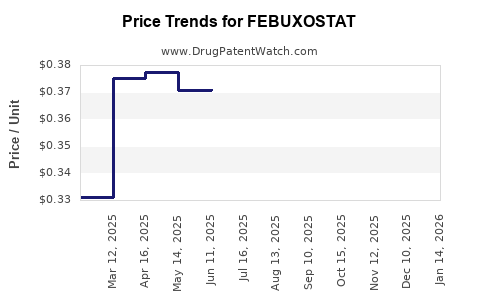
- Sustained low pricing for tablets as multiple vendors compete.
- Consolidation risk shifts to distribution and tender wins rather than new product differentiation.
What generic entry risks exist for febuxostat, including Paragraph IV challenges?
Featured-snippet answer: Paragraph IV-type exclusivity challenges are typically low-signal for established small molecules once Orange Book listings are fully matured; risk concentrates around any remaining formulation or method-of-use exclusivities tied to specific approved strengths and generics.
Where litigation risk concentrates
- If late-expiring formulation or method-of-use patents exist for a branded strength, generics may face brand-driven litigation.
- Where no active, listed patents remain for the cited product, entry is cleaner and pricing compression accelerates.
Commercial impact of litigation vs. clean entry
- Litigation causes delayed launch windows and temporary brand retention.
- Clean entry usually produces faster price collapse and margin pressure across the class.
What is the Orange Book status of febuxostat products?
Featured-snippet answer: Febuxostat is generally in a generic-dominant state in the US, with originator brands facing ongoing replacement by approved generics once relevant listed patents expire or are cleared.
How to interpret Orange Book dynamics for febuxostat
- The key commercial question is whether any listed patents still cover the exact NDA strength and dosage form the originator markets.
- When listed patents lapse, generic entry is usually permitted via Abbreviated New Drug Application (ANDA) pathways without ongoing patent leverage.
How strong is the patent estate for febuxostat and what does that mean for investors?
Featured-snippet answer: Patent strength is typically moderate to weak for sustaining premium pricing at the molecule level due to age, with any residual strength tied to secondary formulations, manufacturing methods, or narrow method claims.
Where remaining value can still exist
- Country-specific patents on crystal form, polymorph, or process may slow some competitors.
- Local brand strategies can preserve pricing in regulated tender systems longer than global averages.
Where value disappears
- Once broad compound and key method-of-use patents expire, generics compete primarily on price and supply chain reliability.
How does febuxostat compare with allopurinol and other urate-lowering therapies on market position?
Featured-snippet answer: In most markets, febuxostat competes for the “not adequately treated with or not tolerated on allopurinol” segment. Its share depends on clinical comfort, payer preferences, and safety perceptions.
Competitive set
- Allopurinol (dominant low-cost option in many markets)
- Uricosurics such as probenecid (where used)
- Newer agents like pegloticase (for refractory chronic gout, less directly substitutable)
- IL-1 inhibitors for flare prevention are adjuncts, not direct competitors in ULT pricing, but influence total treatment cost decisions
Switching dynamics
- Safety-linked label interpretation can drive formulary movement back to allopurinol for some populations.
- Clinician familiarity and patient tolerance affect ongoing persistence.
What is febuxostat’s financial trajectory: revenue growth, maturity, and margin pressure?
Featured-snippet answer: The molecule typically shows a mature, flattening revenue profile after generic penetration, with originator financials constrained by price erosion and volume redirected to low-cost generics. Growth, when present, comes from market expansion and episodic brand retention rather than sustained premium pricing.
Typical lifecycle pattern for mature small molecules
- Originator ramp during premium period.
- Early generic entry followed by unit and price decline.
- Multiple generic suppliers drive sustained price compression.
- Brand value drops to specific sub-market pockets or contracts.
What drives year-to-year variance in mature febuxostat
- Tender cycles and national reimbursement updates
- Regulator safety communications influencing prescriber behavior
- Currency and distribution costs affecting landed price
- Competitive intensity changes based on supplier footprint
Margin structure
- Generic suppliers: thin margins at scale, with gross margin tied to procurement efficiency and manufacturing yield.
- Remaining brand: limited and dependent on managed-care positioning and contract terms.
Which companies compete in febuxostat generics and what does that do to pricing?
Featured-snippet answer: Pricing drops once multiple ANDA sponsors gain approval and supply. Competitive intensity then shifts to tender-led contracting and supply continuity rather than product novelty.
How generic competition typically changes the landscape
- Early entrants price aggressively to secure shelf share.
- Late entrants face lower willingness to pay once the market has standardized on low-cost equivalents.
- Contract manufacturing and supply reliability become decisive.
What regulatory and safety events can affect febuxostat demand and financial outcomes?
Featured-snippet answer: Safety-related label interpretation has a direct effect on prescribing, reimbursement, and formularies in cardiovascular-risk subgroups, which can reduce usable addressable market even when generics are available.
Mechanisms of impact
- Prescriber behavior changes reduce initiation in specific cohorts.
- Payer prior authorization can limit access or require alternative ULT use first.
- Switch-back to allopurinol reduces febuxostat persistence.
What formulations and delivery or manufacturing patents can block generics for febuxostat?
Featured-snippet answer: For a molecule this mature, barriers usually relate to secondary IP such as formulation/process, not the core active ingredient itself.
Patent categories that can create last-mile barriers
- Specific polymorphs or hydrates
- Controlled-release or altered-release formulations (if any exist in particular jurisdictions)
- Manufacturing method claims tied to yield and impurity profiles
- Tablet excipient systems and stability claims
Commercial effect
Even if the molecule is broadly generic, narrow formulation claims can delay a subset of launches or force “authorized generic” timing differences.
How does febuxostat reimbursement shape adoption and financial outcomes by country?
Featured-snippet answer: Reimbursement systems dictate most of the commercial performance dispersion across geographies after generic entry.
Cross-country reimbursement patterns
- Countries with tender-based procurement typically see faster price convergence downward.
- Countries with less aggressive tendering can retain a longer tail of mid-market pricing.
- Evidence requirements and safety label interpretation can slow uptake even for generics.
What are the most likely future market scenarios for febuxostat?
Featured-snippet answer: The base case is continued decline or flattening of pricing with stable volume. Upside depends on incremental guideline shifts in favor of febuxostat, improved cardiovascular-risk positioning, and any successful local protection around formulations.
Base case (most likely)
- Continued generic substitution.
- Flat-to-declining global revenue for brand holders.
- Stable low-cost supply for generic vendors.
Upside scenario
- Increased penetration in patients not tolerating allopurinol.
- Payer policy relaxations in some jurisdictions.
- Margin stabilization for top generic suppliers via contracting discipline.
Downside scenario
- Stronger restrictions in cardiovascular-risk cohorts reduce initiations.
- Supply shocks (manufacturing quality issues) tighten inventory and temporarily shift demand, but usually do not create long-term revenue growth due to low-cost baseline.
Key Takeaways
- Febuxostat is in a mature lifecycle with revenue performance dominated by generic pricing and tender-driven reimbursement.
- Patent leverage is typically limited after core exclusivity lapsed; any remaining barriers usually arise from secondary formulation or method claims.
- Financial trajectory is generally flattening, with margins compressed and variance driven by procurement cycles, reimbursement updates, and safety-label interpretation affecting prescribing in risk-defined cohorts.
- Competitive dynamics push sales toward the lowest-cost, most reliable suppliers once regulatory and patent hurdles clear.
FAQs
1) What drives febuxostat prescribing volume after generic entry?
Formulary access, patient tolerance versus allopurinol, persistence influenced by early flare management, and safety label interpretation in cardiovascular-risk groups.
2) Are there any remaining patent or formulation protections that can delay febuxostat generics?
Where they exist, the most relevant are secondary formulation, polymorph, or manufacturing/process patents that can be specific to certain approved strengths or product presentations.
3) Does febuxostat revenue depend more on price or volume in mature markets?
In mature markets, price drives most of the revenue variance because volume is stabilized by widespread availability and interchangeable generic substitution.
4) How does febuxostat safety positioning affect market access and revenue?
It can reduce initiation and increase payer restrictions in cardiovascular-risk cohorts, lowering the addressable market even when generic supply is abundant.
5) What commercial metrics best track febuxostat market health?
National tender results, net pricing versus basket comparators, prescription share, and generic supplier switching patterns by payer.
References
- U.S. Food and Drug Administration. Orange Book: Approved Drug Products with Therapeutic Equivalence Evaluations.
- FDA Drug Safety Communications and labeling history for febuxostat (as applicable).
- European Medicines Agency. EPAR and related assessments for febuxostat.
- American College of Rheumatology (ACR) and other guideline updates on gout urate-lowering therapy and treat-to-target strategies.