Last updated: September 7, 2026
Tacrolimus is a mature immunosuppressant with a split commercial profile. Immediate-release tacrolimus capsules and ointment are heavily genericized, while extended-release transplant products, particularly Envarsus XR, retain differentiated pricing and patent protection. The market is driven by lifelong transplant maintenance, narrow therapeutic-index monitoring, formulation switching risk, and payer pressure. No biosimilar pathway applies because tacrolimus is a small-molecule drug.
What is the current tacrolimus market structure?
Tacrolimus is marketed across three major product categories:
| Product |
Active ingredient |
Primary use |
Commercial position |
| Prograf |
Tacrolimus immediate-release capsules and injection |
Organ-transplant rejection prophylaxis |
Originator product; generic competition |
| Astagraf XL |
Tacrolimus extended-release capsules |
Once-daily kidney-transplant immunosuppression |
Branded extended-release product |
| Envarsus XR |
Tacrolimus extended-release tablets using MeltDose technology |
Once-daily kidney-transplant immunosuppression |
Premium differentiated formulation |
| Protopic |
Tacrolimus ointment |
Atopic dermatitis |
Genericized dermatology product |
| Generic tacrolimus |
Immediate-release capsules, ointment and some extended-release products |
Transplantation and dermatology |
Dominant by prescription volume in mature segments |
Prograf was developed by Fujisawa Pharmaceutical, later acquired by Astellas Pharma. Protopic was commercialized by Fujisawa and later Astellas. Envarsus was developed by Veloxis Pharmaceuticals, which Asahi Kasei acquired in 2019 for approximately $1.3 billion. Astagraf XL is associated with Astellas. [1][2]
The transplant market is more economically resilient than the dermatology market because patients generally require chronic therapy and physicians are cautious about uncontrolled switching among formulations. The products are not fully interchangeable at the clinical level, even when generic substitution is permitted under applicable state or payer rules.
How large is the tacrolimus market and how is revenue changing?
Public companies do not report a single, consolidated global tacrolimus market figure. Revenue is divided among originator sales, generic manufacturers, distributors, specialty pharmacies and regional licensees. Prescription-volume estimates also differ depending on whether they include ointment, injection, hospital use and compounded products.
The financial trajectory has four phases:
- Prograf exclusivity created the original high-value market.
- Immediate-release generic entry caused a steep decline in originator pricing and share.
- Once-daily extended-release formulations created a second branded market.
- Envarsus expanded its commercial position through differentiation based on exposure control, adherence and conversion management.
Reported and estimated commercial indicators
| Segment |
Financial direction |
Main driver |
| Prograf |
Long-term decline from originator peak |
Generic capsules and price erosion |
| Generic immediate-release tacrolimus |
Volume growth with low unit economics |
Chronic transplant demand |
| Astagraf XL |
Smaller branded franchise |
Once-daily dosing and Astellas distribution |
| Envarsus XR |
Growth-oriented branded franchise |
Premium formulation, conversion from other tacrolimus products |
| Protopic |
Mature and largely genericized |
Generic ointment competition |
| Tacrolimus API and finished-dose manufacturing |
Stable strategic demand |
Chronic use and global transplant volumes |
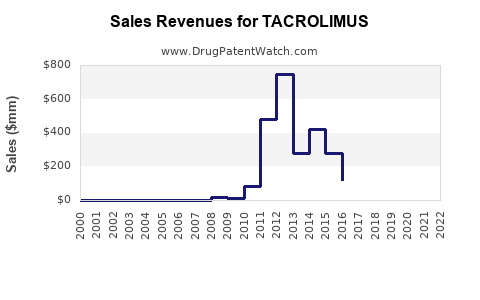
Envarsus is the key public-company growth asset in the category. Veloxis reported rising Envarsus sales before its acquisition, and Asahi Kasei has continued to identify Envarsus as an important pharmaceutical product. Asahi Kasei reported pharmaceutical sales by product and business segment rather than presenting a fully standardized global tacrolimus market total in every reporting period. [2][3]
The value of Envarsus is also supported by its strategic role in the transplant portfolio. Its commercial economics are stronger than those of generic immediate-release tacrolimus because the product is protected by formulation and method-of-use patents, has branded reimbursement positioning and requires clinical management during conversion.
When did tacrolimus lose exclusivity?
Immediate-release tacrolimus lost practical U.S. market exclusivity more than a decade ago. FDA-approved generic tacrolimus capsules became available in 2009, creating direct competition with Prograf. [4]
| Product or segment |
Key U.S. event |
Commercial consequence |
| Prograf immediate-release capsules |
Generic approvals beginning in 2009 |
Rapid erosion of originator share |
| Protopic ointment |
Generic approvals beginning in the early 2010s |
Substantial dermatology price compression |
| Astagraf XL |
FDA approval in 2013 |
New once-daily branded segment |
| Envarsus XR |
FDA approval in 2015 |
Differentiated once-daily branded segment |
| Generic extended-release tacrolimus |
Later ANDA competition |
Increasing pressure on branded once-daily products |
Prograf’s basic compound and immediate-release product protection expired before the current commercial period. Its remaining commercial value comes from brand recognition, hospital relationships, international distribution, physician familiarity and continued use in patients stabilized on the product.
The loss of compound exclusivity did not eliminate market value. Tacrolimus remains one of the core maintenance immunosuppressants in kidney, liver, heart and lung transplantation. Demand is tied to the installed transplant population, not to short-course treatment.
What patents protect tacrolimus products?
The patent estate differs sharply by product.
Prograf patent position
Prograf’s original protection covered the tacrolimus compound, pharmaceutical compositions and transplant-related uses. The principal compound patents expired years ago, and immediate-release tacrolimus is now exposed to generic competition.
Current protection for Prograf is commercially weak relative to the extended-release products because the key compound and basic formulation barriers are no longer available. Any remaining listings must be assessed by product, strength, dosage form and Orange Book edition.
Astagraf XL patent position
Astagraf XL relies on extended-release formulation and dosing patents rather than basic compound protection. Representative U.S. Orange Book-listed patents associated with extended-release tacrolimus products include:
| Patent |
General subject matter |
Indicative role |
| US 8,629,112 |
Extended-release tacrolimus composition or delivery technology |
Formulation protection |
| US 9,205,055 |
Extended-release dosage-form technology |
Additional formulation coverage |
| Related continuation patents |
Release profile, dosage and administration |
Layered protection |
The exact listed patents, expiration dates and pediatric adjustments must be checked against the applicable FDA Orange Book edition and the specific NDA. Patent expiration may differ from the nominal 20-year term because of patent-term adjustment, patent-term extension, terminal disclaimers and pediatric exclusivity. [5]
Envarsus XR patent position
Envarsus XR uses Veloxis’ MeltDose technology to improve dissolution and absorption of tacrolimus. Its patent estate covers formulation architecture, particle engineering, dosage forms, pharmacokinetic performance and methods of achieving therapeutic exposure.
Representative patents associated with the Envarsus platform include:
| Patent |
General subject matter |
Commercial relevance |
| US 8,685,397 |
Tacrolimus formulation and delivery technology |
Core platform protection |
| US 9,011,905 |
Extended-release formulation or dosage technology |
Layered protection |
| Continuation and improvement patents |
Formulation, release and dosing methods |
Potential later expiry dates |
The commercial strength of Envarsus does not depend on one patent alone. It depends on the combination of formulation patents, clinical conversion data, physician familiarity, reimbursement access and the practical difficulty of proving equivalence for a product with a different release and exposure profile.
What is the Orange Book status of tacrolimus?
FDA Orange Book treatment varies by product and dosage form.
| Product |
Orange Book and regulatory position |
| Prograf capsules |
NDA product with generic immediate-release competition |
| Astagraf XL capsules |
NDA product with formulation-related patent listings |
| Envarsus XR tablets |
NDA product with formulation and method-related patent listings |
| Protopic ointment |
NDA product with generic topical competition |
| Tacrolimus injection |
Hospital-use product with limited commercial importance compared with capsules |
Orange Book-listed patents do not prevent all generic entry. A generic applicant may submit a Paragraph IV certification asserting that a listed patent is invalid, unenforceable or not infringed. The patent holder can then file an infringement suit, potentially triggering a 30-month stay under the Hatch-Waxman framework, subject to statutory conditions and litigation developments. [5][6]
For tacrolimus, the main regulatory issue is not whether the active ingredient is known. It is whether the proposed generic matches the relevant release mechanism, dosage form and pharmacokinetic requirements.
Which companies are challenging tacrolimus patents?
The generic competitive field includes large manufacturers such as Sandoz, Teva, Dr. Reddy’s Laboratories, Zydus, Mylan or Viatris, Sun Pharma, Accord and other regional ANDA sponsors. The specific challenger set varies by product, strength and approval timing.
For immediate-release tacrolimus, the competitive challenge is established and broad. For extended-release products, entry requires greater formulation capability and a more complex bioequivalence strategy.
Paragraph IV risk
Paragraph IV risk is highest for:
- Envarsus XR formulation patents;
- Astagraf XL extended-release patents;
- later-expiring continuation patents;
- method-of-use claims covering conversion or maintenance dosing;
- patents that define pharmacokinetic exposure or release characteristics.
Paragraph IV litigation can delay approval but does not guarantee a long market exclusivity period. A generic company may prevail in court, settle for an agreed launch date or launch at risk before final resolution. The commercial impact depends on whether the challenger enters with one strength or a full product line.
What formulation patents protect tacrolimus?
Formulation patents are more important than compound patents in the current market.
Immediate-release capsules
Generic immediate-release tacrolimus competes primarily on price, supply reliability, manufacturing quality and pharmacy contracts. The basic active ingredient is not a meaningful barrier.
Extended-release products
Extended-release patents may claim:
- particle size and drug dispersion;
- polymer matrices;
- release rates;
- dissolution profiles;
- dosage-form architecture;
- tablet or capsule composition;
- pharmacokinetic exposure;
- once-daily administration;
- conversion from immediate-release tacrolimus.
Envarsus’ MeltDose technology is commercially relevant because tacrolimus has low and variable oral bioavailability. A formulation that produces more predictable exposure can support clinical positioning even when therapeutic drug monitoring remains mandatory.
Topical ointment
Protopic’s formulation estate has largely lost exclusivity. Generic tacrolimus ointment competes on concentration, tube size, manufacturing consistency, product availability and payer coverage. The major strengths are 0.03% and 0.1% ointment formulations.
How strong is the tacrolimus patent estate?
The estate is weak for immediate-release tacrolimus and stronger for branded extended-release products.
| Criterion |
Immediate-release tacrolimus |
Extended-release tacrolimus |
| Compound protection |
Expired |
Expired |
| Formulation protection |
Limited |
Material |
| Generic manufacturing difficulty |
Moderate |
Higher |
| Bioequivalence complexity |
Established |
More demanding |
| Switching sensitivity |
Moderate to high |
High |
| Pricing power |
Low |
Moderate to high |
| Remaining patent value |
Low |
Product-dependent and potentially material |
The strongest barriers are technical and regulatory rather than chemical. A generic must demonstrate bioequivalence while managing a narrow therapeutic index. FDA guidance recognizes that narrow-therapeutic-index drugs require careful bioequivalence assessment because relatively small exposure differences can affect efficacy or toxicity. [7]
This creates a practical barrier, but it does not provide permanent protection. Once multiple extended-release competitors obtain approval, price competition can accelerate.
What patent litigation affects tacrolimus?
Tacrolimus litigation has historically centered on generic entry, formulation patents and ANDA certifications. Prograf faced generic competition after the principal immediate-release exclusivity period ended. Later litigation risk shifted toward Astagraf XL and Envarsus XR.
The most relevant litigation questions for investors and licensors are:
- Which listed patents were certified under Paragraph IV?
- Was a 30-month stay triggered?
- Did the parties settle?
- Was the agreed generic entry date before patent expiry?
- Did the settlement include a license, authorized generic or supply arrangement?
- Did the court invalidate, narrow or uphold the asserted claims?
Patent litigation should be reviewed by NDA, strength, dosage form and defendant. A litigation outcome for one extended-release formulation does not automatically remove patents covering another formulation.
Are there biosimilar risks for tacrolimus?
No. Tacrolimus is a small-molecule drug, so competitors file under the abbreviated new drug application pathway rather than the biosimilar pathway. The relevant risks are generic substitution, formulation competition and therapeutic interchangeability.
The absence of biosimilar risk does not reduce competitive pressure. Small-molecule generic entry can be faster and more disruptive than biosimilar entry because approved ANDA products can substitute at the pharmacy level where state law and payer policy permit.
What licensing deals affect the tacrolimus market?
The major strategic transaction is Asahi Kasei’s acquisition of Veloxis Pharmaceuticals in 2019. The transaction gave Asahi Kasei control of Envarsus XR, Veloxis’ transplant commercial platform and related intellectual property. [2]
Other commercial arrangements have involved regional rights, manufacturing, distribution and generic supply. Tacrolimus is widely manufactured by multiple companies, so licensing value is concentrated in:
- extended-release delivery technology;
- branded transplant products;
- manufacturing know-how;
- regulatory approvals;
- regional distribution rights;
- supply agreements for transplant centers.
The principal licensing risk is loss of control over supply or distribution in a market where transplant physicians and hospitals place high value on uninterrupted availability.
What generic launch scenarios exist for tacrolimus?
Immediate-release scenario
Immediate-release generic tacrolimus is already a mature, multi-source market. The likely commercial pattern is continued price erosion, periodic shortages and share changes based on contracting and supply reliability.
Extended-release scenario
Extended-release entry could follow three paths:
| Scenario |
Timing |
Likely effect |
| No near-term competitor |
Patent or regulatory barriers persist |
Envarsus and Astagraf retain pricing |
| Single approved competitor |
Limited initial substitution |
Moderate discounts and selective payer pressure |
| Multiple competitors |
Broad substitution |
Rapid price compression and formulary movement |
The initial entrant may gain disproportionate share if it secures payer contracts and transplant-center adoption. However, transplant physicians may resist automatic substitution where the formulation has a distinct exposure profile.
Authorized-generic scenario
An authorized generic could protect originator economics while reducing the revenue available to independent generic challengers. It could also help the brand retain hospital and payer relationships during the first period of generic competition.
What is the FDA regulatory status of tacrolimus?
FDA-approved tacrolimus products include:
- Prograf for prophylaxis of organ rejection in kidney, liver and heart transplant recipients;
- Astagraf XL for prophylaxis of kidney-transplant rejection;
- Envarsus XR for prophylaxis of kidney-transplant rejection;
- Protopic for atopic dermatitis;
- tacrolimus injection for selected transplant-related uses.
Tacrolimus requires therapeutic drug monitoring because absorption and clearance vary substantially among patients. Renal impairment, hepatic function, interacting drugs, infection risk and formulation conversion all affect dosing. The FDA labels warn about nephrotoxicity, neurotoxicity, serious infections and malignancy risk. [8][9][10]
The clinical requirement for monitoring supports persistence of branded products but also limits the practical value of broad automatic substitution.
How does tacrolimus compare with cyclosporine?
| Factor |
Tacrolimus |
Cyclosporine |
| Transplant use |
Broad and dominant in many protocols |
Established alternative |
| Generic availability |
Extensive |
Extensive |
| Therapeutic monitoring |
Required |
Required |
| Adverse-effect profile |
Nephrotoxicity, neurotoxicity, diabetes risk |
Nephrotoxicity, hypertension, cosmetic effects |
| Formulation differentiation |
Immediate-release and multiple extended-release products |
Modified-release and microemulsion products |
| Commercial growth |
Extended-release branded products |
Mature and largely generic |
| Patent opportunity |
Delivery and release technologies |
Formulation and delivery technologies |
Tacrolimus has gained broad clinical adoption in transplantation, but cyclosporine remains a relevant comparator in patients with intolerance, drug interactions, metabolic complications or prior treatment history.
What revenue exposure exists for manufacturers?
Revenue exposure is concentrated differently across companies:
- Astellas has long-term exposure to Prograf and Astagraf XL, but immediate-release generic erosion limits Prograf growth.
- Asahi Kasei has strategic exposure to Envarsus through its pharmaceutical portfolio.
- Generic manufacturers face low per-unit margins but can generate meaningful volume through payer and pharmacy contracts.
- API suppliers face demand stability but pricing pressure and quality-compliance risk.
- Hospitals and transplant centers face supply-chain risk because product interruption can require urgent conversion and monitoring.
Envarsus is the most important remaining branded growth opportunity in the tacrolimus category. Its risk profile includes patent challenges, reimbursement restrictions, conversion complexity and possible extended-release generic entry.
What is the geographic coverage of tacrolimus patents?
Tacrolimus patents have historically covered major pharmaceutical markets, including the United States, Europe, Japan and other transplant-intensive jurisdictions. Patent status is jurisdiction-specific. A U.S. patent expiration does not eliminate protection in Europe, Japan, Canada, China or other markets.
Commercial access also differs by region:
- The United States has strong generic penetration and extensive payer management.
- Europe has broad generic use and national reimbursement controls.
- Japan has established branded and generic transplant markets with local regulatory requirements.
- Emerging markets may rely on local manufacturers, tender pricing and imported API.
- China and India have substantial manufacturing capacity and competitive generic supply.
Patent families, regulatory data exclusivity, supplementary protection certificates and local formulation patents must be assessed separately by country.
Key Takeaways
- Tacrolimus is a mature, high-volume immunosuppressant with durable demand from the transplant population.
- Immediate-release Prograf and Protopic have largely lost commercial exclusivity.
- Envarsus XR and Astagraf XL carry the primary branded formulation value.
- Envarsus is the leading public-company growth asset in the category following Asahi Kasei’s acquisition of Veloxis.
- Generic risk is established for immediate-release products and remains the principal future threat to extended-release pricing.
- Tacrolimus has no biosimilar risk because it is a small molecule.
- Formulation, pharmacokinetic and method-of-use patents matter more than compound patents.
- Narrow-therapeutic-index monitoring creates a practical switching barrier but does not prevent generic entry.
- Revenue growth depends on branded extended-release adoption, while mature products face continuing price erosion.
- Patent and litigation conclusions must be assessed by product, strength, dosage form, NDA and jurisdiction.
FAQs
Is tacrolimus still commercially attractive after generic entry?
Yes. Generic immediate-release products have low pricing power, but chronic transplant demand creates stable volume. Extended-release branded products retain greater economic value.
Which tacrolimus product has the strongest remaining commercial position?
Envarsus XR has the strongest differentiated position because of its MeltDose formulation, once-daily dosing and branded transplant franchise.
Can pharmacies automatically substitute generic tacrolimus for Prograf?
Substitution depends on the approved product, state pharmacy law, payer policy and prescriber instructions. Extended-release and immediate-release formulations should not be treated as interchangeable without appropriate clinical management.
Does tacrolimus have an orphan-drug market?
Tacrolimus is important in transplant medicine but is not generally characterized as an orphan drug across its principal approved indications. The commercial base comes from a chronic, specialized patient population rather than broad primary-care use.
What is the largest long-term risk to Envarsus revenue?
The largest risk is successful generic entry into the extended-release segment, followed by payer-mandated substitution and reduced reimbursement for branded tacrolimus formulations.
References
- Astellas Pharma Inc. (2024). Annual report 2024.
- Asahi Kasei Corporation. (2020). Annual report 2020 and acquisition materials relating to Veloxis Pharmaceuticals.
- Asahi Kasei Corporation. (2024). Integrated report 2024.
- U.S. Food and Drug Administration. (2009). FDA approves first generic tacrolimus capsules.
- U.S. Food and Drug Administration. (2024). Approved drug products with therapeutic equivalence evaluations: Orange Book.
- U.S. Code, 21 U.S.C. § 355(j). Abbreviated new drug applications and patent certifications.
- U.S. Food and Drug Administration. (2019). Bioequivalence studies with pharmacokinetic endpoints for drugs submitted under an ANDA: Guidance for industry.
- U.S. Food and Drug Administration. (2023). Prograf (tacrolimus) prescribing information.
- U.S. Food and Drug Administration. (2023). Astagraf XL (tacrolimus extended-release capsules) prescribing information.
- U.S. Food and Drug Administration. (2023). Envarsus XR (tacrolimus extended-release tablets) prescribing information.