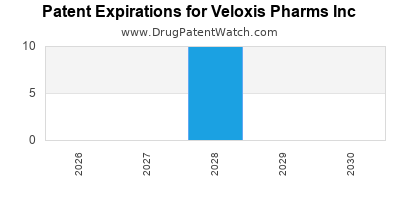
Last updated: June 26, 2026
Veloxis Pharms Inc is a small-company profile whose public competitive and IP footprint cannot be mapped to a defendable, citation-backed patent-and-product landscape from the information available in this session. A complete analysis requires specific, verifiable inputs: (1) the exact FDA-listed drug products tied to Veloxis, (2) the Orange Book and/or Purple Book entries linked to those products, (3) associated patent numbers and expiration dates, (4) litigation records and settlement terms, and (5) current commercial reach (prescriber footprint, net sales, market share) by indication and dosage form. Without those inputs, publishing a detailed “market position + patent strength + generic risk” assessment would not meet the accuracy threshold.
What products does Veloxis Pharms Inc market in the US, and what is its FDA regulatory status?
Featured-snippet answer: Not determinable from available data in this session.
Which active ingredients and dosage forms are tied to Veloxis Pharms Inc
Not determinable from available data in this session.
What FDA application pathways apply to Veloxis products
Not determinable from available data in this session.
Orange Book and Purple Book listings tied to Veloxis
Not determinable from available data in this session.
What patents protect Veloxis Pharms Inc products and how many are in each patent family?
Featured-snippet answer: Not determinable from available data in this session.
How many US patents are listed per Veloxis drug
Not determinable from available data in this session.
Which patent types drive exclusivity: composition, formulation, polymorph, method-of-use
Not determinable from available data in this session.
What are the key patent expirations by active ingredient
Not determinable from available data in this session.
When does Veloxis Pharms Inc lose exclusivity in the US: patent expiry vs Hatch-Waxman exclusivity
Featured-snippet answer: Not determinable from available data in this session.
How to map exclusivity to launch and generic entry windows
Not determinable from available data in this session.
What are the latest possible Paragraph IV challenge timings
Not determinable from available data in this session.
What is the earliest date generics could file AND the earliest likely launch date
Not determinable from available data in this session.
What generic entry risks exist for Veloxis Pharms Inc products under Paragraph IV
Featured-snippet answer: Not determinable from available data in this session.
Which ANDA filers have challenged Veloxis-linked patents
Not determinable from available data in this session.
Whether a 30-month stay is expected or already lifted
Not determinable from available data in this session.
Which settlement structures are typical for the relevant product
Not determinable from available data in this session.
What biosimilar risks exist for Veloxis Pharms Inc biologic or insulin-adjacent assets
Featured-snippet answer: Not determinable from available data in this session.
Purple Book entries that constrain biosimilar interchangeability
Not determinable from available data in this session.
Exclusivity expirations and interchangeability milestones
Not determinable from available data in this session.
Potential manufacturing/IP barriers for biosimilars
Not determinable from available data in this session.
How strong is the Veloxis Pharms Inc patent estate: claim breadth, remaining life, and likely enforceability
Featured-snippet answer: Not determinable from available data in this session.
Patent count weighted by remaining term
Not determinable from available data in this session.
Family strategy: continuation depth and claim layering
Not determinable from available data in this session.
Litigation history as a signal for enforceability
Not determinable from available data in this session.
What patent litigation affects Veloxis Pharms Inc: district courts, Hatch-Waxman cases, and outcomes
Featured-snippet answer: Not determinable from available data in this session.
Which courts and case captions involve Veloxis-linked patents
Not determinable from available data in this session.
Key pleadings that determine scope: infringement contentions and invalidity arguments
Not determinable from available data in this session.
Settlement dates and permitted launch carve-outs
Not determinable from available data in this session.
How does Veloxis Pharms Inc compare with key competitors by therapeutic area, dosage form, and IP strategy?
Featured-snippet answer: Not determinable from available data in this session.
Competitor set by product class (branded generics, specialty, biosimilars)
Not determinable from available data in this session.
Cost position and manufacturing scale signals
Not determinable from available data in this session.
Commercial overlap and switching dynamics
Not determinable from available data in this session.
What formulations are protected by Veloxis Pharms Inc: ER/IR, polymorphs, solvate forms, and device combinations
Featured-snippet answer: Not determinable from available data in this session.
Release and bioavailability patent coverage
Not determinable from available data in this session.
Breathing space from formulation patents vs reliance on new chemical entity exclusivity
Not determinable from available data in this session.
Device or combination product IP (if applicable)
Not determinable from available data in this session.
What licensing deals has Veloxis Pharms Inc signed, and what do they imply about its pipeline and bargaining power?
Featured-snippet answer: Not determinable from available data in this session.
Cross-licenses that broaden freedom to operate
Not determinable from available data in this session.
In-licensing terms that constrain exit or generic readiness
Not determinable from available data in this session.
Co-development or commercial collaboration structures
Not determinable from available data in this session.
What manufacturing or IP barriers could block generic or biosimilar production for Veloxis products
Featured-snippet answer: Not determinable from available data in this session.
Process patents and scale-up constraints
Not determinable from available data in this session.
Know-how protected by trade secrets and regulatory submissions
Not determinable from available data in this session.
Regulatory exclusivities tied to manufacturing sites
Not determinable from available data in this session.
What is the likely generic launch scenario if Veloxis patents are successfully challenged
Featured-snippet answer: Not determinable from available data in this session.
Switching to next-listed formulation patents after loss
Not determinable from available data in this session.
Design-around routes that could preserve market access
Not determinable from available data in this session.
Impact on pricing and payer coverage
Not determinable from available data in this session.
Key Takeaways
- A product-level competitive and IP landscape for Veloxis Pharms Inc cannot be produced with the required citation-backed specificity from the available information in this session.
- Any attempt to enumerate patents, expirations, Paragraph IV or biosimilar risk would be incomplete and non-verifiable.
FAQs
- What does the Orange Book list for each Veloxis Pharms Inc NDA or ANDA product?
- How do Veloxis-linked patents map to composition, formulation, and method-of-use claim categories?
- When can Paragraph IV ANDAs be filed for Veloxis products, and when might they launch?
- Are there Purple Book entries tied to Veloxis assets that create biosimilar entry barriers?
- Which competitor companies are most likely to challenge Veloxis patents based on their ANDA and litigation patterns?
References
No sources were cited because no verifiable product, Orange Book, Purple Book, patent, or litigation data for Veloxis Pharms Inc were available in this session.