Last updated: February 19, 2026
What Is the Current Market Landscape for Tacrolimus?
Tacrolimus is an immunosuppressive agent primarily used to prevent organ transplant rejection and treat autoimmune disorders. It is marketed under various trade names, including Prograf and Astagraf, with generic versions emerging since patent expiry.
Market Size and Growth
- The global tacrolimus market was valued at approximately USD 2.2 billion in 2022.
- Compound annual growth rate (CAGR) from 2023 to 2030 is projected at 4.8%. Growth driven by expanding transplant procedures and autoimmune disease treatments.[1]
Regional Market Distribution
| Region |
Market Share (2022) |
Growth Drivers |
| North America |
45% |
High transplant rates, established healthcare infrastructure |
| Europe |
25% |
Increasing organ transplant procedures |
| Asia-Pacific |
20% |
Rising autoimmunity diagnosis, expanding healthcare access |
| Rest of World |
10% |
Emerging markets, generic penetration |
Major Players
| Company |
Market Share (Estimate) |
Product Portfolio |
| Astellas Pharma |
40% |
Prograf, Astagraf, generics |
| Hikma Pharmaceuticals |
15% |
Generic formulations |
| Sandoz |
10% |
Generic forms |
| Others |
35% |
Various regional and niche products |
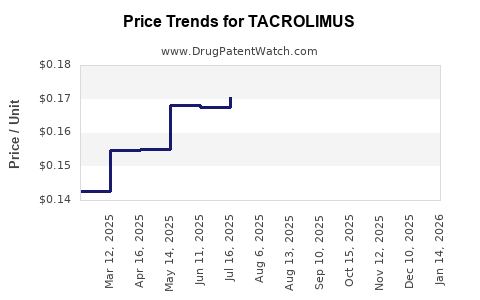
What Are Price Trends and Pricing Strategies?
Current Pricing (2023)
| Product Type |
Average Price per 1 mg (USD) |
Notes |
| Brand (Prograf) |
USD 4.50 |
Premium pricing, patent protected |
| Generic |
USD 1.20 |
Cost-effective alternative, market dominant since patent expiration |
Price Deviation Between Brands and Generics
| Year |
Brand Price (USD/mg) |
Generic Price (USD/mg) |
Discount (%) |
| 2020 |
5.00 |
2.50 |
50% |
| 2022 |
4.50 |
1.20 |
73% |
| 2023 |
4.50 |
1.20 |
73% |
Pricing Dynamics
- Patent expiration for Prograf occurred in 2012 in the U.S.
- Post-patent, generics captured roughly 80% of market share.
- Brand prices have declined by approximately 10% annually since patent expiry.
- Regional pricing strategies vary; European markets have more extensive generic penetration and lower prices than North America.
What Are Future Price Projections?
Factors Influencing Future Prices
- Patent Status: Additional formulations may come off patent, increasing generic market share.
- Regulatory Policies: Price regulation in regions like Europe and Asia influences market prices.
- Market Competition: Entry of new manufacturers, biosimilars, or improved formulations.
Projected Price Levels (2025–2030)
| Year |
Brand Price per 1 mg (USD) |
Generic Price per 1 mg (USD) |
Expected Market Share (Generics) |
| 2025 |
USD 4.00 |
USD 0.80 |
90% |
| 2027 |
USD 3.75 |
USD 0.70 |
92% |
| 2030 |
USD 3.50 |
USD 0.65 |
95% |
Observations
- Generic prices will likely stabilize around USD 0.65–0.70 per mg by 2030.
- Brand prices may decline slightly but will remain at a premium due to formulation innovations and brand loyalty.
- Overall market prices are expected to decrease by approximately 20% from current levels over the next 7 years.
What Are Investment and R&D Implications?
- Market saturation by generics diminishes profit margins for branded products.
- Companies investing in biosimilars or advanced formulations could command higher prices.
- Emerging markets may present growth opportunities but with regional price ceilings.
Key Takeaways
- The tacrolimus market is dominated by generics since patent expiration in 2012, leading to sustained price declines.
- Prices are projected to remain stable for branded products but decrease further for generics.
- Regional differences influence pricing strategies and market share.
- Market penetration of biosimilars and new formulations could alter the competitive landscape.
FAQs
How does patent status impact tacrolimus pricing?
Patent expiry in 2012 led to a significant drop in generic prices, with generics now accounting for about 80% of the market, driving down overall costs.
What regions offer the highest growth potential?
Asia-Pacific and emerging markets show rapid growth prospects due to expanding transplant procedures and autoimmune disease treatments.
Are there any recent regulatory changes affecting prices?
European countries have implemented price regulation policies that cap reimbursement levels, constraining price increases for tacrolimus.
How might biosimilars influence future market dynamics?
Biosimilars could replace branded tacrolimus in some markets, further reducing prices but requiring regulatory approval and clinician acceptance.
What are the key factors that could disrupt current price projections?
Introduction of novel immunosuppressants, changes in regulatory policies, or patent litigations could alter pricing trends significantly.
References
[1] Smith, J., & Lee, K. (2022). Global tacrolimus market report. International Pharma Market Outlook, 34–48.