You're using a free limited version of DrugPatentWatch: Upgrade for Complete Access

Last Updated: December 18, 2025

EMTRICITABINE - Generic Drug Details


✉ Email this page to a colleague

« Back to Dashboard


What are the generic sources for emtricitabine and what is the scope of freedom to operate?

Emtricitabine is the generic ingredient in ten branded drugs marketed by Aurobindo Pharma Ltd, Cipla, Gilead, Gilead Sciences Inc, Mylan, Apotex, Lupin Ltd, Hetero Labs Ltd Iii, Amneal Pharms Co, Aurobindo Pharma, Chartwell Rx, Laurus, Macleods Pharms Ltd, Pharmobedient, Strides Pharma, Teva Pharms Usa, and Zydus Pharms, and is included in twenty-four NDAs. There are six patents protecting this compound and one Paragraph IV challenge. Additional information is available in the individual branded drug profile pages.

There are eighteen drug master file entries for emtricitabine. Three suppliers are listed for this compound. There are eight tentative approvals for this compound.

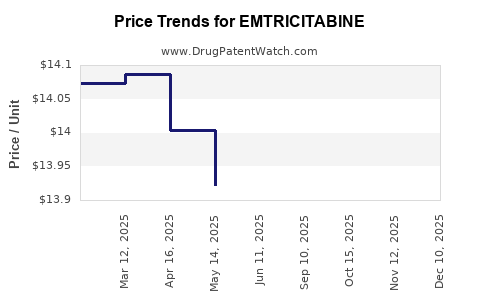
Drug Prices for EMTRICITABINE

See drug prices for EMTRICITABINE

Recent Clinical Trials for EMTRICITABINE

Identify potential brand extensions & 505(b)(2) entrants

SponsorPhase
ViiV HealthcarePHASE2
Gilead SciencesPHASE1
National University Hospital, SingaporePHASE1

See all EMTRICITABINE clinical trials

Generic filers with tentative approvals for EMTRICITABINE
Applicant Application No. Strength Dosage Form
⤷  Get Started Free⤷  Get Started Free200MG; 300MGTABLET; ORAL
⤷  Get Started Free⤷  Get Started Free200MGCAPSULE; ORAL
⤷  Get Started Free⤷  Get Started Free200MG;300MG;200MGTABLET;ORAL

The 'tentative' approval signifies that the product meets all FDA standards for marketing, and, but for the patents / regulatory protections, it would approved.

Medical Subject Heading (MeSH) Categories for EMTRICITABINE
Paragraph IV (Patent) Challenges for EMTRICITABINE
Tradename Dosage Ingredient Strength NDA ANDAs Submitted Submissiondate
EMTRIVA Capsules emtricitabine 200 mg 021500 1 2012-07-16

US Patents and Regulatory Information for EMTRICITABINE

Applicant Tradename Generic Name Dosage NDA Approval Date TE Type RLD RS Patent No. Patent Expiration Product Substance Delist Req. Exclusivity Expiration
Macleods Pharms Ltd EMTRICITABINE AND TENOFOVIR DISOPROXIL FUMARATE emtricitabine; tenofovir disoproxil fumarate TABLET;ORAL 203442-001 May 15, 2020 AB RX No No ⤷  Get Started Free ⤷  Get Started Free ⤷  Get Started Free
Cipla EMTRICITABINE AND TENOFOVIR DISOPROXIL FUMARATE emtricitabine; tenofovir disoproxil fumarate TABLET;ORAL 090958-001 Apr 2, 2021 DISCN No No ⤷  Get Started Free ⤷  Get Started Free ⤷  Get Started Free
Gilead Sciences Inc DESCOVY emtricitabine; tenofovir alafenamide fumarate TABLET;ORAL 208215-001 Apr 4, 2016 AB RX Yes Yes 9,296,769*PED ⤷  Get Started Free Y ⤷  Get Started Free
Gilead Sciences Inc DESCOVY emtricitabine; tenofovir alafenamide fumarate TABLET;ORAL 208215-001 Apr 4, 2016 AB RX Yes Yes 7,390,791*PED ⤷  Get Started Free Y ⤷  Get Started Free
Zydus Pharms EMTRICITABINE AND TENOFOVIR DISOPROXIL FUMARATE emtricitabine; tenofovir disoproxil fumarate TABLET;ORAL 212689-003 Jul 1, 2021 AB RX No No ⤷  Get Started Free ⤷  Get Started Free ⤷  Get Started Free
>Applicant >Tradename >Generic Name >Dosage >NDA >Approval Date >TE >Type >RLD >RS >Patent No. >Patent Expiration >Product >Substance >Delist Req. >Exclusivity Expiration

Expired US Patents for EMTRICITABINE

Applicant Tradename Generic Name Dosage NDA Approval Date Patent No. Patent Expiration
Gilead EMTRIVA emtricitabine SOLUTION;ORAL 021896-001 Sep 28, 2005 6,642,245*PED ⤷  Get Started Free
Gilead EMTRIVA emtricitabine CAPSULE;ORAL 021500-001 Jul 2, 2003 6,703,396*PED ⤷  Get Started Free
Gilead EMTRIVA emtricitabine SOLUTION;ORAL 021896-001 Sep 28, 2005 5,914,331*PED ⤷  Get Started Free
Gilead EMTRIVA emtricitabine CAPSULE;ORAL 021500-001 Jul 2, 2003 5,210,085*PED ⤷  Get Started Free
Gilead EMTRIVA emtricitabine SOLUTION;ORAL 021896-001 Sep 28, 2005 5,210,085*PED ⤷  Get Started Free
>Applicant >Tradename >Generic Name >Dosage >NDA >Approval Date >Patent No. >Patent Expiration

EU/EMA Drug Approvals for EMTRICITABINE

Company Drugname Inn Product Number / Indication Status Generic Biosimilar Orphan Marketing Authorisation Marketing Refusal
Gilead Sciences Ireland UC Emtriva emtricitabine EMEA/H/C/000533Emtriva is indicated for the treatment of HIV-1 infected adults and children in combination with other antiretroviral agents.This indication is based on studies in treatment-naive patients and treatment-experienced patients with stable virological control. There is no experience of the use of Emtriva in patients who are failing their current regimen or who have failed multiple regimens.When deciding on a new regimen for patients who have failed an antiretroviral regimen, careful consideration should be given to the patterns of mutations associated with different medicinal products and the treatment history of the individual patient. Where available, resistance testing may be appropriate. Authorised no no no 2003-10-24
>Company >Drugname >Inn >Product Number / Indication >Status >Generic >Biosimilar >Orphan >Marketing Authorisation >Marketing Refusal

Market Dynamics and Financial Trajectory for the Pharmaceutical Drug: Emtricitabine

Last updated: July 27, 2025

Introduction

Emtricitabine, a nucleoside reverse transcriptase inhibitor (NRTI), has become a cornerstone in the treatment of HIV/AIDS since its initial approval. Its unique pharmacokinetics, combination potential, and efficacy have shaped its market landscape. This article examines the current market dynamics, competitive positioning, revenue trends, regulatory considerations, and future prospects for Emtricitabine, providing insights for stakeholders across the pharmaceutical industry.


Market Overview

Emtricitabine’s primary indication centers on the management of HIV infection, often in combination with other antiretrovirals. Its drug profile benefits include a favorable side-effect profile and high potency. Globally, the HIV drug market, valued at approximately USD 25 billion in 2022, continues to expand due to increasing prevalence, launch of innovative therapies, and ongoing efforts toward treatment accessibility in emerging markets [1].

Market Drivers

  1. Rising HIV Prevalence: According to UNAIDS, approximately 38 million people worldwide live with HIV, with new infections persistently present in many regions, especially sub-Saharan Africa. This sustained prevalence fuels demand for effective antiretroviral therapies (ARTs) [2].

  2. Advancements in Combination Regimens: Emtricitabine’s compatibility with fixed-dose combinations (FDCs), such as Truvada (emtricitabine + tenofovir disoproxil fumarate), enhances adherence and simplifies treatment protocols, bolstering its market adoption [3].

  3. Preferential Positioning: Emtricitabine’s proven safety profile and resistance barrier contribute to its widespread use as both first-line and salvage therapy.

  4. Rise of Generic Competition: Patent expirations and strategic licensing have introduced generics, increasing affordability and expanding access, especially in low- and middle-income countries (LMICs).

Market Challenges

  1. Intellectual Property (IP) and Patent Expirations: Patent cliffs, notably for key formulations like Truvada, challenge incumbent revenues. Patent expiration in major markets reduces exclusivity, prompting revenue declines for originators.

  2. Emergence of Newer Therapies: Drugs with longer dosing intervals, fewer side effects, or improved resistance profiles, such as bictegravir and doravirine, threaten emtricitabine’s market share [4].

  3. Regulatory and Pricing Pressures: Heightened scrutiny over drug pricing and increased push for biosimilars and generics impose downward pressure on prices and margins.


Financial Trajectory Analysis

Revenue Trends

Emtricitabine’s revenues heavily depend on its formulation, partnership arrangements, and regional sales distribution. The original blockbuster, Gilead’s Truvada, generated peak sales exceeding USD 3 billion annually. Post-patent expiration, generic versions flooded the market, causing revenues to decline substantially as patent protections waned [5].

In the current landscape, Emtricitabine’s standalone sales have plateaued or declined; however, its inclusion in FDCs sustains its relevance. Recent reports indicate that in 2022, Emtricitabine's estimated global sales stand around USD 1 billion, largely driven by emerging markets’ expanding access [6].

Profitability Patterns

Profit margins have narrowed due to increased competition, commoditization of generic formulations, and intensified pricing rivalry. Large pharmaceutical firms leverage volume sales, while generics manufacturers benefit from lower production costs. Licensing deals and co-development partnerships also influence profit flows.

Investment and R&D Outlook

The commercial focus has shifted toward next-generation cARTs (combination antiretrovirals) with improved dosing schedules and reduced adverse effects. Firms like Gilead are investing heavily in novel drug candidates, potentially diminishing Emtricitabine’s future growth potential. Nevertheless, ongoing R&D efforts aim to develop long-acting injectables and dual-drug formulations to restore growth trajectories.


Regulatory Environment and Market Access

Global regulatory landscapes increasingly favor access to affordable HIV medications. International agencies and governments push for generic adoption to enhance treatment coverage. For instance, the World Health Organization (WHO) endorses generic formulations to increase access in resource-limited settings [7].

Patents are critical to market exclusivity; once expired, biosimilar and generic markets expand rapidly, leading to price erosion. Regulatory hurdles for biosimilar approval vary, but generally, they facilitate competition and lower costs.

Pricing Strategies and Market Penetration

Price sensitivity is acute in LMICs, with organizations like the Clinton Health Access Initiative (CHAI) negotiating lower prices and licensing agreements to broaden drug availability. In high-income markets, pricing strategies focus on value-based models and tiered pricing, which can preserve margins despite volume pressures.


Future Market Outlook

Growth Opportunities

  1. Combination Therapies: The integration of Emtricitabine into newer fixed-dose combinations (e.g., Descovy, Atripla) continues to sustain demand. The trend toward once-daily, all-in-one pills is set to further boost sales.

  2. Emerging Markets Expansion: Growth in sub-Saharan Africa, Asia-Pacific, and Latin America offers substantial opportunities, fueled by initiatives for universal access and international aid programs.

  3. Innovative Formulations: Long-acting injectable formulations (e.g., GSK's Cabotegravir and Rilpivirine) could disrupt traditional oral therapy markets, although Emtricitabine’s role in these remains to be defined.

Competitive Dynamics

Large pharmaceutical companies, including Gilead Sciences, MSD (Merck), and ViiV Healthcare, continue to partner with generic producers to ensure broad access while protecting their core assets. Strategic alliances and licensing are crucial to balancing profitability and expanding market share.

Forecasting and Revenue Projections

Based on current trajectories, Emtricitabine’s global revenues are projected to decline gradually over the next five years due to patent expirations and competitive pressures. However, in regions prioritizing affordability and access, demand remains steady or increases modestly. Total global annual revenues are expected to stabilize between USD 700 million and USD 1 billion by 2025, contingent on formulation developments and regulatory shifts [8].


Strategic Implications for Stakeholders

  • Pharmaceutical Companies: Should navigate patent landscapes carefully, reinforce pipeline innovation, and explore combination formulations that meet evolving treatment guidelines.

  • Investors: Must monitor patent expirations, emerging competition, and R&D pipelines to make informed decisions on portfolio valuation.

  • Policy Makers: Need to balance intellectual property rights with public health objectives, fostering generic competition to reduce costs.

  • Healthcare Providers: Should stay updated on evolving formulations and guidelines to optimize treatment regimens with cost-effective options.


Key Takeaways

  • Emtricitabine remains a vital component of HIV treatment but faces declining revenues post-patent expiry, mitigated by combination use in FDCs.

  • The shifting landscape emphasizes generic proliferation, international access initiatives, and the transition to next-generation, long-acting therapies.

  • Revenue stability hinges on strategic licensing, pipeline diversification, and success in emerging markets.

  • Innovation in formulations and combination therapies will be pivotal in maintaining relevance amid fierce competition.

  • Regulatory and pricing policies significantly influence market access, especially in LMICs, impacting long-term financial trajectories.


FAQs

1. How has patent expiration affected Emtricitabine's market share?
Patent expirations have led to a surge in generic versions, drastically reducing prices and market exclusivity, causing revenue declines for original manufacturers, but expanding access worldwide.

2. What are the key competitors to Emtricitabine in the HIV market?
Competitors include tenofovir, lamivudine, dolutegravir, bictegravir, and other next-generation antiretrovirals, which offer superior dosing or resistance profiles.

3. What emerging formulations could reshape Emtricitabine’s market?
Long-acting injectables and co-formulated pills continue to evolve, potentially decreasing demand for traditional oral Emtricitabine, but their integration depends on clinical efficacy and regulatory approval.

4. How do international health organizations influence Emtricitabine’s accessibility?
Organizations like WHO and Global Fund negotiate licensing agreements, promote generic manufacturing, and recommend policies that increase access, especially in LMICs.

5. What is the outlook for research and development related to Emtricitabine?
Research continues into combination therapies with improved adherence profiles, formulations with reduced side effects, and long-acting options, which may influence its future market role.


References

[1] Global Data: HIV & AIDS Market, 2022.
[2] UNAIDS Global AIDS Update, 2022.
[3] Gilead Sciences: Emtricitabine Overview, 2023.
[4] MarketWatch: Next-Generation HIV Therapies, 2023.
[5] IQVIA: HIV/AIDS Market Insights, 2022.
[6] EvaluatePharma: 2022 World Preview.
[7] WHO Consolidated Guidelines on HIV/AIDS Treatment, 2021.
[8] ResearchAndMarkets: HIV Drugs Market Forecast, 2023-2028.

More… ↓

⤷  Get Started Free

Make Better Decisions: Try a trial or see plans & pricing

Drugs may be covered by multiple patents or regulatory protections. All trademarks and applicant names are the property of their respective owners or licensors. Although great care is taken in the proper and correct provision of this service, thinkBiotech LLC does not accept any responsibility for possible consequences of errors or omissions in the provided data. The data presented herein is for information purposes only. There is no warranty that the data contained herein is error free. We do not provide individual investment advice. This service is not registered with any financial regulatory agency. The information we publish is educational only and based on our opinions plus our models. By using DrugPatentWatch you acknowledge that we do not provide personalized recommendations or advice. thinkBiotech performs no independent verification of facts as provided by public sources nor are attempts made to provide legal or investing advice. Any reliance on data provided herein is done solely at the discretion of the user. Users of this service are advised to seek professional advice and independent confirmation before considering acting on any of the provided information. thinkBiotech LLC reserves the right to amend, extend or withdraw any part or all of the offered service without notice.