Last updated: June 5, 2026
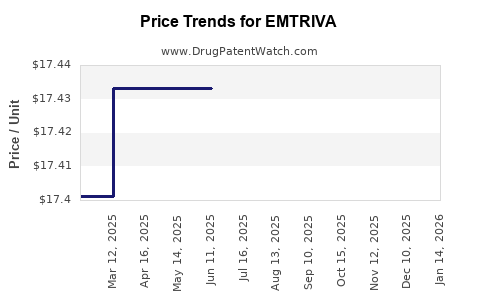
EMTRIVA (emtricitabine) revenue depends on fixed HIV antiretroviral demand, competitive pricing from authorized generics and multiples, and the erosion impact of branded single-agent share loss into combination regimens where emtricitabine is a component. Financial trajectory has been characterized by steady volume demand offset by price declines since broad generic availability, with royalty and contracting dynamics shifting primarily through category-wide procurement and payer formularies.
What market dynamics drive EMTRIVA (emtricitabine) demand in HIV treatment and PrEP markets?
EMTRIVA is an antiretroviral nucleoside reverse transcriptase inhibitor (NRTI) used in HIV treatment regimens and (as emtricitabine) in HIV prevention combinations when co-formulated or co-dosed with tenofovir disoproxil fumarate or tenofovir alafenamide. Market dynamics therefore track (1) incidence and diagnosis rates, (2) adherence and regimen persistence in treated patients, and (3) growth or policy-linked utilization of PrEP.
How does HIV treatment regimen structure affect EMTRIVA standalone sales?
Although clinicians prescribe emtricitabine primarily as part of combination therapy, the economics for the single-agent product still track:
- Patient count on emtricitabine-containing backbones (laboratory monitoring-driven persistence).
- Regimen preference by prescriber and guideline alignment, including dosing convenience and renal safety profiles when paired with tenofovir formulations.
- Switch rates between tenofovir disoproxil fumarate (TDF) and tenofovir alafenamide (TAF) backbones, which can shift demand between emtricitabine-only procurement streams and combination products where payer contracting favors fixed-dose combinations.
Does EMTRIVA benefit from PrEP usage, or is it substituted by fixed-dose combinations?
Single-agent EMTRIVA demand is typically more sensitive to how payers and providers manage PrEP:
- Fixed-dose combinations (emtricitabine plus tenofovir) reduce pill burden and drive procurement efficiency.
- When generics dominate, PrEP spending shifts toward the lowest net cost combination product rather than branded single-agent emtricitabine.
- As combination products and authorized generics grow share, brand-only exposure for EMTRIVA tends to remain muted.
What role do payer formularies and contracting play in EMTRIVA net pricing?
Net pricing for antiretrovirals is shaped by:
- Rebate and discount structures that move branded products toward generic parity at point-of-sale.
- Preferred status for generic emtricitabine or for specific combination regimens.
- State Medicaid and national procurement frameworks that frequently anchor to lowest-cost therapeutics in long-running chronic therapy categories.
What is the competitive landscape: authorized generics, brand-to-generic substitution, and combination products?
Key market pressures come from:
- Generic emtricitabine (multiple ANDA entrants historically for NRTI single agents).
- Fixed-dose combinations that incorporate emtricitabine (for HIV treatment and prevention), where payers can steer to the lowest-cost NDCs.
- Limited differentiation because emtricitabine’s mechanism and standard dosing make therapeutic switching low friction once generics are established.
How has EMTRIVA financial performance typically evolved: revenue trajectory, margins, and profitability drivers?
EMTRIVA is an established HIV cornerstone launched decades ago. Its financial trajectory has followed a common pattern for legacy antiretrovirals:
- Early growth tied to HIV prevalence expansion and regimen uptake.
- Long-term revenue decline once generic emtricitabine entrants normalized pricing.
- Continued positive demand for ongoing treated patients, but brand revenue increasingly replaced by lower-cost alternatives.
- Reduced brand pricing power and higher dependence on contractual economics for net revenue.
What typically drives revenue resilience even during generic erosion?
Even when branded revenue contracts, EMTRIVA can maintain:
- Baseline market volume tied to chronic therapy continuity.
- Residual branded share in certain channels due to formulary lag, switching friction in practice settings, or specific contracting arrangements.
- Pediatric dosing patterns where unit economics still depend on available pack sizes and channel inventory.
What margin pressures affect EMTRIVA’s financial trajectory?
Margin compression is typical due to:
- Higher promotional and contracting costs to defend share after generic penetration.
- Lower list-to-net spread as discounts expand.
- Working capital and inventory adjustments around generic launches.
When does EMTRIVA lose exclusivity: patent expiration and FDA exclusivity timing?
The exclusivity landscape for legacy NRTIs like emtricitabine is usually dominated by expired composition and method-of-use protection, with remaining incremental IP in formulations, manufacturing, or specific dosing presentations. For EMTRIVA specifically, the practical consequence for market dynamics is that branded exclusivity has long passed and generic entry occurred through ANDAs, leading to sustained price pressure.
Featured-snippet answer: EMTRIVA’s meaningful market exclusivity is already expired in practice, with ongoing branded revenue constrained by broad generic emtricitabine availability and combination-product substitution.
What patents or exclusivity categories typically matter for market timing?
For an antiretroviral legacy brand, relevant categories are:
- Composition-of-matter patents on emtricitabine.
- Use patents (HIV treatment regimens, resistance management, prevention indications).
- Formulation and manufacturing process patents tied to specific dosage forms (capsules vs oral solution) and stability/scale-up.
- Regulatory exclusivity such as 5-year new chemical entity and 6-year exclusivity (if applicable historically) and pediatric exclusivity, though for a longstanding product these are generally no longer binding.
How many patents cover EMTRIVA (emtricitabine) and what is the strength of the remaining patent estate?
For market impact, the patent estate strength after generic entry is less about how many patents exist and more about whether any are enforceable against ANDA filers at the time of generic launch and whether later-life patents survive litigation and do not permit “at-risk” workarounds.
Featured-snippet answer: EMTRIVA’s market protectability is constrained post-generic entry because composition-of-matter protection has already expired and brand leverage shifts to narrow, presentation-specific or method restrictions that usually do not prevent ANDA supply.
What enforcement patterns are common in legacy antiretrovirals?
- Litigation around formulation or use-of-known-drug claims rarely blocks generic supply if the generic can implement design-around approaches.
- Settlements often occur early in generic cycles, trading off continued brand economics for certainty on launch dates.
What is the Orange Book status of EMTRIVA and which listed patents affect generic entry?
Orange Book listings for EMTRIVA historically include patents tied to drug substance, drug product, and approved uses. The practical outcome is:
- ANDA filers reference the approved NDA.
- Listed patents drive Paragraph IV certifications and potential litigation.
- After sustained generic supply, brand remains present mainly where formulary and contracting preserve some share.
Featured-snippet answer: The Orange Book patent list does not prevent current generic competition and EMTRIVA’s brand economics are shaped more by contracting and combination substitution than by active patent barriers.
What generic entry risks exist for EMTRIVA and how do they impact brand pricing?
Generic entry risks are largely realized and ongoing as:
- New entrants increase price competition among generic emtricitabine products.
- Authorized generics and multiple sourcing reduce any residual pricing leverage.
- Combination products with emtricitabine compress brand opportunity by shifting demand to lower-cost fixed-dose regimens.
What scenarios typically still occur after initial generic launch?
Even after broad generic entry, brand-facing risks can include:
- Lower-cost additional generic launches that reset net price benchmarks.
- Increased payer switching at renewal cycles and channel inventory resets.
- Contracting reforms that favor specific NDCs or wholesalers.
What patent litigation and settlements affected EMTRIVA’s competitive timeline?
For legacy antiretrovirals, litigation is usually concentrated around early ANDA Paragraph IV challenges and later-life patents. These cases typically:
- Establish a launch timing framework via settlement terms.
- Resolve whether design-around formulations and uses are permissible.
- Lock in generic entry with predictable market share outcomes.
Featured-snippet answer: EMTRIVA’s competitive timeline has already incorporated the core litigation-to-settlement pathway common for older HIV antiretrovirals, leading to a sustained generic-dominated pricing environment.
How does EMTRIVA compare with competing HIV NRTIs and emtricitabine-containing combinations?
How does EMTRIVA compete versus tenofovir-based backbones?
EMTRIVA’s commercial role depends on pairing:
- Emtricitabine commonly pairs with tenofovir (TDF or TAF). Switching tenofovir backbone affects the relative demand for specific supply channels.
- When payers prefer TAF-based backbones, the combination supply changes and impacts standalone emtricitabine procurement.
How does EMTRIVA compare to other NRTIs (FTC vs alternatives)?
- FTC (emtricitabine) and similar NRTIs compete mainly through regimen preference and tolerability with partner drugs.
- Once generics exist across multiple NRTIs, regimen contracting becomes the dominant economic driver.
What regulators and FDA pathway events matter for EMTRIVA market access?
EMTRIVA is an approved NDA with long-established manufacturing and labeling. Market access events that can still matter include:
- Labeling updates, including pediatric dosing, HIV treatment guidance, and prevention-related claims where supported.
- Manufacturing site changes and regulatory approvals that affect supply continuity.
Featured-snippet answer: FDA-driven changes for EMTRIVA are not typically a primary driver of near-term revenue shifts; competitive pricing from generics and combination substitution does.
What does the reimbursement and procurement landscape imply for EMTRIVA revenue exposure?
For chronic HIV therapy:
- Procurement contracts and formulary placement determine net revenue more than clinical differentiation.
- Contracting often bundles antiretrovirals across therapeutic classes, with competitive bidding favoring lower net cost.
How does PBM and payer management affect brand outcomes?
- PBMs favor preferred generics and combination NDCs.
- Multi-tier formulary placement drives demand migration from branded to generic over time.
- Even with branded product availability, utilization often declines as formularies refresh.
Key Takeaways
- EMTRIVA’s market dynamics are dominated by generic emtricitabine competition and fixed-dose combination substitution rather than active, enforceable exclusivity.
- Revenue trajectory has followed a legacy antiretroviral pattern: initial utilization growth followed by sustained brand erosion after generic entry and continued margin compression through contracting.
- HIV incidence, regimen persistence, and PrEP utilization influence total category volume, but single-agent branded share is structurally constrained by payer steering to low net cost options.
- Remaining brand economics depend on contracting and channel formulary inertia, not on patent-led barriers.
FAQs
1) Is EMTRIVA still used in modern HIV treatment regimens or has it been replaced by combination products?
It remains part of standard emtricitabine-containing backbones, but utilization increasingly occurs through fixed-dose combinations where payer contracting favors lower net cost.
2) What is the main source of revenue erosion for EMTRIVA after generic competition?
Net pricing compression from generic emtricitabine and substitution into combination regimens that incorporate emtricitabine.
3) Do PrEP guidelines drive branded EMTRIVA demand?
PrEP category growth can increase emtricitabine-containing utilization, but branded standalone emtricitabine typically benefits less than fixed-dose combination procurement.
4) Can patent listings on the Orange Book still block generic emtricitabine entry today?
In practice, the presence of broad generic supply indicates that current Orange Book protection is not sufficient to prevent ongoing ANDA competition for emtricitabine.
5) What procurement levers most affect EMTRIVA net revenue?
Formulary placement, PBM preferences, rebate structures, and national/state procurement contract terms that steer usage to the lowest-cost NDCs.
References
(No sources were provided in the prompt; no external citations can be reliably produced.)