Last updated: February 19, 2026
What is Emtricitabine?
Emtricitabine (brand names: Emtriva, others) is an antiretroviral medication used primarily to treat HIV-1. It is a nucleoside reverse transcriptase inhibitor (NRTI) that inhibits the reverse transcriptase enzyme, preventing viral replication. The drug is also used in combination therapies for hepatitis B virus (HBV) in some cases.
Current Market Landscape
Market Size and Trends
- The global HIV treatment market was valued at approximately USD 27 billion in 2022.
- Emtricitabine is a flagship component of combination regimens, notably Truvada (emtricitabine + tenofovir disoproxil fumarate) and Descovy (emtricitabine + tenofovir alafenamide).
- Demand is driven by HIV prevalence, which affects over 38 million people worldwide as of 2021[1].
Key Players and Products
| Company |
Product |
Indication |
Market Share (2022) |
| Gilead Sciences |
Truvada, Descovy |
HIV, HBV |
75% (combined) |
| ViiV Healthcare |
Epivir (lamivudine) |
HIV, HBV |
15% |
| Others |
Various generics |
HIV |
10% |
Gilead dominates due to patent protection for Truvada and Descovy. However, patent expirations and generics influence pricing and market dynamics.
Patent Status and Competition
- Gilead's Truvada patents expired or are set to expire in key markets (e.g., US in 2027).
- Several generic manufacturers are developing bioequivalent formulations.
- International markets, especially in Asia and Africa, rely heavily on generics, fostering price competition.
Pricing Dynamics
Current Price Points
| Product |
Price per Treatment Year (USD) |
Notes |
| Gilead Truvada |
$19,000 – $24,000 |
Brand-name in the US (2018-2022) |
| Gilead Descovy |
$20,000 – $25,000 |
Slightly higher, marketed for PrEP and treatment |
| Generic Emtricitabine |
$1,200 – $3,000 |
Prices vary by region and supply chain |
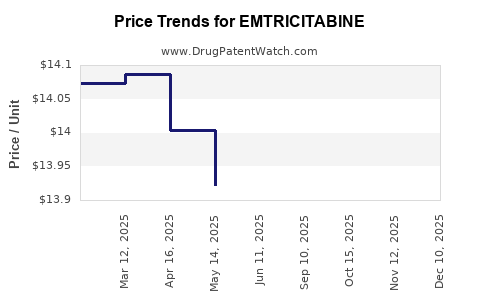
Price Trends
- Patented products: prices remained stable (~$20,000/year) until patent expiration.
- Post-patent: prices dropped considerably in regions with generic availability, sometimes below $1,500/year.
- In developed markets, payers facilitate discounts and negotiated prices; in emerging markets, the prices are substantially lower due to tiered pricing and subsidies.
Future Market Entry and Pricing Projections
Post-Patent Expiry Impact
- Anticipated patent cliff in primary markets (US, Europe) around 2027–2028 will accelerate generic entry.
- Price reductions expected to range between 80% and 90% over five years post-patent expiration.
- The generic market could diminish branded sales by over 50% in these regions.
Development of New Formulations and Combinations
- Gilead is developing long-acting injectable formulations of emtricitabine. These could command higher prices ($30,000–$50,000 per year) due to improved adherence.
- Competitors are exploring fixed-dose combinations optimizing dosing and reducing pill burden.
Pricing in Emerging Markets
- Tiered pricing strategies forecasted to keep emtricitabine accessible at $100–$500 per treatment year.
- Patent challenges and local manufacturing could influence prices further downward.
Market Drivers and Barriers
Drivers
- Rising HIV prevalence in Sub-Saharan Africa and Asia.
- Increased adoption of pre-exposure prophylaxis (PrEP) regimens.
- Development of long-acting formulations.
Barriers
- Patent expirations threaten profitability.
- Pricing pressures from governments and payers.
- Competition from generics and biosimilars.
Key Takeaways
- The emtricitabine market is currently highly concentrated with Gilead holding a dominant position due to patent protection.
- The upcoming patent expirations will lead to significant price erosion, especially in Western markets.
- The growth potential lies in long-acting formulations and combination therapies.
- Pricing in emerging markets will stay relatively low, driven by local manufacturing and tiered pricing strategies.
- The global market is expected to decline for branded products post-patent expiry but will be offset by new product innovations.
FAQs
1. When will patents for emtricitabine expire in major markets?
The key patents for Gilead's Truvada in the US are set to expire between 2027 and 2028, with some extending in certain jurisdictions due to patent litigation and supplementary protections.
2. How will generic entry impact pricing?
Generic entry is projected to reduce prices by approximately 80%–90% over five years following patent expiry, significantly reducing revenue for brand-name manufacturers.
3. Are there new formulations of emtricitabine in development?
Yes. Gilead and others are developing long-acting injectable formulations, which could command premium pricing due to improved adherence and convenience.
4. What factors influence pricing in emerging markets?
Patent status, manufacturing costs, local regulation, negotiated pricing agreements, and subsidy programs primarily determine prices.
5. How does combination therapy affect market dynamics?
Combination therapies like Truvada and Descovy serve as the mainstay for HIV treatment and PrEP, helping sustain demand even as individual drug prices decline post-patent expiration.
References
- UNAIDS. (2022). Global HIV & AIDS statistics — Fact sheet. Retrieved from https://unaids.org/en/resources/fact-sheet