Last updated: August 12, 2026
Clonidine is a mature, largely generic antihypertensive and central alpha-2 adrenergic agonist. Its commercial value has shifted from the original Catapres hypertension franchise to low-cost generic tablets, transdermal systems, and niche branded or generic extended-release products for attention-deficit/hyperactivity disorder (ADHD). No single company reports consolidated global clonidine revenue, and public data do not support a reliable standalone market-size figure.
The principal commercial facts are:
- Original clonidine chemical and hypertension patents expired decades ago.
- Generic competition is extensive in immediate-release tablets and patches.
- Extended-release clonidine for ADHD remains commercially differentiated by dosage form and labeling, not by a durable chemical patent moat.
- FDA-approved clonidine products include oral tablets, extended-release tablets, transdermal patches, and epidural injection.
- Revenue exposure is concentrated in prescription volume, institutional use, ADHD prescribing, and supply reliability rather than patent-protected pricing.
- Generic entry risk is high where products are therapeutically substitutable and low-cost competitors are available.
What is clonidine and how is it used?
Clonidine is a centrally acting alpha-2 adrenergic receptor agonist. It reduces sympathetic outflow and lowers blood pressure. FDA-approved and established uses include hypertension, ADHD in extended-release tablet form, and epidural administration for severe cancer-related pain in a specialized formulation.[1][2]
Major clonidine dosage forms
| Product category |
Typical U.S. use |
Commercial status |
| Immediate-release oral tablets |
Hypertension; off-label withdrawal, anxiety, sleep, and tic-related uses |
Generic-dominated |
| Extended-release oral tablets |
ADHD in children and adolescents |
Branded and generic competition |
| Transdermal patch |
Hypertension |
Generic-dominated |
| Epidural injection |
Severe cancer pain in selected patients |
Niche hospital and specialty market |
Clonidine is also used off label for opioid withdrawal, alcohol withdrawal, menopausal symptoms, insomnia, post-traumatic stress symptoms, and certain pediatric behavioral conditions. These uses expand clinical demand but do not create separate FDA exclusivity.
How large is the clonidine market?
There is no authoritative public financial statement for the global clonidine market. Clonidine is sold by multiple generic manufacturers, contract manufacturers, wholesalers, and pharmacies. Public company filings generally aggregate clonidine into broader generic, cardiovascular, central nervous system, or hospital-product categories.
The market is best understood through product segments:
- Immediate-release tablets generate the highest unit volume but face intense price competition.
- Transdermal patches have lower volume and greater manufacturing complexity.
- Extended-release tablets command higher prices than immediate-release tablets because of ADHD labeling and formulation requirements.
- Epidural clonidine is a small specialty segment with limited volume and hospital-distribution economics.
What drives clonidine demand?
Demand is supported by:
- Long clinical experience and low acquisition cost.
- Continued hypertension prescribing, although newer drug classes have reduced clonidine’s first-line role.
- ADHD use when stimulants are unsuitable, poorly tolerated, or insufficient.
- Off-label withdrawal management.
- Use in pediatric and specialty settings.
- Periodic shortages or manufacturer exits that redirect purchasing to remaining suppliers.
Demand is constrained by sedation, dizziness, hypotension, bradycardia, rebound hypertension after abrupt discontinuation, and the availability of newer antihypertensive and ADHD treatments.[1][3]
What is the financial trajectory for clonidine?
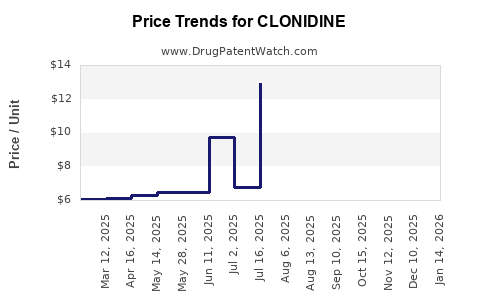
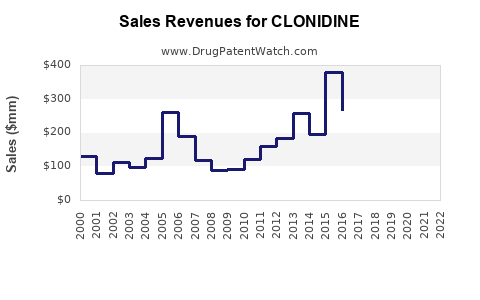
Clonidine’s financial trajectory follows the standard pattern for an off-patent medicine: high initial product value, rapid erosion after generic entry, long-term volume persistence, and intermittent pricing increases when supply becomes concentrated.
Historical trajectory
| Period |
Commercial development |
Financial effect |
| 1970s-1980s |
Catapres establishes clonidine in hypertension |
Branded pricing and physician familiarity |
| 1990s-2000s |
Broad generic entry across tablets and patches |
Major price and margin erosion |
| 2010 onward |
Kapvay extended-release product approved for ADHD |
New branded niche based on formulation and indication |
| 2010s-2020s |
Generic extended-release competition develops |
Reduced branded exclusivity and pricing pressure |
| Current mature phase |
Multiple manufacturers and dosage forms |
Low average unit economics, with pockets of supply-driven pricing |
The original Catapres business no longer represents a conventional protected-brand growth asset. Financial value resides in manufacturing scale, distribution access, product availability, and specialized formulation capabilities.
Revenue exposure by segment
Immediate-release tablets are likely to represent the largest unit base but have limited pricing power. Patch products can produce better economics per prescription because they require transdermal manufacturing, adhesive performance, dose uniformity, and packaging controls. Extended-release tablets can support higher reimbursement than standard tablets, but generic entry reduces the premium over time.
Epidural clonidine has the smallest market but may have higher operational barriers. It requires sterile manufacturing, validated delivery systems, and hospital procurement access. A manufacturing disruption can have a larger commercial effect in this segment than in standard tablets.
What is the FDA regulatory status of clonidine?
FDA-approved clonidine products remain available across several dosage forms. The regulatory pathway differs by formulation.
| Product |
FDA status |
Key regulatory issue |
| Catapres tablets |
Original branded product; legacy approval |
Generic substitution and historical labeling |
| Catapres-TTS patch |
Original transdermal product |
Patch adhesion, release rate, and bioequivalence |
| Kapvay extended-release tablets |
FDA-approved ADHD product |
Extended-release formulation and pediatric labeling |
| Duraclon injection |
FDA-approved epidural product |
Sterile manufacturing and specialty administration |
| Generic tablets, patches, and ER tablets |
ANDA products |
Bioequivalence, manufacturing, and supply continuity |
Kapvay was approved by FDA in September 2010 for ADHD as monotherapy or adjunctive therapy to stimulant medications in children and adolescents ages 6 to 17.[2] The approval expanded clonidine’s commercial relevance beyond hypertension.
FDA labeling warns that extended-release clonidine should not be substituted for immediate-release clonidine on a milligram-for-milligram basis because the pharmacokinetic profiles differ.[2] That distinction protects clinical positioning but does not create broad patent exclusivity.
What patents protect clonidine products?
The original clonidine compound and early hypertension products are long off patent. The current patent question concerns formulation, delivery, and method-of-use rights.
Chemical and primary-use patents
The original chemical patent estate has expired. Immediate-release clonidine tablets therefore have no meaningful composition-of-matter protection in the United States. Generic manufacturers can compete through abbreviated new drug applications if they meet FDA requirements.
Formulation patents
Extended-release tablets and transdermal systems historically relied on formulation and delivery patents rather than new-molecule protection. Those rights may cover:
- Controlled-release matrices.
- Release-rate profiles.
- Tablet composition.
- Transdermal adhesive and reservoir systems.
- Dose delivery over multiple days.
- Manufacturing processes tied to release characteristics.
The commercial importance of these patents has declined as the relevant patent terms expired and generic products entered the market. For current business analysis, the strongest barriers are regulatory development, manufacturing validation, and distribution rather than enforceable exclusivity.
Method-of-use patents
Clonidine’s ADHD use received FDA approval through product labeling for extended-release tablets. Method-of-use rights, if listed historically, would be narrower than chemical patents and vulnerable to design-around strategies, label carve-outs, and off-label prescribing dynamics. Clonidine’s hypertension, withdrawal, sleep, and pain uses do not create a new molecule patent position.
What is the Orange Book status of clonidine?
The FDA Orange Book records approved drug products and relevant patent and exclusivity information. Clonidine’s original branded products are legacy entries, while generic products are generally approved through ANDA pathways.[4]
The key Orange Book conclusion is that clonidine is not protected by a current composition-of-matter patent. Any residual patent relevance would be product-specific and tied to a listed formulation, delivery system, or method of use. The practical risk to a generic entrant is therefore product development and approval execution, not a broad molecule-level blocking patent.
Orange Book analysis must distinguish:
- Immediate-release tablets from extended-release tablets.
- Oral products from transdermal systems.
- Hypertension labeling from ADHD labeling.
- Drug patents from regulatory exclusivity.
- Listed patents from patents that remain commercially enforceable.
When did clonidine lose exclusivity?
Clonidine lost meaningful molecule-level exclusivity decades ago. Generic immediate-release tablets and transdermal products have been commercially available for many years. The extended-release ADHD product obtained a later regulatory launch, but its commercial protection was formulation- and indication-specific.
FDA pediatric exclusivity can add six months to qualifying patent or regulatory exclusivity periods, but pediatric exclusivity does not revive an expired chemical patent or block unrelated generic dosage forms.[5]
Which companies compete in the clonidine market?
Competition varies by formulation and changes as manufacturers enter, exit, or experience shortages. The market has included major generic suppliers such as Teva, Mylan/Viatris, Par Pharmaceutical, Hikma, Rising Pharmaceuticals, and other FDA-registered manufacturers. Brand and specialty commercialization has involved companies associated with Catapres, Kapvay, and Duraclon at different points in the products’ histories.
A company’s competitive position depends on:
- FDA approval for the exact dosage form and strength.
- Ability to maintain reliable active pharmaceutical ingredient supply.
- Packaging and serialization compliance.
- Wholesaler and group purchasing organization access.
- Capacity to absorb price reductions.
- Shortage management and customer service.
No single competitor controls the entire clonidine market across tablets, patches, extended-release products, and epidural injection.
What generic entry risks exist for clonidine?
Generic entry risk is high for immediate-release oral clonidine because the products are mature, widely prescribed, and technically straightforward relative to transdermal or sterile products. Price competition can be severe when several approved manufacturers have available inventory.
Risk is more differentiated by product type:
| Product type |
Generic entry risk |
Main barrier |
| Immediate-release tablets |
High |
Limited formulation complexity |
| Extended-release tablets |
Moderate to high |
Release profile and bioequivalence |
| Transdermal patch |
Moderate |
Adhesion, delivery rate, and manufacturing |
| Epidural injection |
Moderate |
Sterile production and specialty distribution |
Existing manufacturers also face substitution risk from other therapies. In hypertension, clonidine competes with ACE inhibitors, angiotensin receptor blockers, calcium-channel blockers, beta blockers, and thiazide-type diuretics. In ADHD, it competes with stimulants, guanfacine extended release, atomoxetine, and newer nonstimulant options.
What patent litigation and Paragraph IV challenges affect clonidine?
Clonidine has no widely recognized current patent litigation comparable to high-value protected specialty drugs. Historical generic litigation risk was concentrated around later formulations and branded product rights rather than the original molecule.
Paragraph IV challenges are most relevant when an ANDA applicant certifies that a listed patent is invalid, unenforceable, or not infringed. For a mature product such as clonidine, Paragraph IV exposure is generally limited to residual formulation or method-of-use patents. The commercial payoff from litigation is constrained by low generic pricing and the availability of alternative suppliers.
No active, market-defining clonidine patent settlement is a central feature of the current U.S. competitive landscape through June 2024.
How strong is the clonidine patent estate?
The patent estate is weak on a molecule basis and moderate only in narrow product categories.
| Patent layer |
Current strength |
| Composition of matter |
Very weak or expired |
| Immediate-release tablet |
Very weak |
| Extended-release tablet |
Limited, formulation-dependent |
| Transdermal delivery |
Limited, with technical design barriers |
| Epidural injection |
Regulatory and manufacturing barriers exceed patent barriers |
| ADHD method of use |
Narrow and dependent on labeling and listed rights |
Clonidine’s durable commercial defenses are operational. They include validated transdermal manufacturing, sterile production, reliable supply, regulatory history, and pharmacy-channel coverage.
How does clonidine compare with guanfacine?
Clonidine and guanfacine are both central alpha-2 agonists used in ADHD and selected cardiovascular settings. Guanfacine extended release has a stronger modern ADHD commercial identity, while clonidine has broader historical use and lower-cost generic availability.
| Attribute |
Clonidine |
Guanfacine |
| Primary historical use |
Hypertension |
Hypertension |
| ADHD role |
Extended-release product and off-label immediate release |
Strong extended-release ADHD franchise |
| Sedation and hypotension |
Important limitations |
Also important, often viewed as less sedating in practice |
| Generic competition |
Extensive |
Extensive for major forms |
| Patent value |
Mature and weak |
More recent formulation history, but largely eroded |
| Commercial positioning |
Low-cost, flexible, established |
ADHD-focused, differentiated by clinical use |
The two products compete in pediatric nonstimulant treatment, but neither has the patent economics of a newly launched branded CNS product.
What manufacturing and geographic barriers affect clonidine?
Geographic patent coverage has limited strategic importance because the core clonidine molecule is globally mature. Regulatory approval, local manufacturing requirements, and procurement rules matter more.
Manufacturing risks include:
- API concentration among a small number of qualified suppliers.
- Transdermal patch adhesion and dose-release failures.
- Extended-release dissolution variability.
- Sterile manufacturing capacity for epidural injection.
- Facility inspections and remediation.
- Low margins that discourage redundant production capacity.
U.S. supply is exposed to international API and finished-dose manufacturing networks. A manufacturer with a small market share can still gain temporary pricing power if competitors experience recalls or shortages.
What licensing deals affect clonidine?
Clonidine has had product-level commercialization and distribution arrangements, but it is not generally associated with a current high-value licensing market. The main deal opportunities involve:
- Regional rights for extended-release tablets.
- Hospital distribution for epidural products.
- Contract manufacturing and private-label supply.
- Authorized generic arrangements.
- Combination products or reformulations.
Licensing economics are modest unless a transaction includes differentiated delivery technology, pediatric labeling, or an established shortage-resilient manufacturing platform.
Key Takeaways
- Clonidine is a mature generic drug with no meaningful molecule-level patent protection.
- Immediate-release tablets are highly exposed to generic price competition.
- Extended-release tablets retain commercial value through ADHD labeling and formulation complexity, not a durable composition patent.
- Transdermal and epidural products have higher manufacturing barriers than oral tablets.
- No consolidated public revenue figure reliably captures the global clonidine market.
- Financial performance depends on volume, supply reliability, formulation mix, and temporary shortages.
- Paragraph IV and patent-litigation risk is limited compared with newer branded drugs.
- The principal competitors are generic clonidine suppliers, guanfacine, stimulants, atomoxetine, and established antihypertensive therapies.
- Clonidine remains commercially relevant because of low cost, broad clinical familiarity, and use in ADHD and withdrawal-related care.
FAQs
Is clonidine still profitable for pharmaceutical manufacturers?
It can be profitable at scale, particularly when a supplier has efficient tablet production, stable API access, and low selling costs. Profitability is weaker for undifferentiated immediate-release tablets and stronger for products with manufacturing or distribution barriers.
Does clonidine have new-drug exclusivity?
The original clonidine product does not have current new-drug exclusivity. Later extended-release and specialized formulations may have received product-specific regulatory exclusivity, but those periods do not provide ongoing molecule-wide protection.
Can a generic manufacturer launch clonidine without challenging a patent?
Yes. An ANDA applicant can use a Paragraph III certification when relevant patent rights remain and launch after expiration, or a Paragraph IV certification when it seeks to invalidate or avoid listed patents. For mature clonidine products, the absence of broad active molecule patents reduces the need for a major patent challenge.
Is clonidine a biologic or does it face biosimilar competition?
Clonidine is a small-molecule chemical drug, not a biologic. It therefore faces generic competition under the ANDA framework rather than biosimilar competition under the Public Health Service Act.
Which clonidine formulation has the highest commercial barrier?
The epidural injection and transdermal patch generally have higher technical and manufacturing barriers than immediate-release tablets. Extended-release tablets occupy an intermediate position because bioequivalence and dissolution performance can complicate generic development.
References
-
U.S. Food and Drug Administration. (2023). Catapres-clonidine hydrochloride tablet prescribing information. FDA labeling database.
-
U.S. Food and Drug Administration. (2023). Kapvay-clonidine hydrochloride extended-release tablet prescribing information. FDA labeling database.
-
U.S. Food and Drug Administration. (2023). Clonidine hydrochloride transdermal system prescribing information. FDA labeling database.
-
U.S. Food and Drug Administration. (2024). Approved drug products with therapeutic equivalence evaluations: Orange Book. U.S. Department of Health and Human Services.
-
U.S. Food and Drug Administration. (2024). Regulatory exclusivity. U.S. Department of Health and Human Services.