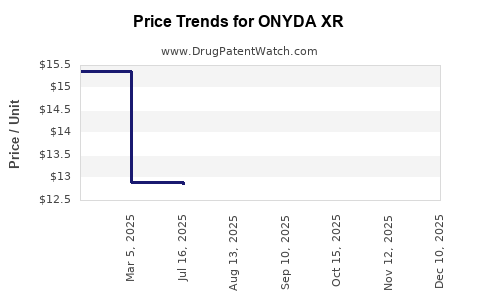
Last updated: August 8, 2026
ONYDA XR, the first and only liquid, extended-release clonidine hydrochloride product approved for attention-deficit/hyperactivity disorder, entered the U.S. market in 2024 as a differentiated ADHD treatment from Tris Pharma. Its commercial opportunity depends on adoption among children who cannot swallow tablets, have inadequate stimulant control, or need adjunctive nonstimulant therapy. Tris has not publicly disclosed standalone ONYDA XR revenue, prescription volume, profitability, or a product-specific forecast. The most defensible financial view is therefore scenario-based rather than based on reported sales.
What is ONYDA XR and what did the FDA approve?
ONYDA XR is clonidine hydrochloride extended-release oral suspension, administered once daily. The FDA approved it on May 19, 2024, for the treatment of ADHD as monotherapy or adjunctive therapy to stimulant medications in pediatric patients aged six years and older.[1]
| Attribute |
ONYDA XR profile |
| Active ingredient |
Clonidine hydrochloride |
| Dosage form |
Extended-release oral suspension |
| Route |
Oral |
| FDA indication |
ADHD, monotherapy or adjunctive therapy |
| Patient population |
Pediatric patients aged 6 years and older |
| Sponsor |
Tris Pharma Inc. |
| FDA approval |
May 19, 2024 |
| Administration |
Once daily, with or without stimulant therapy |
| Therapeutic class |
Central alpha-2 adrenergic receptor agonist |
| Principal differentiation |
Liquid extended-release formulation |
Clonidine has long been used in immediate-release and extended-release tablet forms. ONYDA XR's commercial distinction is its liquid formulation combined with extended-release delivery. That combination targets pediatric patients who have difficulty swallowing tablets and prescribers seeking a nonstimulant option without changing to a different active ingredient.
How large is the ONYDA XR market opportunity?
The addressable market is the U.S. pediatric ADHD treatment market, with the initial commercial opportunity concentrated in nonstimulant and adjunctive therapy.
The main demand segments are:
- Children who cannot reliably swallow tablets or capsules.
- Patients with inadequate response to stimulant monotherapy.
- Patients experiencing stimulant-related insomnia, appetite suppression, irritability, or cardiovascular concerns.
- Patients requiring evening or adjunctive symptom control.
- Families and clinicians seeking a liquid treatment with once-daily dosing.
The market is commercially attractive because ADHD is a chronic condition with repeated prescription demand. The product's revenue ceiling is constrained by the fact that clonidine is a mature active ingredient, generic immediate-release and extended-release tablet products are available, and stimulants remain the dominant first-line treatment.
ONYDA XR is therefore more likely to win share through formulation and patient fit than through broad replacement of established ADHD therapies.
How does ONYDA XR compare with competing ADHD drugs?
ONYDA XR competes across several distinct product categories rather than against one direct substitute.
| Product category |
Examples |
Competitive position versus ONYDA XR |
| Stimulants |
Adderall XR, Vyvanse, Concerta, Focalin XR |
Higher efficacy for many patients but controlled-substance restrictions and tolerability issues |
| Nonstimulants |
Strattera, Qelbree, Intuniv |
Directer clinical alternatives; tablets or capsules limit suitability for some children |
| Clonidine products |
Kapvay and generic clonidine ER tablets |
Same active ingredient, lower-cost alternatives, less suitable for patients unable to swallow tablets |
| Liquid ADHD products |
Certain liquid stimulant formulations |
Compete for patients needing liquid administration but differ in mechanism and abuse-control profile |
| Behavioral therapy |
Parent training and school interventions |
Often complementary rather than pharmacologically substitutive |
Qelbree, marketed by Supernus Pharmaceuticals, is a key branded nonstimulant competitor. Intuniv, the extended-release guanfacine product, competes in the alpha-2 agonist segment. ONYDA XR's clearest product-level advantage is its liquid extended-release presentation, not a novel mechanism.
What commercial advantages does the liquid formulation provide?
The liquid dosage form gives Tris access to a clinically identifiable subgroup that tablet-based competitors serve poorly.
Swallowing and administration
Pediatric medication adherence can be affected by tablet size, swallowing ability, sensory aversion, and caregiver administration burden. A liquid product can reduce those barriers, although it introduces dosing-measurement and storage requirements.
Nonstimulant positioning
Clonidine does not carry the controlled-substance classification associated with stimulant ADHD products. That can simplify prescribing, storage, and pharmacy handling. The product still requires careful titration and monitoring because clonidine can cause somnolence, hypotension, bradycardia, and rebound hypertension if discontinued abruptly.[1]
Adjunctive treatment
FDA approval for adjunctive use with stimulants expands the target population beyond patients seeking a complete alternative to stimulant therapy. This positioning can support use in patients with residual symptoms, sleep-related issues, or stimulant tolerability challenges.
Formulation premium
A branded liquid extended-release product can command a premium over generic clonidine tablets if payers and families accept the incremental value of administration convenience. That premium is vulnerable to prior authorization, step-therapy rules, and pharmacy substitution pressure.
What is the FDA regulatory and exclusivity status of ONYDA XR?
ONYDA XR received FDA approval through the NDA pathway. The FDA label identifies the product as a prescription treatment for pediatric ADHD and establishes dosing, titration, safety warnings, and administration requirements.[1]
The available public approval information does not establish a standalone product revenue history or a separate FDA-granted exclusivity period beyond the protections associated with the approved NDA and any applicable listed patents. ONYDA XR is not a biologic, so biosimilar substitution and biosimilar competition do not apply.
FDA exclusivity timeline
| Event |
Date or status |
| FDA approval |
May 19, 2024 |
| Commercial launch |
2024 |
| New chemical entity exclusivity |
Not applicable to clonidine, an established active ingredient |
| Orphan-drug exclusivity |
Not indicated |
| Pediatric exclusivity |
No publicly established product-specific award identified in the cited approval materials |
| Biosimilar pathway |
Not applicable |
| Generic pathway |
Abbreviated New Drug Application pathway may become relevant, subject to patent and regulatory protections |
The key regulatory question is whether a generic applicant can replicate the extended-release suspension and obtain approval without infringing enforceable formulation, delivery, or method-of-use claims.
What patents protect ONYDA XR?
ONYDA XR's protection is expected to rely primarily on formulation, release-profile, dosing, and use claims rather than composition-of-matter protection for clonidine itself.
The active ingredient is old and widely available in generic form. The commercial IP case therefore depends on whether Tris can maintain enforceable protection around:
- Extended-release clonidine in an oral suspension.
- Particle-size, polymer, matrix, or release-control characteristics.
- Once-daily dosing in pediatric ADHD.
- Pharmacokinetic performance.
- Treatment methods involving monotherapy or adjunctive stimulant use.
- Manufacturing processes that produce a consistent extended-release liquid product.
A complete patent-expiration analysis requires a verified FDA Orange Book listing and the underlying U.S. patent records. The approval announcement and prescribing information do not provide a complete patent schedule.[1,2] No standalone composition-of-matter exclusivity should be assumed for clonidine.
Orange Book considerations
The FDA Orange Book is the controlling source for listed patents and patent-use codes associated with an approved drug product.[2] The commercial relevance of ONYDA XR's Orange Book position will depend on:
- Whether Tris lists formulation patents.
- Whether any method-of-use patents are listed.
- The expiration dates of listed patents.
- Whether pediatric ADHD use is protected by a patent-use code.
- Whether a generic applicant can file a Paragraph IV certification.
- Whether a generic applicant can carve out protected uses under a section viii statement.
Without a confirmed Orange Book patent table, it is not possible to state a reliable final generic-entry date or identify a specific Paragraph IV challenger.
When could generic competition affect ONYDA XR?
Generic risk is likely to develop in stages.
First stage: branded launch and payer access
The first commercial challenge is not generic entry. It is formulary placement. ONYDA XR must secure coverage against low-cost clonidine tablets, guanfacine products, and established nonstimulants. Prior authorization could materially slow early adoption.
Second stage: patent and formulation challenges
A potential ANDA applicant would need to address the extended-release liquid formulation and any listed method-of-use patents. A Paragraph IV filing could trigger patent litigation and a 30-month stay of approval under the Hatch-Waxman framework, subject to statutory conditions and court decisions.[3]
Third stage: authorized or ordinary generic entry
A generic liquid extended-release clonidine product could pressure price and market share rapidly because the underlying molecule is inexpensive and familiar to prescribers. The strength of ONYDA XR's commercial defense would depend on formulation complexity, manufacturing know-how, patent scope, and prescriber loyalty.
Generic launch scenarios
| Scenario |
Commercial consequence |
| No viable liquid generic before key patents expire |
Tris retains a differentiated niche and pricing power |
| Paragraph IV challenge settled with delayed entry |
Revenue remains protected until the agreed launch date |
| Early generic approval after patent loss or successful challenge |
Rapid price erosion and payer-driven substitution |
| Generic tablet substitution only |
Limited direct impact because tablets do not replicate the liquid formulation |
| Competing branded liquid ADHD product |
Share pressure without immediate generic-level price erosion |
What is the financial trajectory for ONYDA XR?
Tris Pharma is privately held and does not report ONYDA XR revenue in public company filings comparable to those of a listed pharmaceutical company. No reliable standalone sales, operating margin, acquisition value, or product-level cash-flow data has been disclosed in the cited public materials.
The likely financial trajectory has four phases.
2024: launch investment
The first year required spending on salesforce deployment, payer contracting, sampling, patient support, pharmacy distribution, and clinician education. Early revenue would likely be limited by formulary access and the time required to shift prescribing behavior.
2025 to 2026: formulary and prescriber expansion
The product's growth should depend on conversion of patients who need a liquid formulation and on adjunctive use with stimulants. This is the period in which prescription growth, refill persistence, and payer coverage would determine whether ONYDA XR remains a niche product or becomes a material Tris franchise.
2027 onward: scale versus price pressure
A successful product could generate durable branded revenue if it establishes a preferred position among pediatric patients with swallowing barriers. Growth would slow if payers require generic clonidine tablets or if competing liquid ADHD products gain traction.
Financial sensitivity
| Driver |
Positive effect |
Negative effect |
| Liquid dosage form |
Captures patients unable to swallow tablets |
Narrower addressable segment |
| Once-daily dosing |
Supports adherence and caregiver convenience |
Does not eliminate clonidine safety monitoring |
| Adjunctive indication |
Expands prescribing opportunity |
Stimulant use remains the primary treatment for many patients |
| Mature active ingredient |
Established clinical familiarity |
Weak composition-of-matter protection |
| Branded formulation |
Supports premium pricing |
Payer resistance to formulation premiums |
| Private ownership |
Allows focused commercialization |
Limits public visibility into sales and profitability |
| Generic tablets |
Validate clonidine familiarity |
Create strong price benchmark |
The most important financial variable is net price after rebates and coverage restrictions, not the product's wholesale list price. A liquid formulation can support a premium, but the premium must exceed the cost of commercial infrastructure and patient-support programs.
How strong is the ONYDA XR patent estate?
The estate should be viewed as formulation-led and therefore more vulnerable than a new chemical entity estate.
Strengths
- The product combines a known drug with a differentiated extended-release suspension.
- A liquid formulation can create technical barriers involving stability, uniformity, dose measurement, and release control.
- Pediatric dosing and adjunctive-treatment claims may support commercial segmentation.
- Manufacturing complexity can delay practical competition even after narrow patent claims are challenged.
Weaknesses
- Clonidine has no new-molecule exclusivity.
- Generic clonidine tablets establish a low-cost therapeutic reference.
- Formulation claims can face obviousness, written-description, enablement, and design-around challenges.
- Competitors may develop alternative liquid or modified-release products without copying every claim limitation.
The IP estate is commercially meaningful but should not be valued like a protected novel chemical entity. Its durability will depend on claim breadth, Orange Book listings, prosecution history, litigation outcomes, and the availability of noninfringing extended-release technologies.
Which companies compete with or could challenge ONYDA XR?
The immediate competitive set includes Tris Pharma, Supernus Pharmaceuticals, manufacturers of generic clonidine ER tablets, manufacturers of guanfacine ER, and companies selling stimulant or nonstimulant ADHD products.
No specific Paragraph IV challenger or ONYDA XR patent litigation matter is established in the cited public sources. The principal future challenger would likely be a generic manufacturer with extended-release oral-liquid capabilities, not a conventional tablet-only clonidine supplier.
What revenue exposure does ONYDA XR create for Tris Pharma?
ONYDA XR gives Tris a branded ADHD asset with recurring prescription potential and a formulation-based market position. Its revenue exposure is concentrated in the U.S. pediatric market and depends on:
- Prescription adoption among patients six years and older.
- Refill persistence.
- Insurance coverage.
- Net realized price.
- Expansion of adjunctive use.
- Duration of patent and regulatory protection.
- Timing of liquid generic competition.
Because Tris is privately held, product-level revenue concentration cannot be calculated from public filings. The asset's value should be modeled through prescription volume, net price, launch ramp, gross-to-net deductions, commercialization costs, and patent-adjusted duration.
Key Takeaways
- ONYDA XR is a once-daily extended-release clonidine oral suspension approved for pediatric ADHD monotherapy and adjunctive therapy.
- Its main commercial advantage is the liquid formulation, not a novel active ingredient.
- The principal target is children who cannot swallow tablets and patients needing nonstimulant or adjunctive treatment.
- Tris has not publicly disclosed standalone ONYDA XR revenue or profitability.
- Generic clonidine tablets create immediate price pressure, but they are not direct dosage-form substitutes.
- Patent protection is likely formulation-led, making Orange Book listings and claim scope central to valuation.
- No specific Paragraph IV challenger, patent settlement, or ONYDA XR litigation matter is established in the cited sources.
- Biosimilar competition does not apply because ONYDA XR is a small-molecule drug.
- The commercial outlook is strongest if Tris secures broad payer coverage and maintains a premium for liquid extended-release delivery.
FAQs
Does ONYDA XR contain a new ADHD drug molecule?
No. ONYDA XR contains clonidine hydrochloride, an established alpha-2 adrenergic receptor agonist. Its differentiation comes from the extended-release oral suspension formulation.
Is ONYDA XR a stimulant?
No. ONYDA XR is a nonstimulant ADHD treatment and can be used alone or alongside stimulant therapy.
Can generic clonidine tablets replace ONYDA XR?
They may be therapeutic alternatives for some patients, but they do not replicate ONYDA XR's liquid extended-release dosage form. Substitution depends on clinical judgment, formulation requirements, payer rules, and state pharmacy law.
Does ONYDA XR have biosimilar risk?
No. Biosimilar regulation applies to biologic products. ONYDA XR is a small-molecule drug subject to generic-drug competition.
What is the most important investment variable for ONYDA XR?
The key variable is the duration and commercial value of formulation protection after accounting for payer coverage, net pricing, prescription persistence, and the timing of a viable generic liquid competitor.
References
- U.S. Food and Drug Administration. (2024). ONYDA XR (clonidine hydrochloride) extended-release oral suspension prescribing information.
- U.S. Food and Drug Administration. (n.d.). Approved drug products with therapeutic equivalence evaluations: Orange Book.
- U.S. Food and Drug Administration. (n.d.). Abbreviated new drug application process and patent certifications under the Hatch-Waxman Act.