Last updated: July 16, 2026
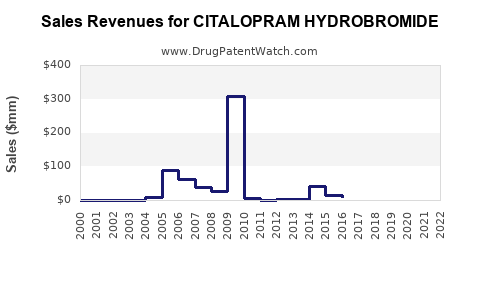
Citalopram hydrobromide is a mature, off-patent oral SSRI with broad generic availability globally and limited incremental innovation-led IP leverage in most markets. Financial trajectory is driven mainly by (1) steady, low to mid single-digit erosion from generics, (2) periodic demand shifts from safety-driven prescribing preferences and label constraints, and (3) localized competitive intensity tied to formulary access, tender cycles, and payer rebates. The near-term economics are dominated by price compression in established markets, with volume persistence supported by chronic depression and anxiety indications.
What is the current market structure for citalopram hydrobromide (generics vs branded)?
Answer: The market is overwhelmingly generic in most jurisdictions; branded presence is limited and varies by country. Citalopram is typically positioned as a low-cost first-line SSRI where formularies favor cost-effective options.
How does competitive intensity affect pricing and revenue
- Generic penetration: High. Brand-linked pricing power is minimal in mature markets.
- Cost competitiveness: Multiple authorized generics and parallel suppliers pressure wholesale and payer net prices.
- Formulary dynamics: SSRI class competition (sertraline, escitalopram, fluoxetine, paroxetine) determines share more than molecule-level differentiation.
- Tender and rebate mechanics: In payer-heavy systems (EU national tenders, managed care PBM contracting in the US), citalopram pricing tends to track the lowest-cost supplier set.
What demand drivers sustain volume despite price erosion
- Chronic treatment: Depression and anxiety management supports sustained prescription volume.
- Switching behavior: Patients and clinicians often continue SSRI regimens unless efficacy or tolerability issues arise, limiting turnover.
- Safety labeling in practice: Prescribing is influenced by QT-prolongation risk constraints and maximum dose limits; this can shift some demand toward escitalopram or other SSRIs, but it does not eliminate baseline SSRI demand.
How do QT-related labeling limits impact citalopram prescribing and sales?
Answer: Safety constraints influence dosing, patient selection, and switching to alternatives, shaping share more than total SSRI demand.
Maximum dose and QT risk: commercial implications
- Dose ceiling effect: When prescribers adhere to dose limits, average daily dose can decline, which can modestly reduce “pill-equivalent revenue” even if patient counts remain stable.
- High-risk exclusions: Patients with risk factors for torsades de pointes (concomitant QT-prolonging drugs, congenital long QT, certain cardiac conditions) can be steered away from citalopram, affecting share in cardiology and polypharmacy cohorts.
- Net effect on market: Label constraints typically shift mix within the SSRI class rather than shrinking the overall market for chronic antidepressants.
Why escitalopram often captures marginal share
- Perceived tolerability profile: Clinical practice frequently favors escitalopram after QT concerns, which can redirect new starts.
- Switching as a competitor moat: Once patients stabilize on escitalopram, retuning to citalopram is less common unless cost or availability pushes it.
When does citalopram hydrobromide lose exclusivity, and what does that mean for financial trajectory?
Answer: Citalopram HBr is long past typical small-molecule composition and method-of-use exclusivity milestones in key markets. The financial arc is therefore characterized by generics-driven price compression rather than a single cliff event.
Exclusivity framework that historically mattered
For legacy SSRIs like citalopram:
- Composition-of-matter: Drives the end of brand exclusivity earliest.
- Method-of-use: If present, can extend specific indication protection, but for citalopram the indication set is largely mature and typically accessible via generic labeling.
- Formulation/combination patents: Only matter materially when they support a distinct product (strength, delivery, or dosing convenience). Most citalopram sales are plain oral tablets.
What “post-exclusivity” looks like in practice
- Revenue becomes volume-led: Net sales track units more than pricing.
- Margin becomes supplier-dependent: Generic manufacturers compete on scale and manufacturing cost; weaker margin players exit or consolidate.
What patents protect citalopram hydrobromide today, and how many remain relevant?
Answer: The active patent landscape is generally limited to incremental filings (process, formulations, specific strengths, manufacturing methods) with narrow scope. Practical protection is typically not strong enough to block generic citalopram of record for major strengths.
Typical patent categories still found in citalopram estates
- Manufacturing/process patents for specific crystallization, drying, or impurity controls.
- Formulation patents for tablet matrix and excipient combinations, sometimes tied to a specific strength.
- Polymorph/solvate patents, if claimed and enabled for a particular form.
- Method-of-use patents are less common as standalone levers because generic labeling commonly overlaps with established SSRI uses.
Commercial relevance threshold
Even if patents exist on paper, most do not materially affect commercial entry unless they map to:
- a specifically claimed product form,
- an FDA-approved strength/dosage configuration,
- or a clearly litigated claim that blocks manufacturing supply.
What is the Orange Book status of citalopram hydrobromide?
Answer: Orange Book coverage for citalopram is dominated by legacy entries with broad generic availability. The functional outcome is that most generic products can be approved without being blocked by a currently enforceable, broadly covering patent.
How to interpret Orange Book “blocking” in mature SSRI products
- Look for patents listed for drug substance and drug product that are:
- actively relevant to the approved dosage strength,
- tied to an enforceable expiration date in the future,
- and not already effectively design-around or resolved via prior Paragraph IV litigation or settlement.
How does patent litigation affect generic entry risk for citalopram hydrobromide?
Answer: For citalopram specifically, the litigation-driven risk is usually low for established generic strengths in major markets because the product is mature and most disputes have already played out historically.
Paragraph IV challenge mechanics in a mature SSRI
- For a mature product, Paragraph IV filings typically occur earlier in the life cycle when a still-expiring patent is in force.
- Once most enforceable patents have expired, later generics do not face a meaningful 30-month stay on the core “first generic” trigger, and competition shifts to supply and pricing.
What generic entry risks exist for citalopram hydrobromide in new markets?
Answer: Risks are primarily regulatory and supply-chain, not IP in most jurisdictions.
Regulatory and manufacturing barriers that can still slow entry
- Local registration requirements: BE data acceptance and dossier requirements can take time.
- Quality system constraints: cGMP capacity and impurity control requirements can delay launches for smaller manufacturers.
- Supply concentration: Some markets rely on a limited set of suppliers; procurement lead times can extend.
How does citalopram hydrobromide compare with escitalopram and sertraline on market dynamics?
Answer: Escitalopram often has share advantage in cardioprescriber and QT-sensitive populations; sertraline maintains broad primary-care and psychiatry positioning. Citalopram remains cost-competitive but faces mix pressure from SSRI safety preferences and competitive prescribing.
Competitive positioning by payer and prescriber
- Payers: choose based on contracted net price, not molecule.
- Prescribers: choose based on tolerability perceptions and guideline interpretations.
- Switching: mix shift toward escitalopram can be gradual as new starts and step therapy adjust.
What commercial metrics best explain citalopram’s financial trajectory?
Answer: Unit volume stability, net price erosion rate, and share-of-formulary placement explain most of the financial trajectory for citalopram generics and any remaining branded remnants.
Key metrics to track
- Net price per tablet (or per DDD equivalent), not list price.
- Prescription volume (TRx) and new starts vs continuation.
- Formulary tier placement (preferred vs non-preferred).
- Channel mix: retail vs mail order vs institutional.
- Manufacturing capacity utilization for major suppliers.
How do currency, tender cycles, and region mix change earnings outcomes?
Answer: For generic-exposed business models, citalopram earnings are highly sensitive to geography mix and tender timing.
Region-specific dynamics
- US: PBM contracting and mail-order penetration drive net price and volume.
- EU: tender cycles and national pricing rules push down net price; winners depend on bid economics.
- Emerging markets: price competition can be less intense, but market access delays and supply reliability matter.
What is the financial outlook for companies selling citalopram generics?
Answer: Outlook is stable-to-pressure in pricing, with profitability depending on cost position and scale. Growth is usually incremental via share gains or incremental formularies, not via net price expansion.
Profit drivers for generic suppliers
- Manufacturing cost leadership: yield, downtime, and impurity handling.
- Scale effects: multi-market distribution lowers fixed cost per unit.
- Portfolio balancing: companies typically offset SSRI pricing erosion by higher-margin launches in adjacent therapeutic areas.
Which business scenarios create upside or downside for citalopram’s revenue?
Answer: Upside comes from formulary wins and manufacturing cost reductions; downside comes from accelerated price competition, adverse supply events, or prescriber shifts to competitors.
Upside scenarios
- Preferential formulary placement via net-price reductions.
- Supply expansion that wins tender cycles.
- Reduced input cost volatility (API intermediates, excipients, packaging).
Downside scenarios
- Aggressive competitor bids that reset tender pricing.
- Temporary supply disruptions that lose contracted volume.
- Continued mix shift toward escitalopram in QT-risk populations.
Key patent and market timeline: how the generic era typically unfolded
Answer: Citalopram moved into generic dominance years ago; the timeline since then is characterized by recurring pricing pressure and incremental regulatory updates.
What matters in a “generic era” timeline
- Patent expiry and Orange Book removal: determines when generic supply ramps in each jurisdiction.
- Local regulatory transitions: variations in BE requirements and substitution rules.
- Safety label updates: drive mix changes within SSRI class.
Key Takeaways
- Citalopram hydrobromide’s financial trajectory is defined by generics-dominated competition, net price erosion, and formulary access more than by remaining IP leverage.
- Safety-related QT labeling constraints influence prescribing mix, often shifting marginal share toward escitalopram while maintaining baseline SSRI demand.
- Patent and litigation risk is typically low for major established strengths because the product is mature; market dynamics are primarily regulatory and commercial (tender, rebates, supply).
- Earnings resilience for generic sellers depends on manufacturing cost position, scale, and geography mix rather than on exclusivity events.
FAQs
- Why does citalopram often face stronger mix pressure in cardiology-heavy patient populations?
- How do PBM step-therapy policies affect citalopram prescription volume versus escitalopram?
- What supply disruptions most commonly impact stable citalopram tablet availability in generic markets?
- Do alternative dosage strengths of citalopram (different tablets) materially change generic entry risk?
- How do tender cycles in EU markets translate into quarter-by-quarter net sales volatility for citalopram suppliers?
References
- US Food and Drug Administration. “Orange Book: Approved Drug Products with Therapeutic Equivalence Evaluations.” https://www.accessdata.fda.gov/scripts/cder/daf/
- FDA-approved labeling for citalopram-containing products (current prescribing information on QT risk and dosing constraints). https://www.accessdata.fda.gov/scripts/cder/daf/