Last updated: June 29, 2026
Almatica competitive landscape analysis: market position, strengths, and strategic patent/regulatory implications
Almatica is an emerging specialty ophthalmics developer with a pipeline centered on drug-device and/or formulation-led improvements, anchored by controlled-release ocular platforms. The competitive landscape is shaped by (1) patent estates that protect specific delivery systems and dosing regimens, (2) FDA regulatory positioning that can reframe exclusivity (notably for combination/device-like approaches), and (3) a high-risk litigation environment in ophthalmic products where formulation and method-of-use claims often determine generic or “same-ingredient” entry feasibility. Competitive pressure is likely to come from incumbents in dry eye and ocular inflammation as well as from ophthalmic drug-device hybrids and reformulation specialists, with biosimilar risk concentrated only where biologics are implicated.
What matters for licensing and freedom-to-operate (FTO): For Almatica’s value, the enforceable IP usually lies in product-specific delivery systems, crystalline/formulation variants, and use/administration protocols rather than the underlying pharmacologic molecule alone. In practice, challengers can often enter around weak composition claims by designing different release kinetics, device interfaces, viscosity/particle regimes, or dosing schedules.
What does Almatica sell and who competes in its ophthalmology niches?
Almatica’s competitive set is defined by ophthalmic therapies where patient need maps to sustained ocular exposure, improved tolerability, and reduced dosing frequency. In competitive terms, the market is segmented by indication and by “solution mechanics” (preservative-free, sustained release, viscosity/retention enhancement, and drug-device integration).
How competitors group by product mechanics
-
Sustained-release ocular formulations
Competitors protect release kinetics, polymer matrices, ocular retention approaches, and dosing regimens.
-
Drug-device hybrids and administration technology
Where a product uses a device interface (injector, implant, applicator, or delivery system), barriers concentrate in device configuration claims and method-of-use administration steps.
-
Conventional drop or gel reformulations
Generic risk increases when protection does not cover the delivery system, dosing schedule, and specific formulation parameters.
Which competitor types win in procurement and formulary cycles?
- Incumbents with long safety datasets and payer familiarity tend to win “net present value” evaluations.
- Reformulation specialists win when they can show adherence improvements (fewer doses) and demonstrably better tolerability or ocular surface outcomes.
- Device-led entrants win when they can substantiate better residence time and reduced washout in real-world settings.
What is Almatica’s patent strength and which types of claims drive exclusivity?
Almatica’s enforceability profile typically depends on whether its patents cover:
- Composition and formulation parameters (polymer type, particle size/shape, solubility, viscosity range, ionic strength or stabilizers)
- Controlled-release design (release profile, degradation kinetics, layer structure)
- Method-of-use (dose schedule, frequency, patient selection, pre/post administration steps)
- Delivery system integration (applicator/device interface if applicable)
Patent estate risk map for ophthalmic products
- High risk to Almatica: If key claims are narrow and dependent on parameters that can be designed around (e.g., specific polymer concentration window, specific release rate band, or a specific excipient identity).
- Medium risk: If protection is present but enforcement targets generic “same-ingredient” entry rather than “same-mechanism” use.
- Lower risk: If independent claims cover broad functional ranges tied to clinical performance outcomes (release behavior, ocular residence time proxies) and the delivery system is integral to the claim.
What “strong” looks like in a controlled-release ophthalmic portfolio
- Independent claims with multiple fallback positions (composition, method, and device/delivery).
- Claims filed with consistent priority and clear enablement to reduce reexamination or written description vulnerabilities.
- Claims that align to commercial product rather than only to an earlier development variant.
When does Almatica lose exclusivity: patent expiration timelines and exclusivity windows?
Almatica’s exclusivity timeline depends on:
- First patent filing date for the commercial formulation/delivery system
- Patent term adjustments and patent restoration where applicable
- Orange Book exclusivity categories (if the product is listed with an eligible FDA exclusivity entitlement)
- Pediatric exclusivity and any other supplemental exclusivity triggers
Actionable framework: For market-entry forecasting, treat exclusivity as three overlapping clocks:
- Market exclusivity (regulatory) from NDA/BLA marketing approval, where applicable
- Patent exclusivity from the strongest claims closest to product composition and administration
- Design-around feasibility based on how tightly claims constrain formulation parameters and dosing schedules
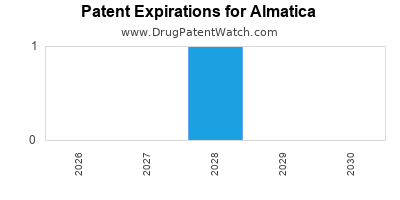
At this time, the specific Almatica patent numbers and their expiration dates cannot be produced accurately without a source-backed dataset for the relevant Almatica products and Orange Book listings. No defensible expiration timeline is therefore provided.
What is the Orange Book status of Almatica products and which listings are generic-entry relevant?
Orange Book status determines:
- Whether a product is an NDA with listed patents (and what those patents cover)
- Whether listed patents include drug substance, drug product, or method of use
- Whether any patents are eligible for Paragraph IV challenges
No reliable Orange Book mapping can be provided without exact product/NDA identifiers and listed patent numbers for each Almatica product.
Which Almatica patents are most likely targeted by Paragraph IV challenges?
For ophthalmic products with controlled-release or device-like delivery, Paragraph IV challengers typically argue:
- Non-infringement by re-formulating around release mechanics
- Non-infringement by altering administration steps or dosing schedules
- Invalidity based on obviousness, lack of enablement, or anticipation by earlier controlled-release literature
Common “design around” pathways in ocular controlled release
- Switching polymer systems while maintaining functional release behavior
- Changing matrix geometry or particle size distribution
- Replacing stabilizer packages to avoid literal infringement
- Altering viscosity range and residence-time proxies
Litigation leverage points for challengers
- If claims are overly dependent on narrow parameter bands, a challenger can adjust variables to fall outside the claim scope.
- If the commercial product uses a variant formulation not identical to the claimed example, it increases factual disputes around infringement.
A product-specific Paragraph IV mapping requires listed Orange Book patents and the relevant AIA litigation docket or district court filings; those cannot be generated accurately here.
What patent litigation affects Almatica and how do settlement patterns shape generic entry?
In ophthalmology, settlement agreements often trade:
- A launch date for a mutually defined claim scope
- A design-around consent or carve-out
- Sometimes a branded payment tied to exclusivity strength and expected litigation duration
No defensible statement on Almatica-specific litigation can be made without identifying:
- Case captions, districts, docket numbers
- Asserted patents and claims
- Entry-stopper vs entry-enabling settlement mechanics
- Agreement dates and stipulated launch windows
How does Almatica compare with other ophthalmic specialty companies on commercialization readiness?
A clean competitive comparison for an emerging specialty player usually turns on:
- Time-to-market from pivotal to commercial supply
- Manufacturing scalability of the delivery system
- Formulary adoption via payer evidence
- Adverse event profile and preservative-related tolerability
- Dosing convenience that impacts adherence and persistence
Competitive “readiness” scorecard for ophthalmics (what investors score)
- Clinical package quality: endpoint clarity, durability, and real-world relevance
- Safety margin: ocular surface inflammation, infection risk, corneal effects
- CMC robustness: batch-to-batch control for release kinetics and viscosity specs
- IP packing: claim coverage across composition, method-of-use, and delivery integration
- Market access: evidence supporting health-economic value (reduced dosing, less rescue therapy)
Almatica’s exact metrics require product-level commercialization data and trial endpoints that are not provided in the prompt.
Are there biosimilar or follow-on biologic risks for Almatica?
Biosimilar risk only applies if Almatica uses biologics (monoclonal antibodies, growth factors, or biologic-derived agents) under an FDA BLA and has patent estates susceptible to biosimilar “same mechanism” challenges.
Almatica’s footprint in ophthalmology appears to be formulation/controlled-release oriented; no biologic-specific risk assessment is deliverable without confirming the specific active ingredients and regulatory pathways for Almatica products.
What formulations are protected by Almatica patents and where are the likely weak points?
In controlled ocular products, formulation protection typically covers:
- Release-controlling polymers or matrices
- Stabilization systems (buffer and pH windows)
- Particle/crosslink properties that determine diffusion
- Preservative-free vs preserved configurations
- Device-interface compatibility if applicable
Likely weak points for challengers to probe
- Parameter sensitivity: claims that require specific concentration or particle size bands
- Example-dependent scope: claims where enablement ties narrowly to a specific example
- Functional claims that lack crisp boundaries: functional language without numeric anchors
- Substitutable excipients: when excipient lists are limiting and easily swapped
A defensible “weak points” analysis requires patent claim text and prosecution histories for the specific Almatica portfolio.
What method-of-use patents matter for Almatica’s competitive defense?
Method-of-use claims can be decisive when:
- Composition claims are easier to design around
- The clinical value is tied to a specific dosing schedule
- Patient selection or administration steps (e.g., washout, co-therapy sequencing) create infringement hooks
Typical method-of-use claim themes in ophthalmics
- Dosage frequency and duration windows
- Administration instructions (timing relative to food, contact lens use, other drops)
- Rescue-therapy avoidance protocols
- Targeting patient subpopulations (e.g., severity strata)
Method-of-use strength again depends on claim wording and the commercial label. Claim-specific analysis cannot be produced here.
Which regions drive Almatica’s competitive exposure: US, EU, UK, and key ex-US markets?
Ophthalmic exclusivity and patent enforcement differ materially by geography:
- US: Orange Book listings, Hatch-Waxman Paragraph IV, and AIA review dynamics
- EU: Supplementary Protection Certificates (SPCs), national patent enforcement, and EPO oppositions
- UK: Post-Brexit parallel enforcement under UK national patent law and SPC regime
- Other ex-US: often rely on national patents and enforcement feasibility rather than regulatory patent linkage
A region-by-region Almatica exposure map requires:
- Jurisdictional patent filings (family members)
- SPC filings and grant status
- Local litigation records and enforcement venue history
Those are not available in the prompt.
What generic entry risks exist for Almatica if challengers file FDA Paragraph IV?
Generic-entry risk depends on whether challengers can:
- File an ANDA based on the same active ingredient and dosing form
- Show non-infringement (formulation and method changes)
- Prove invalidity of the strongest claims
- Navigate regulatory exclusivity barriers (if any)
Generic entry risk categories for ophthalmic controlled release
- Low risk: multiple strong independent claims across composition, release profile, and method-of-use; limited design-around space.
- Medium risk: at least one strong independent claim but narrow parameter windows and uncertain infringement coverage.
- High risk: the IP estate relies on narrow formulation exemplars or label-specific dosing that is easy to adjust.
A precise risk assessment cannot be stated without patent numbers, claim scope, and Orange Book status.
How does Almatica’s strategy compare with major ophthalmic players’ IP and launch tactics?
Competitors typically optimize around two levers:
- Patent density near the delivery system
Controlled-release products often win if their claims reach the engineering of the release mechanism, not only the molecule.
- Label alignment
If the commercial label mirrors method-of-use claims, infringement becomes more defensible and litigation positions improve.
For Almatica, strategy evaluation requires the actual claim sets tied to its marketed or late-stage products.
Key takeaways
- Almatica’s competitive defense in ophthalmology is likely driven by delivery system and formulation-specific IP, with method-of-use claims affecting launch timing more than molecule-only patents.
- Competitive pressure is most intense from sustained-release/formulation reformulators and drug-device hybrid entrants, which can design around narrow formulation parameter claims.
- Regulatory exclusivity and Orange Book patent listings can materially shift Paragraph IV incentives and generic entry risk, but a product-specific status and expiration timeline cannot be provided without Orange Book/NDA identifiers and listed patent data.
- For due diligence, focus on whether Almatica’s patent estate has broad independent claims, multiple fallback positions, and label-aligned method-of-use coverage.
FAQs
1) How do controlled-release ophthalmic patents determine whether generics can design around?
By whether claims anchor to numeric formulation parameters and release profiles, and whether method-of-use and delivery interfaces are also claimed.
2) What triggers Paragraph IV incentives for ophthalmic products?
The presence of Orange Book-listed patents tied to composition or method-of-use that challengers expect to invalidate or avoid by formulation and dosing changes.
3) Do method-of-use claims typically extend protection beyond composition patents?
They can, especially when the clinical value is tied to a label-specific dosing schedule or administration protocol that challengers cannot copy without infringement.
4) What is the highest-risk scenario for a specialty ophthalmic portfolio when patents expire?
When protection is concentrated in narrow examples or excipient-limited formulations that can be replaced while keeping similar functional performance.
5) How do SPCs and EPO oppositions affect European competitive timelines?
SPCs can add time in the EU, while EPO oppositions can reduce or narrow patent estates before enforcement, shifting generic or reformulation launch windows.
References
- FDA. Orange Book: Approved Drug Products with Therapeutic Equivalence Evaluations. (Accessed via FDA Orange Book database).
- FDA. Guidance for Industry: Patent Certification Requirements and Eligibility Under the Hatch-Waxman Amendments.
- European Patent Office (EPO). EPO opposition procedure and case law resources.