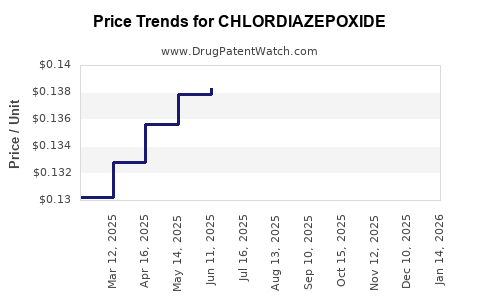
Last updated: September 8, 2026
Chlordiazepoxide is a mature, off-patent benzodiazepine with limited commercial differentiation and no meaningful branded exclusivity in the U.S. The market is supplied primarily through generic capsules and combination products. Revenue is low per prescription, competition is price-driven, and demand is concentrated in alcohol-withdrawal treatment, anxiety-related indications, and selected inpatient or institutional settings.
The financial outlook is stable to declining in value terms. Volume can persist because chlordiazepoxide remains clinically useful, but pricing pressure, regulatory scrutiny of benzodiazepines, substitution by lorazepam and diazepam, and limited manufacturer investment constrain growth.
What is the FDA regulatory status of chlordiazepoxide?
Chlordiazepoxide is an FDA-approved prescription benzodiazepine and a Schedule IV controlled substance in the United States. It was introduced under the Librium brand in the early 1960s and is now available mainly as chlordiazepoxide hydrochloride capsules.
The approved labeling covers:
- Management of anxiety disorders
- Short-term relief of anxiety symptoms
- Acute alcohol withdrawal
- Anxiety associated with irritable bowel syndrome
- Anxiety associated with gastrointestinal disease in some labeling versions
The drug acts through the gamma-aminobutyric acid type A, or GABA-A, receptor complex. Its active metabolites contribute to a relatively prolonged pharmacologic effect.
Chlordiazepoxide carries class warnings for abuse, misuse, addiction, physical dependence, and withdrawal reactions. The FDA requires boxed warnings for benzodiazepines as a class, particularly when combined with opioids or other central nervous system depressants.[1]
What dosage forms are marketed?
The dominant U.S. dosage form is the oral capsule. Common strengths include:
| Strength |
Typical commercial status |
| 5 mg |
Generic capsule |
| 10 mg |
Generic capsule |
| 25 mg |
Generic capsule |
Chlordiazepoxide is also present in some fixed-dose products, including combination products with clidinium bromide. These products have separate regulatory and commercial considerations because the combination may be used for gastrointestinal disorders rather than alcohol withdrawal.
When did chlordiazepoxide lose patent exclusivity?
Chlordiazepoxide lost meaningful U.S. patent exclusivity decades ago. The original Roche intellectual-property estate dates to the early benzodiazepine development period. One historically associated patent is U.S. Patent No. 3,296,249, covering substituted benzodiazepine compounds including chlordiazepoxide-related chemistry. The patent issued in 1967 and expired under the pre-1995 17-year-from-grant framework in the 1980s.[2]
The original Librium composition-of-matter protection therefore has no current commercial relevance. Any remaining protection would have to arise from a later formulation, manufacturing process, combination, or method-of-use patent. No such patent has created a material U.S. exclusivity barrier for ordinary chlordiazepoxide hydrochloride capsules.
What is the Orange Book status of chlordiazepoxide?
The Orange Book lists approved chlordiazepoxide products and generic equivalents, but chlordiazepoxide does not have an active branded patent barrier comparable to newer small-molecule medicines.[3]
| Exclusivity category |
Current commercial position |
| New chemical entity exclusivity |
Expired |
| Original composition-of-matter patent |
Expired |
| Pediatric exclusivity |
No material current barrier |
| Orphan exclusivity |
Not applicable to the established product |
| Active formulation exclusivity |
No significant barrier for standard capsules |
| Generic approval pathway |
Abbreviated New Drug Application, or ANDA |
The practical result is an open generic market. Manufacturers compete through price, supply reliability, wholesaler access, and controlled-substance compliance.
Are there Paragraph IV challenges involving chlordiazepoxide?
Paragraph IV litigation is not a material current market issue for standard chlordiazepoxide capsules. Paragraph IV certifications challenge listed patents during the ANDA process. Because the foundational patents expired long ago and standard capsules do not depend on an active Orange Book patent estate, there is little strategic value in a conventional Paragraph IV campaign.
The market has moved beyond the patent-challenge phase. Generic entry occurred after the original branded exclusivity period, and subsequent entrants have generally faced regulatory approval and commercial competition rather than patent litigation.
No major current U.S. litigation campaign has altered generic access to conventional chlordiazepoxide capsules based on the public Orange Book and FDA product records.[3,4]
What patent litigation affects chlordiazepoxide?
Patent litigation risk is low for the active ingredient in its standard oral capsule form. Potential disputes could still arise around:
- A novel extended-release delivery system
- A new combination product
- A manufacturing process with demonstrated commercial value
- A reformulated product with a distinct clinical profile
- Trade secrets involving API synthesis or impurity control
These categories do not currently create a broad barrier to generic chlordiazepoxide supply.
How strong is the chlordiazepoxide patent estate?
The patent estate is weak from a commercial exclusivity perspective. Its strengths and weaknesses are:
| Patent-estate factor |
Assessment |
| Active composition-of-matter protection |
None of commercial significance |
| Active U.S. Orange Book patent |
No meaningful barrier identified for standard capsules |
| Formulation protection |
Limited or immaterial for conventional products |
| Method-of-use protection |
Not material to routine generic use |
| Manufacturing protection |
Possible at process level, but unlikely to block generic entry |
| International coverage |
Historical rights expired in major markets |
| Litigation leverage |
Low |
| Generic-entry barrier |
Low |
The drug’s chemistry is also well established. Process knowledge and API availability matter operationally, but they do not provide the type of exclusivity associated with a protected synthesis route or a complex biologic manufacturing platform.
What companies manufacture or supply chlordiazepoxide?
The U.S. market has historically included several generic manufacturers and labelers. Availability can vary by dose, National Drug Code, wholesaler inventory, and manufacturer business decisions. FDA and DailyMed records have identified products marketed by companies such as Amneal Pharmaceuticals, Rising Pharma Holdings, Major Pharmaceuticals, and other generic labelers over time.[4,5]
The market structure is fragmented:
- API production is concentrated in specialized chemical suppliers.
- Finished-dose manufacturing is divided among generic pharmaceutical companies and contract manufacturers.
- Wholesalers and institutional buyers influence product availability.
- Retail pharmacies may stock only one or two approved suppliers at a time.
A manufacturer’s presence in the FDA database does not necessarily indicate continuous commercial supply. Controlled-substance products may be discontinued, temporarily unavailable, or supplied through institutional channels without a major public brand presence.
What manufacturing and intellectual-property barriers exist?
The main barriers are operational rather than patent-based:
- Compliance with Schedule IV controlled-substance requirements
- Validation of API identity, potency, and impurity limits
- Stability and packaging controls
- FDA manufacturing compliance
- Reliable API sourcing
- Inventory management for low-value products
- Wholesale and pharmacy contracting
- Pharmacovigilance and abuse-diversion controls
Chlordiazepoxide is a chemically conventional small molecule. It does not have the cell-line, cold-chain, device, or complex analytical barriers associated with biologics or advanced drug-delivery products.
How large is the chlordiazepoxide market?
Public company filings generally do not disclose chlordiazepoxide revenue as a separate product line. Generic manufacturers report broad portfolios, and product-level sales data are usually available only through commercial prescription-audit services.
The market is economically small relative to newer specialty medicines. Its value is constrained by:
- Low generic acquisition prices
- Multiple approved suppliers
- Limited patient-facing brand equity
- Substitution by other benzodiazepines
- Restrictive prescribing practices
- Low marketing expenditure
- Institutional purchasing pressure
The market can maintain prescription volume without generating significant manufacturer revenue. This distinction is important: clinical persistence does not imply strong pricing power.
What is the revenue exposure for generic manufacturers?
Revenue exposure is usually immaterial at the company level unless a manufacturer has unusually concentrated share or benefits from a temporary shortage. Chlordiazepoxide can contribute incremental portfolio revenue, but it is unlikely to drive a generic company’s valuation, pipeline strategy, or licensing activity.
The strongest commercial opportunities are generally linked to supply disruption rather than innovation. A manufacturer with dependable inventory can gain short-term share when a competitor exits or experiences an FDA manufacturing issue. That advantage is typically reversible once supply normalizes.
What is driving demand for chlordiazepoxide?
The principal demand driver is treatment of alcohol withdrawal. Chlordiazepoxide has a long duration of action and is used in detoxification protocols, outpatient withdrawal management, and institutional settings where clinicians prefer a longer-acting benzodiazepine.
Other demand sources include:
- Anxiety disorders
- Gastrointestinal conditions involving anxiety symptoms
- Hospital and rehabilitation facilities
- Correctional-health systems
- Long-term-care settings
- Selected emergency and inpatient protocols
Demand is limited by safety concerns. The FDA warns that benzodiazepines can cause dependence and serious respiratory depression when combined with opioids or other sedatives.[1]
How do clinical guidelines affect demand?
Clinical practice varies by indication. For alcohol withdrawal, chlordiazepoxide competes with diazepam, lorazepam, oxazepam, and phenobarbital-based protocols. Lorazepam may be preferred when hepatic impairment, older age, or a shorter-acting and more controllable regimen is relevant. Oxazepam is also used when metabolism is a concern.
For chronic anxiety, long-term benzodiazepine use has declined as clinicians favor selective serotonin reuptake inhibitors, serotonin-norepinephrine reuptake inhibitors, buspirone, psychotherapy, and other approaches.
This creates a split market:
- Alcohol-withdrawal use remains clinically established.
- Chronic anxiety use faces secular pressure.
- Institutional demand is more durable than routine primary-care prescribing.
How does chlordiazepoxide compare with competing benzodiazepines?
| Drug |
Common market role |
Competitive position versus chlordiazepoxide |
| Diazepam |
Alcohol withdrawal, muscle spasm, seizures, anxiety |
Strong substitute; long-acting and widely available |
| Lorazepam |
Alcohol withdrawal, anxiety, seizures |
Strong hospital substitute; often favored for predictable metabolism |
| Oxazepam |
Alcohol withdrawal and anxiety |
Competes where hepatic metabolism is a concern |
| Alprazolam |
Panic disorder and anxiety |
More associated with outpatient anxiety and dependence concerns |
| Clonazepam |
Panic disorder and seizure disorders |
Longer-acting substitute for selected anxiety uses |
| Phenobarbital |
Severe or refractory withdrawal |
Alternative in hospitals and critical-care settings |
Chlordiazepoxide’s main competitive advantage is familiarity in alcohol-withdrawal protocols. Its disadvantages include prolonged effects, active metabolites, sedation, fall risk, and dependence potential.
Is chlordiazepoxide involved in licensing deals or business-development activity?
There is no major current licensing narrative around standalone chlordiazepoxide. The product is a mature generic compound, and licensing economics are weak because:
- Patent exclusivity has expired.
- Regulatory development risk is low but commercial upside is limited.
- Multiple generic suppliers exist.
- Product differentiation is minimal.
- The active ingredient is not a platform technology.
Business-development activity is more likely to involve generic portfolio acquisitions, contract manufacturing, distribution rights, or fixed-dose combinations containing chlordiazepoxide than a new standalone licensing transaction.
What generic launch scenarios exist for chlordiazepoxide?
A new entrant would most likely follow one of three scenarios.
Standard ANDA entry
The company files an ANDA for 5 mg, 10 mg, or 25 mg capsules and competes on price and supply reliability. This is the lowest-risk route but also the most commoditized.
Portfolio or contract-manufacturing entry
A generic company acquires or licenses an existing product, manufacturing authorization, or label. This can accelerate entry but offers limited differentiation unless the target has strong distribution or shortage-related share.
Reformulated or combination-product entry
A company develops a new delivery system or combination product. This could create more defensible intellectual property, but it would require clinical, regulatory, and commercial justification. A reformulation would compete against a low-cost generic standard, making reimbursement and prescriber adoption difficult.
What is the geographic coverage of chlordiazepoxide?
Chlordiazepoxide is marketed in multiple countries, but regulatory status and commercial availability vary. The drug is generally more established in markets with long-standing benzodiazepine use and formal alcohol-withdrawal treatment protocols.
Geographic commercial risks include:
- Different controlled-substance classifications
- National reimbursement restrictions
- Local generic-registration requirements
- Variation in alcohol-withdrawal treatment standards
- API import dependence
- Country-specific pharmacovigilance obligations
The United States remains a generic, low-price market. In other jurisdictions, supply may be concentrated in a small number of distributors or hospitals, which can create local shortages without generating global pricing power.
What is the financial trajectory for chlordiazepoxide?
The most probable trajectory is flat-to-declining revenue with episodic volume and pricing changes.
| Period |
Financial profile |
| 1960s-1980s |
Branded product and patent-protected value |
| 1990s-2000s |
Generic conversion and substantial price erosion |
| 2010s |
Mature generic demand with declining branded relevance |
| 2020s |
Low-value, fragmented market with supply-driven fluctuations |
| Forward outlook |
Stable clinical use, limited revenue growth, continued price pressure |
Volume may remain resilient because alcohol-withdrawal treatment generates recurring institutional demand. Revenue growth is harder to sustain because generic prices tend to decline and prescribers can switch to diazepam, lorazepam, or oxazepam.
A temporary supply shortage could improve margins for a remaining supplier, but that would be a market-dislocation event rather than a durable product strategy.
What is the investment and commercial assessment?
Chlordiazepoxide is best viewed as a low-value, operationally manageable generic rather than an innovation asset.
| Investment factor |
Assessment |
| Patent upside |
None of significance |
| Regulatory risk |
Moderate because of controlled-substance requirements |
| Clinical demand |
Durable in alcohol withdrawal |
| Pricing power |
Very low |
| Competitive intensity |
High |
| Manufacturing complexity |
Low to moderate |
| Supply-chain risk |
Meaningful relative to product value |
| Licensing value |
Low |
| Litigation exposure |
Low |
| Revenue growth potential |
Limited |
| Strategic value |
Portfolio continuity and institutional supply |
The key commercial variable is not patent exclusivity. It is whether a supplier can maintain compliant, dependable inventory at acceptable cost while competitors exit or reduce production.
Key Takeaways
- Chlordiazepoxide is an established FDA-approved Schedule IV benzodiazepine.
- Its original composition-of-matter protection expired decades ago.
- Standard capsules have no material current patent barrier or Paragraph IV litigation risk.
- Generic competition keeps prices and manufacturer margins low.
- Alcohol-withdrawal treatment is the most durable source of demand.
- Lorazepam, diazepam, oxazepam, and phenobarbital are important clinical substitutes.
- Public company filings generally do not disclose standalone chlordiazepoxide revenue.
- The principal commercial risks are supply disruption, controlled-substance compliance, and declining prescribing for chronic anxiety.
- The forward financial profile is stable-to-declining, with occasional shortage-driven opportunities.
FAQs
Is chlordiazepoxide still sold under the Librium brand?
Librium is the historical brand associated with chlordiazepoxide. Current U.S. dispensing is primarily generic, and brand availability may vary by market and supplier.
Is chlordiazepoxide a biologic or biosimilar product?
No. Chlordiazepoxide is a chemically synthesized small-molecule drug. Generic versions are approved through the ANDA pathway, not the biosimilar pathway.
Can a new company obtain five years of exclusivity for chlordiazepoxide?
No. The original new-chemical-entity exclusivity period expired long ago. A new product would need a qualifying reformulation, combination, or other regulatory basis for any separate exclusivity.
Does chlordiazepoxide have a meaningful shortage premium?
Usually not. A shortage can improve pricing for a supplier with available inventory, but the effect is generally temporary and depends on the duration and scope of competing supply disruptions.
Which chlordiazepoxide use is most commercially defensible?
Alcohol-withdrawal treatment is the strongest continuing use because it is embedded in institutional protocols and detoxification practice. Chronic anxiety treatment is less defensible because of dependence concerns, regulatory scrutiny, and competition from non-benzodiazepine therapies.
References
-
U.S. Food and Drug Administration. (2020). FDA requiring boxed warning updated to improve safe use of benzodiazepine drug class. https://www.fda.gov/drugs/drug-safety-and-availability/fda-requiring-boxed-warning-updated-improve-safe-use-benzodiazepine-drug-class
-
U.S. Patent and Trademark Office. (1967). U.S. Patent No. 3,296,249: 7-chloro-2-methylamino-5-phenyl-3H-1,4-benzodiazepine 4-oxide. https://patents.google.com/patent/US3296249
-
U.S. Food and Drug Administration. (n.d.). Approved drug products with therapeutic equivalence evaluations, Orange Book. https://www.fda.gov/drugs/drug-approvals-and-databases/approved-drug-products-therapeutic-equivalence-evaluations-orange-book
-
U.S. Food and Drug Administration. (n.d.). Drugs@FDA: FDA-approved drugs. https://www.accessdata.fda.gov/scripts/cder/daf/
-
National Library of Medicine. (n.d.). DailyMed: Current medication information. https://dailymed.nlm.nih.gov/dailymed/