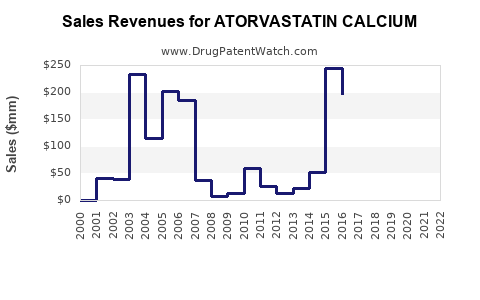
Last updated: October 29, 2026
Atorvastatin calcium is a mature, high-volume statin with global generic competition, broad guideline adoption, and limited remaining originator protection. Pfizer’s Lipitor franchise generated more than $10 billion annually before generic entry, then experienced a sharp revenue decline after U.S. exclusivity ended in November 2011. The active ingredient remains commercially important because atorvastatin is widely prescribed for hypercholesterolemia and cardiovascular-risk reduction, but current value is concentrated in manufacturing scale, distribution, contracting, and low-cost supply rather than proprietary intellectual property.
What is atorvastatin calcium and how is it used?
Atorvastatin calcium is the calcium salt of atorvastatin, an HMG-CoA reductase inhibitor. It lowers low-density lipoprotein cholesterol, total cholesterol, apolipoprotein B, and triglycerides while increasing high-density lipoprotein cholesterol in some patients.
The FDA-approved product is marketed primarily as an immediate-release oral tablet in 10 mg, 20 mg, 40 mg, and 80 mg strengths. The principal indications include:
- Primary hypercholesterolemia
- Mixed dyslipidemia
- Hypertriglyceridemia
- Dysbetalipoproteinemia
- Heterozygous familial hypercholesterolemia
- Homozygous familial hypercholesterolemia
- Reduction of cardiovascular events in selected high-risk patients
The drug is generally administered once daily. Its broad dosing range and extensive clinical evidence have supported continued use after loss of exclusivity.
When did atorvastatin lose exclusivity?
U.S. market exclusivity for Lipitor ended on November 30, 2011, following expiration of Pfizer’s relevant protection and a pediatric exclusivity period. Generic atorvastatin approvals began in 2011, creating immediate substitution pressure in the largest pharmaceutical market.
Atorvastatin exclusivity timeline
| Event |
Approximate date |
Commercial effect |
| U.S. Lipitor approval |
1997 |
Originator launch |
| Peak global Lipitor sales |
2009-2011 |
More than $10 billion annually |
| Core U.S. patent protection |
Expired before or during 2011 |
Opened the path to generic entry |
| Pediatric exclusivity period |
Ended November 30, 2011 |
Delayed broad generic launch |
| First U.S. generic launches |
November 30, 2011 |
Rapid price and share erosion |
| Broad generic competition |
2012 onward |
Originator revenue collapse |
| Current status |
Mature generic market |
Low unit prices and high volume |
The exact protection profile depended on the patent, formulation, jurisdiction, and regulatory exclusivity period. The main commercial barrier was removed in the United States in late 2011, and corresponding protection ended earlier or later in other countries based on local patent and regulatory rules.
What patents protected Lipitor and atorvastatin calcium?
The original atorvastatin patent estate included compound, process, formulation, and use-related claims. The most important commercial protection covered atorvastatin and its pharmaceutical use, rather than a complex delivery technology.
Principal patent categories
| Patent category |
Protected subject matter |
Current commercial relevance |
| Compound patents |
Atorvastatin chemical structure and related compounds |
Expired in major markets |
| Salt and crystalline-form claims |
Atorvastatin calcium and solid-state forms |
Historically relevant to generic challenges |
| Process patents |
Chemical synthesis and intermediate production |
May remain relevant only where unexpired and claim scope is enforceable |
| Formulation patents |
Tablet composition, stability, or manufacturing parameters |
Limited value after broad generic entry |
| Method-of-use patents |
Cholesterol treatment and cardiovascular-risk reduction |
Subject to carve-outs and labeling restrictions |
| Regulatory exclusivity |
New-drug and pediatric exclusivity |
Expired |
U.S. Patent No. 4,681,893 covered an early atorvastatin compound family and expired before the end of Lipitor’s commercial life. Later patents and pediatric exclusivity helped preserve market protection into 2011. The relevant Orange Book listings and expiration dates changed over time as patents were delisted, expired, or became commercially immaterial [1].
What was the Orange Book status of Lipitor?
Lipitor was listed in the FDA Orange Book as a prescription drug with patent information submitted by the innovator. Generic applicants could challenge listed patents through Paragraph IV certifications or wait for patent expiry through Paragraph III certifications.
The Orange Book was commercially important because it determined:
- Which patents generic applicants had to address
- Whether a Paragraph IV certification could trigger litigation
- Whether the first successful Paragraph IV applicant could receive 180 days of generic exclusivity
- Whether a generic applicant could use a section viii statement to omit a patented method of use
Atorvastatin’s principal U.S. patents and exclusivity periods are now historical rather than active barriers to ordinary generic entry. Current generic applicants generally compete through abbreviated new drug applications, not through development of a biosimilar or a novel biologic pathway [1].
Which companies challenged Lipitor patents?
Ranbaxy Laboratories was the principal early challenger associated with U.S. atorvastatin patent litigation. Pfizer sued Ranbaxy after Ranbaxy filed an abbreviated new drug application with a Paragraph IV certification. The dispute delayed generic entry until the negotiated launch date in late 2011.
The commercial settlement allowed Ranbaxy to launch generic atorvastatin in the United States on November 30, 2011, subject to the terms of the agreement. The case became one of the most commercially significant patent disputes in the statin market because Lipitor was one of the largest-selling prescription products in history.
Other generic manufacturers, including Watson Pharmaceuticals, Mylan, Teva, and additional suppliers, entered as regulatory and commercial barriers fell. The FDA approved multiple atorvastatin products over time, increasing pharmacy substitution and reducing Pfizer’s branded share [2].
What was the financial trajectory of Lipitor?
Lipitor reached peak sales before generic entry and then declined rapidly. Pfizer reported global Lipitor revenue of approximately $10.7 billion in 2009 and approximately $10.7 billion in 2010. Sales fell to roughly $9.6 billion in 2011, a decline reflecting the November generic launch, and dropped substantially in 2012 [3][4].
Indicative Lipitor revenue trajectory
| Period |
Approximate global revenue |
Main driver |
| 2009 |
$10.7 billion |
Full branded protection |
| 2010 |
$10.7 billion |
Mature, high-volume branded franchise |
| 2011 |
$9.6 billion |
Generic entry late in the year |
| 2012 |
Approximately $2 billion to $3 billion |
Full-year generic erosion |
| 2013 onward |
Much lower branded revenue |
Generic substitution and portfolio transition |
The drop was not caused by clinical obsolescence. Atorvastatin remained widely prescribed. The decline resulted from price compression, pharmacy substitution, payer preference for generics, and the loss of Pfizer’s ability to control market pricing.
How does generic competition affect the atorvastatin market?
Generic atorvastatin is a conventional small-molecule product with comparatively low development risk. ANDA applicants must demonstrate pharmaceutical equivalence and bioequivalence rather than repeat the full clinical development program required for a new drug.
Generic competition has produced four structural effects:
- Unit prices fell sharply after multiple suppliers entered.
- Prescription volume remained high because statin demand is chronic and guideline-supported.
- Market share moved from Pfizer’s Lipitor to generic manufacturers and pharmacy benefit channels.
- Profitability shifted from brand-level pricing to manufacturing efficiency and scale.
The market remains attractive for efficient producers with reliable active pharmaceutical ingredient supply, validated manufacturing, and access to large pharmacy and wholesaler contracts. It is less attractive for manufacturers relying on premium pricing or undifferentiated single-source distribution.
What formulation patents protect atorvastatin calcium products?
Atorvastatin calcium tablets are relatively simple immediate-release oral dosage forms. Formulation-related protection has historically covered tablet composition, excipient selection, stability, dissolution, coating, and manufacturing processes.
These claims have lower commercial leverage than the original compound and market-exclusivity claims because generic manufacturers can often design around narrow formulation claims while preserving bioequivalence. A formulation patent can still matter if it covers a required stability profile, a difficult particle-size distribution, or a manufacturing process that is expensive to replicate. For standard atorvastatin tablets, those barriers are generally limited.
Extended-release, fixed-dose combination, or specialty formulations could create differentiated patent opportunities, but the dominant commercial market remains standard immediate-release atorvastatin calcium.
Are there biosimilar risks for atorvastatin calcium?
No. Atorvastatin calcium is a chemically synthesized small molecule, not a biologic. Biosimilar regulation under the Public Health Service Act does not apply.
The relevant competitive risks are:
- ANDA-based generic entry
- Authorized generic competition
- Contract-manufacturing price pressure
- API supply interruptions
- Regulatory warning letters or manufacturing restrictions
- Pharmacy benefit manager formulary changes
- Tender and government-purchasing discounts
This distinction matters because generic entry does not require the clinical comparability package associated with biosimilars. The technical and regulatory pathway is simpler, and competition can develop quickly once exclusivity expires.
What generic launch risks exist for atorvastatin?
The principal generic launch risk is not market acceptance. It is margin compression. Atorvastatin is already a recognized, high-volume product, so demand is established. The risk is that several approved suppliers compete for the same prescriptions.
Commercial risks by market participant
| Participant |
Primary risk |
| Branded manufacturer |
Rapid substitution and loss of price control |
| First generic entrant |
Later entrants eroding first-mover margins |
| Smaller generic manufacturer |
Inability to match scale-based pricing |
| API supplier |
Price competition and customer concentration |
| Distributor |
Inventory valuation pressure after price reductions |
| Pharmacy benefit manager |
Rebate and preferred-tier economics |
| Investor |
Revenue collapse after loss of exclusivity |
Quality failures can create temporary supply shortages and improve pricing for remaining suppliers, but shortages are difficult to forecast and do not provide durable exclusivity.
How strong is the current atorvastatin patent estate?
The current patent estate is weak for ordinary atorvastatin calcium tablets because the foundational U.S. and major-market protections have expired. Any remaining value is likely to be narrow, jurisdiction-specific, or linked to a particular process, formulation, combination product, or use.
Patent-strength assessment
| Factor |
Assessment |
| Core compound protection |
Expired |
| U.S. branded exclusivity |
Expired |
| Standard immediate-release tablet |
Highly commoditized |
| Manufacturing know-how |
Potentially valuable but difficult to protect broadly |
| New formulation opportunity |
Possible, but limited by generic substitution |
| Method-of-use claims |
Narrow practical value after generic entry |
| International protection |
Expired or historically expired in major markets |
| Litigation leverage |
Low for standard products |
Manufacturing know-how can still create an operational advantage. Examples include higher-yield synthesis, impurity control, improved crystallization, lower solvent use, and stable supply of atorvastatin calcium API. These advantages are usually protected through trade secrets, process controls, and regulatory files rather than broad blocking patents.
How does atorvastatin compare with other statins?
Atorvastatin remains one of the strongest commercial statins despite generic status because of its potency, flexible dosing, evidence base, and broad availability.
| Drug |
Potency and use profile |
Exclusivity status |
Market position |
| Atorvastatin |
High potency; 10-80 mg dosing |
Generic |
High-volume global standard |
| Rosuvastatin |
High potency; strong LDL reduction |
Generic |
Major competitor |
| Simvastatin |
Moderate potency |
Generic |
Mature and price-sensitive |
| Pravastatin |
Moderate potency; interaction advantages |
Generic |
Niche and lower-intensity use |
| Pitavastatin |
Potent; differentiated tolerability and dosing profile |
Generic in some markets |
Smaller premium segment |
Rosuvastatin is the closest major comparator in high-intensity statin therapy. Both products compete primarily on clinical familiarity, formulary position, physician preference, and price. Atorvastatin’s earlier loss of exclusivity gave it a longer period of generic volume accumulation.
What licensing deals affected atorvastatin?
The most important commercial arrangements involved Pfizer’s originator rights, generic launch agreements, and authorized-generic or distribution arrangements surrounding the loss of exclusivity. The Pfizer-Ranbaxy settlement was particularly important because it established the timing of U.S. generic entry.
After generic launch, the market became less dependent on licensing and more dependent on:
- API sourcing agreements
- Contract manufacturing
- Distribution contracts
- State and federal purchasing arrangements
- Pharmacy benefit manager formulary contracts
No current licensing structure is known to restore broad exclusivity for standard atorvastatin calcium tablets.
What revenue exposure remains for atorvastatin calcium?
Atorvastatin continues to generate substantial industry revenue through volume, even though the originator no longer captures Lipitor-era economics. The global market is fragmented among generic manufacturers, wholesalers, pharmacies, and public purchasers. Pfizer’s direct branded exposure is minimal compared with the pre-2011 period.
Revenue opportunity is strongest in:
- High-volume generic tenders
- Emerging markets with rising cardiovascular disease prevalence
- Reliable API supply
- Combination products
- Contract manufacturing
- High-dose and chronic-use segments
- Markets with slower generic penetration
Revenue risk is highest in the United States and other markets where multiple approved suppliers have created intense price competition.
What is the current FDA regulatory status?
Atorvastatin calcium remains an FDA-approved prescription medicine. Generic products are approved through the ANDA pathway, subject to requirements for pharmaceutical equivalence, bioequivalence, manufacturing quality, labeling, and postmarket compliance.
The FDA regulatory environment supports continued generic supply but does not provide meaningful commercial protection for standard atorvastatin tablets. Any new product seeking differentiated protection would need a distinct formulation, combination, delivery system, or clinical use with separate regulatory and patent support [1].
Key Takeaways
- Atorvastatin calcium is a mature, high-volume generic statin.
- Lipitor lost U.S. exclusivity on November 30, 2011.
- Pfizer’s Lipitor revenue exceeded $10 billion annually before generic entry.
- Generic competition caused a rapid and permanent decline in branded revenue.
- The core compound, standard tablet, and principal market protections are expired.
- Atorvastatin is not subject to biosimilar competition because it is a small molecule.
- Current value depends on scale, low-cost API supply, manufacturing reliability, and formulary access.
- Remaining patent opportunities are narrow and most relevant to specialized formulations, combinations, or manufacturing processes.
- The principal commercial risk is margin erosion, not demand erosion.
FAQs About Atorvastatin Calcium Patents and Market Value
Is atorvastatin calcium still profitable for generic manufacturers?
Yes, but profitability depends on production scale, procurement costs, customer contracts, and the number of competing suppliers. Volume remains high while unit prices are low.
Did Lipitor face Paragraph IV patent challenges?
Yes. Ranbaxy filed a Paragraph IV challenge and litigated with Pfizer. The dispute concluded with an agreement permitting U.S. generic entry on November 30, 2011.
Can a new atorvastatin formulation receive patent protection?
Potentially. A novel formulation, fixed-dose combination, manufacturing process, or clinically differentiated delivery system could support patent claims, but ordinary immediate-release atorvastatin tablets are heavily commoditized.
Does atorvastatin calcium require a biologics license application?
No. It is a chemically synthesized small molecule regulated through the new drug application and abbreviated new drug application frameworks.
Which drug is the closest competitor to atorvastatin?
Rosuvastatin is the closest major competitor in high-intensity LDL-lowering therapy. Both are available as generics and compete on potency, formulary placement, physician familiarity, and price.
References
-
U.S. Food and Drug Administration. (2024). Approved drug products with therapeutic equivalence evaluations: Orange Book. https://www.fda.gov/drugs/drug-approvals-and-databases/approved-drug-products-therapeutic-equivalence-evaluations-orange-book
-
U.S. Food and Drug Administration. (2011). FDA approves first generic versions of Lipitor. https://www.fda.gov/news-events/press-announcements/fda-approves-first-generic-versions-lipitor
-
Pfizer Inc. (2010). 2010 annual review. Pfizer Investor Relations.
-
Pfizer Inc. (2012). 2011 annual review. Pfizer Investor Relations.
-
Pfizer Inc. (2023). Lipitor prescribing information. U.S. Food and Drug Administration labeling database.