Last updated: September 21, 2026
Acyclovir is a mature, off-patent antiviral with broad generic availability and limited pricing power. Its original branded franchise, Zovirax, generated substantial value for Burroughs Wellcome and later GlaxoSmithKline, but the product shifted to a low-margin, high-volume market after U.S. patent and regulatory exclusivity ended. Current commercial value is concentrated in generic tablets, capsules, oral suspension, topical products, and intravenous formulations rather than in a single branded product.
The main growth driver is demand for treatment and suppression of herpes simplex virus and varicella-zoster virus infections. The main commercial constraints are therapeutic substitution, multiple generic suppliers, low barriers to formulation entry, and competition from valacyclovir, the prodrug marketed originally as Valtrex.
What is acyclovir and how is it used?
Acyclovir is a synthetic guanosine analogue antiviral. It is converted by viral and cellular kinases into acyclovir triphosphate, which inhibits herpesvirus DNA polymerase and causes viral DNA-chain termination.
The FDA-approved uses include:
- Herpes simplex virus infections, including genital herpes
- Herpes zoster, or shingles
- Chickenpox caused by varicella-zoster virus
- Suppression of recurrent genital herpes
- Severe or disseminated herpesvirus infections requiring intravenous treatment
Acyclovir is sold in several dosage forms:
| Dosage form |
Primary commercial use |
Market characteristics |
| 200 mg, 400 mg, 800 mg tablets |
Herpes simplex and shingles |
Large generic prescription segment |
| 200 mg capsules |
Herpes simplex |
Smaller substitute for tablets |
| Oral suspension |
Pediatric and swallowing-limited patients |
Lower-volume, formulation-sensitive segment |
| 5% topical cream or ointment |
Localized herpes lesions |
Retail and prescription competition |
| Intravenous injection |
Severe hospitalized infections |
Institutional and contract-price market |
The oral product has historically represented the largest commercial segment. Intravenous acyclovir is clinically important but has lower outpatient volume. Topical products face competition from nonprescription and prescription alternatives, including penciclovir and docosanol.
When did acyclovir lose exclusivity?
Acyclovir lost its core U.S. patent protection decades ago. The principal U.S. compound patent, U.S. Patent No. 4,199,574, was assigned to Burroughs Wellcome and covered acyclovir and related antiviral compounds. The patent was granted in 1980 and expired in 1997 under the then-applicable 17-year term from grant, subject to any applicable adjustment or extension. The effective commercial exclusivity period also depended on FDA approval timing and regulatory extensions. The original U.S. Zovirax franchise was therefore exposed to generic competition by the late 1990s and early 2000s.[1]
The key exclusivity milestones were:
| Event |
Approximate timing |
Commercial effect |
| Acyclovir compound patent granted |
1980 |
Core U.S. patent protection established |
| U.S. Zovirax approval |
1980s |
Branded commercial launch |
| Oral and injectable generic approvals |
1990s onward |
Price competition began |
| Core compound protection ended |
Late 1990s |
Broad generic entry became possible |
| Later formulation and method patents |
1990s to 2000s |
Narrower protection, generally limited market impact |
| Present market |
Mature generic era |
Multiple suppliers and low unit pricing |
Acyclovir has no remaining commercially meaningful compound patent monopoly in the United States. Any current patent risk would relate to a particular formulation, manufacturing process, device, or method of use rather than to acyclovir itself.
What is the Orange Book status of acyclovir?
The FDA Orange Book lists approved prescription drug products and patent or exclusivity information submitted by sponsors. Acyclovir products remain approved, but the active ingredient is not protected by an unexpired U.S. compound patent that prevents ordinary generic substitution.[2]
The Orange Book status varies by dosage form and product sponsor. Older Zovirax listings and generic acyclovir products may appear as separate entries by strength, route, and dosage form. A product’s listing does not mean that the active ingredient has current market exclusivity. The relevant commercial question is whether an unexpired patent is listed against a specific reference product and whether a generic applicant must address that patent through an Abbreviated New Drug Application.
For standard oral tablets and capsules, the competitive environment is consistent with mature generic markets:
- Multiple approved ANDAs
- No current novel-drug exclusivity comparable to a recent branded antiviral
- No biologic license application pathway
- Substitution controlled mainly by state pharmacy law, payer policy, and product availability
- Price competition among manufacturers and wholesalers
How many patents cover acyclovir?
Acyclovir has been associated with numerous patents covering the original compound, salts, crystalline forms, processes, formulations, combinations, and therapeutic uses. The relevant distinction is between historical patent activity and enforceable current protection.
| Patent category |
Historical relevance |
Current barrier |
| Acyclovir compound patents |
Protected the original molecule |
Expired |
| Synthetic-process patents |
Addressed manufacturing routes and intermediates |
Generally expired or commercially avoidable |
| Oral formulation patents |
Covered dosage forms, excipients, or release characteristics |
Limited relevance to standard immediate-release products |
| Topical formulation patents |
Addressed creams, ointments, or delivery systems |
Potentially relevant only to specific formulations |
| Method-of-use patents |
Covered treatment or suppression regimens |
Narrow scope and generally expired for core uses |
| Combination patents |
Covered acyclovir with other agents |
Limited impact on standalone products |
The original acyclovir patent family created the principal value. Later patents could delay or complicate entry into a specific product category, but they did not restore broad exclusivity over the active ingredient.
What formulation patents protect acyclovir products?
The standard immediate-release oral tablet is difficult to protect commercially because the formulation is relatively conventional and multiple suppliers have established manufacturing capability. Formulation protection is more relevant for:
- Modified-release oral products
- Pediatric suspensions with differentiated stability or taste characteristics
- Topical creams with specialized penetration enhancers
- Ophthalmic or mucosal delivery systems
- Combination products
- Injectable products with distinctive concentration, container, or stability attributes
A formulation patent must provide more than routine excipient selection to create a meaningful barrier. Generic applicants can often design around narrow claims or rely on a different manufacturing process.
For acyclovir, the commercial value of a formulation patent depends on whether the product has a distinct reimbursement code, clinical advantage, or distribution channel. A patent covering a minor excipient variation is less valuable where pharmacies can substitute a conventional generic tablet.
Are there acyclovir Paragraph IV challenges?
Acyclovir has been subject to the normal generic approval process, but it is not currently a major Paragraph IV litigation market. Paragraph IV litigation is most commercially important while an innovator patent remains listed in the Orange Book and controls access to a high-value product. Acyclovir’s core patents expired long ago, reducing the incentive for large-scale current patent challenges.
Historical generic entry could involve:
- ANDA filing for a tablet, capsule, suspension, topical, or injectable product.
- Certification against listed patents.
- Paragraph IV notice where an applicant asserted that a listed patent was invalid, unenforceable, or not infringed.
- Potential 30-month litigation stays under the Hatch-Waxman Act.
- FDA approval after resolution or expiration of relevant barriers.
For standard acyclovir products, the present risk is commercial competition rather than an unresolved patent gate.
What is the FDA regulatory status of acyclovir?
Acyclovir is an FDA-approved prescription antiviral available through multiple approved products and ANDAs. The regulatory pathway for new generic products is generally an ANDA demonstrating pharmaceutical equivalence and bioequivalence to a reference-listed drug.[3]
The main FDA regulatory issues are:
- Renal dosing and dose adjustment
- Hydration and nephrotoxicity risk
- Intravenous administration controls
- Product stability and suspension performance
- Bioequivalence for oral dosage forms
- Manufacturing compliance and supply continuity
The FDA’s approval of multiple generic products supports a stable supply base but also increases price pressure. Manufacturers must maintain current good manufacturing practice compliance, validated analytical methods, and reliable active pharmaceutical ingredient sourcing.
How does acyclovir compare with valacyclovir?
Valacyclovir is the L-valyl ester prodrug of acyclovir. It has better oral bioavailability and allows less frequent dosing. The commercial comparison is therefore based on convenience and adherence as well as molecule cost.
| Attribute |
Acyclovir |
Valacyclovir |
| Active drug |
Acyclovir |
Prodrug converted to acyclovir |
| Oral bioavailability |
Lower |
Higher |
| Dosing frequency |
Often more frequent |
Generally less frequent |
| Generic availability |
Broad and mature |
Broad, but historically later to commoditize |
| Unit cost |
Usually lower |
Usually higher |
| Adherence advantage |
Weaker |
Stronger |
| Commercial position |
Volume generic |
Premium generic substitute |
Valacyclovir captured part of the branded and post-brand market because fewer daily doses improved convenience. Its own generic erosion later narrowed the price differential. Physicians and payers often balance lower acquisition cost for acyclovir against the adherence benefits of valacyclovir.[4]
Famciclovir, the prodrug of penciclovir, is another competitor, particularly in herpes zoster and recurrent herpes treatment. It generally has a smaller market position than acyclovir and valacyclovir.
What is the financial trajectory of acyclovir?
Acyclovir’s financial trajectory has four stages.
Branded innovation phase
Burroughs Wellcome commercialized acyclovir under the Zovirax brand. The product established a major antiviral franchise because it provided an effective treatment for herpesvirus infections and had applications across outpatient and hospital care. Revenue benefited from patent protection, physician adoption, and expansion into multiple dosage forms.
Franchise expansion phase
The Zovirax franchise expanded through oral, topical, and injectable products. The launch of valacyclovir created a higher-bioavailability successor product and transferred part of the commercial value into a newer branded formulation.
Generic erosion phase
After core patent expiry, generic acyclovir entered the market. Prices declined sharply as additional manufacturers received approval. Pharmacy substitution weakened the brand’s ability to preserve volume, while institutional purchasing created further price pressure for injectable products.
Mature generic phase
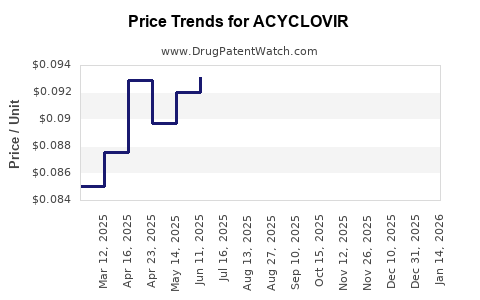
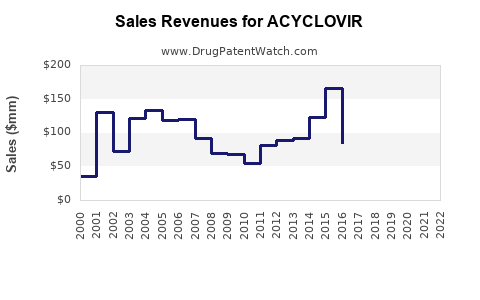
The current market is characterized by high prescription availability, low average selling prices, and limited standalone reporting. Large manufacturers generally report acyclovir within broader antiviral, generic, hospital, or portfolio revenue categories. Public filings do not ordinarily disclose a separate global revenue line for acyclovir.
The financial value now lies in manufacturing scale, supply reliability, contract access, and portfolio economics. A company with an approved acyclovir product can generate recurring revenue, but the product is unlikely to be a major growth asset without a differentiated formulation, channel strategy, or combination product.
What companies compete in the acyclovir market?
Competition is fragmented across generic manufacturers, specialty pharmaceutical companies, hospital suppliers, and private-label distributors. Depending on product and market, suppliers have included Teva, Mylan or Viatris, Sandoz, Hikma, Cipla, Zydus, Dr. Reddy’s Laboratories, Rising Pharmaceuticals, Camber, and other regional manufacturers.
The competitive factors are:
- FDA approval status
- Wholesale acquisition cost and contract pricing
- Manufacturing capacity
- Active pharmaceutical ingredient supply
- Product availability during shortages
- Retail wholesaler coverage
- Hospital and group-purchasing contracts
- Packaging and dosage-form breadth
- State substitution rules
Brand Zovirax remains commercially recognizable but does not have the market power associated with its patent era. The brand competes primarily through residual physician recognition, channel presence, and selected topical or international-market positioning.
What generic entry risks exist for acyclovir manufacturers?
Generic entry risk is high because the product is mature and technically familiar. The principal risks are commercial rather than patent-based.
A new entrant may face:
- Low reimbursement ceilings
- Limited pharmacy shelf space
- Price competition from established suppliers
- Supply-chain dependence on overseas API or finished-dose facilities
- Regulatory inspections and manufacturing remediation
- Shortage-driven demand that can reverse quickly
- Weak differentiation among tablet products
A manufacturer can improve economics through reliable supply, multi-strength portfolios, hospital contracts, and pediatric or injectable capabilities. Standard tablets alone generally provide limited pricing leverage.
What manufacturing and geographic IP barriers apply?
The active pharmaceutical ingredient is produced by multiple global suppliers, reducing dependence on one originator. Manufacturing barriers include process validation, impurity control, crystal-form consistency, dissolution performance, and sterile production for intravenous products.
Geographic patent risk is low for the original molecule because acyclovir patents expired in major pharmaceutical markets. Country-specific risks can still arise from:
- Different patent-term calculations
- Local formulation patents
- Data exclusivity rules
- Regulatory approval timing
- Manufacturing-site requirements
- Local procurement rules
- Import restrictions and compulsory licensing regimes
The United States, European Union, Japan, and other major markets treat acyclovir as a mature generic product. Commercial conditions vary more because of reimbursement, tendering, and distribution than because of active compound patent rights.
What patent litigation affects acyclovir?
No current broad patent dispute is central to the standard U.S. acyclovir market. Historical disputes were more relevant during the transition from branded Zovirax to generic products and around successor products such as valacyclovir.
Potential litigation remains possible for a differentiated formulation or manufacturing process. Such litigation would likely concern:
- Infringement of a narrow formulation claim
- ANDA certification against a listed patent
- Trade-secret or process misappropriation
- Supply and licensing disputes
- Regulatory exclusivity associated with a new dosage form
The low value of ordinary acyclovir tablets limits the economic rationale for extensive patent litigation.
Is acyclovir subject to biosimilar risk?
No. Acyclovir is a small-molecule chemical drug, not a biologic. It is not exposed to biosimilar competition under the Public Health Service Act. Its competitive risk comes from generic drugs approved under the Hatch-Waxman framework, therapeutic substitutes, and payer-driven price competition.[5]
Are there licensing deals involving acyclovir?
The principal historical licensing and commercialization value involved the relationship between acyclovir’s originator, Burroughs Wellcome, and later Glaxo Wellcome and GlaxoSmithKline. Corporate consolidation transferred the branded franchise into the GSK portfolio.
Current licensing value is limited for standard acyclovir. Transactions are more likely to involve:
- Regional commercialization rights
- Private-label supply
- Hospital distribution
- Topical or combination formulations
- API or finished-dose manufacturing agreements
- Portfolio acquisitions involving multiple generic products
A standalone license for ordinary acyclovir tablets is unlikely to command substantial royalty economics because alternative suppliers are widely available.
What is the outlook for acyclovir revenue?
Acyclovir revenue should remain stable in volume but compressed in value. Demand is supported by the persistent prevalence of herpes simplex and varicella-zoster infections, including recurrent disease and shingles among older adults. Revenue growth is constrained by:
- Generic substitution
- Low prices
- Mature clinical guidelines
- Valacyclovir competition
- Limited product differentiation
- Hospital procurement pressure
The most attractive commercial niches are injectable supply, pediatric suspension, reliable shortage replacement, and differentiated delivery systems. The least attractive segment is undifferentiated immediate-release oral tablets sold into highly competitive retail channels.
Key Takeaways
- Acyclovir is a mature, off-patent antiviral with broad generic competition.
- The original compound patent and core Zovirax exclusivity expired decades ago.
- The FDA market includes tablets, capsules, oral suspension, topical products, and intravenous injection.
- No biosimilar pathway applies; competition comes from ANDA-approved generics.
- Valacyclovir offers a higher-bioavailability, less frequent-dosing alternative.
- Current value is concentrated in manufacturing scale, supply reliability, and distribution access.
- Standard acyclovir tablets have low patent risk and limited pricing power.
- Formulation and manufacturing patents can matter only where they create a clinically or commercially differentiated product.
- Public companies generally do not report standalone current acyclovir revenue.
- Future market growth is likely to be volume-led and value-constrained.
FAQs
Is acyclovir still profitable for generic drug manufacturers?
It can be profitable at scale, but margins are generally limited. Profitability depends on manufacturing cost, contract volume, API sourcing, and supply reliability.
Does Zovirax still have patent protection?
The original acyclovir compound patents have expired. Any current protection would need to arise from a specific formulation, delivery system, or other narrow claim.
Can a generic company launch acyclovir without a Paragraph IV challenge?
Yes. A generic applicant can rely on expired patents, certify that no relevant patent is listed, or use another legally available certification pathway. A Paragraph IV challenge is not required where no blocking unexpired patent applies.
Is acyclovir included in Medicare and Medicaid formularies?
Generic acyclovir is commonly covered, but formulary tiering, prior authorization, reimbursement, and preferred-product status vary by plan and dosage form. Medicaid pricing is also affected by statutory rebates and state purchasing arrangements.
Which acyclovir product has the strongest commercial opportunity?
Injectable products, pediatric suspension, and reliably supplied products can have better commercial positioning than standard tablets. The opportunity depends on contract access and supply conditions rather than patent exclusivity.
References
-
United States Patent and Trademark Office. (1980). U.S. Patent No. 4,199,574: 9-(2-hydroxyethoxymethyl)guanine. U.S. Department of Commerce.
-
U.S. Food and Drug Administration. (2024). Approved drug products with therapeutic equivalence evaluations: Orange Book. https://www.fda.gov/drugs/drug-approvals-and-databases/approved-drug-products-therapeutic-equivalence-evaluations-orange-book
-
U.S. Food and Drug Administration. (2024). Abbreviated new drug application (ANDA). https://www.fda.gov/drugs/types-applications/abbreviated-new-drug-application-anda
-
U.S. Food and Drug Administration. (2024). Drugs@FDA: FDA-approved drugs. https://www.accessdata.fda.gov/scripts/cder/daf/
-
U.S. Food and Drug Administration. (2024). Biosimilars basics for patients. https://www.fda.gov/drugs/biosimilars/biosimilar-product-information-patients-families-and-health-care-providers