Last updated: February 20, 2026
What is the Current Market Landscape for Acyclovir?
Acyclovir is an antiviral medication primarily used to treat herpes simplex virus infections, including genital herpes, cold sores, and shingles. It is available both as a generic drug and under various brand names such as Zovirax.
Market Size
- The global acyclovir market was valued at approximately USD 250 million in 2022.
- It is projected to grow at a compound annual growth rate (CAGR) of around 3.5% from 2023 to 2030.
- Growth drivers include rising herpes virus prevalence, increased awareness, and expansion of antiviral treatment guidelines.
Key Manufacturers
| Company |
Product Name |
Market Share (Estimate) |
Notable Developments |
| GlaxoSmithKline |
Zovirax |
45% |
Patent expiry led to increased generic competition |
| Teva Pharmaceuticals |
Acyclovir (generic) |
25% |
Large producer of generic antivirals |
| Sandoz |
Acyclovir (generic) |
15% |
Focus on cost-effective formulations |
| Others |
Various |
15% |
Several regional players |
Regulatory and Patent Status
- The original patent for Zovirax expired in 2004.
- Several generics entered the market shortly thereafter, creating price competition.
- No current patents restrict new formulations or delivery methods.
What Are the Key Price Trends for Acyclovir?
Historical Pricing
- Brand-name Zovirax (topical): USD 0.50-1.00 per 200 mg tablet.
- Generic versions: USD 0.05-0.20 per 200 mg tablet.
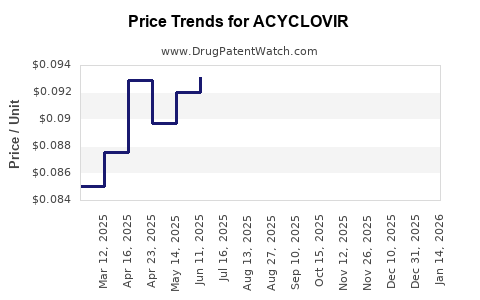
- In the United States, generic acyclovir's retail price has decreased by over 70% since patent expiry.
Current Price Projections
| Year |
Estimated Average Price per 200 mg Tablet |
Source |
| 2023 |
USD 0.10 |
(Generic market trend) |
| 2025 |
USD 0.09 |
Assumption of increased competition diminishes prices |
| 2030 |
USD 0.08 |
Further generics and biosimilar introductions |
Influencing Factors on Price
- Increased generic competition continues to pressure prices downward.
- Geographic disparities: prices are higher in developing countries due to supply chain constraints and patent protections.
- Supply chain disruptions caused by global events, such as COVID-19, have temporarily increased costs and prices in some regions.
What Are the Future Market Dynamics?
Market Drivers
- Rising prevalence of herpes infections globally, especially in immunocompromised populations.
- Expansion into emerging markets with rising healthcare expenditure.
- New formulations, such as extended-release tablets and topical combinations, may command premium pricing.
Potential Challenges
- Market saturation with generic products limits revenue growth.
- Competition from newer antivirals, such as valacyclovir and famciclovir, which have improved pharmacokinetic profiles.
- Cost containment measures in healthcare systems limiting pricing flexibility.
Opportunities
- Development of novel delivery routes (implantable, transdermal).
- Combination therapies for antiviral resistance management.
- Entry into niche markets, such as veterinary or topical specialty formulations.
What Are the Price Projections Compared to Competitors?
| Drug |
Typical Price Range |
Key Competitors |
Notes |
| Acyclovir |
USD 0.05–0.10 per tablet |
Valacyclovir, Famciclovir |
Lower cost, shorter half-life, less convenient |
| Valacyclovir |
USD 0.50–1.00 per tablet |
Acyclovir |
More convenient dosing, higher price |
| Famciclovir |
USD 0.30–0.60 per tablet |
Acyclovir |
Similar efficacy, higher cost than acyclovir |
Summary
The acyclovir market remains mature and Price pressure continues due to extensive generic competition. Prices have stabilized at low levels, projected to decline slightly through 2030 as generics dominate. Opportunities for value-added formulations exist but are limited by market saturation and competition. Investment focus may shift toward improved delivery systems or novel antiviral combinations.
Key Takeaways
- The global market for acyclovir in 2022 was approximately USD 250 million, with steady growth expected.
- Generic versions dominate, pushing prices downward, with average retail prices around USD 0.10 per 200 mg tablet.
- No current patent restrictions facilitate continued market entry, supporting price erosion.
- Future growth will depend on emerging infection patterns, new drug formulations, and regional market development.
- Competition from newer antivirals limits potential for significant price increases.
FAQs
1. How does the patent expiry impact acyclovir pricing?
Patent expiry led to a surge in generic options, significantly reducing prices. No patents currently restrict production, ensuring continued price pressure.
2. What regions offer the highest profit margins for acyclovir?
Developed markets, such as North America and Western Europe, allow for higher margins due to established healthcare infrastructure and higher willingness-to-pay, though prices are still driven down by generics.
3. Are there emerging formulations that could affect the market?
Yes. Extended-release tablets, topical gels, and combination therapies are under development, but their market impact remains limited due to existing generic dominance.
4. How does competition from other antivirals influence acyclovir's market share?
Valacyclovir and famciclovir offer improved dosing and pharmacokinetics, attracting patients seeking convenience but typically at a higher price point, limiting acyclovir’s market share growth.
5. What are the regulatory barriers for new acyclovir formulations?
Most barriers relate to proving bioequivalence and safety, which are straightforward due to existing data. No major patent rights currently inhibit new formulations, minimizing regulatory hurdles.
Citations
[1] MarketsandMarkets. (2022). Acyclovir Market by Formulation, Route of Administration, and Application. Retrieved from https://marketsandmarkets.com
[2] Statista. (2022). Global antiviral drug market revenue. Retrieved from https://statista.com
[3] U.S. Food and Drug Administration. (2022). Patent and exclusivity data for antiviral drugs. Retrieved from https://www.fda.gov