Last updated: November 10, 2026
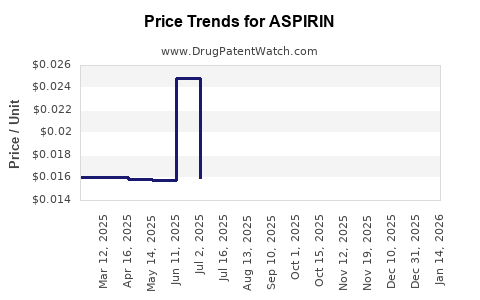
Aspirin, or acetylsalicylic acid, is a mature, low-cost pharmaceutical with minimal foundational patent protection and broad global availability. Its commercial value is concentrated in branded over-the-counter products, private-label generics, low-dose cardiovascular products, and combination medicines rather than in the active ingredient itself. Bayer remains the leading branded reference company, but most volume is exposed to generic substitution and retailer pricing.
The aspirin market has stable demand in analgesia and antiplatelet use, although cardiovascular-prevention guidance has reduced the growth potential of daily aspirin. Revenue is likely to remain volume-driven, with modest nominal growth from price increases, premium formulations, packaging, and distribution rather than from new indications.
What is aspirin used for and how is the market segmented?
Aspirin is used in four principal commercial segments:
| Segment |
Primary use |
Commercial characteristics |
| Analgesic and antipyretic |
Headache, fever, muscle pain, minor arthritis pain |
Mature OTC category with heavy generic competition |
| Low-dose antiplatelet |
Secondary prevention of myocardial infarction and ischemic stroke |
Physician-directed or self-directed use; demand depends on cardiovascular guidelines |
| Combination products |
Migraine, gastrointestinal protection, cold symptoms, and pain combinations |
Higher differentiation and stronger brand positioning |
| Prescription combinations |
Aspirin with dipyridamole or other active ingredients |
Separate prescription markets with distinct patent estates |
Aspirin inhibits cyclooxygenase enzymes and platelet aggregation. Its irreversible antiplatelet effect distinguishes low-dose aspirin from many competing analgesics, but cardiovascular use is constrained by gastrointestinal bleeding and hemorrhagic-stroke risk.
The principal competitors in pain relief are acetaminophen, ibuprofen, and naproxen. In secondary cardiovascular prevention, clopidogrel and combination antiplatelet regimens compete with aspirin. Aspirin retains a cost advantage over branded and newer prescription antiplatelet products.
How large is the aspirin market?
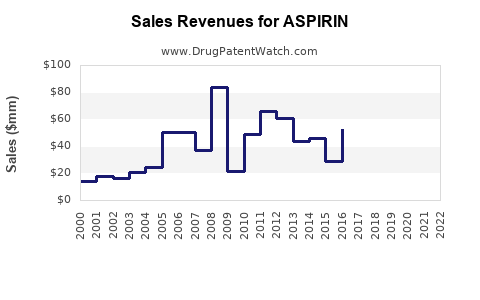
Public companies generally do not report aspirin sales as a separate global line item. Bayer reports Consumer Health and product-category results, but does not disclose a standalone worldwide revenue figure for Aspirin. Retailer private-label products and generic manufacturers also report aspirin revenue within broader analgesic or consumer-health categories (Bayer AG, 2025).
This reporting structure makes the active-ingredient market difficult to measure precisely. The economically relevant market consists of:
- Bayer-branded Aspirin products.
- Store-brand and generic aspirin tablets.
- Aspirin-containing combination products.
- Prescription products that include aspirin.
- Institutional and hospital purchases.
The market is mature rather than discovery-driven. Unit demand is supported by aspirin’s low price, long clinical history, extensive manufacturing capacity, and global recognition. Revenue growth is limited because price competition is intense and the active ingredient has no meaningful exclusivity.
Which companies compete in aspirin?
The competitive landscape includes:
- Bayer, through Aspirin and related low-dose or combination products.
- Perrigo, which manufactures and supplies private-label and store-brand OTC medicines.
- Major pharmacy retailers, including CVS, Walgreens, and Walmart, which sell private-label aspirin.
- Generic manufacturers and contract manufacturers supplying tablets, chewables, enteric-coated products, and bulk active pharmaceutical ingredient.
- Regional consumer-health companies in Europe, Asia, and Latin America.
- Manufacturers of competing analgesics, including Johnson & Johnson, Haleon, Reckitt, and generic drug companies.
Bayer’s advantage is brand recognition, not patent exclusivity. Retailer brands can offer materially lower prices because aspirin tablets are inexpensive to manufacture and do not require differentiated active-ingredient technology.
What is the financial trajectory for aspirin?
Aspirin revenue is likely to follow a low-growth, high-volume trajectory. The principal drivers are:
| Driver |
Expected effect on aspirin economics |
| Retail price increases |
Supports nominal revenue but can accelerate private-label substitution |
| Low manufacturing cost |
Preserves margins for efficient producers |
| Brand loyalty |
Supports Bayer’s price premium in selected markets |
| Cardiovascular-prevention guidance |
Limits growth in new daily users |
| Aging populations |
Supports secondary-prevention demand |
| Generic competition |
Compresses unit prices |
| Combination products |
Creates higher-value niches |
| Retailer private labels |
Transfers value from branded manufacturers to retailers |
| Packaging and formulation |
Supports premium positioning in selected channels |
Bayer’s annual reports do not provide a standalone Aspirin revenue series. The product is reported within Consumer Health activities, where portfolio performance is affected by the broader analgesics, nutritionals, dermatology, and self-care markets (Bayer AG, 2025).
The likely financial pattern is:
- Stable or slowly declining core tablet volumes in mature markets.
- Modest nominal revenue growth from inflation-linked price increases.
- Continued pressure on standard uncoated and enteric-coated tablets.
- Better pricing in branded chewable, effervescent, buffered, and combination products.
- Greater value capture by retailers and private-label suppliers.
- Limited prospect of pharmaceutical-style margin expansion.
Aspirin is strategically important as a durable consumer-health brand, but it is unlikely to be a major source of pharmaceutical research returns. Its value lies in recurring cash flow, distribution strength, and brand familiarity.
When does aspirin lose exclusivity?
Aspirin has no remaining foundational compound patent exclusivity in the United States or major pharmaceutical markets. The compound has been commercially used for more than a century, and any original composition-of-matter rights expired many decades ago.
The relevant exclusivity position is therefore:
| Protection type |
Current position |
| Original compound patent |
Expired |
| Basic aspirin tablet patent |
Expired or unavailable as a meaningful market barrier |
| OTC monograph eligibility |
Available to compliant manufacturers |
| Brand trademark |
Remains valuable but does not block generic aspirin |
| Formulation patents |
May exist for selected products, but generally do not protect basic aspirin |
| Method-of-use patents |
Potentially relevant to specific combinations or indications |
| Regulatory exclusivity |
No meaningful exclusivity for standard OTC aspirin |
| Biosimilar exclusivity |
Not applicable |
Aspirin’s trademark rights can restrict use of the Bayer Aspirin brand name, packaging, and trade dress. They do not prevent competitors from selling acetylsalicylic acid under generic or private-label names.
What is the FDA regulatory status of aspirin?
In the United States, aspirin is widely marketed as an OTC analgesic and antipyretic under the FDA’s OTC monograph framework. The relevant regulatory framework is 21 C.F.R. Part 343, which covers internal analgesic, antipyretic, and antirheumatic drug products (U.S. Food and Drug Administration, 2024a).
Common dosage forms include:
- Immediate-release tablets.
- Chewable tablets.
- Enteric-coated tablets.
- Buffered tablets.
- Effervescent products.
- Powder or granule formulations.
- Combination products.
Aspirin products must comply with active-ingredient, labeling, dosage, warning, and packaging requirements. Pediatric use has particular restrictions because of the association between aspirin and Reye’s syndrome. Product labeling warns against use in children and teenagers with viral illnesses unless directed by a physician.
FDA labeling and consumer guidance also distinguish between aspirin use for established cardiovascular disease and aspirin use for primary prevention. The FDA states that people should not begin daily aspirin therapy for primary prevention without consulting a healthcare professional (U.S. Food and Drug Administration, 2024b).
What is the Orange Book status of aspirin?
Standard OTC aspirin is generally outside the commercial scope of the FDA Orange Book because it is marketed under the OTC monograph system rather than through an individual prescription New Drug Application.
The Orange Book remains relevant to prescription aspirin-containing products, such as aspirin and extended-release dipyridamole combinations. Those products have separate approval histories, labeling, and potential patent listings. The presence of an aspirin component does not create patent protection for aspirin itself.
The practical distinction is:
| Product type |
Orange Book relevance |
| Basic OTC aspirin tablet |
Generally no meaningful Orange Book patent barrier |
| Branded low-dose OTC aspirin |
Trademark and formulation considerations, not compound exclusivity |
| Aspirin-containing prescription combination |
Potential Orange Book listings and Paragraph IV exposure |
| Aspirin medical device combination |
Separate device and drug regulatory issues |
| Generic OTC aspirin |
Monograph compliance rather than ANDA-based patent clearance |
What patents protect aspirin formulations?
Basic aspirin tablets have little defensible patent protection. Commercially relevant formulation protection can arise from:
- Enteric coatings.
- Delayed-release systems.
- Effervescent delivery.
- Buffered formulations.
- Taste-masking technology.
- Combination products.
- Modified-release prescription products.
- Packaging designed to control moisture and hydrolysis.
Aspirin is chemically susceptible to hydrolysis into salicylic acid and acetic acid, making stability, moisture control, excipient selection, and packaging important manufacturing issues. These factors can support process know-how and limited formulation patents, but they generally do not prevent competitors from selling standard aspirin tablets.
Formulation patents tend to be narrower than compound patents. A competitor may avoid infringement by using a different coating polymer, excipient system, manufacturing process, or release profile.
Are there Paragraph IV challenges involving aspirin?
Paragraph IV litigation is not a major feature of the standard OTC aspirin market. A generic manufacturer seeking to sell basic OTC aspirin normally relies on the applicable monograph rather than challenging an Orange Book-listed patent for the active ingredient.
Paragraph IV activity can arise for prescription aspirin-containing products. The most relevant examples involve proprietary combinations, controlled-release technology, or other drug components. In those cases, the patent dispute concerns the specific approved product rather than aspirin as a molecule.
For standard aspirin:
- There is no active compound patent that blocks generic entry.
- OTC monograph compliance is the primary market-access route.
- A Paragraph IV challenge would have limited commercial relevance unless directed to a specific prescription formulation.
- Litigation risk is more likely to concern trademarks, packaging, advertising, or combination-product patents.
Which companies are challenging the aspirin market?
The core challenge comes from private-label and generic manufacturers rather than patent litigants. Retailers can source chemically equivalent products and sell them at lower prices. This creates a permanent price ceiling for unbranded aspirin.
Competitive pressure is strongest in:
- Standard 81 mg tablets.
- Standard 325 mg tablets.
- Large-count bottles.
- Hospital and institutional supply.
- Basic enteric-coated tablets.
Brand resilience is stronger in:
- Products with high consumer recognition.
- Chewable formulations.
- Buffered or effervescent products.
- Combination products.
- Markets where Bayer has strong pharmacy distribution.
The leading competitive substitution risk is not a single generic entrant. It is continuous channel substitution from branded aspirin to store brands.
What is the cardiovascular impact on aspirin demand?
Cardiovascular use creates both a stable base and a ceiling on demand. Aspirin remains widely used for secondary prevention in patients with prior myocardial infarction, ischemic stroke, or established cardiovascular disease. However, guidance has become more restrictive for primary prevention.
The U.S. Preventive Services Task Force recommends individualized decision-making for adults aged 40 to 59 with elevated cardiovascular risk and recommends against initiating aspirin for primary prevention in adults aged 60 or older (U.S. Preventive Services Task Force, 2022).
This change has several commercial effects:
- Fewer new consumers are likely to begin daily aspirin solely to prevent a first cardiovascular event.
- Existing secondary-prevention patients remain an important recurring-use population.
- Physician and pharmacist counseling becomes more important.
- Cardiovascular demand is less sensitive to brand advertising than analgesic demand.
- Safety concerns can reduce unsupervised long-term use.
In mature markets, cardiovascular use may provide volume stability, but it is unlikely to create rapid market expansion.
What manufacturing and intellectual-property barriers exist?
Aspirin manufacturing has low barriers at the active-ingredient and basic-tablet level. The principal capabilities include:
- Reliable acetylation chemistry.
- Control of salicylic acid and related impurities.
- Moisture management.
- Tablet compression and coating.
- Stability testing.
- Good Manufacturing Practice compliance.
- Packaging that limits degradation.
Manufacturing scale, regulatory compliance, quality systems, and distribution are more important than patent access. Large suppliers benefit from procurement scale and established retailer relationships. Smaller companies can enter through contract manufacturing, but they remain dependent on regulatory compliance and channel access.
The principal technical risk is product degradation rather than access to protected chemistry. Companies with robust stability data and packaging systems can reduce recalls, shelf-life problems, and customer complaints.
What patent litigation and settlements affect aspirin?
No major current patent litigation appears to threaten the basic U.S. aspirin market. The original aspirin patent estate is obsolete, and standard OTC aspirin is not dependent on a narrow patent-protected technology.
Litigation exposure can still arise from:
- Prescription aspirin combinations.
- Formulation patents.
- Trademark disputes involving the Aspirin name.
- Trade dress and packaging.
- Marketing claims.
- Product liability allegations.
- Regulatory disputes involving labeling or safety.
Public company disclosures do not identify a material current aspirin-specific licensing transaction that changes the competitive structure of the basic aspirin market. Licensing is more commercially relevant to combination products and branded consumer-health portfolios than to the aspirin active ingredient itself (Bayer AG, 2025).
How does aspirin compare with ibuprofen and acetaminophen?
| Factor |
Aspirin |
Ibuprofen |
Acetaminophen |
| Core use |
Pain, fever, inflammation, antiplatelet therapy |
Pain, fever, inflammation |
Pain and fever |
| Antiplatelet effect |
Strong and irreversible |
Reversible and less suitable for standard prevention |
Minimal |
| Gastrointestinal risk |
Material |
Material, especially with chronic use |
Lower gastrointestinal risk |
| Liver toxicity |
Lower central concern |
Lower central concern |
Key overdose risk |
| Cardiovascular use |
Established in secondary prevention |
Not a direct substitute |
Not a direct substitute |
| Generic competition |
Very high |
Very high |
Very high |
| Brand differentiation |
Bayer and low-dose products |
Motrin, Advil, private labels |
Tylenol, private labels |
| Patent position |
Expired |
Expired |
Expired |
Aspirin has a differentiated clinical role because of platelet inhibition. That role protects part of demand from direct substitution. In routine pain relief, however, consumers and retailers can readily shift to ibuprofen or acetaminophen.
What generic launch risks exist for aspirin?
Generic launch risk is effectively permanent for standard aspirin because entry is already permitted. The commercial question is not whether a generic can launch, but whether a branded product can retain price and shelf-space advantages.
Key risks include:
- Retailer replacement of branded aspirin with private-label products.
- Price compression during promotional periods.
- Contract-manufacturer consolidation.
- Raw-material or packaging cost increases.
- Reduced primary-prevention use.
- Safety-related labeling changes.
- Substitution by ibuprofen or acetaminophen in analgesia.
- Loss of pharmacy shelf space to higher-margin products.
Branded manufacturers can defend value through formulation, packaging, consumer trust, and distribution. They cannot rely on compound-level exclusivity.
What is the geographic coverage of aspirin?
Aspirin is sold across North America, Europe, Latin America, Asia-Pacific, and other global markets under Bayer and local generic brands. Regulatory treatment differs by country:
- The United States relies heavily on OTC monograph pathways for standard products.
- Europe has national and decentralized authorization structures, with extensive generic availability.
- Emerging markets often have large volumes of low-cost generic acetylsalicylic acid.
- Pharmacy and physician control over low-dose cardiovascular products varies by jurisdiction.
- Brand strength is highest where Bayer has maintained long-term retail distribution and consumer recognition.
Global growth is more likely to come from population growth, expanding pharmacy access, and branded consumer-health distribution than from new medical indications.
What is the patent strength of the aspirin estate?
The basic aspirin patent estate is weak because the compound and standard tablet technology are long out of patent. The remaining defensible assets are commercial rather than foundational:
| Asset |
Relative strength |
| Aspirin active ingredient |
Very weak |
| Standard tablet |
Very weak |
| Bayer trademark |
Strong where registered and recognized |
| Brand packaging and trade dress |
Moderate, subject to local law |
| Specialty formulations |
Variable and product-specific |
| Prescription combinations |
Potentially stronger |
| Manufacturing know-how |
Moderate but difficult to enforce as a market monopoly |
| Distribution and retail placement |
Commercially important |
The investment case therefore depends on brand economics, operational efficiency, and portfolio strategy rather than patent duration.
Key Takeaways
- Aspirin is a mature, globally available product with no meaningful foundational patent exclusivity.
- Bayer’s commercial advantage comes from brand recognition, distribution, and product range.
- Private-label and generic competition place a permanent ceiling on pricing.
- Standard OTC aspirin is generally governed by the FDA monograph system, not Orange Book exclusivity.
- Paragraph IV litigation is relevant mainly to prescription aspirin combinations and specialized formulations.
- Cardiovascular secondary prevention supports recurring demand, while restrictive primary-prevention guidance limits growth.
- Aspirin revenue is not separately disclosed by Bayer, making precise brand-level financial forecasting difficult.
- Financial performance should be modeled as stable volume, low unit pricing, modest inflation-driven revenue growth, and sustained margin pressure.
- Formulation, packaging, quality control, and distribution are more important than compound patents.
- Biosimilar risk is not applicable because aspirin is a small-molecule drug, not a biologic.
FAQs About Aspirin Market and Patent Exposure
Does Bayer still own a patent on aspirin?
No. Bayer retains important trademark and brand rights, but the original aspirin compound patent expired long ago.
Can a company launch generic aspirin without a Paragraph IV certification?
Yes, standard OTC aspirin can generally be marketed under the applicable FDA OTC monograph if the product meets the regulatory requirements. Paragraph IV certifications are more relevant to prescription aspirin-containing products.
Is low-dose aspirin FDA-approved for primary prevention?
The FDA does not recommend that consumers begin daily aspirin for primary prevention without medical advice. The benefit-risk balance depends on age, cardiovascular risk, and bleeding risk.
Is aspirin a biologic or biosimilar product?
No. Aspirin is a chemically synthesized small-molecule drug. Biosimilar regulations do not apply.
Which aspirin products have the strongest commercial protection?
Branded products with strong consumer recognition, distinctive formulations, combination ingredients, stable distribution, and retailer support have the strongest commercial protection. Standard aspirin tablets have the weakest protection.
References
Bayer AG. (2025). Annual report 2024. Bayer AG.
U.S. Food and Drug Administration. (2024a). 21 CFR Part 343: Internal analgesic, antipyretic, and antirheumatic drug products for over-the-counter human use. U.S. Department of Health and Human Services.
U.S. Food and Drug Administration. (2024b). Aspirin for prevention of cardiovascular disease. U.S. Department of Health and Human Services.
U.S. Preventive Services Task Force. (2022). Aspirin use to prevent cardiovascular disease: Preventive medication. JAMA, 327(16), 1577-1584.