Waylis Therap Company Profile
✉ Email this page to a colleague
What is the competitive landscape for WAYLIS THERAP
WAYLIS THERAP has fifteen approved drugs.
There is one US patent protecting WAYLIS THERAP drugs.
Summary for Waylis Therap
| US Patents: | 1 |
| Tradenames: | 15 |
| Ingredients: | 14 |
| NDAs: | 15 |
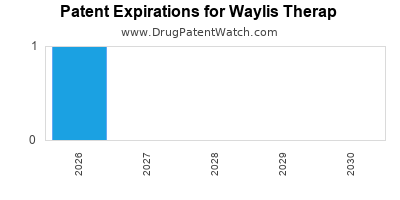
Drugs and US Patents for Waylis Therap
| Applicant | Tradename | Generic Name | Dosage | NDA | Approval Date | TE | Type | RLD | RS | Patent No. | Patent Expiration | Product | Substance | Delist Req. | Exclusivity Expiration |
|---|---|---|---|---|---|---|---|---|---|---|---|---|---|---|---|
| Waylis Therap | HYDREA | hydroxyurea | CAPSULE;ORAL | 016295-001 | Approved Prior to Jan 1, 1982 | AB | RX | Yes | Yes | ⤷ Start Trial | ⤷ Start Trial | ||||
| Waylis Therap | DROXIA | hydroxyurea | CAPSULE;ORAL | 016295-004 | Feb 25, 1998 | RX | Yes | No | ⤷ Start Trial | ⤷ Start Trial | |||||
| Waylis Therap | COREG | carvedilol | TABLET;ORAL | 020297-003 | Sep 14, 1995 | AB | RX | Yes | No | ⤷ Start Trial | ⤷ Start Trial | ||||
| Waylis Therap | ADAPALENE | adapalene | SOLUTION;TOPICAL | 204593-001 | Jan 5, 2016 | AB | RX | No | No | ⤷ Start Trial | ⤷ Start Trial | ||||
| Waylis Therap | COREG CR | carvedilol phosphate | CAPSULE, EXTENDED RELEASE;ORAL | 022012-002 | Oct 20, 2006 | AB | RX | Yes | No | 8,101,209*PED | ⤷ Start Trial | Y | ⤷ Start Trial | ||
| Waylis Therap | VALIUM | diazepam | TABLET;ORAL | 013263-006 | Approved Prior to Jan 1, 1982 | AB | RX | Yes | Yes | ⤷ Start Trial | ⤷ Start Trial | ||||
| >Applicant | >Tradename | >Generic Name | >Dosage | >NDA | >Approval Date | >TE | >Type | >RLD | >RS | >Patent No. | >Patent Expiration | >Product | >Substance | >Delist Req. | >Exclusivity Expiration |
Expired US Patents for Waylis Therap
| Applicant | Tradename | Generic Name | Dosage | NDA | Approval Date | Patent No. | Patent Expiration |
|---|---|---|---|---|---|---|---|
| Waylis Therap | VALIUM | diazepam | TABLET;ORAL | 013263-002 | Approved Prior to Jan 1, 1982 | 4,316,897 | ⤷ Start Trial |
| Waylis Therap | AVODART | dutasteride | CAPSULE;ORAL | 021319-001 | Nov 20, 2001 | 5,565,467 | ⤷ Start Trial |
| Waylis Therap | LOVAZA | omega-3-acid ethyl esters | CAPSULE;ORAL | 021654-001 | Nov 10, 2004 | 5,502,077 | ⤷ Start Trial |
| Waylis Therap | LOVAZA | omega-3-acid ethyl esters | CAPSULE;ORAL | 021654-001 | Nov 10, 2004 | 5,656,667 | ⤷ Start Trial |
| Waylis Therap | JALYN | dutasteride; tamsulosin hydrochloride | CAPSULE;ORAL | 022460-001 | Jun 14, 2010 | 5,998,427 | ⤷ Start Trial |
| Waylis Therap | HYDREA | hydroxyurea | CAPSULE;ORAL | 016295-001 | Approved Prior to Jan 1, 1982 | 3,968,249 | ⤷ Start Trial |
| >Applicant | >Tradename | >Generic Name | >Dosage | >NDA | >Approval Date | >Patent No. | >Patent Expiration |
Paragraph IV (Patent) Challenges for WAYLIS THERAP drugs
| Drugname | Dosage | Strength | Tradename | Submissiondate |
|---|---|---|---|---|
| ➤ Subscribe | Extended-release Capsules | 10 mg and 20 mg | ➤ Subscribe | 2008-03-18 |
| ➤ Subscribe | Extended-release Capsules | 80 mg | ➤ Subscribe | 2007-11-19 |
| ➤ Subscribe | Capsule | 0.5 mg/0.4 mg | ➤ Subscribe | 2010-10-26 |
| ➤ Subscribe | Tablets | 1 mg, 2 mg and 3 mg | ➤ Subscribe | 2008-12-15 |
| ➤ Subscribe | Extended-release Capsules | 40 mg | ➤ Subscribe | 2007-12-21 |
| ➤ Subscribe | Capsules | 0.5 mg | ➤ Subscribe | 2007-10-29 |
| ➤ Subscribe | Capsules | 1 g | ➤ Subscribe | 2008-11-10 |
International Patents for Waylis Therap Drugs
| Country | Patent Number | Estimated Expiration |
|---|---|---|
| China | 1976682 | ⤷ Start Trial |
| China | 100341493 | ⤷ Start Trial |
| Israel | 160795 | ⤷ Start Trial |
| Spain | 2661723 | ⤷ Start Trial |
| Brazil | 0213175 | ⤷ Start Trial |
| World Intellectual Property Organization (WIPO) | 2005099671 | ⤷ Start Trial |
| >Country | >Patent Number | >Estimated Expiration |
Supplementary Protection Certificates for Waylis Therap Drugs
| Patent Number | Supplementary Protection Certificate | SPC Country | SPC Expiration | SPC Description |
|---|---|---|---|---|
| 1458369 | 132008901685368 | Italy | ⤷ Start Trial | PRODUCT NAME: ADAPALENE E BENZOILE PEROSSIDO(EPIDUO); AUTHORISATION NUMBER(S) AND DATE(S): 40440, 20071218;DA 038261018/M A 038261057/M, 20080618 |
| 0268956 | 1999C0030 | Belgium | ⤷ Start Trial | PRODUCT NAME: RABEPRAZOLE SODIUM; NAT. REGISTRATION NO/DATE: 5532 IE 1 F 3 19990201; FIRST REGISTRATION: GB 10555/0010 19980508 |
| 1458369 | SPC/GB10/005 | United Kingdom | ⤷ Start Trial | PRODUCT NAME: ADAPALENE AND BENZOYL PEROXIDE; REGISTERED: DK 40440 20071218; UK PL10590/0057 20091111 |
| 1458369 | 08C0024 | France | ⤷ Start Trial | PRODUCT NAME: ADAPALENE - PEROXYDE DE BENZOLE; REGISTRATION NO/DATE IN FRANCE: NL 33724 DU 20080123; REGISTRATION NO/DATE AT EEC: 40440 DU 20071218 |
| 0719278 | 23/2003 | Austria | ⤷ Start Trial | PRODUCT NAME: DUTASTERIDE, GEGEBENENFALLS IN FORM EINES PHARMAZEUTISCH ANNEHMBAREN SOLVATES; NAT. REGISTRATION NO/DATE: 1-24844, 1-24845 20030217; FIRST REGISTRATION: SE 17871, 17872 20020719 |
| 0719278 | SPC/GB03/018 | United Kingdom | ⤷ Start Trial | PRODUCT NAME: DUTASTERIDE, OPTIONALLY IN THE FORM OF A PHARMACEUTICALLY ACCEPTABLE SOLVATE.; REGISTERED: SE 17871 20020719; SE 17872 20020719; UK PL 19494/0005 20030117; UK PL 19494/0006 20030117 |
| >Patent Number | >Supplementary Protection Certificate | >SPC Country | >SPC Expiration | >SPC Description |
Similar Applicant Names
Applicants may be listed under multiple names.
Here is a list of applicants with similar names.
Here is a list of applicants with similar names.
