Last updated: October 12, 2026
Diazepam is a mature benzodiazepine with broad generic availability, minimal protection for its original oral and injectable products, and limited pricing power in conventional indications. Commercial value has shifted from Valium tablets to differentiated rescue-delivery products, including rectal gel and intranasal formulations. Generic diazepam remains a low-margin, high-volume business, while branded rescue products carry the principal growth and patent risk.
What is the current FDA and regulatory status of diazepam?
Diazepam is an FDA-approved benzodiazepine indicated for anxiety disorders, alcohol withdrawal, skeletal-muscle spasm, seizure disorders, and status epilepticus in selected formulations. FDA first approved Valium in 1963. Diazepam is a Schedule IV controlled substance under the U.S. Controlled Substances Act because of abuse, dependence, and diversion risks (FDA, 2024a; DEA, 2023).
| Product type |
Representative product |
U.S. regulatory status |
Principal commercial use |
| Oral tablets |
Generic diazepam; Valium historically |
Generic and brand products approved |
Anxiety, muscle spasm, seizure adjunct |
| Oral solution |
Generic diazepam solution |
Approved in selected strengths |
Patients unable to swallow tablets |
| Injection |
Generic diazepam injection |
Approved |
Acute seizures, sedation, withdrawal |
| Rectal gel |
Diastat, diazepam rectal gel |
Approved |
Acute repetitive seizures |
| Nasal spray |
Valtoco, diazepam nasal spray |
Approved in 2020 |
Acute seizure clusters |
| Veterinary products |
Multiple animal-health products |
Separate regulatory products |
Seizure and muscle-spasm treatment in animals |
The oral, injectable, and rectal products are not new chemical entities. Their original regulatory exclusivity periods expired decades ago. Valtoco received approval under the 505(b)(2) pathway and obtained limited exclusivity linked to new clinical investigations, but that period has expired.
When did diazepam lose exclusivity, and when do its patents expire?
Diazepam’s core composition-of-matter protection expired many years ago. Generic manufacturers can compete in oral tablets, oral solution, and injection without waiting for an original-product patent term to end.
| Protection category |
Diazepam position |
| Original composition-of-matter patent |
Expired |
| Original Valium exclusivity |
Expired |
| Oral tablet patents |
No meaningful blocking protection for the active ingredient |
| Injectable formulation protection |
Legacy protection expired |
| Diastat rectal-gel protection |
Legacy product protection largely expired |
| Valtoco nasal-delivery protection |
Product-specific patents and regulatory protections may remain relevant depending on formulation, device, and listing |
| FDA orphan-drug exclusivity |
Not applicable to diazepam as a broad active ingredient |
| Biosimilar exclusivity |
Not applicable because diazepam is a small-molecule drug |
The key distinction is between diazepam itself and proprietary delivery systems. A competitor can manufacture generic diazepam, but a direct substitute for Valtoco may need to address patents covering nasal delivery, formulation, device configuration, manufacturing, or clinical use.
The Orange Book is therefore most relevant to branded diazepam rescue products rather than to the mature generic tablet market. Orange Book patent listings can change through patent expiration, delisting, litigation, or corrections. Commercial diligence should treat the product-specific listing, not the diazepam molecule, as the relevant freedom-to-operate question (FDA, 2024b).
What patents protect Valtoco, Diastat, and generic diazepam products?
Generic diazepam tablets and injection
The generic market is primarily exposed to:
- Active-ingredient price competition
- FDA approval and manufacturing requirements
- Controlled-substance quota and inventory controls
- Product liability risk
- Supply-chain interruptions
- State and federal substitution rules
The commercial value of a generic diazepam tablet is not protected by an active ingredient patent. Manufacturers compete through abbreviated new drug applications, wholesaler contracts, hospital tenders, pharmacy benefit coverage, and supply reliability.
Diastat rectal gel
Diastat established a proprietary route of administration for acute repetitive seizures. Its commercial differentiation came from patient and caregiver usability rather than from a new active ingredient. The principal barriers were product-specific formulation, applicator design, dosing calibration, labeling, and clinical familiarity.
The older Diastat franchise does not have the same protection profile as a newly launched branded drug. Generic or alternative rescue products can compete when FDA-approved products demonstrate equivalent or clinically acceptable delivery and dosing.
Valtoco nasal spray
Valtoco moved diazepam rescue therapy from rectal administration to intranasal delivery. Its protection is more concentrated in:
- Nasal formulation and absorption characteristics
- Dose delivery and spray-device performance
- Stability and packaging
- Manufacturing process
- Clinical use in seizure clusters
- Device and formulation patents
- Product-specific regulatory exclusivity
This structure can create a longer commercial runway than oral diazepam, but it does not restore exclusivity to diazepam as a molecule. Patent strength depends on claim scope, validity, enforceability, and whether a competing nasal product can design around the claims.
How many patents cover diazepam?
There is no single commercially meaningful patent count for diazepam. The relevant universe includes expired molecule patents, formulation patents, delivery-device patents, manufacturing patents, method-of-use patents, and patents assigned to different product owners.
A practical segmentation is:
| Patent group |
Economic relevance |
| Expired composition patents |
None for current generic entry |
| Oral dosage-form patents |
Low, because tablets and solutions are mature products |
| Rectal-delivery patents |
Moderate historically; limited current blocking value |
| Intranasal formulation patents |
Potentially high for Valtoco competition |
| Nasal-device patents |
Potentially high if claims cover the commercial device |
| Manufacturing patents |
Relevant where competitors cannot reproduce process performance efficiently |
| Method-of-use patents |
Relevant only when listed, enforceable, and linked to an approved indication |
| Veterinary-use patents |
Limited relevance to human pharmaceutical competition |
Patent quantity is a weak indicator of estate strength. A small number of narrow device claims can provide less protection than one broad, enforceable formulation claim. Conversely, a large portfolio may have limited value if most patents are expired, redundant, invalidated, or easy to design around.
What is the Orange Book status of diazepam?
Generic diazepam tablets, solutions, and injections compete through the abbreviated new drug application system. They do not rely on a surviving Valium composition patent.
For branded rescue products, Orange Book analysis should focus on:
- Listed patents for the specific product.
- Patent expiration dates and any pediatric extensions.
- Whether a generic applicant filed a Paragraph IV certification.
- Whether the patent holder sued within the 45-day statutory period.
- Whether litigation triggered a 30-month stay.
- Whether settlement terms permit an earlier launch.
- Whether the competing product is an ANDA product or a 505(b)(2) product.
A Valtoco competitor may face different legal exposure depending on whether it seeks approval as an equivalent generic nasal spray or as a distinct 505(b)(2) product. Device differences can affect both regulatory and patent analysis.
Which companies are challenging diazepam exclusivity?
The conventional diazepam market has already been challenged by multiple generic manufacturers. Competition includes manufacturers of generic tablets, oral solutions, injection, and rectal gel. The identity and number of active suppliers vary by product, strength, manufacturing capacity, and FDA approval status.
The more material competitive question concerns differentiated rescue products. Potential challengers include:
- Generic manufacturers developing nasal diazepam products
- 505(b)(2) applicants using alternative delivery systems
- Companies marketing intranasal benzodiazepines
- Manufacturers of competing seizure-rescue products such as intranasal midazolam
- Specialty pharmaceutical companies targeting epilepsy and caregiver-administered rescue therapy
A public, complete list of current Paragraph IV filers cannot be inferred from diazepam’s active ingredient alone. Paragraph IV activity is product-specific and depends on the Orange Book listing and litigation docket for each branded rescue product.
What patent litigation affects diazepam products?
Diazepam’s historical litigation profile is concentrated in generic substitution and product-specific delivery systems rather than in disputes over the molecule.
Generic diazepam litigation
Litigation risk is generally low for standard oral and injectable products because the principal patents expired long ago. Remaining disputes are more likely to concern:
- Manufacturing defects
- Labeling
- Bioequivalence
- Product liability
- Controlled-substance distribution
- Anticompetitive contracting or supply practices
Branded rescue products
Valtoco-type litigation could involve:
- Nasal-device patent infringement
- Formulation and stability claims
- Method-of-use claims for seizure clusters
- Patent-validity challenges
- Obviousness and enablement defenses
- Substitution and device-equivalence disputes
Settlement agreements can materially change launch timing. A settlement may permit an authorized generic, an agreed future entry date, or a license subject to manufacturing and regulatory conditions. Public financial analysis should not assume that a Paragraph IV filing will produce immediate generic entry.
How does diazepam compare with competing seizure-rescue drugs?
| Product |
Active ingredient |
Route |
Commercial position |
Main competitive issue |
| Diastat |
Diazepam |
Rectal gel |
Established rescue product |
Caregiver acceptance and access |
| Valtoco |
Diazepam |
Intranasal spray |
Branded, differentiated rescue product |
Patent and device competition |
| Nayzilam |
Midazolam |
Intranasal spray |
Competing branded rescue product |
Clinical substitution and payer coverage |
| Generic diazepam |
Diazepam |
Oral, injectable, other forms |
Low-cost mature market |
Price and supply |
| Generic midazolam |
Midazolam |
Multiple routes |
Broad hospital and outpatient use |
Low-cost substitution |
Valtoco competes most directly with Nayzilam rather than with generic diazepam tablets. Both products address rapid rescue outside a hospital, but the active ingredients, devices, dosing instructions, clinical labeling, and patent estates differ.
The competitive market is influenced by caregiver preference, ease of administration, insurance coverage, pharmacy availability, patient age, seizure pattern, and neurologist prescribing behavior.
What is the financial trajectory for diazepam?
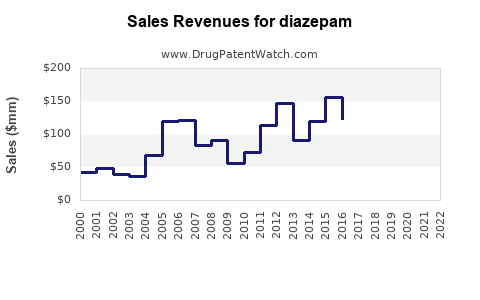
Diazepam revenue has split into two distinct economic segments.
Mature generic segment
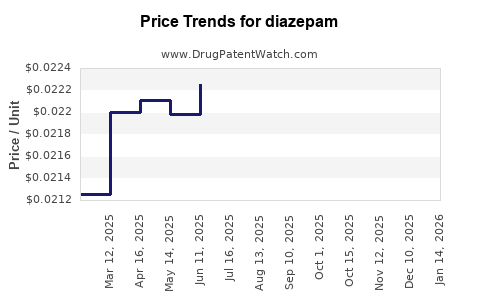
The generic segment has a declining or flat price trajectory in nominal terms, with intermittent volume growth. Competitive pressure is strongest in standard oral dosage forms. Gross margins are constrained by:
- Multiple approved suppliers
- Pharmacy benefit substitution
- Hospital purchasing contracts
- Low switching costs
- Limited product differentiation
- Controlled-substance compliance costs
Shortages or supplier exits can temporarily improve pricing, but such increases are usually unstable. The molecule remains commercially important because of its broad indications and low-cost status, not because of durable pricing power.
Branded rescue segment
The branded segment has a stronger revenue profile because the product provides an administration benefit. Valtoco can command a premium over generic oral diazepam because oral tablets are not interchangeable with a rapid, caregiver-administered nasal rescue product in an acute seizure event.
Revenue drivers include:
- Growth in diagnosed epilepsy
- Increased rescue-prescription rates
- Wider use by caregivers and schools
- Payer coverage and copay support
- Expansion of specialty-pharmacy distribution
- Physician preference for nonrectal rescue therapy
- Product availability during generic or competing-product shortages
Revenue risks include formulary restrictions, competing intranasal midazolam, new generic nasal products, patent settlements, payer step edits, and safety-related prescribing constraints.
Public-company filings generally do not isolate total global diazepam revenue because generic sales are fragmented and branded products report revenue under broader portfolios. Product-level revenue for Valtoco or Diastat may be disclosed by the commercial owner, but no unified financial statement captures the entire diazepam market.
What generic launch scenarios exist for diazepam?
Scenario 1: Continued generic price erosion
This is the base case for oral tablets, solutions, and injection. Additional suppliers or contracting pressure can reduce average selling prices, while volume remains stable.
Scenario 2: Supply-driven price recovery
A manufacturing interruption, regulatory action, or supplier exit can create temporary pricing power. The effect depends on inventory levels and the number of approved alternative manufacturers.
Scenario 3: Generic nasal entry
A successful generic or 505(b)(2) nasal product would place the greatest pressure on branded diazepam rescue revenue. Entry timing would depend on patent resolution, FDA approval, device equivalence, and commercial distribution.
Scenario 4: Continued branded differentiation
Valtoco can maintain a premium if patients, prescribers, and payers continue to value its device, dosing profile, and caregiver usability. This scenario is stronger when competing products face access or supply constraints.
What manufacturing and intellectual-property barriers affect diazepam?
Manufacturing barriers are modest for standard diazepam but higher for proprietary delivery systems. Oral tablets and injection require controlled-substance handling, validated processes, quality systems, and reliable API supply. These requirements are operational barriers, not strong patent barriers.
Intranasal diazepam adds technical requirements involving:
- Uniform dose delivery
- Nasal absorption
- Device reproducibility
- Container-closure integrity
- Stability
- Packaging and transport
- Human-factors performance
- Pediatric and caregiver usability
A competitor may obtain regulatory approval yet struggle commercially if it cannot match device reliability, supply consistency, or payer access.
What is the geographic coverage of diazepam patents and commercial rights?
Diazepam’s original molecule protection has expired globally in major markets. Commercial protection for rescue formulations is jurisdiction-specific. Patent terms, Orange Book-style listings, regulatory exclusivity, and generic substitution rules differ across the United States, European Union, Japan, and emerging markets.
The United States remains the most commercially significant market for branded rescue formulations because of its patent-linkage system and higher specialty-drug pricing. European markets generally place greater emphasis on national reimbursement, reference pricing, and health-technology assessment. Generic diazepam is widely available internationally, with local manufacturing and procurement practices determining market share.
Key Takeaways
- Diazepam’s molecule and core Valium products have no meaningful remaining exclusivity.
- Generic oral and injectable diazepam is a mature, price-sensitive market.
- Commercial value has shifted toward rectal and intranasal rescue formulations.
- Valtoco has the most strategically relevant product-specific patent and device exposure.
- Generic diazepam is not subject to biosimilar competition because it is a small-molecule drug.
- The main financial risk is generic or 505(b)(2) competition against branded nasal rescue products.
- Revenue is fragmented and cannot be reliably represented by one global diazepam market figure.
- Manufacturing, controlled-substance compliance, device performance, payer access, and supply reliability matter more than molecule-level patent protection.
FAQs About Diazepam Market and Patent Risk
Is diazepam still commercially protected by a composition patent?
No. The original diazepam composition protection and Valium exclusivity expired decades ago.
Can a company launch generic diazepam tablets without challenging a brand patent?
Yes. Standard generic diazepam tablets rely on the expired molecule protection and do not need to overcome a current Valium composition patent.
Does diazepam have biosimilar risk?
No. Biosimilar pathways apply to biologic products. Diazepam is a small-molecule drug and faces generic-drug competition instead.
Which diazepam product has the strongest commercial protection?
Intranasal diazepam, particularly Valtoco, has the strongest product-specific protection because its value depends on formulation, device, manufacturing, and clinical-use claims rather than on the diazepam molecule.
What would most reduce branded diazepam rescue revenue?
A regulated and commercially available competing nasal product with broad payer coverage would create the greatest pressure. A generic nasal product could reduce pricing and market share more sharply than additional tablet competition.
References
- U.S. Drug Enforcement Administration. (2023). Drug fact sheet: Benzodiazepines. https://www.dea.gov
- U.S. Food and Drug Administration. (2024a). Diazepam prescribing information and drug database. https://www.accessdata.fda.gov
- U.S. Food and Drug Administration. (2024b). Approved drug products with therapeutic equivalence evaluations: Orange Book. https://www.fda.gov/drugs/drug-approvals-and-databases/approved-drug-products-therapeutic-equivalence-evaluations-orange-book
- U.S. Food and Drug Administration. (2020). FDA approves first nasal spray for treatment of seizure clusters. https://www.fda.gov/news-events/press-announcements
- U.S. Food and Drug Administration. (2024c). Drugs@FDA: FDA-approved drugs database. https://www.accessdata.fda.gov/scripts/cder/daf/