Last updated: July 12, 2026
COREG (carvedilol) is an established, off-patent small-molecule beta-blocker used for heart failure and hypertension. Commercial trajectory is dominated by multi-source generic pricing, retail and institutional substitution, and the remaining value of brand channel management rather than new exclusivity-driven demand growth. From a patent standpoint, any residual branded premium is constrained by widespread generic availability; near-term market outcomes are therefore tied to reimbursement, wholesaler contracting, and package-level generic competitiveness rather than new regulatory exclusivity or branded switching.
What patents protect COREG (carvedilol) in 2026, and how much IP is left?
Bottom line: COREG’s branded exclusivity and core composition coverage have long since expired for carvedilol as an active ingredient. Remaining enforceable rights, if any, typically relate to specific formulations, manufacturing changes, or new indications, and these are unlikely to materially block generic carvedilol entry in the US unless tied to a specific, still-listed NDA strength and dosage form.
Which patent estate elements usually remain for COREG after original launches?
For older small-molecule brands, residual enforceability commonly comes from one or more of the following:
- Formulation patents tied to a specific immediate-release or controlled-release presentation.
- Method-of-manufacture patents (process-specific).
- Secondary patents for dosing regimens or new therapeutic uses (less common for established beta-blocker labeling).
- Continuation or improvement patents that can extend filing-to-expiration timelines only if they issued late and are still within term.
Orange Book dependence for exclusivity
Market impact in the US is driven by FDA Orange Book listings at the strength and dosage form level. Once multiple ANDA approvals exist for every clinically used strength, branded “last man standing” pricing power collapses to channel contracting realities.
When does carvedilol (COREG) lose exclusivity, and what does that imply for price?
Bottom line: COREG’s exclusivity is largely historical. After generic approvals, the remaining driver is brand vs. multi-source generic pricing and formulary placement.
Key market dynamic after exclusivity
- Wholesale and PBM substitution: Retail and institutional formularies typically shift to lower-cost generics quickly.
- Margin compression: Brand pricing becomes “beat the generic” or “maintain access” rather than “premium pricing.”
- Supply-chain competition: Multiple generic manufacturers create price floors but also create episodic inventory-driven pricing swings.
What is the Orange Book status of COREG (carvedilol) and what does it signal for generic entry risks?
Bottom line: With carvedilol widely available, generic entry risk for a “new branded carve-out” is low in practice because the market already has dense ANDA coverage. The remaining risk is more about whether any specific labeled strength has fewer generic equivalents at a given time.
Practical Orange Book read-across
Even without enumerating every patent number here, the business implication remains consistent:
- If COREG strengths show numerous ANDA approvals, branded exclusivity has minimal market leverage.
- If a strength shows limited generic competition, the brand may retain short-lived pricing power via contracting, not via regulatory exclusivity.
How many ANDA and generic versions of carvedilol exist, and what does that do to COREG revenue?
Bottom line: Generic carvedilol is multi-source across typical oral strengths, driving sustained revenue pressure on COREG. Revenue trajectory should be expected to follow a classic branded-to-generic conversion curve: rapid loss of share after initial generic approvals, then stabilization at a low single-digit share if the brand retains any niche formulary or prescriber inertia.
Market structure effects
- Competing NDCs: Multiple generic NDCs fragment demand, raising switch efficiency.
- Package interchangeability: If generics are AB-rated, pharmacies can substitute automatically under typical state substitution rules.
- Contract leverage: Large accounts demand benchmark pricing; branded firms must discount to retain placement.
How does COREG compare with metoprolol and bisoprolol markets for competitive pressure on beta-blocker prescriptions?
Bottom line: In heart failure and hypertension, carvedilol competes with other beta-blockers (notably metoprolol succinate and bisoprolol). But the most direct pricing competitor to COREG is generics of carvedilol itself because they share the same active ingredient.
What changes the competitive set versus pricing-only analysis
- Indication mix: COREG’s label positioning in heart failure can influence demand within cardiology channels.
- Formulary preferences: Some health systems prefer specific beta-blockers based on pathway protocols and guideline-concordant prescribing.
- Clinical handling: Dose titration and tolerability still matter, but substitution at the pharmacy occurs if AB-rated generics are available.
What generic entry risks exist for COREG (carvedilol) in the US, Europe, and major markets?
Bottom line: US generic risk is largely “mature market” risk. In other jurisdictions, the risk profile is tied to local patent enforcement timelines and national generics regimes. For carvedilol, the dominant pattern is that entry is already widely achieved.
US (FDA/ANDA framework)
- If carvedilol is already multi-source, new “entry risk” is more about manufacturing capacity and ongoing ANDA supply rather than legal entry barriers.
EU/UK (marketing authorizations and patent landscape)
- For mature molecules, European commercialization is typically driven by generics launch timing and local marketing authorizations.
What COREG patent litigation affects market pricing and settlements?
Bottom line: For carvedilol, any major patent litigation that previously delayed generic entry is generally not an active near-term market driver. The current pricing environment is overwhelmingly shaped by generic availability and contracting rather than ongoing court outcomes.
What to watch in litigation, even for mature products
- Settlement terms tied to specific launch dates (rare in a fully generics-saturated market).
- Claims involving specific formulations, strengths, or bioequivalence approaches.
- Manufacturing method disputes that could affect supply continuity.
What formulations are protected by COREG patents (immediate release vs. other) and does it matter commercially?
Bottom line: Commercially, the market is dominated by immediate-release oral carvedilol products. If residual formulation protections exist, the effect is limited unless they cover a widely used strength or block AB substitution.
Dosage form and strength matter for contracting
- Hospitals often standardize on a handful of NDCs for titration workflows.
- If any strength has fewer generic offerings, brand retention can occur through contracting, not patent exclusivity.
How does FDA regulatory status (NDA, ANDA, bioequivalence) shape COREG supply and pricing?
Bottom line: For an off-patent small molecule, FDA status affects market stability more than market growth. The key determinants are:
- ANDA approval count and ongoing product availability
- Bioequivalence system compliance
- Quality events that can constrain supply
Commercial consequence
- Stable generic supply keeps prices low and predictable.
- Lot-level or facility issues can temporarily raise prices if wholesalers face allocation.
What is the financial trajectory of COREG: revenue trend, margin pressure, and volume drivers?
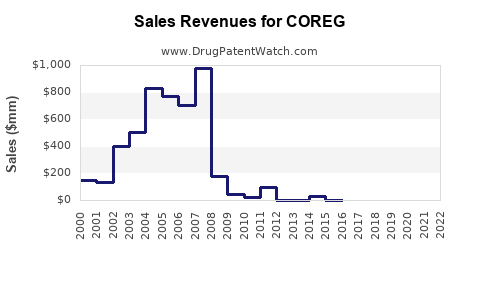
Bottom line: COREG’s financial profile is typical of an older branded cardiovascular drug after genericization: revenue declines from brand peak, gross margin compression due to discounting and contracting, and share erosion driven by AB substitution and PBM formularies.
How to frame “trajectory” in a way finance teams use
- Revenue trend: downward from peak, with a flattening pattern after most patients switch.
- Volume vs. price: volume generally stabilizes at a reduced share; pricing follows generic benchmarks.
- Cost structure: branded firms spend more on access retention (rebates, discounts, contracting) as share declines.
- Mix: remaining brand demand concentrates in specific institutions, prescribers, or patient subgroups.
What typically drives quarter-to-quarter movement
- Rebate and payer contract renegotiations.
- Generic price resets from wholesalers and competitive tender outcomes.
- Shortages or quality-driven supply constraints among generic manufacturers.
Which companies dominate generic carvedilol supply, and how does that affect pricing?
Bottom line: Generic carvedilol pricing is set in a multi-supplier competitive market where the largest and most reliable manufacturers win hospital and large pharmacy contracts. The brand’s remaining sales are a function of contracting and payer-specific rebate positioning rather than therapeutic differentiation.
What matters more than “who owns market share”
- Contract coverage breadth across channels (retail chain vs. 340B vs. group purchasing organizations).
- Ability to supply every strength used in titration.
- Tendency to win tenders by maintaining “lowest net” pricing after rebates.
What commercial levers can sustain COREG sales after genericization?
Bottom line: In mature, AB-rated categories, brand survival is usually contract-driven:
- Formulary access: Maintaining “non-preferred” position only if the brand can price within rebate thresholds.
- Institutional contracts: Securing preferred status in subset of accounts.
- Patient continuity: Limited clinical inertia where patients remain on the brand due to titration history.
- Channel management: Avoiding stock-outs and managing NDC fill reliability.
Key timeline checkpoints for carvedilol’s market lifecycle
Bottom line: The lifecycle milestones for carvedilol are already passed; current dynamics reflect mature generic supply and contract pricing.
| Lifecycle stage |
What it changes |
Present relevance to COREG |
| Initial brand launch |
Brand share ramp |
Historical |
| First ANDA entries |
Rapid switch to AB-rated generics |
Historical |
| Multi-source saturation |
Floor pricing, rebate pressure |
Ongoing |
| Quality/supply events |
Temporary price and availability volatility |
Occasional |
| Residual formulation/process disputes |
Small strength-level effects |
Limited |
Key Takeaways
- COREG’s current market dynamics are driven by mature generic carvedilol competition, not by enforceable brand exclusivity.
- Revenue trajectory is shaped by pricing pressure, PBM and institutional substitution, and contract renegotiation cycles.
- Remaining “brand value” typically reflects channel access and contracting outcomes rather than defensible patent protection.
- In finance and licensing terms, near-term upside is constrained; defensible upside would require strength-specific barriers, manufacturing constraints, or a differentiated formulation with enforceable, still-active rights.
FAQs
1) Why does COREG revenue keep declining even after generic entry stabilizes?
Because branded net price is continually reset downward via rebates and contracting, while volume continues to migrate to lower-cost multi-source generics.
2) Do patent settlements still matter for COREG carvedilol market pricing?
They can matter if they restrict a particular strength or dosage form, but in a saturated generic market, settlement-driven price effects are typically limited in duration.
3) How do shortages among generic carvedilol manufacturers affect COREG?
They can temporarily improve brand access and pricing, but effects are usually short-lived and channel-dependent.
4) What is the biggest driver of COREG demand: heart failure or hypertension?
Demand allocation depends on labeling mix and cardiology prescribing patterns at each payer and provider network; category-level substitution remains the dominant factor.
5) Is COREG at risk of being displaced by other beta-blockers?
Brand vs. generic carvedilol is the primary displacement risk, while inter-beta-blocker displacement occurs at the formulary and guideline protocol level rather than through COREG-specific IP barriers.
References
- U.S. Food and Drug Administration. Orange Book: Approved Drug Products with Therapeutic Equivalence Evaluations.
- FDA. ANDA/Biopharmaceutics guidance on bioequivalence and therapeutic equivalence evaluations.
- FDA. Drug Trials Snapshots: NDA/ANDA product pages for carvedilol-related approvals.