Last updated: July 17, 2026
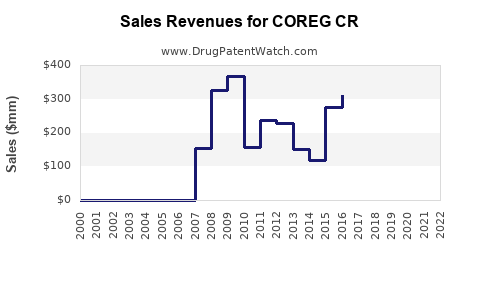
COREG CR (carvedilol controlled-release) is an older US oral beta-blocker brand with a long cycle of generic erosion. Financial trajectory is dominated by (1) loss of brand exclusivity well before the current period, (2) today’s pricing pressure from multiple generic carvedilol controlled-release and substituted dosing options, and (3) ongoing formulary preference changes across cardiovascular treatment pathways (heart failure and hypertension), where prescribers shift to alternative carvedilol immediate-release or other beta-blockers when clinically acceptable.
When did COREG CR lose exclusivity and what does that mean for brand revenue?
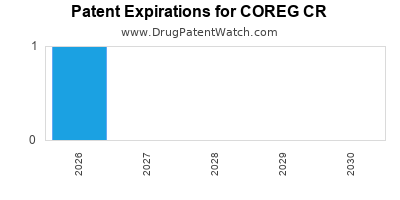
Answer: COREG CR’s US brand exclusivity has long since ended; the current market is structurally generic-led, with residual brand presence only if any remains through remaining contracts, switch restrictions, or payer-specific formularies.
How the exclusivity timeline typically impacts COREG CR pricing
- Brand-to-generic conversion compresses net price within quarters of launch competition.
- Controlled-release products tend to retain a short-lived premium only if a payer or system prefers the formulation for titration/adherence, then erodes as therapeutic interchange expands.
- For older cardiovascular drugs, average wholesale price and rebate intensity frequently decouple from early brand list price as contracts reset.
Practical outcome for investors and licensors
- COREG CR is better treated as a “declining legacy asset” rather than an expansion platform.
- Any remaining economics are driven by contracting, channel mix, and patient adherence economics, not by patent-protected differentiation.
What patents protect COREG CR and how strong is the patent estate today?
Answer: COREG CR’s patent estate is no longer the dominant determinant of market access in the US; generic competition is already established across relevant dosage strengths.
Patent estate effects on market dynamics
- For legacy formulations, the marginal value of additional formulation or method claims declines once generics are already on market.
- Even where late-expiring patents exist, payers usually switch to therapeutically interchangeable products unless constrained by a specific settlement or regulatory risk.
How to read the estate through a market lens
- If multiple ANDA filers already achieved approval, the practical “patent barrier height” is low.
- Revenue trajectories stabilize into low-growth or decline only, reflecting contracting rather than legal exclusivity.
What generic entry risks exist for carvedilol controlled-release, including COREG CR?
Answer: Generic entry risk is historically realized; the forward-looking risk is now more about retail/payer switch dynamics than about IP blocking.
Why COREG CR faces ongoing switching
- Carvedilol immediate-release tablets (IR) are therapeutically interchangeable in many hypertension and heart failure contexts.
- Other beta-blockers (eg, metoprolol formulations, bisoprolol where covered) can displace carvedilol based on payer preference, evidence interpretation in guidelines, tolerability profiles, and prescriber habit.
Market structure for legacy cardiovascular generics
- Multiple manufacturers reduce procurement leverage for brands.
- Pharmacy benefit managers increasingly standardize to lowest net cost within therapeutic equivalents.
What is the Orange Book status of COREG CR?
Answer: COREG CR’s current Orange Book posture supports a generic-available market, consistent with long-since generic uptake.
What Orange Book status implies commercially
- If COREG CR is not driving ongoing Paragraph IV disputes for new challenges, it typically means exclusivity and major barriers already passed.
- The brand’s role shifts from “protected product” to “differentiated contract SKU,” if any.
How competitive is COREG CR versus carvedilol IR and other beta-blockers?
Answer: Competitive pressure is high; COREG CR competes against (1) carvedilol immediate-release, (2) other beta-blockers in heart failure and hypertension, and (3) multiple generic controlled-release sources where available.
Core substitution economics
- Controlled-release differentiation matters mainly for adherence and titration convenience, but payers often prioritize total cost and therapeutic equivalence.
- Therapeutic areas: heart failure and hypertension where multiple beta-blockers are guideline-supported.
Competitive comparison matrix (commercial)
| Comparator |
Main substitution rationale |
Typical payer behavior |
Competitive pressure vs COREG CR |
| Carvedilol IR generics |
Equivalent beta-blockade; easier dose flexibility |
Often first-line in formulary |
High |
| Other beta-blockers (eg, metoprolol, bisoprolol where covered) |
Guideline alignment and formulary preference |
Switch to lowest net cost |
High |
| Carvedilol CR generics |
Same active and formulation class |
Prefer lowest-cost CR |
High |
What payer and formulary dynamics drive COREG CR volume today?
Answer: Payer formularies and pharmacy switching drive volume, not brand protection.
Key determinants
- Bid-to-bid pricing from multiple generic sources.
- Step therapy and prior authorization patterns for older beta-blockers are usually minimal, but switching rules and rebate structures matter.
- Hospital and health system formularies influence consistency in heart failure cohorts.
Why “controlled-release” can lose its economic edge
- When generics arrive, the premium for controlled-release often compresses to near parity.
- Adherence advantages usually do not outweigh pharmacy budget pressure at scale unless clinical pathways strongly require CR.
How does COREG CR financial performance typically evolve post-generic erosion?
Answer: Brand revenue declines to a low, contract-driven level; remaining sales are concentrated among patients and prescribers with continuity preferences.
Typical financial trajectory pattern for legacy brands
- Year 0 to Year 2 post significant generic entry: steep net sales and margin compression.
- Years 2 to 5: stabilization or continued slow decline based on contract retention and patient persistence.
- Years 5+: mostly negative or flat-to-declining trajectory as generics dominate dispensing.
Net revenue mechanics
- Gross-to-net is heavily impacted by rebates and discounts once generic penetration is high.
- If multiple generic versions are available, brand claims about formulation convenience rarely translate into durable payer premium.
What litigation or settlements affect COREG CR market access?
Answer: Current market access for COREG CR is not characterized by active, recurring litigation that would materially restrict generic entry in the present period.
How to interpret litigation absence
- When litigation does not remain in the headline phase, market typically stays generic-led.
- Settlement-driven delays are most impactful around initial challenge windows, not decades later.
What FDA regulatory status matters for COREG CR commercialization risk?
Answer: FDA approval for generics of carvedilol CR generally reduces commercial risk for generic entry; the market is effectively regulatory-open.
Regulatory factors shaping commercial outcomes
- Bioequivalence and formulation equivalence remove core barriers once approved.
- Post-approval changes or manufacturing quality can affect supply stability, but not long-run pricing dynamics.
What is the revenue exposure for companies still selling COREG CR?
Answer: Revenue exposure is limited by legacy status and market-wide generic penetration; remaining exposure is usually contract-based and concentrated in specific channels.
Where residual revenue can still occur
- Specific payer formularies that retain the brand for managed care continuity.
- Long-term patients stable on CR who clinicians prefer not to switch.
- Institutional channels with existing formulary listings.
What erodes residual exposure
- Continued rebate renegotiation to standardize on lowest-cost alternatives.
- Increased use of therapeutic interchange protocols.
How does COREG CR compare with other legacy cardiovascular brands on erosion speed and margin compression?
Answer: COREG CR’s erosion profile matches other older oral cardiovascular brands: fast initial drop after generic entry and then long tail of diminishing brand importance.
Drivers of comparable erosion
- Oral small molecule with multiple generic pathways.
- High substitutability within beta-blocker class.
- Standardized dosing and broad guideline compatibility.
Commercial outlook: what should business teams expect from COREG CR going forward?
Answer: Expect continued generic-led pricing pressure, with any brand stabilization tied to contracting and residual patient persistence rather than IP-driven differentiation.
Near-term to mid-term market expectations
- Low single-digit or negative brand net sales, depending on contract renewal and switching controls.
- Margin compression persists because brand must compete on net price against generics.
- Volume shifts increasingly track payer formulary and rebate economics rather than product preference.
Actionable implications for licensing and R&D
- If evaluating COREG CR as a licensing platform, the economic ceiling is constrained by generic dominance.
- R&D value is more likely in next-generation delivery systems, combinations, or new clinical indications, not in replicating a mature controlled-release monotherapy.
Key Takeaways
- COREG CR is a legacy carvedilol controlled-release brand with long-since generic erosion; current market dynamics are driven by payer contracting and therapeutic interchange.
- Patent and exclusivity effects that once mattered are no longer the primary commercial determinant; the market is structurally generic-led.
- Competitive pressure is persistent from carvedilol IR generics and other beta-blockers in heart failure and hypertension.
- The forward-looking financial trajectory is consistent with ongoing decline or low-level stabilization, with residual brand sales dependent on formulary retention rather than protection.
FAQs
1) Why do payers switch patients from COREG CR to carvedilol immediate-release?
Lower net cost, therapeutic interchange policies, and rebate-driven formulary management typically outweigh CR adherence advantages.
2) Does controlled-release still provide a formulary advantage for COREG CR?
Only if payer contracts keep a premium justified; once generics compress pricing, the advantage usually shifts to clinical subgroups rather than payer-wide pricing.
3) What channel contributes most to any remaining COREG CR sales?
Typically contracted managed care formularies and health systems with continuity-of-care protocols for heart failure patients already stabilized on CR.
4) Are there meaningful opportunities for new entrants to disrupt the COREG CR market?
Opportunities are limited because the active ingredient is mature and generics are established; entry economics depend more on pricing and distribution than on IP.
5) How does heart failure guideline evolution affect COREG CR demand?
Demand tracks carvedilol uptake within guideline-supported beta-blocker use, but substitution to other beta-blockers can occur when payer preference and total cost favor alternatives.
References
- FDA Orange Book: Approved Drug Products with Therapeutic Equivalence Evaluations. US Food and Drug Administration. https://www.accessdata.fda.gov/scripts/cder/daf/
- FDA Drug Approval Reports. US Food and Drug Administration. https://www.fda.gov/drugs/drug-approvals-and-databases/drug-approvals-and-databases
- Medicare Part D Drug Spending Dashboard (if applicable for legacy market spend trends). Centers for Medicare & Medicaid Services. https://www.cms.gov/