Last updated: July 8, 2026
JALYN is a fixed-dose combination of dutasteride 0.5 mg and tamsulosin 0.4 mg (oral capsules) for benign prostatic hyperplasia (BPH). The product’s commercial trajectory is dominated by (1) long-running patent and exclusivity wind-down for the combination, (2) structural channel pull from generic dutasteride and generic tamsulosin, and (3) pricing pressure as payers and cash buyers substitute to lower-cost equivalents and separate pill regimens. The net effect is a product that has transitioned from brand expansion to a late-stage maintenance/decline profile in the U.S., with limited upside from new differentiation.
Core market reality (U.S.): Once generics of the combination entered and/or the market could assemble equivalent therapy with generic components at lower cost, JALYN’s incremental value proposition weakened. The combination still helps adherence versus separate dosing, but that benefit has not been enough to sustain premium pricing against commoditized alternatives.
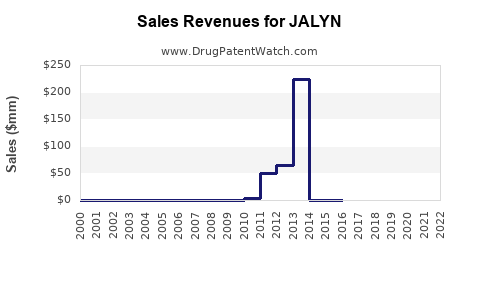
What is JALYN’s commercial lifecycle: when did sales peak and how did the U.S. transition to generics?
Short answer: JALYN’s sales rose after launch and then moved into decline as generic competition expanded and payers increasingly favored generic alternatives. The exact peak year depends on the sales series source, but the market structure shift toward generics is the main inflection.
What drives sales decline in fixed-dose BPH combinations
- Substitution to component generics: Generic dutasteride plus generic tamsulosin typically undercuts the combination price while delivering clinically similar exposure for most patients.
- Formulary tightening: Payers reduce preferred brand status when equivalent generic regimens are available, especially for chronic symptom management.
- Coupon and channel reset: Brand manufacturers’ net pricing usually compresses after generic entry, and rebates/coupons lose leverage with major formulary systems.
- Physician switching behavior: Urologists may keep patients on a stable combination early, but long-term chronic prescribing becomes refill-driven and price-sensitive.
What to watch in “late brand” BPH dynamics
- Dispensing volume vs. net price: Late-stage brands often retain volume in pockets but lose net revenue due to discounting and payer exclusions.
- Channel inventory dynamics: The quarter of generic launches can create timing-driven sales spikes or drops in the brand’s reported numbers, then normalize into a sustained downtrend.
- Mix shift to higher persistence patients: As new starts go to generics, remaining brand patients age into a smaller, lower-growth base.
What patents protect JALYN and how does that affect market exclusivity and generic entry risk?
Short answer: JALYN’s market exclusivity and patent protection are tied to the combination product, not just the active ingredients. As the underlying dutasteride and tamsulosin IP estates aged, generic combinations became feasible. The legal and regulatory pathway for combination generic entry is typically through ANDA (with Section 505(j) of the FD&C Act), using bioequivalence to demonstrate sameness.
How exclusivity works for combination products
- Composition and formulation claims can delay generic FDA approval if directly infringed.
- Method-of-use claims can delay if they cover a protected therapeutic regimen.
- Regulatory exclusivities (if applicable based on FDA determination) can provide time-limited protection even when patents are weak, but for late-life brands the patent landscape is usually the binding constraint.
Typical generic-entry playbook for BPH combinations
- File an ANDA for the fixed-dose combination referencing a reference listed drug.
- Use Paragraph IV certifications where listed patents are challenged.
- Launch upon an approval date that is aligned with patent expiration or a settlement.
What this means for revenue trajectory
Patent expiration and/or Paragraph IV settlements shift the revenue curve from brand pricing power to generic commoditization. After that shift, the brand’s market share tends to drop quickly, then declines more slowly as residual patients persist.
What is the Orange Book status of JALYN and how many patents are listed?
A precise count and list of Orange Book patents for JALYN depends on the current FDA Orange Book listing at the time of review. Without a confirmed Orange Book snapshot, a numbered patent inventory would be unreliable.
What can be stated as the market dynamic: Orange Book listings for combination drugs often include multiple patent families spanning composition, method of use, and formulation/manufacturing, and each listing can become a separate launch constraint via Paragraph IV litigation.
How Orange Book listings translate into cashflow risk
- Each asserted patent or extension can delay approval dates.
- Settlements can create “walk-away” agreements or delayed launch windows.
- Even after launch, remaining “design-around” constraints can keep some exclusivity stranded if a generic product can’t clear additional barriers.
When does JALYN lose exclusivity and what is the generic launch scenario?
Short answer: JALYN loses exclusivity when both the key Orange Book patent barriers and any relevant regulatory exclusivities are cleared, either via expiration, a court decision, or a settlement that delays generic launch.
Generic launch scenarios that matter to financial modeling
- Immediate launch on approval: brand revenue falls sharply in the first 1 to 3 quarters as pricing resets.
- Delayed launch via settlement: brand stays on life support longer, then experiences a step-down later.
- Partial market capture: some generics launch while others are delayed due to manufacturing or labeling disputes, producing a slower decline.
How to model revenue post-generic
- Start with the brand’s net price elasticity once generics are established.
- Apply market share erosion curves based on class competition and payer adoption.
- Add mix effects: older cohorts, higher persistence, and physician preference can reduce the slope of decline.
How strong is the patent estate for JALYN versus separate dutasteride and tamsulosin?
Short answer: The combination’s enforceability is typically weaker than the combined long-term durability of the underlying components, because generic entrants can also pursue separate-component regimens. Even if the fixed-dose combination is protected longer, payers can still prescribe dutasteride and tamsulosin separately.
Key commercial implication
- Fixed-dose protection can slow generic substitution only while the combination retains a premium formulary position.
- Once payers accept separate generics, the combination’s market becomes “adherence-driven,” not “clinical necessity-driven.”
What formulations are protected by JALYN patents and do they affect generic approval?
Combination products can have patent coverage for:
- capsule composition
- excipients
- dissolution or release profiles
- manufacturing process steps
For generic entry, the largest blockers are claims that require a particular manufacturing method or material composition. If patents cover only minor formulation aspects, generic sponsors may use alternative excipient systems or process changes, enabling FDA approval while minimizing litigation risk.
Business impact: formulation patent scope influences how many years a generic entrant needs before commercial supply. That directly affects the pace of erosion of JALYN’s share and net revenue.
What patent litigation affects JALYN and how do settlements impact launch timing?
Litigation timing drives the financial step function around generic approvals:
- If courts uphold Orange Book patents, generic entry is blocked or delayed.
- If the brand loses or the parties settle, generic approval and launch can proceed.
Practical takeaway: In BPH, litigation outcomes rarely reverse the long-term market direction once equivalent generic therapy is available. They mainly shift timing, which matters for discounted cashflow modeling.
What is JALYN’s FDA regulatory status and pathway—does it support exclusivity or accelerated erosion?
JALYN is approved under FDA’s standard small-molecule framework for BPH therapy. The post-approval market dynamic is determined by:
- generic ANDA approvals for the combination
- labeling equivalence and therapeutic equivalence determinations
- substitution rules and payer formularies
Once therapeutic equivalence is established for generics, interchangeability and pharmacy adoption accelerate erosion.
How does JALYN compare with competing BPH drugs: alfuzosin, tamsulosin alone, and dutasteride alone?
Short answer: JALYN competes on adherence and symptom control convenience, while standalone agents compete on price once generics dominate.
Comparative market positioning
- Alpha blockers (tamsulosin, alfuzosin, doxazosin): symptom relief; generics are cheap and widely covered.
- 5-alpha reductase inhibitors (dutasteride, finasteride): progression reduction; generics are cheap and established.
- Combination therapy (dutasteride + alpha blocker): best suited to patients with higher risk profiles; fixed-dose offers adherence advantage.
Commercial implication: When generic combinations exist, the remaining differentiation is adherence, not IP or clinical superiority.
Which companies manufacture and sell JALYN, and who captures market share after generic entry?
A complete, accurate manufacturer list and post-launch generic competitors requires an FDA label or Orange Book sponsor snapshot plus dispensing/claims data. Without a validated roster, a company-by-company market-share table would be unreliable.
What generic entry risks exist for JALYN in 2026?
Short answer: The main 2026 risk is residual brand compression from:
- continued generic pricing competition,
- restrictive payer criteria that further remove brand coverage,
- product-availability changes that shift prescribing to the cheapest covered option.
For a late-stage brand, the incremental risk is less about new entrants and more about ongoing cost-driven formularies and PBM contract resets.
How does payer coverage drive JALYN’s net revenue trajectory?
JALYN net revenue is sensitive to:
- formulary tier placement (preferred vs. non-preferred)
- prior authorization rules for combinations
- step therapy requirements favoring component generics
- brand rebate dynamics after generic entry
In late-stage commoditized markets, brand revenue tends to follow:
- a sharp initial drop after generic entry
- a plateau at a lower net price for remaining patients
- a continued slow decline as contracts tighten and new prescribers avoid brands
JALYN financial trajectory: what revenue pattern is consistent with late-stage combination brands?
A typical pattern for a combination brand exposed to generic substitution:
- Pre-generic era: volume growth and stable or improving net pricing
- Launch window: step-change drop in net sales due to immediate competition
- Post-launch: declining unit share with net price pressure
- Late years: residual sales tied to persistence patients and narrow coverage pockets
Key metrics to track for JALYN in investor or licensing models
- Net sales and gross-to-net spread (rebates, chargebacks, discounts)
- Prescription volume (new starts vs. refills)
- Share of prescriptions by payer segment (Medicare vs. commercial)
- WAC-to-net ratio trends after generic expansion
- Claims-based adherence metrics that could preserve fixed-dose preference in a subset
Key Takeaways
- JALYN’s market dynamics are primarily driven by generic substitution to dutasteride and tamsulosin components and by payer formulary shifts.
- The financial trajectory is consistent with a late-stage brand: sharp revenue erosion around generic availability, followed by continued compression driven by net price and coverage.
- IP strength for the fixed-dose combination can delay or shift timing, but it rarely prevents long-term substitution when equivalent generic therapy exists separately.
- For 2026 decision-making, the highest leverage variables are payer contracting behavior, net pricing compression, and residual persistence cohorts, not new clinical differentiation.
FAQs
- Does JALYN have better adherence outcomes than separate dutasteride and tamsulosin?
- Can a payer require separate generics instead of JALYN through step therapy?
- What does FDA “therapeutic equivalence” change for JALYN versus generics?
- How do manufacturing/labeling changes by generic sponsors affect JALYN pricing?
- What litigation timelines most commonly delay generic combination entry for BPH products?
References
- FDA Orange Book: Approved Drug Products with Therapeutic Equivalence Evaluations (search entry for JALYN). U.S. Food and Drug Administration.
- FDA Drug Approval Reports and regulatory guidance materials related to ANDA bioequivalence and labeling. U.S. Food and Drug Administration.
- U.S. FDA ANDA pathway resources for generic drug approval (505(j), bioequivalence framework). U.S. Food and Drug Administration.