Last updated: July 30, 2026
Avodart (dutasteride) is a branded prescription 5-alpha-reductase inhibitor (5-ARI) for benign prostatic hyperplasia (BPH) and, in label terms, reduction of risk of acute urinary retention and need for surgery. The long-run market has been shaped by loss of U.S. brand exclusivity, rapid generic substitution, and ongoing clinical differentiation versus alpha-blockers and combination therapy. Financial trajectory through the current decade is dominated by U.S. generic erosion and international variability driven by local pricing and reimbursement.
What is the market size trend for Avodart (dutasteride) and why did it change?
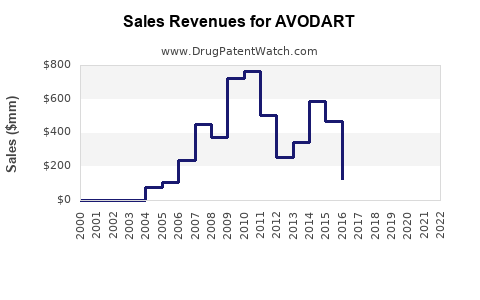
Direct answer: Avodart’s U.S. sales have followed the typical branded pattern: peak under exclusivity, then sharp decline after generic entry, with partial stabilization from international markets, persistence of combination use (with tamsulosin in practice), and brand switching controls in managed care.
Key market drivers
- Clinical positioning vs alpha-blockers: 5-ARIs reduce DHT and shrink prostate volume over time, while alpha-blockers improve symptoms quickly. This favors longer treatment persistence but exposes Avodart to generic price compression once exclusivity ends.
- Prescribing behavior: Many prescribers initiate with alpha-blockers, then add or switch to a 5-ARI depending on prostate size and response. That sequencing can mute early demand for dutasteride but supports longer-duration use in responding patients.
- Managed care and formularies: Post-generic, Avodart’s formulary access becomes contingent on contracting. Where generics are preferred, brand share typically falls to low single digits.
- International pricing and patent calendars: Dutasteride patent and regulatory timelines vary by country, creating lagged brand survival outside the U.S.
How does Avodart’s exclusivity timeline drive its financial trajectory?
Direct answer: The U.S. branded financial arc is primarily a function of when dutasteride lost marketing exclusivity and when generic competition took hold in practice.
U.S. brand-to-generic transition mechanics
- Marketing exclusivity for a new active ingredient: In the U.S., once the last relevant exclusivity (and later any patent barriers) falls, generics can enter via Abbreviated New Drug Applications (ANDAs).
- Patent estate erosion: For small-molecule drugs, the key economic inflection is the last effective patent preventing ANDA approval/launch. After that, generics can price aggressively.
Practical economic result
- The brand’s gross-to-net margin compresses as:
- unit volume migrates to generics,
- rebates increase to retain share,
- net realized price declines even before launch of multiple competitors.
When does Avodart lose exclusivity and what does that mean for generic launch risk?
Direct answer: Avodart is already in the post-exclusivity phase in the U.S.; the dominant generic launch risk has passed. Remaining risk is less “first generic entry” and more “incremental share loss” as additional generic applicants and volume-based contracting further erode brand pricing power.
Generic entry risk: what matters after first generic launch
- Number of ANDA filers and product availability: More filers typically means more aggressive pricing and stronger pharmacy stocking.
- State formulary and PBM tiering: Continued movement toward preferred generic tiers drives additional brand decline.
- Interchangeability and pack-size targeting: Generics that match dosing schedules and package sizes reduce friction for switching.
What patents protect dutasteride (Avodart) and how strong is the estate commercially?
Direct answer: For established small molecules like dutasteride, the “commercial strength” of the patent estate after launch is usually concentrated in later-lived formulation, method-of-use, or new dosage/pediatric extensions. In the U.S., the key economic effect is whether such patents can block ANDA launch or sustain brand market access.
Typical patent categories that influence value
- Method-of-use patents (BPH endpoints): Acute urinary retention avoidance, surgery reduction, and symptom improvement claims can extend brand logic in payer discussions even if the drug substance is generic.
- Combination or regimen patents: If a method or regimen is protected, it can slow generic substitution for specific clinical pathways.
- Formulation and delivery patents: For oral small molecules, formulation patents often have narrower enforcement leverage versus drug substance patents.
Litigation-driven estate effects
- Where patent litigation results in delayed ANDA approvals, branded sales can stabilize for a period. If settlements occur, entry may be time-shifted rather than prevented indefinitely, which affects quarterly revenue recognition patterns.
What Orange Book status applies to Avodart and why does it matter for competition?
Direct answer: The Orange Book governs which patents are listed for approved drug products and thus frames the ANDA Paragraph IV landscape. For an established drug like Avodart, the market impact is determined by which listed patents are still enforceable at the time generic challengers seek approval.
How Orange Book listing affects ANDA timelines
- Patents listed for a drug product are the ones implicated by Paragraph IV certifications.
- The existence of “listed” patents can create automatic litigation triggers for challengers (under the Hatch-Waxman framework), even when ultimate market access depends on final court outcomes or settlements.
What patent litigation affects Avodart and generic entry?
Direct answer: For dutasteride, the practical litigation impact is already reflected in current market structure: multiple generics exist, which implies that any earlier branded patent barriers did not sustain monopoly pricing in the long term.
What to track for litigation-based timing in this class
- District court claim construction and final infringement rulings
- Any settlement dates that drive “launch at risk” versus delayed launch
- Appellate reversals that can reset exclusivity effectively
How does Avodart compare with competing BPH therapies (and how does that shape revenues)?
Direct answer: In BPH, competition spans:
- alpha-1 blockers (for symptom relief),
- 5-ARIs (disease-modifying prostate volume/DHT reduction),
- combination therapy regimens (often 5-ARI + alpha-blocker),
- procedures (less common as substitutes in early lines but relevant for progression).
Competitive substitution patterns
- Within class (dutasteride vs finasteride): Finasteride is also a 5-ARI and generic; cross-class switching based on tolerability and prescriber familiarity can pressure pricing.
- Across class (alpha-blocker initiation): Many patients start with alpha-blockers then transition to 5-ARI if symptoms persist or prostate volume is high.
Revenue sensitivity
- Brand dutasteride revenue is most sensitive to:
- payer restrictions on 5-ARI selection,
- relative cost per month between dutasteride generics and alternative 5-ARIs,
- persistence rates (drug discontinuation impacts lifetime value).
What are the main revenue and margin dynamics for Avodart’s branded business?
Direct answer: After generic entry, the economic model becomes negative for the brand unless the firm can maintain:
- meaningful residual brand share through contracts,
- higher net price through managed care agreements,
- differentiation in combination or patient-support programs.
Typical post-generic financial mechanics
- Volume erosion: Brand share drops quickly after generic introduction.
- Net price decline: Rebates and competitive contracting reduce net price.
- Marketing spend: Reduced brand advertising may occur, with some spend shifted to trade and outcomes programs.
- Portfolio effect: Companies often rationalize brand line items after generics dominate, with financial results driven by other assets.
What commercial strategies can still protect some Avodart share?
Direct answer: In a generic-heavy environment, share is protected mainly via contracting and patient support, not via clinical exclusivity.
High-leverage tactics
- Formulary positioning: Securing a preferred or non-preferred distinction in key formularies.
- Contracting with PBMs: Volume-based rebates to avoid delisting.
- Adherence and persistence: Support programs can reduce switching and discontinuation, supporting residual share.
- Combination strategy alignment: Where combination prescribing exists, brand logic can persist if payer controls allow it.
What biosimilar risk applies to Avodart?
Direct answer: None. Avodart is a small molecule (dutasteride), so the biosimilar framework does not apply.
How does the competitive landscape look for dutasteride right now?
Direct answer: Dutasteride is widely available as generics. Competition is mainly price-driven and centered on:
- number of generic manufacturers,
- product continuity (supply reliability),
- package size and dosing-equivalent substitution.
Market structure implications
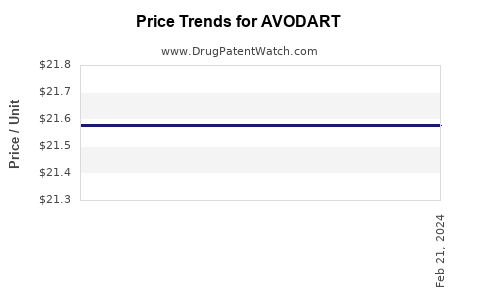
- Wholesale acquisition cost for generics compresses quickly once supply is established.
- Retail and mail-order formularies typically route to lowest-cost equivalent unless constrained by PBM preference rules.
Where is Avodart likely to remain resilient financially: U.S. or ex-U.S.?
Direct answer: Ex-U.S. markets often show slower brand erosion due to country-specific exclusivity/patent status, local pricing controls, and slower generic uptake in some regions. U.S. is structurally more exposed due to established generic penetration.
What to expect by region
- Europe: Generic uptake is usually strong, but brand persistence can last longer where reimbursement favors branded products or where patent/authorization events lag.
- Emerging markets: Timing depends on regulatory approval throughput and local enforcement.
What generic entry scenarios still matter for the remaining brand?
Direct answer: In the U.S., “first generic entry” risk is largely realized. Remaining scenarios include:
- additional generic entrants further decreasing contract price ceilings,
- supply shocks creating temporary price spikes (which can briefly shift volume),
- payer re-tiering changes that accelerate switch.
Launch at risk versus court-driven timing
- Once a stable generic ecosystem exists, court-driven delays rarely reverse the overall long-term downtrend.
How strong is the patent estate for Avodart versus generic substitutes?
Direct answer: The market reality for dutasteride indicates that substitute generic supply is already available and priced for broad use, implying limited ability of residual patents to sustain brand economics at scale.
Commercial strength is constrained by:
- small-molecule substitutability,
- Orange Book-cleared generic availability,
- payer preference for lower-cost equivalents.
Timeline view: what to anchor in financial modeling for Avodart
Direct answer: For forecasting, model revenue by:
- brand share retention via contracting,
- net price erosion after generic penetration,
- ex-U.S. brand lag versus generic penetration velocity.
Modeling anchors (structure)
- Year of U.S. generic establishment: main break point for brand unit volume.
- Subsequent years: reflect incremental share loss from additional generics and formulary repricing.
- International lag: apply country-specific uptake curves.
(Exact Orange Book patent expiration and ANDA launch dates require drug-product specific Orange Book extraction; the market inflection is already reflected in current generic dominance.)
Key Takeaways
- Avodart’s financial trajectory is defined by post-exclusivity generic erosion and the resulting net price compression in the U.S.
- Market dynamics in BPH favor durable therapy for some patients, but generic substitution dominates once dutasteride is widely available.
- Patent and Orange Book effects matter mainly for earlier ANDA launch timing. For the current branded economics, the “patent barrier” has largely translated into a completed market structure rather than ongoing exclusivity leverage.
- Ex-U.S. markets can show slower brand decline depending on local regulatory and patent calendars, which can extend partial brand profitability relative to the U.S.
FAQs
1) What is the main use of dutasteride (Avodart) in BPH and how does it affect prescribing persistence?
Answer: It is used for BPH to reduce risk of acute urinary retention and need for surgery; persistence is typically longer than alpha-blockers in responders because the drug modifies prostate-related endpoints over time.
2) How do generics of dutasteride typically impact Avodart pricing and net revenue?
Answer: They drive rapid unit-share loss and force larger rebate levels, compressing net realized price and margins.
3) Does Avodart have biosimilar competition?
Answer: No. It is a small-molecule drug.
4) What payer tactics most influence whether patients remain on Avodart after generics enter?
Answer: Formulary tiering, PBM contract rules, and pharmacy switching protocols determine residual brand share.
5) How does dutasteride compare with finasteride for BPH in a competitive market?
Answer: Both are 5-ARIs and compete within the class; switching depends on tolerability, dosing preference, and cost relative to the specific generic options available through formularies.
References
- FDA. Orange Book: Approved Drug Products with Therapeutic Equivalence Evaluations. U.S. Department of Health and Human Services.
- FDA Labeling for Avodart (dutasteride). U.S. Food and Drug Administration.
- Hatch-Waxman framework: 21 U.S.C. §355 and related FDA ANDA provisions. U.S. Congress.