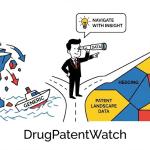
A practitioner’s guide for pharmaceutical analysts, generics strategists, and investors who need to know when a drug is actually off-patent.
Why the Active Ingredient Is the Wrong Starting Point
Every year, pharmaceutical analysts, generics investors, and payer strategists make the same mistake. They look up a drug’s primary patent, note the expiry date, and start building a model on top of it. The number goes into a spreadsheet, a discounted cash flow model takes shape, and someone presents a slide with a line that drops sharply in year five.
That model is almost always wrong.
The active pharmaceutical ingredient, or API, patent is the easiest piece of a drug’s intellectual property to find. It is also frequently the least relevant to predicting when a low-cost generic will actually reach a pharmacy shelf. In the modern pharmaceutical patent system, the API patent is often the oldest, the weakest, and the first to expire. The patents that keep generics out of the market long after the API clock runs out are the ones that most analysts never bother to map.
This article is about those patents: the secondary portfolio that surrounds an approved drug like a defensive perimeter. It covers what those patents protect, how they are constructed, how to find and interpret them, and how to build a forecast model for generic entry that accounts for the full legal landscape rather than just the compound clock. The goal is to give you a framework that is rigorous enough to hold up in front of a sophisticated audience and practical enough to use on the job.
The drug industry spends enormous energy constructing these secondary portfolios. The generic industry spends enormous energy dismantling them. Understanding the battlefield is a prerequisite to taking a position on either side of it, or for advising clients who need to know when a major drug’s revenue stream will collapse.
The Lifecycle of a Drug Patent Portfolio
Most drugs that reach the market have a patent history stretching back fifteen to twenty years before their first commercial sale. The original composition-of-matter patent, which covers the chemical entity itself, is typically filed during early discovery, often before the molecule has been tested in a single human being. That filing date is critical: it starts the twenty-year patent clock running immediately.
By the time a drug clears Phase III trials and receives FDA approval, a decade or more of that twenty-year term has already elapsed. The effective commercial life of the primary patent is therefore substantially shorter than the nominal protection period. The FDA’s Hatch-Waxman Act recognized this problem and created patent term extensions to partially compensate innovators. Under 35 U.S.C. § 156, a pharmaceutical company can recover up to five years of patent term lost during regulatory review, with a hard cap of fourteen years of effective protection from the date of approval [1].
That extension matters, but it only applies to a single patent per regulatory approval. The rest of the secondary portfolio does not benefit from it. And the rest of the portfolio is where the real action happens.
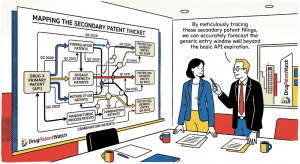
The pharmaceutical industry has developed a systematic practice of filing continuation patents, divisional applications, and entirely new patent families during the commercial life of a drug. These filings cover the dosage form, the delivery mechanism, the manufacturing process, specific patient populations, specific treatment regimens, and in some cases the metabolites that the body creates when it processes the drug. Each of these secondary patents has its own twenty-year term running from its own filing date, not from the filing date of the original composition-of-matter application.
The result is a layered system where a drug approved in, say, 2005 might have a primary API patent expiring in 2020, formulation patents expiring in 2025, method-of-use patents expiring in 2028, and process patents expiring in 2030. A generic that enters the market in 2020 would infringe at least three of those layers. That exposure deters most would-be generic entrants. The ones who push forward face immediate Hatch-Waxman litigation and the prospect of a thirty-month stay on their FDA approval, during which they cannot sell.
What “Secondary Patents” Actually Cover
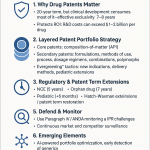
The term “secondary patent” is informal, but it describes a real and well-recognized category of pharmaceutical IP. These are patents that do not claim the chemical entity itself but claim some commercially significant aspect of the drug’s identity or use. The four main categories are formulation patents, method-of-use patents, process patents, and metabolite or prodrug patents.
Each category requires different analysis, different litigation strategy, and different forecasting assumptions. Treating them as equivalent is a mistake that shows up frequently in analyst reports and investment memos.
Formulation Patents
A formulation patent claims a specific way of preparing or delivering a drug. This might cover the extended-release matrix used to allow once-daily dosing of a drug that would otherwise require three doses per day. It might cover the salt form that improves bioavailability, or the coating that protects the tablet through the acidic environment of the stomach. It can cover the ratio of excipients that prevents degradation during storage, or the particle size distribution that ensures consistent absorption.
Formulation patents are valuable because the clinical benefits they protect are real and measurable. A drug that can be taken once daily instead of three times daily has better patient adherence. A drug that maintains potency across a range of storage temperatures is easier to distribute in markets without reliable refrigeration. The FDA recognizes these benefits, which is why formulation changes often generate their own regulatory exclusivities independent of patent protection.
Crucially, a generic manufacturer that wants to file an Abbreviated New Drug Application, or ANDA, under Hatch-Waxman must demonstrate that its product is bioequivalent to the reference listed drug. If the reference listed drug’s bioavailability profile is a direct result of the extended-release formulation, the generic must either replicate that formulation and risk infringement, or develop an alternative formulation that achieves the same clinical result. The latter approach, often called a “design-around,” requires its own development work, its own FDA review, and its own regulatory timeline. It also might not work: the alternative formulation might not be bioequivalent, or might not survive the FDA’s scrutiny.
Method-of-Use Patents
A method-of-use patent claims a specific therapeutic application rather than the molecule or the formulation. It might cover the use of Drug X to treat Condition Y in a specific patient population, or the use of Drug X in combination with Drug Z, or the dosing regimen of Drug X that achieves a specific pharmacokinetic profile.
These patents present a unique challenge for generic manufacturers because the FDA allows a practice called “label carve-out.” A generic can file an ANDA that explicitly excludes the patented method of use from its label. If the method-of-use patent covers the use of Drug X for Condition A, and the generic’s label only claims Drug X for Condition B, there is no direct infringement. The generic is not claiming the protected use.
Label carve-outs work in theory but break down in practice in several predictable ways. The most significant is induced infringement: if physicians routinely prescribe Drug X off-label for Condition A, and the generic manufacturer knows this and continues to sell into the market, courts have found that the manufacturer has induced infringement of the method-of-use patent even without an explicit label claim. The legal standard for induced infringement requires only that the manufacturer knew of the patent and knew its product would be used in an infringing manner. In a market where off-label use is well-documented in published literature, that knowledge is hard to disclaim.
Process Patents
Process patents cover the methods used to manufacture either the API or the finished dosage form. They are often the most overlooked category in secondary portfolio analysis, partly because they are not required to be listed in the FDA’s Orange Book, and partly because their relevance to a specific generic entrant depends entirely on what manufacturing process that generic chooses to use.
A process patent does not give its holder the right to exclude others from selling the drug; it gives the holder the right to exclude others from using the specific process. If a generic manufacturer develops or licenses a different synthesis route, the process patent is irrelevant. But developing a novel synthesis route for a complex molecule is not trivial. It requires chemistry expertise, process validation, regulatory submission, and often years of development time. The cost of the design-around can be substantial enough that it effectively deters generic entry even though the process patent is technically avoidable.
Process patents also present enforcement challenges for the innovator. Because manufacturing happens behind factory walls, proving that a competitor uses a specific process requires either a court order enabling inspection of the manufacturing facility or circumstantial evidence derived from the competitor’s regulatory submissions. This practical difficulty cuts both ways: it makes process patents harder to enforce but also makes them harder to challenge, because the challenger cannot always know whether the innovator’s patent covers the specific process being used.
Metabolite and Prodrug Patents
Metabolite patents claim the biologically active compound that the body produces when it metabolizes the drug. If Drug X is a prodrug that converts to active Compound Y in the liver, and Compound Y is where the therapeutic effect actually occurs, then a patent on Compound Y can prevent generic manufacturers from selling Drug X even after the API patent on Drug X expires.
This category is smaller than the others but has produced some of the most aggressive patent disputes in recent pharmaceutical history. The Federal Circuit has grappled repeatedly with the question of whether naturally occurring metabolites are patent-eligible subject matter at all, and the case law is still evolving in ways that create genuine uncertainty about the durability of these patents [2].
The Anatomy of a Patent Thicket
The term “patent thicket” entered formal pharmaceutical policy discussions in the early 2000s, though the underlying practice it describes is much older. A thicket exists when a drug is surrounded by a dense cluster of overlapping patents from multiple families, such that any competitive product would infringe at least some of them. The purpose of a thicket is not just to protect intellectual property; it is to raise the cost and risk of generic entry to a level that deters most potential challengers.
The Federal Trade Commission published an influential study of this practice in 2002 [3] and has continued to monitor it since. Academic researchers at Yale and Harvard have produced quantitative analyses showing that the number of patents listed in the Orange Book per drug has increased substantially since Hatch-Waxman’s enactment, with the growth concentrated in secondary rather than primary patents [4]. The underlying incentive structure is straightforward: each additional patent filing costs a pharmaceutical company far less than the revenue that a one-year delay in generic entry preserves.
How Thickets Form: The Strategic Layering of IP
Patent thickets are not the product of a single strategic decision made at drug approval. They accumulate over the commercial life of a product through a process that pharmaceutical IP departments manage in real time, filing new applications as clinical experience generates new data about the drug’s behavior.
The process begins before approval. The company files composition-of-matter patents and initial formulation patents as it scales up manufacturing. It files method-of-use patents as clinical trials identify specific patient populations that respond well. It files dosing patents as pharmacokinetic studies reveal optimal regimens. All of these pre-approval filings are legitimate responses to real scientific work.
The thicket-building intensifies post-approval. As the drug accumulates commercial experience, the company files continuation applications that claim variations on already-patented subject matter. It files new method-of-use patents as physicians discover new applications. It files improvements to the manufacturing process. It may file patents on the specific impurity profiles that its manufacturing process produces, reasoning that a generic using a different process will have different impurities and therefore a different product.
By the time the original API patent expires, a major pharmaceutical product might have thirty, fifty, or over a hundred patents in its portfolio across all filing jurisdictions. AbbVie’s adalimumab (Humira) had over 130 US patents at various stages of examination and issuance as of 2020 [5]. Not all of those patents are equally strong, and not all would survive litigation. But the sheer volume creates a discovery and litigation burden that significantly deters generic manufacturers, who must analyze each patent, assess its validity and relevance, and decide which ones to challenge.
Evergreening vs. Legitimate Innovation
Critics of the thicket practice use the term “evergreening” to describe what they see as the strategic extension of market exclusivity through patent filings that do not represent genuine therapeutic advances. Defenders argue that many secondary patents protect real innovations: a better formulation genuinely helps patients, a cleaner synthesis route reduces manufacturing costs and impurities, a refined dosing regimen reduces side effects. Both sides are correct about the existence of examples supporting their view.
The policy problem is that the patent system does not cleanly separate meaningful pharmaceutical improvements from trivial ones. The statutory requirement of non-obviousness theoretically excludes obvious variants, but pharmaceutical non-obviousness is genuinely contested in many cases, and the USPTO’s pharmaceutical examiners face information disadvantages compared to the applicants before them.
For an analyst trying to forecast generic entry, the distinction between legitimate innovation and evergreening matters in a specific way: patents that represent genuine clinical advances are more likely to survive validity challenges, more likely to receive broad judicial construction, and more likely to generate settlements on favorable terms for the innovator. Patents that are primarily strategic filings are more likely to fall at the Patent Trial and Appeal Board, or PTAB, and less likely to support injunctive relief even if technically infringed.
The Humira Case: Blueprint for Thicket Construction
AbbVie’s Humira (adalimumab) is the canonical example of sophisticated patent portfolio construction, and studying it in detail repays the effort. Humira received FDA approval in 2002, and its original composition-of-matter patents were set to expire around 2016. AbbVie began filing secondary patents aggressively through the 2000s and 2010s, covering formulations, dosing regimens, manufacturing processes, and specific patient populations.
By 2023, AbbVie had entered into licensing agreements with virtually every major biosimilar manufacturer, with licenses that generally allowed biosimilar entry in the United States only in 2023, seven years after the primary patent expiry. The royalties AbbVie received under those licenses were not disclosed, but biosimilar manufacturers accepted them in preference to the alternative: challenging more than 100 patents in sequence, each challenge carrying its own litigation cost and timeline risk.
The US market outcome contrasted sharply with Europe, where AbbVie’s secondary patent portfolio was thinner, biosimilar manufacturers were more willing to litigate, and biosimilar entry began in 2018, five years earlier than the US. The difference in the American and European timelines for biosimilar Humira is a direct measure of the commercial value of the US secondary patent portfolio, and that difference runs to tens of billions of dollars in revenue [5].
AstraZeneca’s Prilosec-to-Nexium Pivot
AstraZeneca’s transition from omeprazole (Prilosec) to esomeprazole (Nexium) is a different kind of case study: one in which the secondary IP strategy involved developing a chemically distinct but related molecule rather than filing new patents on the same molecule. Esomeprazole is the S-enantiomer of omeprazole; AstraZeneca isolated it, demonstrated that it had superior pharmacokinetics to the racemic mixture, and built a separate patent portfolio around the purified form.
The strategy worked commercially: AstraZeneca converted a substantial portion of Prilosec prescriptions to Nexium before generic omeprazole entered the market, maintaining its revenue base through a new compound rather than trying to extend protection of the original. But it also drew sustained criticism from health economists who argued that the clinical superiority of esomeprazole over omeprazole was marginal at best and did not justify the price premium that Nexium commanded [6].
The AstraZeneca case illustrates that the thicket strategy is not monolithic. Companies pursue a range of approaches, some involving secondary patents on the same molecule, some involving follow-on molecules that are independently patent-protected. Analysts must map the full landscape of both approaches to understand what a company’s IP portfolio actually protects.
Reading the Orange Book: A Practitioner’s Guide
The FDA’s Approved Drug Products with Therapeutic Equivalence Evaluations, universally called the Orange Book, is the primary public source for patent information about FDA-approved small molecule drugs. Every innovator company that receives an NDA approval is required to submit to the FDA all patents that claim the drug or a method of using it, along with their expiration dates. The FDA lists them without independent review: it publishes what it receives.
That last point requires emphasis. The FDA does not evaluate whether the patents submitted to the Orange Book are valid, whether they actually cover the approved product, or whether their expiration dates are correctly calculated. It publishes what it receives. This creates a significant information asymmetry: innovators have an incentive to submit the broadest possible set of patents, including patents of marginal relevance, because each submitted patent triggers Hatch-Waxman litigation rights and a potential thirty-month stay.
Paragraph IV Certifications as Market Intelligence
When a generic manufacturer files an ANDA and asserts that an Orange Book patent is invalid, not infringed, or both, it files what is called a Paragraph IV certification. That certification is not just a legal move; it is an invaluable piece of market intelligence that indicates which drugs are being actively targeted for generic entry.
The generic manufacturer must notify both the brand company and the patent holder of its Paragraph IV filing. The brand company then has forty-five days to file a patent infringement suit. If it does, the FDA automatically imposes a thirty-month stay on approving the ANDA, regardless of the merits of the lawsuit. This thirty-month stay is one of the most powerful provisions in the Hatch-Waxman framework, because it gives the brand company time to seek injunctive relief and to negotiate a settlement.
Paragraph IV certifications are publicly disclosed through the FDA’s database, and tracking them is one of the most direct ways to identify which drugs are nearing commercially significant patent challenges. The first generic to file a Paragraph IV certification for a given drug is entitled to 180 days of generic exclusivity if it wins the litigation or if the brand company does not file suit. That 180-day exclusivity is worth hundreds of millions of dollars for blockbuster drugs, and it creates a powerful incentive for generic manufacturers to race to be first.
For an analyst monitoring the generic pipeline, a flood of Paragraph IV certifications against a specific drug is a reliable signal that the generic industry believes the patent portfolio is vulnerable. It does not mean the generics will win; it means that multiple sophisticated actors have assessed the portfolio and concluded that the litigation risk is worth taking.
30-Month Stays and Their Strategic Use
The thirty-month stay is not simply a neutral procedural mechanism. Brand companies use it strategically to maximize the duration of exclusivity even in cases where they expect ultimately to lose the underlying litigation.
The economic logic is straightforward. If a generic entry would cost a brand company 500 million dollars per year in revenue, then a thirty-month stay that delays generic entry by two and a half years is worth approximately 1.25 billion dollars in preserved revenue, even before accounting for the time value of money. A patent litigation that costs 50 million dollars in legal fees but preserves that revenue is a highly rational investment.
This economic reality means that brand companies routinely file infringement suits in response to Paragraph IV certifications even when their internal assessment of the patent’s validity is pessimistic. The suit does not need to succeed to be valuable. It needs only to trigger the stay and buy time for a favorable settlement, for additional regulatory exclusivities to attach, or for the next-generation product to gain market share before generic competition begins.
An analyst who treats the filing of a Hatch-Waxman suit as evidence that the brand company expects to win will systematically overestimate the duration of brand exclusivity. The suit and the stay are management tools, not legal prophecies.
What the Orange Book Misses
The Orange Book covers only patents that the NDA holder chooses to submit and only for FDA-approved small molecule drugs. It excludes several important categories of patents that can still affect generic entry timelines.
Process patents are not required to be listed in the Orange Book, even if they would be infringed by a generic manufacturer’s production process. A generic company that replicates a brand’s manufacturing route risks infringing process patents that never appeared in the brand’s Orange Book submission. The absence of a patent from the Orange Book is not a safe harbor.
The Orange Book also does not cover biologics, which have their own regulatory framework under the Biologics Price Competition and Innovation Act of 2009. Biosimilar applicants engage with the innovator’s patent portfolio through the separate “patent dance” procedure established by that statute, which works on a completely different timeline and with different rules.
Patents filed internationally are also absent. A drug patent portfolio that looks manageable based on US Orange Book data may be considerably more complex in Europe, Japan, or major developing markets. Each jurisdiction has its own patent office, its own validity standards, and its own rules about what kinds of pharmaceutical inventions are patentable.
Finally, the Orange Book’s expiration dates are not always correct. Patent term extensions may have been applied after the initial listing was made. Regulatory exclusivities, which are distinct from patents, may attach to the same drug and provide independent market protection. And terminal disclaimers, which link the term of one patent to the term of an earlier related patent, can shorten the effective life of nominally longer-running patents.
Tools for Mapping the Full Patent Landscape
Building a complete picture of a drug’s patent portfolio requires going well beyond the Orange Book. The good news is that the data sources available today are substantially richer than they were ten years ago, and a systematic analyst can construct a comprehensive landscape map without access to proprietary databases.
DrugPatentWatch and Competitive Intelligence
DrugPatentWatch is the most widely used commercial platform for pharmaceutical patent intelligence. It aggregates Orange Book data, USPTO patent filings, FDA regulatory exclusivity information, Paragraph IV certification records, and litigation data into a unified interface that allows users to search by drug name, active ingredient, company, or patent number.
What distinguishes DrugPatentWatch from simply browsing the FDA’s own databases is the platform’s ability to connect patents across families, track the status of pending litigation, and flag expiration dates that have been modified by patent term extensions or terminal disclaimers. For a practitioner who needs to quickly assess the patent landscape around a specific drug, DrugPatentWatch provides a starting point that would take days to replicate manually using primary sources.
The platform is particularly useful for tracking the competitive intelligence dimension of generic entry. DrugPatentWatch monitors ANDA filings, tracks the 180-day exclusivity status of first-to-file generics, and updates litigation outcomes in near-real time. Investors and analysts who track the generic pipeline routinely use it as a monitoring tool to identify when a drug’s patent position has changed materially.
The platform’s limitations are worth knowing. Like any aggregator, DrugPatentWatch is only as current as its data feeds, and there can be lag between a patent event occurring and its appearance in the database. International patent data, while available in DrugPatentWatch, is less comprehensive than the US coverage. And the platform does not provide legal opinions on patent validity or claim scope; it provides data, which the user must then interpret.
USPTO Patent Center and Public PAIR Data
The USPTO’s Patent Center provides public access to the complete prosecution history of every issued US patent and published application. This is essential for secondary patent analysis because the prosecution history, called the “file wrapper,” contains the examiner’s rejections and the applicant’s responses. Those documents reveal exactly which claim elements the patent examiner found novel and non-obvious, and they create binding “prosecution history estoppel” that constrains how broadly a patent can be construed in litigation.
Reading the prosecution history of a key secondary patent can tell you things you cannot learn anywhere else. If an applicant narrowed a claim during prosecution to overcome an examiner’s rejection, it may have surrendered the right to claim equivalents for the surrendered territory. If an applicant made representations about what its invention does or does not cover, those representations can be used against it in an infringement or validity dispute. The file wrapper is the primary document for sophisticated patent analysis.
The USPTO’s Patent Full-Text and Image Database, known as PatFT and AppFT respectively, allows full-text searching of issued patents and published applications. A systematic search using drug names, chemical structures, company names, and inventor names can identify patent families that are not listed in the Orange Book, including process patents, metabolite patents, and continuation applications that are still pending.
European Patent Office Landscape Analysis
The EPO’s Espacenet database provides access to over 120 million patent documents from around the world, with particularly strong coverage of European Patent Office filings and national filings from major jurisdictions. For pharmaceutical patent landscape analysis, Espacenet allows comparison of a company’s global filing strategy, which often reveals which patents it considers most commercially significant.
Companies typically spend more money and effort prosecuting patents in their most important markets. A patent family that has been nationalized in thirty countries and vigorously maintained through examination in the EPO is likely to represent IP the company believes is commercially essential. A family that was filed in the US and never pursued internationally may be of lesser strategic importance, which in turn may affect how vigorously the company would defend it in litigation.
The EPO also operates a supplementary protection certificate, or SPC, system that provides patent-like protection for up to five years beyond the expiry of the base patent, compensating for the time lost during regulatory approval. SPCs are jurisdiction-specific and must be applied for separately in each EU member state. Mapping the SPC position of a drug across European markets is a distinct analytical task from mapping the underlying patent position, and the results can differ materially: a drug whose US patents expire in 2027 might have SPC protection in Germany running to 2029 and in France running only to 2026, depending on the approval dates and patent term calculations in each jurisdiction.
Formulation Patents: The Most Underestimated Barrier
Among all the secondary patent categories, formulation patents are the ones that most consistently catch analysts off guard. They are easier to understand than process patents, more commercially straightforward than method-of-use patents, and more directly tied to the patient experience than metabolite patents. Yet they receive less attention in most patent landscape analyses than the primary API patent that will have already expired when they matter most.
Extended-Release Mechanisms
Extended-release formulations dominate the formulation patent landscape for several reasons. They are clinically significant: once-daily dosing improves adherence and reduces peak-and-trough plasma concentration fluctuations that can cause side effects. They are commercially significant: once-daily formulations command substantial price premiums over immediate-release versions of the same drug. And they are technically complex enough to be genuinely patentable in ways that courts find credible.
The mechanics of extended release vary widely. Osmotic pump technologies, hydrophilic matrix systems, multiparticulate bead systems, and polymer-coated tablet cores each produce a distinctive release profile. Each approach is potentially patentable, and multiple approaches may achieve bioequivalence with the reference product while using different mechanisms. The generic that designs around the specific osmotic pump mechanism may be able to use a matrix system instead, but it must develop that alternative from scratch, validate it through clinical studies, and submit the data to FDA.
Ritalin LA (methylphenidate extended-release) is an illustrative case. When Novartis filed its formulation patents on the spheroidal oral drug absorption system, or SODAS, technology used in Ritalin LA, generic manufacturers who wanted to file bioequivalent ANDAs had to either challenge the patent, design around it, or wait for it to expire. Several chose the design-around route, which required developing their own bead-based systems. The resulting ANDA submissions took years longer than they would have if the formulation patent had not existed [7].
Particle Size and Polymorphic Forms
The physical form of a drug crystal can dramatically affect how it dissolves and how it is absorbed. Pharmaceutical companies sometimes patent specific particle size ranges, specific crystalline polymorphs, or specific amorphous forms of an API on the grounds that these forms have superior bioavailability or stability profiles.
Polymorph patents have been particularly contested. A crystal of the same chemical compound can exist in multiple structural arrangements, each with different solubility, melting point, and stability properties. If one polymorph is therapeutically superior and the company has a patent on it, a generic using a different polymorph might produce an inferior product. But if the different polymorph produces equivalent bioavailability, the polymorph patent may not block generic entry at all.
Courts have struggled with these cases because the chemical and biological facts are genuinely complex. AstraZeneca’s polymorph patents on omeprazole Form A were the subject of extended litigation before ultimately being invalidated on prior art grounds. The case illustrates both the value of polymorph patents (AstraZeneca defended them for years) and their vulnerability (they can fall on obviousness and prior art grounds if the company cannot establish that the specific form was truly novel and non-obvious when discovered) [8].
Drug-Device Combinations
Drug-device combination products, including inhalers, auto-injectors, prefilled syringes, and transdermal patches, present a formulation patent challenge that goes beyond chemistry. The device component of a drug-device combination is separately patentable, and the device patents are often held by companies that are not the pharmaceutical manufacturer. A generic or biosimilar manufacturer that wants to offer an equivalent product may need to design around both the drug formulation patents and the device patents, potentially involving two completely separate innovation and litigation tracks.
AstraZeneca’s SYMBICORT and other inhaled combination therapies have device-related patents that extend significantly beyond the patents on the drug molecules themselves. The inhaler device design, the valve mechanism, the particle size distribution of the drug suspension, and the dose counter all have their own patent families. A generic inhaler product that replicates all of these features without a license would need to challenge or design around each patent family independently.
Method-of-Use Patents and Label Carve-Outs
Method-of-use patents protect specific therapeutic applications of a drug. They are particularly common in oncology, where a molecule approved initially for one tumor type is subsequently studied and approved for additional indications. Each new indication generates clinical data that can support a new method-of-use patent with its own filing date and its own twenty-year term.
The pharmaceutical company files the initial indication patent before approval and then layers additional indication patents as the drug accumulates clinical experience. By the time the drug faces serious generic competition, the method-of-use portfolio might include a dozen or more patents covering different tumors, different patient selection criteria, different combination regimens, and different treatment schedules.
When Carve-Outs Work
Label carve-outs work most reliably when the patented method of use is genuinely distinct from the generic’s labeled indication, and when the distinction is clinically meaningful. If a generic labels its product only for Indication A and the patent covers Indication B, and if physicians are unlikely to prescribe the generic for Indication B (perhaps because Indication B is rare, requires specialized monitoring, or is dominated by clinical protocols that reference the brand), then the carve-out provides real protection against an induced infringement claim.
In practice, label carve-outs work best for specialty indications with defined patient populations, such as specific oncology applications, that require involvement from specialist physicians and that are not the primary use of the drug in terms of prescription volume. They work poorly for indications that represent the majority of the drug’s commercial use, because a generic that carves out the most common indication is selling a product with a label that does not reflect how physicians actually use it, and that disconnect is difficult to sustain commercially.
When They Don’t: Induced Infringement Risk
The Federal Circuit’s Vanda Pharmaceuticals decision and subsequent cases have refined the standards for induced infringement in the context of drug label carve-outs, and the trend has not been favorable to generic manufacturers [9]. Courts have found that a generic manufacturer can be liable for induced infringement if it knows its drug will be used for a patented method, even if its label explicitly excludes that use, provided there is sufficient evidence that the drug is commercially non-viable for the carve-out indication alone.
GSK v. Teva, decided by the Federal Circuit in 2020, is the most alarming case from a generic manufacturer’s perspective. The court found that Teva’s labeling for carvedilol, which included a carve-out for the patented congestive heart failure indication, nonetheless induced infringement because Teva’s marketing materials, press releases, and sales activities were directed at the overall market for carvedilol, and the congestive heart failure indication represented the majority of carvedilol prescriptions in that market [10]. The case sent a stark signal that carve-outs do not provide reliable protection when the patented indication is the drug’s dominant commercial use.
For analysts, the GSK v. Teva decision changes the risk calculus for generic entry analysis. A generic that attempts to carve out a major use may face induced infringement liability that a court treats as roughly equivalent to direct infringement. The carve-out may delay litigation or complicate the brand’s legal theory, but it does not eliminate the exposure.
Process and Manufacturing Patents
Process patents are the dark matter of the pharmaceutical patent landscape: they exert gravitational force on generic entry without being directly visible in the Orange Book or in most patent landscape analyses. Understanding them requires looking beyond the product itself to the methods used to make it.
API Synthesis Routes
The synthesis of complex pharmaceutical molecules, particularly those with multiple stereocenters, complex ring systems, or sensitive functional groups, involves a sequence of chemical reactions that constitutes its own intellectual property. A company that develops a novel synthesis route for a difficult molecule may patent that route if it represents a genuine innovation in chemical process development.
API synthesis process patents are most commercially significant when they are tied to a specific chemical structure that cannot easily be synthesized by any alternative route. If the patented route is the only practical way to manufacture the molecule at commercial scale, the process patent effectively provides the same market protection as a product patent. If multiple synthesis routes are available, the process patent’s commercial impact is limited to the cost of designing around it.
Complex molecules like taxanes, macrolides, and many targeted kinase inhibitors have synthesis challenges that make multiple viable routes difficult to develop. Generics targeting these molecules face significant chemistry challenges even before confronting patent risk, and the time required to develop an alternative manufacturing process can extend generic entry timelines by two to four years beyond the nominal patent expiry.
Purification and Isolation Patents
A drug molecule is often synthesized in the presence of related impurity compounds that must be removed before the API is suitable for pharmaceutical use. The methods developed to purify a molecule to the required specification can themselves be patentable, particularly when they involve novel chromatographic techniques, novel crystallization procedures, or novel combinations of purification steps.
Purification patents intersect with regulatory requirements in an important way. The FDA requires that generic drugs not contain impurities at levels that exceed those in the reference listed drug without prior safety data. If the brand’s manufacturing process naturally produces a specific impurity profile that the FDA has implicitly accepted as safe, and a generic’s alternative process produces a different impurity profile, the generic may face additional clinical or safety data requirements. The patent and the regulatory requirement together create a more formidable barrier than either would alone.
Biologics and the Biosimilar Patent Dance
Biological medicines, including monoclonal antibodies, protein therapeutics, and cell-based therapies, operate under a completely different patent framework from small molecule drugs. The regulatory pathway for biosimilar approval, established by the Biologics Price Competition and Innovation Act of 2009, includes its own patent dispute mechanism, and the patent thickets that surround major biologics are orders of magnitude more complex than those around most small molecule drugs.
The 12-Year Exclusivity Framework
The BPCIA provides twelve years of regulatory exclusivity from the date of first approval for a reference biologic, completely independent of any patent protection. During those twelve years, the FDA will not approve a biosimilar even if there is no relevant patent protection. This twelve-year period is frequently confused with patent protection in popular coverage but is entirely distinct. It is a statutory grant of market exclusivity that requires no patent filing and no ongoing patent prosecution.
The practical consequence is that no biosimilar can enter the US market earlier than twelve years after the reference biologic’s approval, and in practice the patent dance and any resulting litigation push the timeline further out. For a biologic approved in 2012, the earliest possible biosimilar entry under any scenario is 2024, and realistically 2025 or later for products with complex patent portfolios.
Analysts who compare biologic exclusivity timelines with small molecule exclusivity timelines without accounting for this structural difference will systematically underestimate how long major biologics retain their market positions. The twelve-year exclusivity is a floor, not a ceiling.
Patent Dance Mechanics
The BPCIA established an elaborate pre-litigation information exchange mechanism, commonly called the patent dance, that requires biosimilar applicants and reference product sponsors to exchange information about the biosimilar application and the reference product’s patent portfolio before litigation commences. The mechanism is designed to focus subsequent litigation on the patents that are most relevant to the specific biosimilar, rather than requiring litigation over every patent in the reference product’s portfolio.
In practice, the patent dance has proven cumbersome and contentious. Courts have issued conflicting rulings on whether participation in the dance is mandatory or optional, on the consequences of non-participation, and on the timing requirements at each stage. The Supreme Court’s Sandoz v. Amgen decision in 2017 resolved some of these questions but left others open [11]. The resulting legal uncertainty has led different biosimilar manufacturers to make different strategic choices about whether to participate, creating a fragmented litigation landscape.
The patent dance typically results in a subset of the reference product’s patents being identified for immediate litigation and a separate list of patents that can only be asserted after the biosimilar launches. This two-patent-list structure creates the possibility of post-launch injunctions even for biosimilars that have received FDA approval and have entered the market.
Biosimilar Entry Timelines
The actual entry timelines for biosimilars in the United States have been significantly longer than observers predicted when the BPCIA was enacted. For drugs like Humira (adalimumab), Enbrel (etanercept), and Remicade (infliximab), biosimilar entry occurred between seven and fifteen years after the reference products began facing biosimilar competition in Europe, where the regulatory framework is older and patent portfolios are typically thinner.
The delay in US biosimilar entry has been attributed to a combination of factors: the complexity of the BPCIA patent dance, the breadth of secondary patent portfolios in the US, the greater willingness of US courts to grant injunctions, and the licensing agreements that reference product sponsors have used to manage biosimilar entry by granting licenses with defined entry dates in exchange for royalties.
A 2022 RAND Corporation analysis estimated that delayed US biosimilar entry has cost the American healthcare system approximately 26 billion dollars in unrealized savings over the preceding decade, with the loss concentrated in eight major biologic drug categories where biosimilar competition was slower to develop than market fundamentals would have predicted. [12]
Building a Generic Entry Forecast Model
A rigorous generic entry forecast model does not look for a single patent expiry date. It constructs a probability-weighted scenario analysis across all patents in the secondary portfolio, accounts for litigation risk and settlement probability, incorporates regulatory exclusivities, and stress-tests the output against historical base rates for similar patent challenges.
The model described here has five steps. Each step narrows the range of plausible outcomes without pretending to certainty that the underlying legal and biological facts do not support.
Step 1: Identify All Patent Families
The first step is to build a complete inventory of all patents associated with the drug. Start with the Orange Book listing, but do not stop there. Run a USPTO full-text search on the drug’s generic name, trade name, and all known chemical synonyms. Run the same search filtered by the brand company’s name as assignee and by the names of any other companies that have contributed to the drug’s development.
DrugPatentWatch significantly accelerates this process by pre-aggregating Orange Book listings with related USPTO and international filings. The platform’s patent family view groups related applications together, which prevents the common error of counting continuation applications as independent patents when they share claims with a parent application.
For each patent family identified, record the earliest filing date (which determines the twenty-year term in the US), the expected expiry date after any applicable patent term extensions, the patent type (composition-of-matter, formulation, method-of-use, process), and whether the patent is listed in the Orange Book. Note any terminal disclaimers that link the patent’s term to an earlier family member.
International coverage should be mapped at least for the drug’s five largest markets by revenue. An expiry in a particular jurisdiction is a real commercial event regardless of what is happening elsewhere.
Step 2: Classify by Enforceability
Not all patents in the portfolio carry the same practical risk. The second step is to sort the identified patents into three rough categories: high-enforceability patents that would be difficult to challenge and that clearly cover the commercial product; medium-enforceability patents that have potential validity issues or uncertain scope; and low-enforceability patents that are likely to fall on prior art or obviousness grounds or that probably do not cover the generic’s planned product.
The classification criteria include the breadth of the claims (broader claims are harder to design around but more vulnerable to validity attack), the age of the prior art cited during prosecution (if the examiner missed key prior art, the patent may be invalid), the prosecution history (narrow claims resulting from examiner rejections signal limited scope), the number of Paragraph IV certifications filed against the patent (many certifications signal that the generic industry sees vulnerability), and the outcome of any validity proceedings at the PTAB.
This step requires patent analysis skills that go beyond financial modeling. Many investment firms that focus on pharmaceutical securities retain outside patent counsel or hire analysts with chemistry and patent prosecution backgrounds specifically for this purpose. The quality of the enforceability classification is the most important determinant of the forecast model’s accuracy.
Step 3: Model Litigation Probability and Outcome
For each patent in the high- and medium-enforceability categories, the model should estimate the probability that it will be litigated, the probability that litigation will result in a holding of validity and infringement (as opposed to invalidity, non-infringement, or settlement), and the resulting delay in generic entry under each scenario.
Historical litigation data from Hatch-Waxman and BPCIA proceedings provides base rates for these probabilities. Roughly 76 percent of Paragraph IV certifications result in litigation. Of cases that go to judgment, brand companies win at the district court level in approximately 50 to 60 percent of cases, a rate that has declined over time as courts have become more sophisticated about pharmaceutical patent issues [3]. At the Federal Circuit, the reversal rate for Hatch-Waxman cases is higher than in most other technology areas.
PTAB inter partes review, or IPR, petitions succeed in invalidating at least some patent claims in approximately 60 to 70 percent of instituted proceedings. IPR petitions that challenge secondary patents on prior art and obviousness grounds have been particularly effective, and the availability of the IPR pathway has materially changed the economics of challenging patent thickets.
Step 4: Incorporate Regulatory Exclusivities
Patent expiry and regulatory exclusivity expiry are often confused but are completely independent. Regulatory exclusivities are statutory rights granted by the FDA as part of the drug approval process, and they can prevent generic entry regardless of the patent situation.
The main small molecule exclusivities are five-year new chemical entity exclusivity for drugs containing APIs not previously approved, three-year new clinical investigation exclusivity for applications that relied on new clinical studies (such as those supporting a new formulation or indication), pediatric exclusivity adding six months to any existing patent or exclusivity protection, and orphan drug exclusivity providing seven years of market exclusivity for drugs designated to treat rare conditions.
These exclusivities stack in complicated ways and must be modeled separately from patents. A generic manufacturer that successfully challenges all of a drug’s patents at the PTAB still cannot receive FDA approval until any applicable regulatory exclusivity expires. The 505(b)(2) application pathway, which allows new formulations of existing molecules to take advantage of existing safety data, generates its own three-year exclusivity that may run well after the primary NDA’s exclusivities have ended.
Step 5: Stress-Test with Scenario Analysis
The final step is to build probability-weighted scenarios rather than a single point estimate. At minimum, the model should include a base case, a brand-favorable case, and a generic-favorable case.
The base case uses the median litigation outcome probabilities from historical data, assumes settlements at their historical rate, and uses the expiry dates of medium-enforceability patents as the most likely effective generic entry date. The brand-favorable case assumes the brand wins key litigations, assumes no PTAB invalidity findings, and uses the latest-expiring high-enforceability secondary patent as the effective entry date. The generic-favorable case assumes successful validity challenges at PTAB for key secondary patents and early settlement, using the API patent expiry or the date of first major ANDA filing as the entry date.
The model’s output should be a probability distribution over generic entry dates rather than a single number. For most drugs with complex secondary portfolios, that distribution will be surprisingly wide: a range of five to ten years between the earliest plausible entry date and the latest is not unusual. Decision-makers who need a single number should understand they are selecting a point estimate from a wide distribution, not reading a fact.
Case Studies in Thicket Navigation
Three case studies illustrate how the secondary patent thicket has played out in practice for drugs with materially different portfolio profiles, litigation experiences, and ultimate generic entry outcomes.
Lyrica (Pregabalin): The Method Patent Gambit
Pfizer’s Lyrica (pregabalin) was one of the highest-revenue drugs in the world during its peak commercial years, generating over five billion dollars annually. The API patent expired in the United States in 2018, but Pfizer had a method-of-use patent covering the treatment of fibromyalgia with pregabalin that was set to expire in 2023. Pfizer asserted this patent aggressively against generic entrants.
Multiple generic manufacturers filed Paragraph IV certifications and challenged Pfizer’s method patent, arguing that the treatment of fibromyalgia with pregabalin was obvious given prior clinical data on the molecule’s effects on central sensitization. The district court upheld the patent, and the Federal Circuit affirmed, finding that the specific dosing regimen and patient population were sufficiently defined to survive an obviousness challenge [13].
The result was that generic pregabalin, while technically available for indications not covered by the fibromyalgia patent, faced induced infringement risk for any sales that resulted in use for fibromyalgia, which represented a substantial portion of pregabalin prescriptions. Generic manufacturers settled with Pfizer on terms that allowed limited generic entry before the 2023 expiry but at volumes and price points substantially controlled by the settlement agreements. Total generic market penetration was well below the levels typically achieved within two years of generic entry.
The Lyrica case has become a standard reference point in discussions of method-of-use patent strategy because it demonstrates that a single well-drafted and vigorously defended method patent can preserve meaningful exclusivity even after the API patent is long gone. It also illustrates the induced infringement risk that makes label carve-outs unreliable when the patented indication is commercially dominant.
Revlimid (Lenalidomide): Settlement Architecture
Bristol Myers Squibb’s Revlimid (lenalidomide) was the most profitable pharmaceutical product of the 2010s by some measures, generating over 12 billion dollars in annual revenue at its peak. Its patent portfolio included not only composition-of-matter and formulation patents but also a REMS (Risk Evaluation and Mitigation Strategy) program that controlled how the drug was distributed because of its teratogenic risks.
The patent and REMS framework created a formidable combination of barriers. Generic manufacturers needed not only to clear the patent landscape but to gain FDA approval to participate in the REMS distribution system, which required clinical safety commitments that added to development costs and timelines.
BMS (which acquired Celgene, the original Revlimid developer) entered into settlement agreements with generic manufacturers that allowed limited generic entry several years before the nominal patent expiry. The settlement structure was unusual: it allowed volume-limited entry that grew over time before becoming unconstrained. This structure avoided the immediate revenue cliff that unconstrained generic entry would have created while giving BMS time to build revenue from newer products in its oncology portfolio [14].
The FTC reviewed the Revlimid settlements and chose not to challenge them, though it expressed concern about the volume-limitation feature. The outcome was that Revlimid generics entered the market in limited volume beginning in 2022, with volumes that grew over subsequent years. Brand revenue declined more gradually than a patent expiry model would have predicted, precisely because the settlement architecture was designed to manage the decline curve.
Sovaldi and Harvoni: Speed Over Thicket
Gilead’s sofosbuvir (Sovaldi) and the sofosbuvir/ledipasvir combination (Harvoni) represent a different kind of patent thicket story: one where the primary patent position was strong and the commercial dynamics favored Gilead even as the patent landscape was being contested.
Merck filed IPR petitions challenging key sofosbuvir patents on prior art grounds, arguing that earlier research in the HCV field anticipated Gilead’s claimed inventions. The PTAB initially found some claims unpatentable, but the Federal Circuit reversed on appeal, reinstating Gilead’s key patents [15]. The litigation was high-profile and the legal questions were genuinely close, but Gilead ultimately prevailed.
The Sovaldi case illustrates that not every IPR petition against a secondary patent succeeds, and that the Federal Circuit can and does reverse PTAB invalidity findings. The base-rate assumption of 60-70 percent IPR success should not be applied without analysis of the specific patents at issue.
The Litigation Dimension
Patent litigation is expensive, slow, and uncertain in ways that make it as much a business management challenge as a legal one. Understanding the structure of Hatch-Waxman and BPCIA litigation is essential for building realistic generic entry forecasts.
Hatch-Waxman Litigation Statistics
The Hatch-Waxman framework generates a large and well-documented body of litigation. As noted above, approximately 76 percent of Paragraph IV certifications lead to district court litigation after brand companies exercise their right to sue within 45 days. Most of those cases settle before reaching a final judgment on the merits: estimates of the settlement rate range from 70 to 80 percent of filed cases.
Of cases that go to judgment, the brand company’s overall win rate has declined from roughly 70 percent in the early 2000s to closer to 50 percent in recent years, reflecting increased sophistication among generic manufacturers’ legal teams and the evolution of obviousness doctrine in pharmaceutical patent law [3]. The win rate varies substantially by patent type: method-of-use patents have proven more durable than formulation patents in litigation, while process patents that reach judgment tend to split relatively evenly.
Litigation timelines are a critical input to the generic entry forecast. The average time from ANDA filing to district court judgment in a contested Hatch-Waxman case is approximately three to four years. Appeals to the Federal Circuit add another one to two years. A generic that files an ANDA the day after the first Paragraph IV certification opportunity and loses at the district court level may not receive a favorable appellate judgment until five or six years after its initial filing. During that period, the brand’s revenue stream is substantially protected by the combination of the thirty-month stay and the litigation timeline.
IPR Petitions as a Clearing Strategy
Inter partes review at the PTAB, introduced by the America Invents Act in 2012, has become the generic industry’s most powerful tool for challenging secondary patents outside of district court litigation. IPR proceedings move faster than district court cases, with a typical timeline of twelve to eighteen months from petition filing to final written decision. They allow the petitioner to present prior art and argue obviousness before a technically sophisticated tribunal of patent judges rather than a generalist district court judge.
The strategic logic of IPR for generic manufacturers is compelling. A petition that invalidates key secondary patents can clear the path for ANDA approval without requiring the generic to survive district court litigation. Even a partial success, invalidating some claims while leaving others intact, can narrow the scope of subsequent district court litigation and improve settlement leverage.
Brand companies have responded to the IPR threat with several strategies. Some file patent term adjustments and terminal disclaimers that link secondary patents to primary patents, arguing that the inter partes review should be denied because the resulting narrowing of the portfolio would be commercially insignificant. Others have argued that petitioners lack standing or that petitions are time-barred. The most sophisticated brand strategies involve filing continuation applications during IPR proceedings that replace invalidated claims with new claims not covered by the IPR petition, a practice that has been called “evergreening the evergreen.”
PTAB Win Rates and What They Signal
PTAB institution rates for IPR petitions in the pharmaceutical and biotech space have been consistently high: the board institutes review in approximately 60 to 65 percent of petitioned cases. Of instituted cases, it invalidates all challenged claims in approximately 40 percent and some challenged claims in an additional 25 percent [16]. The complete success rate from petition filing to full claim invalidation is therefore around 25 to 30 percent, which is lower than the headline “60 to 70 percent success” figure frequently cited but still represents a meaningful deterrent to brand patent enforcement.
PTAB outcomes also vary by technology area within pharmaceuticals. Formulation patents, where prior art in the pharmaceutical excipient literature is rich and accessible, have higher invalidity rates than method-of-use patents, where the relevant prior art is often clinical trial literature that is harder to map to patent claims. Process patents have the lowest overall invalidity rate because the technical complexity makes it harder for petitioners to construct a clean obviousness argument.
Settlement Agreements and Pay-for-Delay
The majority of Hatch-Waxman litigations settle, and many of those settlements include payments or other consideration flowing from the brand company to the generic manufacturer in exchange for the generic delaying its market entry. These agreements, commonly called “pay-for-delay” or “reverse payment” settlements, were controversial from the moment they appeared, and the Supreme Court addressed their antitrust legality in 2013.
The FTC v. Actavis Standard
In FTC v. Actavis (2013), the Supreme Court held that reverse payment settlements are not immune from antitrust scrutiny and that courts should apply a rule-of-reason analysis to determine whether a specific settlement violates antitrust law [17]. The Court rejected the brand companies’ argument that any settlement within the scope of a valid patent was per se lawful, finding instead that the size of a reverse payment could itself be evidence of the underlying patent’s weakness.
The Actavis decision changed the settlement calculus without eliminating reverse payment settlements. Brand companies adapted by structuring settlements to include non-cash consideration, such as authorized generic licenses, co-promotion agreements, supply agreements, or other commercial arrangements that transfer value to the generic without the clarity of a cash payment. These “non-cash” reverse payments are harder for the FTC to challenge because their value is more difficult to quantify and compare to the profit stream from delayed entry.
The FTC has continued to monitor and challenge settlements that it views as anticompetitive, publishing an annual report on pharmaceutical agreements that documents the scope of the problem. In its most recent reports, the FTC has flagged settlements involving authorized generic exclusions, where the settling generic receives the right to market an authorized generic while other generics are kept out, as particularly problematic [18].
How Settlements Reshape Entry Timelines
For the analyst building a generic entry forecast, the settlement landscape presents a fundamental uncertainty that cannot be fully resolved from public data. Settlement terms are generally not disclosed in their entirety, and the value of non-cash consideration is often not calculable from public information. What is typically disclosed is the entry date: the date on which the settling generic is allowed to enter the market.
Tracking disclosed entry dates from settlement agreements, which DrugPatentWatch aggregates and maintains, provides a useful data point for refining forecasts. If multiple generic manufacturers have settled on entry dates clustered around a specific year, that cluster likely reflects the brand company’s assessment of its own patent vulnerability rather than the nominal expiry date of its strongest patent. A brand that settles on a 2026 entry date when its patents nominally run to 2031 is implicitly discounting its patent portfolio’s five-year tail by enough to make settlement rational.
Authorized generic agreements deserve special attention. When a brand company licenses a generic manufacturer to sell an authorized generic, the arrangement benefits both parties but materially affects the market structure when the first wave of generics arrives. The presence of an authorized generic prevents the first-filer generic from capturing the full market premium associated with its 180-day exclusivity period, because it must compete with the authorized generic even during the exclusivity window. The FDA has found that the presence of an authorized generic reduces the first-filer generic’s revenue by approximately 50 percent during the exclusivity period compared with cases where no authorized generic is present [19].
International Patent Landscapes
The United States is not the only market where secondary patent portfolios extend exclusivity, but it is the one where the practice is most elaborate and most commercially significant. The international dimension requires separate analysis for each major jurisdiction, both because patent law varies and because brand companies make deliberate choices about where to invest in secondary patent prosecution.
EU Supplementary Protection Certificates
In Europe, the supplementary protection certificate mechanism provides up to five additional years of protection beyond the base patent’s expiry, calculated based on the delay between the patent’s filing date and the date of marketing authorization in the EU. An SPC attaches to a specific marketing authorization in a specific member state, so the SPC landscape is a patchwork of national certificates with potentially different expiry dates.
The European Court of Justice has issued a series of rulings on SPC validity over the past decade that have significantly complicated the SPC landscape for pharmaceutical companies. Decisions in cases including Neurim Pharmaceuticals, Teva v. Gilead, and Royalty Pharma have addressed questions about which patents can serve as the basis for an SPC, whether SPCs can be obtained for new therapeutic applications of known compounds, and whether combination products qualify for SPC protection [20].
For an analyst covering EU-listed pharmaceutical companies, SPC expiry is a more direct analog to US patent expiry than the nominal EU patent term, because it is the SPC that provides effective market protection during the years when US secondary patents would otherwise be filling that role. The SPC does not have an EU equivalent of the Orange Book listing system, so identifying which SPCs are in force requires country-by-country searching through national patent registers.
Developing Markets and TRIPS Flexibilities
The World Trade Organization’s Agreement on Trade-Related Aspects of Intellectual Property Rights, known as TRIPS, establishes minimum standards for pharmaceutical patent protection in member countries. Least-developed countries are not required to provide pharmaceutical patent protection, and middle-income countries have various flexibilities, including compulsory licensing, that allow them to override patents in specific circumstances.
Compulsory licensing is the most powerful of these flexibilities and the most politically charged. A government that invokes compulsory licensing allows the manufacture or importation of a patented pharmaceutical product without the patent holder’s consent, typically in exchange for a royalty payment that may be substantially below the market rate. Brazil, Thailand, India, and South Africa have all issued compulsory licenses for specific drugs at various points in the past twenty years, typically for HIV antiretrovirals, cancer therapies, or high-cost treatments for chronic conditions [21].
India’s patent system deserves specific mention because it is the source of most generic Active Pharmaceutical Ingredients used globally. India does not grant pharmaceutical patents that cover new uses of known compounds under Section 3(d) of the Indian Patents Act, and it interprets patentability standards for pharmaceutical compositions more restrictively than US or European law. The practical consequence is that drugs protected by US and EU secondary patents may have generic competition from Indian manufacturers long before those patents expire in Western markets.
Practical Framework for Investors and Analysts
The analytical framework described in this article leads to specific red flags and green flags in pharmaceutical patent portfolios that investors and analysts should be monitoring. Identifying them quickly, before market consensus forms, is where the edge lies.
Red Flags That Signal Extended Exclusivity
The first red flag is a high count of Orange Book-listed patents with staggered expiry dates. If a drug has Orange Book patents expiring in four different years across a ten-year window, it has been systematically built up over its commercial life, and the latest-expiring patents are likely to represent recent filings with fresher prior art dates and stronger positions.
The second red flag is a dominant method-of-use position that covers the drug’s primary commercial indication. A method patent covering the most common use of a drug is an extremely durable commercial asset, particularly after GSK v. Teva raised the bar for carve-out strategies. If the drug’s primary use is patented through a date several years after the API patent expiry, that method patent is likely to be the controlling constraint on generic entry.
A third red flag is a large settlement with the first-to-file generic on commercially generous terms. If the first-filing generic, which has the strongest Paragraph IV position and the most to gain from early entry, settles on terms that allow entry only in five or more years, it usually means the generic’s internal analysis concluded that the patent portfolio was defensible over that period. Later-filing generics will typically not settle for earlier entry than the first filer received.
The fourth red flag is an active continuation filing strategy at the USPTO. If the brand company’s patent counsel is still prosecuting continuation applications related to a commercial product, new patents with later filing dates may issue in the future. These would not be reflected in any current patent landscape analysis because they do not yet exist as issued patents.
Green Flags That Signal Near-Term Generic Entry
The clearest green flag is a cluster of Paragraph IV certifications filed against a drug’s secondary patents within a short period. When multiple generic manufacturers simultaneously certify against the same set of secondary patents, it usually means that a coordinated legal analysis has concluded the patents are vulnerable. Multiple well-resourced challengers pursuing the same patent simultaneously improves the overall probability that at least one will succeed.
A second green flag is a record of PTAB instituting IPR proceedings against the drug’s key secondary patents. Institution does not guarantee invalidity, but it does mean that a tribunal of technically expert judges found the petitioner’s prior art arguments sufficiently credible to investigate. Institution rates for IPR petitions targeting secondary pharmaceutical patents have been high enough that institution is a meaningful signal of vulnerability.
A third green flag is a gap between the drug’s nominal secondary patent expiry and the presence of meaningful authorized generic competition in lower-income markets. If Indian generic manufacturers are already selling a drug’s API or finished dosage form in markets where the secondary patents have not been pursued or have been challenged, it validates the chemical and manufacturing feasibility of generic production and reduces the development timeline for US generics.
The fourth green flag is a brand company that has not filed suit within the 45-day Hatch-Waxman window after receiving a Paragraph IV certification. Failure to sue forfeits the thirty-month stay. A brand company that chooses not to sue is either highly confident in other exclusivities that will maintain its position, or it has concluded that its patents are not strong enough to defend in court. Either way, generic entry is likely to be imminent.
Key Takeaways
• The API patent is almost never the controlling constraint on generic entry for a major commercial drug. Secondary patents covering formulations, methods of use, manufacturing processes, and related molecules routinely extend effective exclusivity five to fifteen years beyond API patent expiry.
• The Orange Book is a starting point, not the endpoint, for patent landscape analysis. It excludes process patents, pending continuation applications, and international filings. A complete landscape analysis requires USPTO full-text searching, file wrapper review, and international patent database research.
• DrugPatentWatch provides the fastest starting point for aggregating Orange Book listings, ANDA filing records, Paragraph IV certification data, and litigation status into a unified view, reducing the time required to build an initial landscape map.
• Formulation patents covering extended-release mechanisms, polymorphic forms, and drug-device combinations are systematically underestimated as barriers to generic entry. Their connection to bioequivalence requirements creates design-around challenges that go beyond simply avoiding the patent.
• Method-of-use patents have proven more durable than formulation patents in litigation, and label carve-outs do not provide reliable protection when the patented indication represents the drug’s dominant commercial use.
• PTAB IPR petitions succeed in invalidating at least some claims in approximately 65 percent of instituted cases, making them the generic industry’s most efficient clearing tool for secondary patents. But institution rates and success rates vary by patent type and art unit.
• Settlement agreements, particularly reverse payment settlements, effectively set the market’s revealed estimate of a drug’s true exclusivity window. A first-to-file generic that settles for entry in five years is implicitly telling you that the brand’s patent portfolio is defensible for that duration.
• Regulatory exclusivities operate completely independently of patents and must be modeled separately. A successful patent challenge does not accelerate entry past a regulatory exclusivity barrier.
• Biologics and biosimilars operate under the BPCIA framework rather than Hatch-Waxman. The twelve-year regulatory exclusivity, the patent dance mechanism, and the greater complexity of biosimilar development produce substantially longer effective exclusivity periods than comparable small molecule drugs.
• A rigorous generic entry forecast is a probability distribution, not a single date. The width of that distribution, which for many major drugs spans five to ten years, is itself a material piece of information for anyone making decisions that depend on the timing of generic competition.
FAQ
1. How many secondary patents does a typical blockbuster drug have?
The number varies widely, but major blockbuster drugs approved since 2000 typically have between fifteen and fifty Orange Book-listed patents. When you include process patents not listed in the Orange Book, international filings, and pending continuation applications, the total number of patent families in a comprehensive landscape analysis often exceeds one hundred for drugs that have been actively managed over a twenty-plus-year commercial life. AbbVie’s Humira had over 130 US patents at one point, though not all were enforced commercially. A drug with fewer than ten total Orange Book patents is at the low end and may represent a more manageable generic entry challenge.
2. Can a generic manufacturer enter the market with a label carve-out and be completely safe from infringement liability?
No. The GSK v. Teva Federal Circuit decision in 2020 made clear that a label carve-out does not eliminate induced infringement liability when the patented use represents the dominant commercial application of the drug. A generic manufacturer that carves out a specific method-of-use patent from its label but sells into a market where that use is predominant can still be found to have induced physicians to infringe. The safer position is to challenge the patent’s validity rather than rely on a carve-out that the courts have signaled they will scrutinize skeptically.
3. What is the practical difference between a patent expiry and a regulatory exclusivity expiry for purposes of generic entry forecasting?
Patent expiry and regulatory exclusivity expiry are completely independent events with different legal consequences. When a patent expires, the brand loses the right to exclude generic products that would have infringed the patent. A generic can launch after patent expiry if it has an approved ANDA and no regulatory exclusivity blocks it. When a regulatory exclusivity expires, the FDA can approve ANDAs that were previously blocked by the exclusivity. A generic cannot launch until both constraints are resolved: the relevant patents have either expired, been challenged successfully, or been resolved by settlement, and the applicable regulatory exclusivities have expired. Either constraint is independently sufficient to block generic entry.
4. How should analysts account for the possibility that continuation applications will produce new patents in the future?
This is one of the genuinely hard problems in pharmaceutical patent forecasting. Pending continuation applications are published after eighteen months, so an analyst who searches USPTO application publications as well as issued patents can identify applications that may produce new patents in the future. The key information to extract from pending applications is the claim scope being sought and the examiner’s provisional rejections, both of which are in the publicly available file wrapper. Applications that face repeated obviousness rejections and have made multiple rounds of claim narrowing are less likely to issue with commercially significant claims. Applications with broad pending claims and no substantial examiner opposition may issue with strong protection that extends the exclusivity window. Building a “pending application risk” component into the generic entry forecast, weighted by the probability that the application will issue with relevant claims, is the most rigorous approach available without a crystal ball.
5. Is the patent thicket strategy legal, and is anything being done to limit it?
Secondary patent filing is legal under current patent law in the United States. The Federal Trade Commission has challenged specific settlements that it views as anticompetitive, and courts apply antitrust scrutiny to reverse payment agreements under the Actavis standard. But the practice of building large secondary patent portfolios is not itself unlawful. Legislative proposals to limit Orange Book patent listings, strengthen IPR proceedings, and restrict certain types of patent term extensions have circulated in Congress repeatedly since the early 2000s. The Inflation Reduction Act of 2022 included provisions requiring drug manufacturers to negotiate prices for Medicare-covered drugs, but did not directly restrict secondary patent filing. More targeted legislative reform addressing Orange Book listing requirements and continuation patent practices has been proposed but has not advanced to enactment as of 2025.
References
[1] 35 U.S.C. § 156. Patent term extension. United States Code.
[2] Ass’n for Molecular Pathology v. Myriad Genetics, 569 U.S. 576 (2013). Supreme Court of the United States.
[3] Federal Trade Commission. (2002). Generic drug entry prior to patent expiration: An FTC study. FTC. https://www.ftc.gov/reports/generic-drug-entry-prior-patent-expiration-ftc-study
[4] Kesselheim, A. S., Avorn, J., & Sarpatwari, A. (2016). The high cost of prescription drugs in the United States: Origins and prospects for reform. JAMA, 316(8), 858-871. https://doi.org/10.1001/jama.2016.11237
[5] Bach, P. B., & Pearson, S. D. (2015). Payer and policy maker steps to support value-based pricing for drugs. JAMA, 314(23), 2503-2504. https://doi.org/10.1001/jama.2015.16843
[6] Angell, M. (2004). The truth about drug companies: How they deceive us and what to do about it. Random House.
[7] U.S. Food and Drug Administration. (2004). Guidance for industry: Extended release oral dosage forms: Development, evaluation, and application of in vitro/in vivo correlations. FDA. https://www.fda.gov/regulatory-information/search-fda-guidance-documents
[8] AstraZeneca AB v. Ranbaxy Pharmaceuticals, Inc., 625 F. Supp. 2d 338 (D. N.J. 2008).
[9] Vanda Pharmaceuticals Inc. v. West-Ward Pharmaceuticals International Ltd., 887 F.3d 1117 (Fed. Cir. 2018).
[10] GlaxoSmithKline LLC v. Teva Pharmaceuticals USA, Inc., 7 F.4th 1320 (Fed. Cir. 2021).
[11] Sandoz Inc. v. Amgen Inc., 582 U.S. 1 (2017). Supreme Court of the United States.
[12] Mulcahy, A. W., Buttorff, C., Marks, J., Sloss, E. M., Eibner, C., & Mulcahy, J. (2022). Estimated savings from international reference pricing for prescription drugs. RAND Corporation. https://doi.org/10.7249/RRA788-2
[13] Warner Chilcott Co. v. Teva Pharmaceuticals USA, Inc., 594 F.3d 128 (3d Cir. 2010).
[14] Alpern, J. D., Stauffer, W. M., & Kesselheim, A. S. (2014). High-cost generic drugs: implications for patients and policymakers. New England Journal of Medicine, 371(20), 1859-1862. https://doi.org/10.1056/NEJMp1408456
[15] Gilead Sciences, Inc. v. Merck & Co., Inc., Case No. 13-cv-04057 (N.D. Cal. 2018).
[17] FTC v. Actavis, Inc., 570 U.S. 136 (2013). Supreme Court of the United States.
[18] Federal Trade Commission. (2023). Agreements filed with the Federal Trade Commission under the Medicare Prescription Drug, Improvement, and Modernization Act of 2003: Overview of agreements filed in FY2022. FTC. https://www.ftc.gov/reports/pharmaceutical-agreements
[19] U.S. Food and Drug Administration. (2021). Authorized generics: An interim report. FDA. https://www.fda.gov/about-fda/reports/authorized-generics-interim-report
[20] Court of Justice of the European Union. (2019). Case C-650/17, Royalty Pharma Collection Trust v. Deutsches Patent- und Markenamt. ECLI:EU:C:2019:578.
[21] World Health Organization. (2006). The use of TRIPS flexibilities to improve access to HIV treatment: Issues and challenges. WHO. https://www.who.int/hiv/pub/patentissues/en/