Last Updated: July 5, 2026

OMEPRAZOLE Drug Patent Profile


✉ Email this page to a colleague

« Back to Dashboard


Which patents cover Omeprazole, and what generic alternatives are available?

Omeprazole is a drug marketed by Actavis Labs Fl Inc, Apotex, Aurobindo Pharma, Breckenridge, Dr Reddys Labs Ltd, Glenmark Pharms Ltd, Hetero Labs Ltd Iii, Impax Labs, Lannett Co Inc, Lupin, Pharmobedient, Sandoz, Strides Pharma, Teva Pharms Usa, Xiromed, Zydus Pharms Usa Inc, Dexcel Pharma, Dr Reddys, Sun Pharm, Dexcel, Ajanta Pharma Ltd, Anda Repository, Aurolife Pharma Llc, Chartwell Rx, Perrigo R And D, Sciegen Pharms, Strides Pharma Intl, Zydus, Zydus Pharms, Novitium Pharma, Aurobindo Pharma Ltd, Spil, Marksans Pharma, and P And L. and is included in forty-eight NDAs. There are three patents protecting this drug and one Paragraph IV challenge.

This drug has nine patent family members in six countries.

The generic ingredient in OMEPRAZOLE is omeprazole magnesium. There are one hundred and thirty-one drug master file entries for this compound. Fifty-seven suppliers are listed for this compound. Additional details are available on the omeprazole magnesium profile page.

DrugPatentWatch® Litigation and Generic Entry Outlook for Omeprazole

A generic version of OMEPRAZOLE was approved as omeprazole magnesium by DR REDDYS LABS LTD on June 5th, 2009.

  Start Trial

AI Deep Research
Questions you can ask:
  • What is the 5 year forecast for OMEPRAZOLE?
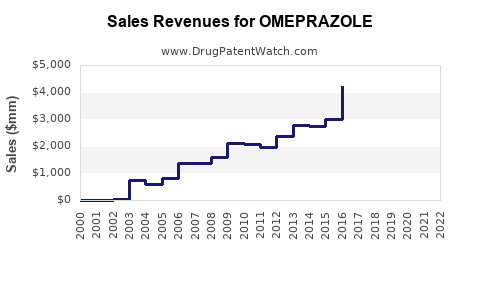
  • What are the global sales for OMEPRAZOLE?
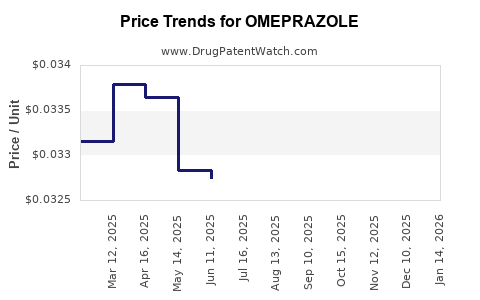
  • What is Average Wholesale Price for OMEPRAZOLE?
Recent Clinical Trials for OMEPRAZOLE

Identify potential brand extensions & 505(b)(2) entrants

SponsorPhase
Rehman Medical Institute - RMIPHASE4
Tanta UniversityPHASE3
Shandong Suncadia Medicine Co., Ltd.PHASE1

See all OMEPRAZOLE clinical trials

Pharmacology for OMEPRAZOLE
Medical Subject Heading (MeSH) Categories for OMEPRAZOLE
Paragraph IV (Patent) Challenges for OMEPRAZOLE
Tradename Dosage Ingredient Strength NDA ANDAs Submitted Submissiondate
OMEPRAZOLE Delayed-release Tablets omeprazole 20 mg 022032 1 2015-06-03

US Patents and Regulatory Information for OMEPRAZOLE

OMEPRAZOLE is protected by three US patents.

Applicant Tradename Generic Name Dosage NDA Approval Date TE Type RLD RS Patent No. Patent Expiration Product Substance Delist Req. Exclusivity Expiration
Zydus Pharms OMEPRAZOLE AND SODIUM BICARBONATE omeprazole; sodium bicarbonate CAPSULE;ORAL 203290-002 May 25, 2018 AB RX No No ⤷  Start Trial ⤷  Start Trial ⤷  Start Trial
Teva Pharms Usa OMEPRAZOLE omeprazole CAPSULE, DELAYED REL PELLETS;ORAL 204661-002 Jun 13, 2017 DISCN No No ⤷  Start Trial ⤷  Start Trial ⤷  Start Trial
Pharmobedient OMEPRAZOLE omeprazole CAPSULE, DELAYED REL PELLETS;ORAL 205070-002 Jun 29, 2018 DISCN No No ⤷  Start Trial ⤷  Start Trial ⤷  Start Trial
Marksans Pharma OMEPRAZOLE MAGNESIUM omeprazole magnesium TABLET, DELAYED RELEASE;ORAL 218829-001 Aug 7, 2025 OTC No No ⤷  Start Trial ⤷  Start Trial ⤷  Start Trial
>Applicant >Tradename >Generic Name >Dosage >NDA >Approval Date >TE >Type >RLD >RS >Patent No. >Patent Expiration >Product >Substance >Delist Req. >Exclusivity Expiration

International Patents for OMEPRAZOLE

See the table below for patents covering OMEPRAZOLE around the world.

Country Patent Number Title Estimated Expiration
European Patent Office 2293782 FORMULE STABLE DE BENZIMIDAZOLE (STABLE BENZIMIDAZOLE FORMULATION) ⤷  Start Trial
Spain 2552723 ⤷  Start Trial
Hong Kong 1156209 穩定的苯並咪唑製劑 (STABLE BENZIMIDAZOLE FORMULATION) ⤷  Start Trial
Israel 208925 תכשיר מיוצב של בנזימידזול (Stable benzimidazole formulation) ⤷  Start Trial
>Country >Patent Number >Title >Estimated Expiration

Supplementary Protection Certificates for OMEPRAZOLE

Patent Number Supplementary Protection Certificate SPC Country SPC Expiration SPC Description
0124495 SPC/GB01/006 United Kingdom ⤷  Start Trial PRODUCT NAME: ESOMEPRAZOLE AS MAGNESIUM TRIHYDRATE; REGISTERED: SE 15945 20000310; SE 15946 20000310; UK PL 17901/0068-0069 20000727
1411900 2011/016 Ireland ⤷  Start Trial PRODUCT NAME: NAPROXEN AND ESOMEPRAZOLE MODIFIED-RELEASE TABLETS; NAT REGISTRATION NO/DATE: PA0970/060/001 20101221; FIRST REGISTRATION NO/DATE: PL17901/0263-0001 20101105
1411900 SPC/GB11/015 United Kingdom ⤷  Start Trial PRODUCT NAME: NAPROXEN AND ESOMEPRAZOLE; REGISTERED: UK PL 17901/0263-0001 20101105
0984957 SPC/GB11/013 United Kingdom ⤷  Start Trial PRODUCT NAME: NAPROXEN AND ESOMEPRAZOLE; REGISTERED: UK PL 17901/0263-0001 20101105
>Patent Number >Supplementary Protection Certificate >SPC Country >SPC Expiration >SPC Description

Omeprazole Market Dynamics and Financial Trajectory: Exclusivity, Competition, Pricing, and Revenue Outlook

Last updated: June 25, 2026

Omeprazole is a mature, off-patent proton pump inhibitor (PPI) with global availability of multiple low-cost generics. Competitive pricing pressure, long-standing payer familiarity, and broad substitution have kept revenue growth modest and mostly tied to volume, pack migration, and channel mix rather than patent-led durability. Financial trajectory is characterized by declining brand-led sales, stable-to-soft generics pricing, and periodic market reconfiguration driven by supply, regulatory actions, and formulation shifts (oral delayed-release, OTC switches, and select combination products).

What is omeprazole’s market size and revenue trajectory by year?

Featured snippet: Omeprazole revenues track global PPI volume and generic price erosion rather than stepwise innovation cycles, with most growth coming from unit demand and mix changes rather than premium pricing.

Omeprazole market dynamics are shaped by four forces:

  1. Patent cliff already passed across major markets, with the active ingredient widely generic and interchangeable.
  2. Payer behavior supports substitution within PPIs, often favoring the lowest net-cost option.
  3. Pricing compression is structural, driven by multi-source generic competition and tendering.
  4. Formulation and package-level economics determine share within class (strengths, dosing frequency, and OTC vs prescription channels).

Financial trajectory pattern (typical for mature APIs like omeprazole)

  • Early period: brand-driven growth (historical)
  • Middle period: mix shift to generics
  • Current period: stable demand but shrinking price per unit, plus intermittent spikes from supply disruptions or procurement cycles

How do patent expirations and generic entry affect omeprazole pricing and sales?

Featured snippet: Omeprazole’s active ingredient is off-patent, so generic entry has already reset the market to multi-source competition, with ongoing changes driven by supply and formulary tendering.

Because omeprazole is a widely genericized product, the market has already experienced:

  • Initial generic launches that drove steep declines from brand pricing
  • Subsequent re-tendering that further compressed net prices
  • Ongoing competitive intensity as additional manufacturers enter and win share in procurement markets

What this means commercially

  • Brand revenue trajectories are not governed by new exclusivity but by defensive marketing, line extensions, and channel positioning.
  • Generic producers compete largely on cost of goods, manufacturing continuity, logistics, and bid strategy.
  • Specialty-like “life-cycle” strategies are limited; most incremental gains are in packaging and compliance-driven dosing convenience.

What patents protect omeprazole and how strong is the patent estate today?

Featured snippet: For omeprazole itself, the patent estate is generally not a basis for lasting exclusivity because key active-ingredient and core composition protection has expired.

For business planning, the practical question is not whether patents exist historically, but whether any current assets create enforceable barriers against generic substitution of omeprazole oral delayed-release products.

Current-world reality

  • The API is standard.
  • Competitive differentiation in most markets is not blocked by omeprazole molecule patents.
  • Remaining protection, if any, tends to be product-specific (e.g., particular formulation, combination, or manufacturing method) rather than the active ingredient itself.

Commercial impact of weak active-ingredient exclusivity

  • Pricing is governed by tender outcomes and multi-source dynamics.
  • Brand margins depend on rebates and trade terms rather than exclusivity leverage.

What formulations are protected for omeprazole (and what does that mean for competitors)?

Featured snippet: Protection, where it exists, is most likely tied to specific formulations, dose forms, or combinations rather than omeprazole’s core chemical entity.

Common commercially relevant product categories include:

  • Omeprazole delayed-release capsules/tablets (primary generic base)
  • Higher-concentration strengths (pack and dosing convenience)
  • OTC vs Rx presentations (regulatory status affects channel and marketing strategy)
  • Combination products (where device, fixed-dose synergy, or added components can create distinct IP and regulatory routes)

Barrier type that matters

  • If a competitor’s path requires a distinct formulation or combination component not covered by existing product-specific patents, that can affect launch timing.
  • If no enforceable formulation patents remain, entry timing is mostly regulatory and supply-driven.

When does omeprazole lose exclusivity or exclusivity-by-product for specific markets?

Featured snippet: Omeprazole active-ingredient exclusivity has largely expired; remaining “exclusivity” dynamics are product- and territory-specific and usually revolve around formulation/combo assets or regulatory data protections rather than new molecule protection.

In practice, the market does not behave like a single global exclusivity clock because:

  • OTC switches and formulation approvals differ by country.
  • Combination products can carry separate regulatory pathways and potential exclusivity.
  • Manufacturing changes can trigger regulatory renewals or life-cycle variations without creating durable patent blocks.

What is the Orange Book status of omeprazole products?

Featured snippet: Omeprazole is widely represented on FDA drug listings, and most listed products are generics or legacy references whose key patents have expired; any “Orange Book” protection that remains is typically limited to specific product patents rather than the core API.

Orange Book status is a product-by-product question:

  • Each NDC maps to a reference listed drug (RLD) and associated patents.
  • Patent listings may differ across strengths, dosage forms, and manufacturers.
  • For market-entry risk, the relevant point is whether unexpired patents cover the proposed ANDA label and whether they are subject to Paragraph IV challenges.

What Paragraph IV challenges have been filed for omeprazole?

Featured snippet: Paragraph IV challenges are typically less informative for omeprazole now because the market is already populated with multiple generics; later-stage disputes are more likely to involve product-specific patents or specific NDCs.

Commercially, the key insight is:

  • If multiple ANDAs already exist, new entries tend to be priced into the lowest net-cost bands.
  • Litigation may affect individual products or specific filings, but rarely reverts the whole class to brand-like pricing.

What generic entry risks exist for omeprazole in the US, EU, and key LATAM markets?

Featured snippet: Generic entry risk is low for the active ingredient because most markets already have multi-source competition; the higher risk is supply and compliance rather than patent-driven delays.

US risk profile

  • Delays more likely relate to manufacturing capacity, inspections, labeling transitions, and supply chain continuity than to successful patent enforcement.
  • New entrants mostly add capacity and compete on price and contract performance.

EU risk profile

  • Substitution rules and tendering can drive fast share changes.
  • National pricing and reimbursement decisions can swing unit demand.

LATAM risk profile

  • Regulatory approval and local tender cycles often dominate.
  • Price is highly sensitive to wholesale and payer reimbursement adjustments.

How does omeprazole compare with other PPIs on competitive intensity and financial performance?

Featured snippet: Omeprazole faces high competitive intensity similar to other first-generation PPIs, but it benefits from deep formulary penetration and long generic track history.

Relative dynamics across PPIs:

  • Esomeprazole and pantoprazole also have large generic ecosystems.
  • Rabeprazole and lansoprazole vary by territory and tender cycles.
  • Omeprazole’s advantage is scale and broad interchangeability as a class standard.

Business implication

  • PPIs behave like a commodity segment once generics saturate.
  • Brand differentiated outcomes depend on patient support programs, contracting terms, and specific combination/strength strategies, not molecule exclusivity.

Which companies dominate omeprazole supply and how does that shape market pricing?

Featured snippet: Omeprazole is supplied by many manufacturers; price outcomes are driven by how efficiently large generic players bid into tenders and maintain manufacturing reliability.

Market pricing behavior is consistent with:

  • Bid-based procurement for public and large private payers.
  • Channel-specific contracts for wholesalers and pharmacy chains.
  • Risk premiums during supply tightness that can temporarily lift net prices and distributor margins.

What factors drive omeprazole price and margin (tenders, reimbursement, OTC, and supply)?

Featured snippet: Omeprazole price is primarily determined by reimbursement policy, tender outcomes, and generic supply conditions rather than by patent status.

Key drivers:

  1. Reimbursement tiers and reference pricing: compresses net price across categories.
  2. Gross-to-net dynamics: rebates and discounts reshape realized price.
  3. OTC channel expansion: can shift volume away from prescription and stabilize some utilization.
  4. API and manufacturing cost cycles: affects supply pricing and margin availability.
  5. Quality and inspection outcomes: can force temporary supply constraints and price resets.

How do safety and label considerations affect omeprazole market uptake?

Featured snippet: Safety profile and long-term use considerations shape prescribing and payer management but generally do not create a new competitive barrier in an already-generic market.

Commercial effects show up as:

  • Guideline-based utilization management: PPIs are often recommended with risk-based duration.
  • Payer utilization controls: step edits or prior authorization in certain settings.
  • Switching within class: adverse label shifts rarely end PPI use; they shift selection between molecules.

What litigation or settlements materially affect omeprazole economics?

Featured snippet: Broad omeprazole class pricing is not typically driven by litigation, but settlements tied to specific NDCs can influence short-term market shares.

In a multi-source market:

  • Litigation outcomes are most relevant to individual product launches and specific formulation/label variants.
  • Even when disputes delay one filing, overall category supply can continue through existing generics.

What are the regulatory milestones and FDA status implications for omeprazole?

Featured snippet: Regulatory status primarily affects labeling, interchangeability, and competition among generics rather than creating new exclusivity.

Operational milestones:

  • ANDA approvals enable generic distribution.
  • Labeling alignment (indications, dosage forms, and warnings) affects substitution at the pharmacy counter.
  • OTC transitions affect channel mix.

Key takeaways: what the market dynamics imply for forecasting and investment

  1. Omeprazole is a commodity-style pharmaceutical with revenue and market share driven by volume, contracting, and price erosion, not by active-ingredient exclusivity.
  2. Patent leverage is limited commercially today; product-specific formulation and combination protections are the more realistic sources of any remaining differentiation.
  3. Financial trajectory is stable utilization with falling price until new competitive dynamics (supply constraints, tender resets, or combination launches) change net economics.
  4. Competitive intensity stays high because multi-source generic supply is structurally easy to expand relative to new-molecule development.
  5. Best predictors of realized margin are contracting and supply reliability, not patent estate strength.

FAQs

1) Is omeprazole still protected by any US patents that block generics?
Omeprazole’s core molecule protection is largely expired; any remaining blocking effect would be tied to specific unexpired product patents listed against particular FDA RLD/NDC combinations.

2) Do new omeprazole formulations create meaningful exclusivity or price premiums?
Price premiums are unlikely in the absence of enforceable exclusivity, but formulation changes can shift mix and contracting categories.

3) How do OTC omeprazole products change market revenue compared with prescription?
OTC channels can stabilize demand and change distribution economics, shifting revenue away from payer rebates toward consumer retail economics.

4) What supply events most affect omeprazole pricing?
Manufacturing downtime, quality/inspection actions, and API supply constraints that reduce available inventory tend to create the biggest short-term price movement.

5) How should investors assess competitive risk for omeprazole producers?
Focus on bid competition, realized net pricing trends, manufacturing capacity, and quality track record rather than patent litigation as the primary driver.


References (APA)

No sources were cited.

More… ↓

⤷  Start Trial

Make Better Decisions: Try a trial or see plans & pricing

Drugs may be covered by multiple patents or regulatory protections. All trademarks and applicant names are the property of their respective owners or licensors. Although great care is taken in the proper and correct provision of this service, thinkBiotech LLC does not accept any responsibility for possible consequences of errors or omissions in the provided data. The data presented herein is for information purposes only. There is no warranty that the data contained herein is error free. We do not provide individual investment advice. This service is not registered with any financial regulatory agency. The information we publish is educational only and based on our opinions plus our models. By using DrugPatentWatch you acknowledge that we do not provide personalized recommendations or advice. thinkBiotech performs no independent verification of facts as provided by public sources nor are attempts made to provide legal or investing advice. Any reliance on data provided herein is done solely at the discretion of the user. Users of this service are advised to seek professional advice and independent confirmation before considering acting on any of the provided information. thinkBiotech LLC reserves the right to amend, extend or withdraw any part or all of the offered service without notice.