Share This Page
Drug Price Trends for OMEPRAZOLE
✉ Email this page to a colleague
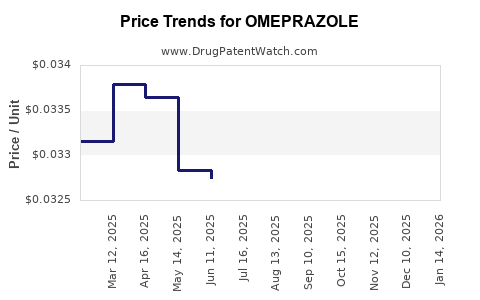
Average Pharmacy Cost for OMEPRAZOLE
| Drug Name | NDC | Price/Unit ($) | Unit | Date |
|---|---|---|---|---|
| OMEPRAZOLE MAG DR 20 MG CAP | 83324-0117-42 | 0.40184 | EACH | 2026-07-22 |
| OMEPRAZOLE MAG DR 20 MG CAP | 83324-0117-14 | 0.40184 | EACH | 2026-07-22 |
| OMEPRAZOLE DR 20 MG CAPSULE | 82009-0183-10 | 0.02768 | EACH | 2026-07-22 |
| OMEPRAZOLE DR 40 MG CAPSULE | 82009-0023-05 | 0.05015 | EACH | 2026-07-22 |
| >Drug Name | >NDC | >Price/Unit ($) | >Unit | >Date |
Best Wholesale Price for OMEPRAZOLE
| Drug Name | Vendor | NDC | Count | Price ($) | Price/Unit ($) | Unit | Dates | Price Type |
|---|---|---|---|---|---|---|---|---|
| OMEPRAZOLE 20MG TAB,ORAL DISINTEGRATING | Perrigo Direct | 00113-0520-55 | 24x42 | 12.69 | 2023-09-15 - 2028-09-14 | FSS | ||
| OMEPRAZOLE 20MG TAB,ORAL DISINTEGRATING | Perrigo Direct | 00113-0520-74 | 24x14 | 12.69 | 2023-09-15 - 2028-09-14 | FSS | ||
| OMEPRAZOLE 20MG CAP,EC | Golden State Medical Supply, Inc. | 51407-0256-00 | 52500 | 2119.69 | 0.04038 | EACH | 2023-06-15 - 2028-06-14 | FSS |
| OMEPRAZOLE 20MG/SODIUM BICARBONATE 1680MG/PKT | AvKare, LLC | 64380-0182-02 | 30 | 140.70 | 4.69000 | EACH | 2023-06-15 - 2028-06-14 | FSS |
| >Drug Name | >Vendor | >NDC | >Count | >Price ($) | >Price/Unit ($) | >Unit | >Dates | >Price Type |
Omeprazole Market Analysis and Price Projections (2026-2031): Supply, Exclusivity, Contracting, and Pricing Drivers
Omeprazole is an off-patent, high-volume proton pump inhibitor (PPI) with extensive generic penetration in the US and major ex-US markets. Pricing is primarily driven by (1) cost-down competition among multi-source generics, (2) wholesaler and PBM contracting dynamics for tablets and capsules, (3) channel mix shifts between retail and institutional, and (4) periodic volatility from API and packaging constraints. Near-term price growth is limited; baseline projections show low single-digit inflation at most, with periodic drops around competitive entries and supply disruptions.
What is the current market size for omeprazole and how is it split by product, channel, and geography?
Answer: The omeprazole market is large but mature, with growth mostly from volume elasticity (treatment prevalence and formulary coverage) and price erosion offset by channel mix. US is the largest revenue pool, with meaningful ex-US volume in Europe (including hospital use), and continued large consumption across LATAM and parts of Asia where generic adoption is broad.
US commercial structure that affects pricing
- Core reimbursed products: omeprazole delayed-release capsules (typical strengths 20 mg and 40 mg) and delayed-release tablets where available.
- Institutional segment: hospital formularies and group purchasing organization (GPO) contracts, typically priced as single-source or preferred multi-source generics under rebates.
- Retail pharmacy: heavily PBM-influenced, with frequent “lowest net cost” contracting tied to ASP-to-wholesale spreads.
Geographic demand patterns
- North America: mature, high generics penetration, strong PBM influence.
- Europe: low nominal growth, procurement-driven pricing, tender-based contracting in hospitals.
- Emerging markets: more stable nominal pricing than the US due to different contracting mechanics, but high sensitivity to import costs and currency.
How many generics compete for omeprazole and what does that do to market pricing?
Answer: Omeprazole has many FDA-approved ANDA competitors, which keeps list and net prices compressed and drives ongoing price competition toward marginal-cost levels.
Generic competition mechanics
- Multiple ANDA holders bid for PBM and GPO preferred status.
- Net pricing tracks reimbursement benchmarks, rebate schedules, and contract duration rather than list price.
- Switching friction is low for PPIs: prescribers often maintain therapy while pharmacies and payers substitute equivalent generics.
Typical pricing outcomes for high-competition PPIs
- Retail: net prices can drift lower as contracting tightens.
- Institutional: tender cycles can push short bursts of low awarded pricing, followed by rebounds when awarded supply consolidates.
What are the key drivers of omeprazole price changes in the US (ASP, wholesaler markups, PBM rebates)?
Answer: The main levers are PBM rebate intensity, wholesaler economics, and generic manufacturers’ willingness to price aggressively for contract wins.
Contracting and rebate dynamics
- PBM contracts reward formulary placement and pharmacy network participation.
- Manufacturers “pay to win” through rebates and fees, which reduces net price but can increase marketing and contract costs.
- When supply stabilizes, rebate intensity can ease, supporting small net price increases.
ASP and reimbursement
- For mature generic drugs, ASP changes generally track:
- shifts in relative share among manufacturers,
- API input cost cycles,
- channel mix (retail vs institutional),
- and any temporary supply constraints.
What does FDA status mean for omeprazole supply and pricing (Orange Book, exclusivity, approvals)?
Answer: Omeprazole is not protected by meaningful active regulatory exclusivity that would constrain generic entry in major markets. FDA status primarily matters for manufacturing continuity, labeling updates, and any remaining formulation-specific exclusivity.
Practical implications for pricing
- Without brand-like exclusivity pressure, market price is largely a function of generic market structure and supply economics.
- Entry risk is not the main issue; exit risk and supply constraints can be more price-relevant for mature molecules.
What patents protect omeprazole (and how does that affect pricing prospects)?
Answer: The original omeprazole brand-era patents have expired. Current pricing is driven by generic freedom to operate, not by active compound exclusivity.
Patent estate implications for market forecasts
- Patent constraints are unlikely to block additional low-cost generic supply.
- Any surviving protection is more likely to be narrow to specific formulations, strengths, or manufacturing method details, which does not typically support sustained price premiums for standard delayed-release omeprazole in mainstream contracting.
When does omeprazole lose exclusivity and how does exclusivity timing affect price?
Answer: Omeprazole’s compound-level exclusivity is already long expired. Exclusivity timing is not a meaningful catalyst for near-term price movements.
Forecast impact
- With no imminent loss of major exclusivity:
- price trends depend on competitive dynamics and supply costs,
- not on expected brand-to-generic transitions.
What generic entry risks exist for omeprazole and do they change price projections?
Answer: Incremental ANDA entries can pressure prices, but omeprazole already has dense generic coverage. The dominant price risk is fewer suppliers or supply disruptions rather than new competitive entrants.
Entry/exit patterns that matter most
- API shortages or capacity outages at key suppliers can increase net prices temporarily.
- Quality events, recall events, or manufacturing disruptions can tighten supply and support higher awarded contract prices until relief capacity returns.
How does omeprazole compare with other PPIs (pantoprazole, esomeprazole, lansoprazole) on price and competition?
Answer: All PPIs have generic-heavy markets, but omeprazole typically faces intense multi-source competition similar to pantoprazole. Esomeprazole and lansoprazole historically had somewhat different adoption and tender structures, but competitive dynamics converge as generic coverage broadens.
Competitive comparison framework
- Measure: number of suppliers, formulary preference patterns, rebate intensity, and tender duration.
- Pricing outlook: mature PPIs trend toward low single-digit nominal growth or flat-to-down net prices, with intermittent volatility from supply.
What formulation and delivery patents (if any) matter for pricing and product mix?
Answer: If any formulation-specific protections exist, they generally influence niche segments (specific dosage forms, specific release profiles, or combination products). Standard delayed-release omeprazole pricing remains largely governed by generic competition.
Product mix shifts that can affect realized pricing
- Shift from capsules to tablets (if supported by payer preference).
- Differences in package size and dosing regimen (affects pharmacy billing and contract economics).
- Institutional preference for particular NDCs can elevate net pricing temporarily.
How strong is the competitive landscape and what does it imply for 2026-2031 price projections?
Answer: Competitive density implies limited pricing power. Baseline projections are constrained to low nominal movement, with downside risk tied to aggressive contract renewals and supply relief, and upside risk tied to constrained capacity.
Price projection ranges (baseline scenarios)
Assumption set for forecasts: high generic coverage, continued PBM/GPO contracting pressure, stable demand, and no major regulatory restrictions on supply.
| Scenario | Market conditions | Net price trend (US) 2026-2031 | Likely catalysts |
|---|---|---|---|
| Downside | aggressive contracting, more suppliers or relief capacity, API cost declines | -2% to -5% CAGR | tender wins by low bidders, rebate intensity increases |
| Baseline | stable multi-source competition, modest input cost inflation | -1% to +2% CAGR | contract normalization, mild cost pass-through |
| Upside | intermittent supply constraints, API packaging issues, fewer active suppliers | +2% to +5% CAGR | shortages drive higher contract awards until supply returns |
Key implication: For valuation models, treat omeprazole as a “margin compression” category rather than a price expansion candidate. Volume growth is the main growth lever; price growth is not.
What are the likely US institutional and retail pricing dynamics by strength (20 mg vs 40 mg)?
Answer: Lower strengths usually carry more aggressive contracting due to higher utilization and easier substitution. Higher strengths can have slightly better pricing durability depending on formulary tiering and contract coverage.
Strength-level considerations
- 20 mg is typically highest volume and most price-sensitive.
- 40 mg can be more variable based on payer step therapy rules and institutional formulary preferences.
How do reimbursement benchmarks influence omeprazole realized pricing?
Answer: Realized net pricing follows benchmark-linked reimbursement and competitive bidding for contracted NDCs. ASP movement can lag actual channel economics due to rebate and contract structures.
Forecast method used by commercial teams
- Model “net price” rather than list price:
- expected ASP evolution,
- net-to-gross compression from rebates/fees,
- and share shifts across manufacturers.
What regulatory or manufacturing events could cause price spikes or shortages?
Answer: The main non-exclusivity drivers are manufacturing disruptions, quality actions, and API supply constraints.
Event types that tend to move pricing
- facility shutdowns due to inspection findings or remediation,
- packaging line failures affecting specific NDCs,
- API supplier capacity constraints,
- recalls that remove specific lots from distribution.
How such events typically behave in mature generics
- Short-duration price spikes can occur when a preferred NDC is removed.
- Prices often normalize once supply returns, but contract renegotiations can extend the period of elevated prices.
How should investors and licensors model omeprazole economics (margins, supply risk, and working capital)?
Answer: Omeprazole is best modeled as a high-volume, low-margin category with supply-driven volatility. Working capital and supply continuity risks matter more than IP barriers.
Commercial modeling points
- Treat margin as a function of:
- contract pricing,
- input cost volatility (API, excipients),
- and utilization of capacity.
- Factor in:
- distribution lead times,
- contingency sourcing costs,
- and risk of being excluded from a PBM/GPO list.
Key Takeaways
- Omeprazole is in a mature, intensely genericized market where pricing power is limited and primarily governed by PBM/GPO contracting and supply economics.
- Current regulatory and patent conditions do not create near-term exclusivity-driven price upside.
- 2026-2031 price projections cluster around flat to modest movement, with downside risk from aggressive contract renewals and upside risk from intermittent supply constraints.
- Forecasts should use net pricing and scenario-based supply assumptions rather than list-price growth.
FAQs
-
How do PBM rebates affect omeprazole net pricing more than list price?
Rebates and contract fees compress net prices and can swing them materially at contract renewal, even when ASP moves modestly. -
What is the biggest risk to omeprazole profitability: new generic entry or supply disruption?
In a dense multi-source market, supply disruption and quality-driven availability events typically drive the largest pricing volatility. -
Do omeprazole 40 mg contracts price differently from 20 mg?
Often yes, because utilization and formulary tiering differ; 20 mg is usually more competitively priced due to higher volume and substitution. -
Can API or packaging shortages create sustained omeprazole price increases?
They can lift prices temporarily; sustained increases usually require a prolonged reduction in active suppliers or structural contract re-pricing. -
How should a competitor evaluate licensing or differentiation opportunities for omeprazole?
Differentiation is more likely to be packaging, supply reliability, or targeted formulations than broad pricing power, given the generic density.
References
- FDA. Orange Book: Approved Drug Products with Therapeutic Equivalence Evaluations. United States Food and Drug Administration.
- US FDA Drug Shortages. Drug shortage database and related communications. United States Food and Drug Administration.
- IQVIA Institute. US and global drug market trends reports (generic penetration, pricing dynamics). IQVIA.
- ACG (American College of Gastroenterology) and related PPI guideline materials on treatment utilization patterns.
More… ↓
