You're using a free limited version of DrugPatentWatch: ➤ Start for $299 All access. No Commitment.

Last Updated: December 11, 2025

LANSOPRAZOLE Drug Patent Profile


✉ Email this page to a colleague

« Back to Dashboard


Which patents cover Lansoprazole, and when can generic versions of Lansoprazole launch?

Lansoprazole is a drug marketed by Ajanta Pharma Ltd, Alkem Labs Ltd, Chartwell Molecular, Dr Reddys Labs Ltd, Glenmark Pharms Inc, Hetero Labs Ltd Iii, Inventia, Krka Tovarna Zdravil, Lannett Co Inc, Macleods Pharms Ltd, Mylan, Mylan Pharms Inc, Natco, Natco Pharma Ltd, Novitium Pharma, Perrigo R And D, Sandoz, Sun Pharm, Teva Pharms, Wockhardt Bio Ag, Xiromed, Zydus Hlthcare, Ani Pharms, Aurobindo Pharma Ltd, Dexcel, Dr Reddys, Teva Pharms Usa, Zydus Pharms, and Rising. and is included in thirty-four NDAs. There are two patents protecting this drug.

This drug has three patent family members in three countries.

The generic ingredient in LANSOPRAZOLE is amoxicillin; clarithromycin; lansoprazole. There are forty-six drug master file entries for this compound. One supplier is listed for this compound. Additional details are available on the amoxicillin; clarithromycin; lansoprazole profile page.

DrugPatentWatch® Generic Entry Outlook for Lansoprazole

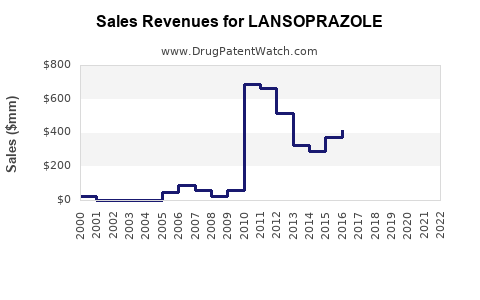
Annual sales in 2022 were $103mm indicating the motivation for generic entry (peak sales were $689mm in 2010).

There have been twelve patent litigation cases involving the patents protecting this drug, indicating strong interest in generic launch. Recent data indicate that 63% of patent challenges are decided in favor of the generic patent challenger and that 54% of successful patent challengers promptly launch generic drugs.

Indicators of Generic Entry

< Available with Subscription >

  Get Started Free

AI Deep Research
Questions you can ask:
  • What is the 5 year forecast for LANSOPRAZOLE?
  • What are the global sales for LANSOPRAZOLE?
  • What is Average Wholesale Price for LANSOPRAZOLE?
Drug patent expirations by year for LANSOPRAZOLE
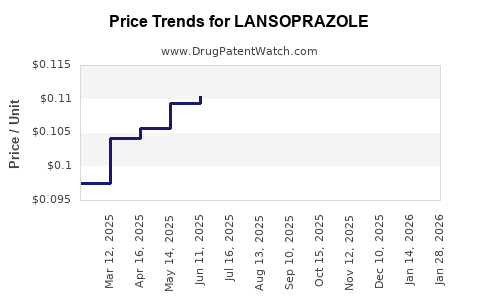
Drug Prices for LANSOPRAZOLE

See drug prices for LANSOPRAZOLE

Drug Sales Revenue Trends for LANSOPRAZOLE

See drug sales revenues for LANSOPRAZOLE

Recent Clinical Trials for LANSOPRAZOLE

Identify potential brand extensions & 505(b)(2) entrants

SponsorPhase
Cinclus Pharma Holding ABPHASE3
National Taiwan University HospitalPHASE2
Assiut UniversityPHASE3

See all LANSOPRAZOLE clinical trials

Pharmacology for LANSOPRAZOLE
Drug ClassProton Pump Inhibitor
Mechanism of ActionProton Pump Inhibitors
Physiological EffectInhibition Gastric Acid Secretion
Medical Subject Heading (MeSH) Categories for LANSOPRAZOLE
Paragraph IV (Patent) Challenges for LANSOPRAZOLE
Tradename Dosage Ingredient Strength NDA ANDAs Submitted Submissiondate
PREVACID Delayed-release Orally Disintegrating Tablets lansoprazole 15 mg and 30 mg 021428 1 2006-12-27
PREVACID Delayed-release Pellets/Capsules lansoprazole 15 mg and 30 mg 020406 2005-12-05

US Patents and Regulatory Information for LANSOPRAZOLE

LANSOPRAZOLE is protected by two US patents.

Applicant Tradename Generic Name Dosage NDA Approval Date TE Type RLD RS Patent No. Patent Expiration Product Substance Delist Req. Exclusivity Expiration
Ani Pharms LANSOPRAZOLE lansoprazole TABLET, ORALLY DISINTEGRATING, DELAYED RELEASE;ORAL 078730-001 Oct 15, 2010 DISCN No No ⤷  Get Started Free ⤷  Get Started Free ⤷  Get Started Free
Sun Pharm LANSOPRAZOLE lansoprazole CAPSULE, DELAYED REL PELLETS;ORAL 091509-001 Sep 13, 2013 DISCN No No ⤷  Get Started Free ⤷  Get Started Free ⤷  Get Started Free
Mylan LANSOPRAZOLE lansoprazole TABLET, ORALLY DISINTEGRATING, DELAYED RELEASE;ORAL 202396-001 Nov 28, 2018 AB RX No No ⤷  Get Started Free ⤷  Get Started Free ⤷  Get Started Free
Dexcel LANSOPRAZOLE lansoprazole TABLET, ORALLY DISINTEGRATING, DELAYED RELEASE;ORAL 208025-001 Jun 7, 2016 OTC No No 11,077,055 ⤷  Get Started Free Y ⤷  Get Started Free
Mylan LANSOPRAZOLE lansoprazole TABLET, ORALLY DISINTEGRATING, DELAYED RELEASE;ORAL 202396-002 Nov 28, 2018 AB RX No No ⤷  Get Started Free ⤷  Get Started Free ⤷  Get Started Free
Ani Pharms LANSOPRAZOLE, AMOXICILLIN AND CLARITHROMYCIN (COPACKAGED) amoxicillin; clarithromycin; lansoprazole CAPSULE, TABLET, CAPSULE, DELAYED REL PELLETS;ORAL 200218-001 Aug 30, 2013 DISCN No No ⤷  Get Started Free ⤷  Get Started Free ⤷  Get Started Free
Perrigo R And D LANSOPRAZOLE lansoprazole CAPSULE, DELAYED REL PELLETS;ORAL 202319-001 May 18, 2012 OTC No No ⤷  Get Started Free ⤷  Get Started Free ⤷  Get Started Free
>Applicant >Tradename >Generic Name >Dosage >NDA >Approval Date >TE >Type >RLD >RS >Patent No. >Patent Expiration >Product >Substance >Delist Req. >Exclusivity Expiration

International Patents for LANSOPRAZOLE

See the table below for patents covering LANSOPRAZOLE around the world.

Country Patent Number Title Estimated Expiration
European Patent Office 3288556 COMPOSITIONS À DÉSINTÉGRATION PAR VOIE ORALE (ORALLY DISINTEGRATING COMPOSITIONS) ⤷  Get Started Free
Israel 255048 הרכבים המתפוררים בפה (Orally disintegrating compositions) ⤷  Get Started Free
World Intellectual Property Organization (WIPO) 2016174664 ⤷  Get Started Free
>Country >Patent Number >Title >Estimated Expiration

Supplementary Protection Certificates for LANSOPRAZOLE

Patent Number Supplementary Protection Certificate SPC Country SPC Expiration SPC Description
0174726 93C0021 Belgium ⤷  Get Started Free PRODUCT NAME: LANSOPRAZOLE; NAT. REG.: 150 S 539 F 4 19921119; FIRST REG.: FR 333 412.1 19901211
1129088 2014/008 Ireland ⤷  Get Started Free PRODUCT NAME: DEXLANSOPRAZOLE OR A SALT THEREOF; NAT REGISTRATION NO/DATE: PA1864/001/001-002;PA1864/002/001-002 20131125; FIRST REGISTRATION NO/DATE: 47911 47912 47913 47914 20130919
0328535 96C0021 Belgium ⤷  Get Started Free PRODUCT NAME: LANSOPRAZOLE + CLARITHROMYCINE + METRONIDAZOLE; REGISTRATION NO/DATE IN FRANCE: K 27 17033R DU 19960209; REGISTRATION NO/DATE AT EEC: K 27 17033R DU 19960209
>Patent Number >Supplementary Protection Certificate >SPC Country >SPC Expiration >SPC Description

Market Dynamics and Financial Trajectory for Lansoprazole: An In-Depth Analysis

Last updated: July 27, 2025


Introduction

Lansoprazole, a proton pump inhibitor (PPI) primarily used to treat gastroesophageal reflux disease (GERD), peptic ulcer disease, and Zollinger-Ellison syndrome, has established itself as a significant entity within the global pharmaceutical landscape. Market forces, regulatory trajectories, patent statuses, and competitive landscapes jointly shape its commercial and financial trajectory. This article explores these dynamics, projecting future market prospects and delineating key factors influencing Lansoprazole's financial outlook.


Market Overview and Therapeutic Positioning

Lansoprazole, initially approved by the U.S. Food and Drug Administration (FDA) in 1995, commands a notable share in the PPI segment, which itself holds a dominant position in acid-related disorder therapies. The global demand for acid suppression drugs is driven by increasing prevalence rates of GERD and related conditions, as well as rising awareness of gastrointestinal health.

The therapeutic efficacy and safety profile of Lansoprazole have historically led to broad prescription acceptance, especially in developed markets. However, regulatory and patent landscapes impact the system's sustainability and competitive positioning.


Market Dynamics

1. Patent Expirations and Generics Entry

A pivotal factor influencing Lansoprazole's market valuation is patent expiration. Pfizer's original patent for Lansoprazole expired in multiple jurisdictions around 2010–2012, paving the way for generic competitors. This significantly eroded the drug’s branded pricing power, leading to a sharp decline in revenue from the original formulation.

The proliferation of generic versions has increased affordability and widened access, yet intensified price competition. Generic manufacturers typically price Lansoprazole at a substantial discount—often 20–40% less than branded counterparts—substantially impacting profit margins for originators.

Impact: Generic penetration has led to a decline in overall sales for branded Lansoprazole but broadened drug accessibility, boosting volume sales globally.

2. Market Penetration and Prescription Trends

Despite generic competition, Lansoprazole maintains a core market share, notably in regions with less extensive generic penetration or where physicians favor the original formulation due to perceived efficacy or safety. Prescription trends in emerging markets continue to evolve as healthcare infrastructure improves, creating additional avenues for growth.

Certain formulations and combination therapies with antibiotics or other agents sustain niche demand, particularly for Helicobacter pylori eradication protocols.

Impact: Volume-based sales remain a significant revenue component, even as per-unit prices decline.

3. Regulatory and Patent Strategies

Pharmaceutical companies employ patent strategies and market exclusivity to delay generic entry. Recent complex formulations, or new delivery mechanisms such as delayed-release formulations, can extend exclusivity periods artificially.

Regulatory hurdles—such as approval of biosimilars or over-the-counter (OTC) status—also influence market dynamics. Some markets increasingly reclassify PPIs for OTC availability, impacting prescription volumes and revenue.

Impact: Strategic patent management and regulatory pathways continue to influence Lansoprazole’s market trajectory, with potential for phased growth or decline depending on regional policies.

4. Competitive Landscape

Besides generics, PPIs like omeprazole, esomeprazole, pantoprazole, and rabeprazole vie for market share. The minor pharmacokinetic differences among these agents influence prescribing habits, especially when considering safety profiles or drug-drug interactions.

Developments in novel therapies, including potassium-competitive acid blockers (P-CABs), threaten the traditional PPI market segment, potentially constraining future growth.

Impact: The competitive pressure constrains pricing power and necessitates differentiation strategies for stable revenues.


Financial Trajectory and Revenue Projections

Historical Revenue Trends

Pfizer’s Lansoprazole sales peaked in the early 2000s, prior to patent expiration, reaching hundreds of millions annually. Post-generic entry, revenues declined precipitously. Industry estimates suggest that the global Lansoprazole market was valued at approximately USD 1.5 billion in 2010, decreasing to below USD 300 million by 2020 for the original branded product.

Emerging markets have stabilized or even slightly increased demand, attributing to lower drug prices and expanding healthcare access.

Future Market Outlook

Forecasting the future entails analyzing several variables:

  • Generic Penetration and Competition: Continued dominance of generics is expected unless branded reformulations re-enter the market with superior benefits or patents are reinstated.
  • Regional Market Dynamics: Growth in Asia-Pacific and Latin America, driven by healthcare expansion, could offset declines in mature markets.
  • Pipeline and Reformulations: Innovations such as vacated patent pathways for novel formulations or combination therapies could revive revenues.
  • Regulatory Changes: Transition of Lansoprazole to OTC in developed markets might reduce prescription revenues but increase OTC sales volumes, potentially stabilizing total revenue streams.

Projected Revenue Range: Based on current industry analyses, the global market for Lansoprazole and its equivalents is projected to stabilize or experience modest growth at a compound annual growth rate (CAGR) of 1–3% over the next five years, primarily driven by emerging markets.

Implications for Stakeholders

Pharmaceutical companies need strategic patent management, formulation innovation, and market segmentation to sustain profitability. Market entrants should focus on low-cost manufacturing, especially in regions with high demand for generic PPIs. Healthcare policy shifts toward OTC availability can redefine revenue models, emphasizing volume over premium pricing.


Regulatory and Competitive Risks

Increasing regulatory scrutiny over PPIs concerning long-term safety issues—such as potential risks for renal disease and fractures—may influence prescribing habits and reimbursement policies, potentially tempering sales growth. Moreover, the advent of P-CABs, which offer faster and potentially more durable acid suppression, poses a competitive threat.


Key Market Drivers and Restraints

Drivers Restraints
Rising prevalence of acid-related gastrointestinal conditions Patent expiries and aggressive generic pricing
Increased healthcare access in emerging markets Market saturation and narrow profit margins
Technological innovations extending patent life Safety concerns impacting prescribing patterns
Development of alternative therapies (P-CABs) Regulatory hurdles and OTC reclassification trends

Key Takeaways

  • Lansoprazole’s commercial landscape has been profoundly shaped by patent expirations, leading to a shift from branded revenues to volume-driven generic sales.
  • The global Lansoprazole market is experiencing a transitional phase characterized by intense price competition but sustained demand in emerging markets.
  • Strategic formulations, patent management, and regional market expansion remain critical for stakeholders seeking financial resilience.
  • Innovation, including formulations with enhanced efficacy or safety profiles, presents potential avenues for revenue stabilization.
  • Regulatory shifts and the emergence of novel acid-suppressive therapies will continue to influence competitive positioning and profitability.

FAQs

1. How has patent expiry impacted Lansoprazole’s market share?
Patent expiry led to widespread generic entry, significantly reducing the original product's market share and pricing power, transitioning revenues from branded to generic sales predominantly.

2. What are the primary regions driving future demand for Lansoprazole?
Emerging markets in Asia-Pacific and Latin America are expected to sustain or increase demand due to expanding healthcare infrastructure and affordability.

3. Are there potential alternatives threatening Lansoprazole's market?
Yes. P-CABs like Vonoprazan offer faster, more durable acid suppression, posing competitive threats to traditional PPIs including Lansoprazole.

4. What strategies can pharmaceutical companies employ to maintain revenues?
Innovative formulations, extending patent exclusivity through new delivery systems, expanding OTC availability, and market diversification are key strategies.

5. How might regulatory developments affect Lansoprazole’s future?
Regulatory restrictions based on safety concerns and shifts toward OTC status could reduce prescription revenues but may expand overall market volume.


Conclusion

Lansoprazole's market and financial trajectory reveal a complex interplay between patent climates, generic competition, regional healthcare dynamics, and therapeutic innovations. While revenue pressures have intensified post-expiry of patent exclusivity, strategic adaptation through formulation innovation and market expansion can sustain its relevance. Stakeholders must remain vigilant to regulatory developments and emerging therapies to optimize their positioning in this evolving landscape.


References

[1] GlobalData. "Proton Pump Inhibitors Market Analysis," 2022.
[2] IQVIA. "Pharmaceutical Market Report," 2022.
[3] U.S. Food and Drug Administration. "Lansoprazole Approval History," 1995.
[4] Statista. "Pharmacoeconomic Trends in Acid Suppressants," 2022.
[5] MarketWatch. "Generic Drug Market Dynamics," 2022.

More… ↓

⤷  Get Started Free

Make Better Decisions: Try a trial or see plans & pricing

Drugs may be covered by multiple patents or regulatory protections. All trademarks and applicant names are the property of their respective owners or licensors. Although great care is taken in the proper and correct provision of this service, thinkBiotech LLC does not accept any responsibility for possible consequences of errors or omissions in the provided data. The data presented herein is for information purposes only. There is no warranty that the data contained herein is error free. We do not provide individual investment advice. This service is not registered with any financial regulatory agency. The information we publish is educational only and based on our opinions plus our models. By using DrugPatentWatch you acknowledge that we do not provide personalized recommendations or advice. thinkBiotech performs no independent verification of facts as provided by public sources nor are attempts made to provide legal or investing advice. Any reliance on data provided herein is done solely at the discretion of the user. Users of this service are advised to seek professional advice and independent confirmation before considering acting on any of the provided information. thinkBiotech LLC reserves the right to amend, extend or withdraw any part or all of the offered service without notice.