Last updated: July 9, 2026
Lansoprazole Market Analysis and Price Projections: Sales Outlook, Generic Competition, and Expected Pricing Pressure
Lansoprazole is a high-volume proton pump inhibitor (PPI) with broad generic coverage in the U.S. Market pricing is dominated by low-cost multi-source generics, store-brand penetration, and wholesaler contracting. Near-term pricing is set by competitive tendering rather than patent-driven scarcity. Mid-to-long-term, revenue growth is expected to be modest and mostly driven by volume stability and channel mix, while ASPs trend downward or flatten.
U.S. market scale and key drivers
- PPIs are mature: most lansoprazole formulations are off-patent and widely available.
- Retail and mail share depends on payer step therapy and formulary placement versus other PPIs (omeprazole, pantoprazole, esomeprazole).
- Price is influenced by:
- multi-source generic competition,
- wholesaler discounts and rebate structures,
- contract pharmacy dynamics and state Medicaid preferred drug lists,
- tablet ODT or delayed-release formulation substitution (where therapeutically interchangeable products compete).
Price projection headline (U.S.)
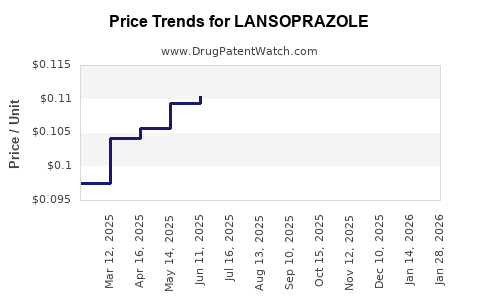
- Short term (0–2 years): flat-to-soft ASPs, with periodic temporary spikes in niche strengths/packaging after supply disruptions, followed by normalization.
- Mid term (2–5 years): gradual ASP erosion from additional generic entries and ongoing competitive pricing, with the pace varying by strength and dosage form.
- Long term (5+ years): stable low ASP base, with revenue growth lagging volume due to continued pricing pressure.
Because the U.S. lansoprazole market is generic-led, “price projections” are best interpreted as expected ASP ranges by channel rather than patent-related step changes.
What is the current market for lansoprazole in the U.S. and which channels control pricing?
Channel mix that drives economics
- Retail (independent + chain)
- Most sensitive to shelf and contracted rates.
- High share of 30-day fills and automatic substitution among AB-rated PPIs.
- Mail order
- Stronger contracting impacts.
- Lower unit prices, higher switching flexibility.
- Institutional (hospitals, clinics)
- Tender-based purchasing with formulary protocols.
- Pricing often reflects national or group purchasing organization (GPO) contracts.
Key competitive set
- Direct PPI substitutes: omeprazole, pantoprazole, esomeprazole.
- Within PPIs, pricing is usually anchored to the lowest AB-rated generic and the strongest payer contract.
Commercial implications
- Lansoprazole maintains demand because it is still stocked widely and remains an option for patients stabilized on specific PPIs, but payer formularies typically keep multiple PPIs available with minimal clinical differentiation.
What factors are pushing lansoprazole pricing down or stabilizing it?
Pricing down factors
- Multi-source generics: aggressive price competition compresses ASP.
- Contracting and rebates: wholesalers and payers negotiate steep discounts that shift realized pricing below published benchmarks.
- Substitution rules: AB-rated switching reduces pricing power.
- Supply normalization: when temporary shortages end, price rebounds fade quickly.
Pricing stabilization factors
- Formulation-specific niches: certain strengths, pack sizes, or delayed-release variants can retain slightly higher pricing.
- Institutional formularies: protocol-based continuity can slow switching away from lansoprazole.
- Payer preference: some managed markets select one PPI as preferred while keeping others covered, which can preserve small pricing differentials.
When do lansoprazole price changes typically occur: supply disruptions, tenders, or competitor moves?
Most common pricing inflection windows
- National tender cycles (institutional): quarterly to annual contract awards can shift prices for a subset of accounts.
- Payer re-contracting (commercial): typically semiannual to annual for pharmacy benefit managers.
- Supply events (retail/mail): manufacturer shortages or quality events can create short-lived price spikes.
Practical projection pattern
- Expect step-down pricing after competitor contract wins or when additional generic inventory reaches the market.
- Expect brief increases following supply disruption, then a reversion as alternative sources restore competitive balance.
Which generics and brand competitors pressure lansoprazole ASPs?
Brand vs generic reality
- Lansoprazole is largely generic. “Brand” pricing influence depends on whether any branded product with meaningful share remains in a given channel (often limited compared with fully generic substitution).
Generic pressure mechanisms
- More entrants in specific strengths or packaging often lower unit price for those SKUs first.
- Manufacturing capacity shifts can create localized price gaps that competitors exploit quickly.
Competitor substitution hierarchy (typical)
- Ongoing payer coverage usually includes multiple PPIs, and realized costs converge toward the lowest-cost option under contract.
How does lansoprazole compare with other PPIs on expected pricing and revenue trajectory?
Competitive comparison (economic positioning)
- Omeprazole / pantoprazole: often strongest in cost leadership, with broad multi-source presence.
- Esomeprazole: tends to have slightly different competitive behavior due to formulation and coverage patterns, but remains generic-multi-source.
- Lansoprazole: generally maintains pricing near the low-cost cluster for PPIs but can underperform if payers prefer other PPIs as preferred generics in specific plans.
Revenue expectations
- Given shared clinical class positioning, lansoprazole’s revenue trajectory is usually volume-driven, with price declines limiting growth.
- In competitive environments, volume gains tend to be incremental rather than structural.
What is the patent and exclusivity landscape for lansoprazole, and how does it affect pricing?
Pricing relevance
- For pricing projections, the core point is whether any meaningful exclusivity remains. In the U.S., lansoprazole’s core active ingredient is off exclusivity in practical terms due to widespread generic entry.
- Any remaining IP tends to be formulation- or method-specific, with limited impact on broad market pricing unless a specific product form is constrained.
Market consequence
- Pricing is governed primarily by generic competition, not by exclusivity calendars.
What is the Orange Book status of lansoprazole, and which products are most exposed to generic entry risk?
Orange Book logic for a generic-dominant product
- A fully open ingredient typically has many ANDA-labeled products with approved labeling.
- “Entry risk” is low at the molecule level and more granular by:
- dosage strength,
- package configuration,
- manufacturer-specific supply and quality performance.
Investment implication
- For price projection, the more relevant question is not “whether generics can enter,” but “whether pricing is likely to move due to changes in competitive supply and contracting.”
How strong is the patent estate for lansoprazole and what formulation patents matter commercially?
Commercial relevance of formulation patents
- If any formulation IP exists, it affects:
- switchability to certain extended-release/ODT/pack-specific equivalents,
- supply availability for protected forms,
- litigation and settlement-driven exclusivity extensions.
For price projections
- Generic-level price movement generally remains the dominant driver.
- Even if some formulation products face slower substitution, the market-wide ASP is usually pulled down by broader multi-source availability.
What paragraph IV challenges or settlements affect lansoprazole market access?
Expected effect
- For a widely generic product, individual challenges tend to have limited market-wide impact unless:
- they delay supply for a meaningful SKU,
- they lead to settlement constraints on specific manufacturers,
- or they create temporary exclusivity for a formulation route.
Price projection translation
- Look for effects primarily in:
- short windows around launch and delisting,
- SKU-specific pricing divergences.
FDA regulatory status of lansoprazole: how do approvals and labeling changes affect pricing?
Regulatory impacts
- FDA approvals rarely move prices directly for mature generics.
- Labeling updates can change payer coverage patterns, but PPIs are usually therapeutically substitutable.
Business consequence
- Pricing and volume are more sensitive to:
- plan formularies,
- step therapy requirements,
- and class-level PPI management policies.
What manufacturing and IP barriers can keep lansoprazole prices above the floor?
Non-IP barriers that affect realized price
- Supply reliability: consistent manufacturing capacity prevents competitor-driven price crashes.
- Quality and compliance: inspections and recalls can temporarily reduce supply.
- Distribution network reach: secured access to retail channels and institutional tenders supports stable demand.
IP barriers
- For mature molecules, IP is typically not a primary barrier, but formulation-specific constraints can protect some niche SKUs.
Price projections for lansoprazole: expected ASP ranges by scenario (U.S.)
Scenario framework
Because the market is competitive and pricing is contract-led, projections are best presented as scenario bands.
| Time horizon |
Base case outcome |
Upside case outcome (less erosion) |
Downside case outcome (faster erosion) |
| 0–2 years |
ASPs flatten to modestly down; SKU-specific spikes fade quickly |
near-flat ASPs where contracts roll forward and supply stays stable |
meaningful downshift after contract losses or new entrants in high-volume strengths |
| 2–5 years |
gradual ASP erosion; revenue growth mostly volume |
slow erosion driven by continued stability in preferred PPI contracting |
steeper erosion if tender pricing resets aggressively or supply expands rapidly |
| 5+ years |
ASPs stabilize at low level; modest volume-led growth |
stabilization with limited new price shocks |
continued competitive compression across most SKUs |
What drives the magnitude
- Entry of additional low-cost suppliers in specific strengths.
- Contract renewals with lower unit cost targets.
- Changes in institutional tender rules and pharmacy benefit manager preferred tiers.
Commercial outlook: where lansoprazole revenue is most resilient and where it is most exposed
Most resilient segments
- Patients stabilized on a particular PPI (continuity effects).
- Institutional accounts with long-standing protocols.
- Pack sizes and strengths with tighter supplier competition.
Most exposed segments
- SKUs where multiple low-cost competitors expand capacity.
- Plans that repeatedly swap preferred PPI generics.
- Channels that drive hard substitution and frequent tender-based reallocation.
Key market metrics to monitor for price forecasting (actionable dashboard inputs)
- Number of AB-rated manufacturers active per key strength (retail and institutional availability).
- Share of volume in preferred tier contracts at PBM level (proxy: formulary preferred status and copay positioning).
- Supply disruptions by major manufacturer (quality, capacity constraints).
- Tender/contract outcomes (especially hospital systems and GPO renewals).
- Inventory behavior and order cadence (fast sell-through after price resets indicates pressure persists).
Key Takeaways
- Lansoprazole pricing is controlled by generic multi-source competition, channel contracting, and substitution behavior, not by molecule-level exclusivity.
- Near-term expectations are flat-to-soft ASPs, with short-lived spikes during supply issues and resets after normalization.
- Over 2–5 years, the baseline is gradual ASP erosion with revenue growth constrained by volume stability and payer preference dynamics.
- The main swing factors for projections are contract renewals and supply availability in high-volume strengths, not litigation-driven market re-entry.
FAQs
1) What strengths of lansoprazole usually see the biggest ASP declines in generic competition?
High-volume strengths with broad multi-source coverage typically show the fastest erosion when new low-cost entrants scale distribution.
2) How do payer formulary shifts among PPIs affect lansoprazole volume?
If a plan tightens preference to another PPI generic or introduces stricter step therapy, lansoprazole volume can drift downward even if coverage remains broad.
3) Do store-brand or private-label versions materially change lansoprazole realized pricing?
They can reduce realized pricing in retail by pulling demand toward lower-cost contracted SKUs, especially when pharmacy substitution rules favor the lowest-cost option.
4) What indicators signal a coming price drop in lansoprazole before it appears in benchmarks?
Rapid new distribution availability across major wholesalers, increased retailer share of lowest-cost NDCs, and contract wins by additional suppliers are leading indicators.
5) Can supply disruptions raise lansoprazole prices for more than a few weeks?
Usually the effect is temporary; sustained higher prices require prolonged supply constraints or quality issues that reduce effective competition.
References (APA)
- U.S. Food and Drug Administration. Orange Book: Approved Drug Products with Therapeutic Equivalence Evaluations. FDA.
- FDA Drug Shortages. U.S. Food and Drug Administration.