Last updated: August 10, 2026
Hydrocodone is a mature, largely generic opioid market with declining prescription volume, fragmented manufacturers, intense regulatory controls, and limited branded revenue. The main commercial products are hydrocodone-acetaminophen immediate-release tablets, hydrocodone extended-release products, and hydrocodone-homatropine combinations. Generic immediate-release products account for most unit volume, while branded extended-release products retain the highest potential margins but face narrow demand, payer restrictions, and opioid-related scrutiny.
How large is the hydrocodone market?
The hydrocodone market is no longer a conventional branded pharmaceutical growth market. It is primarily an established generic market measured by prescriptions, tablets, wholesale acquisition cost, and hospital or retail supply contracts.
| Market segment |
Principal products |
Commercial position |
| Immediate-release combination |
Hydrocodone-acetaminophen, including generic Norco and generic Vicodin equivalents |
Largest volume segment; heavily commoditized |
| Immediate-release single-ingredient |
Hydrocodone bitartrate oral products |
Limited current use |
| Extended-release |
Hysingla ER, Zohydro ER, Vantrela ER, and generic or authorized-generic equivalents where available |
Smaller volume; higher formulation and regulatory barriers |
| Cough products |
Hydrocodone-containing antitussives |
Restricted market after opioid controls and pediatric safety changes |
| Hydrocodone-homatropine |
Generic and branded equivalents to Hycodan |
Niche prescription market |
Public companies generally do not report hydrocodone revenue as a separate line item. The product is often included within broader generic, pain, hospital, or controlled-substance portfolios. As a result, market size estimates differ depending on whether they include only prescription analgesics or also cough products and wholesale API sales.
Prescription volume has declined materially from its peak. CDC data show that U.S. opioid prescribing peaked in 2011 and fell through 2022, with the national prescribing rate declining from 81.3 prescriptions per 100 persons in 2012 to 45.6 in 2022.[1] Hydrocodone-containing products followed this broader contraction.
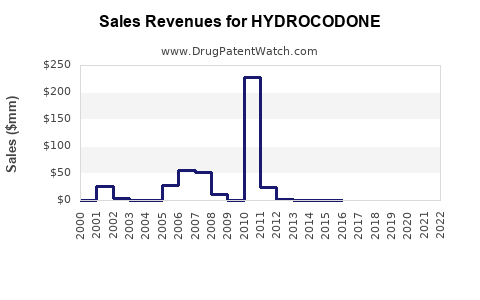
What is the financial trajectory for hydrocodone?
Hydrocodone has moved through four commercial phases:
- Branded expansion before 2010. Vicodin and related hydrocodone-acetaminophen products generated substantial prescription volume, although much of the market was already exposed to generic competition.
- Generic conversion and volume erosion from 2010 to 2014. Generic substitution reduced branded pricing power.
- Regulatory compression from 2014 onward. The FDA moved hydrocodone combination products from Schedule III to Schedule II, eliminating refills and increasing prescribing controls.[2]
- Mature generic decline from 2018 onward. Fewer prescriptions, lower opioid exposure, payer restrictions, and litigation settlements reduced the commercial value of many branded and specialty products.
The immediate-release segment now has low unit economics. Manufacturers compete on manufacturing cost, supply reliability, controlled-substance compliance, wholesaler access, and shortage management. Price increases can occur during shortages, but they do not create durable brand equity.
The extended-release segment has a different financial profile. Products such as Hysingla ER can command higher prices than generic immediate-release tablets, but sales are limited by:
- strict opioid-prescribing criteria;
- abuse-deterrence and risk-management requirements;
- prior authorization;
- payer preference for generic alternatives;
- competition from oxycodone, morphine, transdermal, and non-opioid therapies;
- litigation and reputational exposure.
Purdue Pharma’s bankruptcy and opioid settlement liabilities further reduced the commercial value of legacy hydrocodone brands. Public financial reporting does not provide a reliable current standalone revenue figure for Hysingla ER or the broader hydrocodone category.
Which hydrocodone products have FDA approval?
The FDA-approved hydrocodone landscape includes both combination analgesics and extended-release products.
Immediate-release products
Common FDA-approved combinations include:
- hydrocodone bitartrate and acetaminophen tablets;
- hydrocodone bitartrate and ibuprofen tablets;
- hydrocodone bitartrate and homatropine methylbromide tablets or oral solution.
Vicodin was a major historical brand, but the commercial market has largely shifted to generic equivalents. Norco also has broad generic substitution.
Extended-release products
| Product |
Active ingredient |
Sponsor or historical sponsor |
FDA milestone |
| Hysingla ER |
Hydrocodone bitartrate |
Purdue Pharma |
Approved November 2014 |
| Zohydro ER |
Hydrocodone bitartrate |
Zogenix, later acquired by Pernix |
Approved October 2013 |
| Vantrela ER |
Hydrocodone bitartrate |
Teva Pharmaceuticals |
Approved January 2017 |
| Generic ER hydrocodone products |
Hydrocodone bitartrate |
Multiple ANDA applicants |
Market status depends on FDA approvals and commercial supply |
Hysingla ER and Vantrela ER use extended-release tablet technologies intended to control drug release and reduce certain forms of manipulation. Zohydro ER was notable because it was initially a single-ingredient hydrocodone extended-release product without acetaminophen, reducing acetaminophen-related liver toxicity but raising concerns about abuse potential.
What is the Orange Book status of hydrocodone products?
The Orange Book does not contain one universal hydrocodone patent estate. It lists patents and exclusivity by specific product, dosage form, strength, formulation, and applicant.
For mature immediate-release hydrocodone-acetaminophen products, listed patents and exclusivity have generally expired or become commercially irrelevant because multiple ANDA-approved products compete in the market. The principal competitive barrier is manufacturing and regulatory compliance rather than an active composition-of-matter patent.
Extended-release products have had more relevant formulation patents. Orange Book listings for these products can cover:
- controlled-release matrix technology;
- abuse-deterrent tablet construction;
- release-rate profiles;
- particle size or compression characteristics;
- dosage regimens;
- manufacturing processes;
- methods of treating chronic pain.
Patent status can change through patent expiration, delisting, reissue, terminal disclaimers, litigation settlements, or FDA approval of competing ANDAs. A product-specific Orange Book review is required before drawing a final conclusion about generic launch timing.[3]
What patents protect extended-release hydrocodone?
Extended-release hydrocodone patents generally protect the formulation rather than hydrocodone itself. Hydrocodone is an old active pharmaceutical ingredient, so new-product value depends on delivery technology, dosage design, manufacturing controls, or a particular clinical use.
Formulation patent exposure
The principal protected technologies have included:
- hydrocodone matrix tablets;
- controlled dissolution across the gastrointestinal tract;
- crush-resistant or abuse-deterrent dosage forms;
- hydrocodone-only extended-release systems;
- dose strengths and release characteristics;
- methods of administering extended-release hydrocodone for around-the-clock pain control.
The strongest patent claims are usually those tied to a specific formulation architecture supported by manufacturing and dissolution data. Broad claims directed only to hydrocodone extended release are more vulnerable to invalidity or design-around arguments because controlled-release opioid technology is crowded.
Method-of-use patents
Potential method-of-use claims include treatment of chronic pain requiring continuous opioid analgesia, dosing intervals, conversion from other opioids, and administration of specified strengths. These claims can remain relevant after formulation patents expire, but their commercial value is constrained by:
- narrow labeling;
- physician discretion;
- difficulty proving induced infringement;
- generic carve-outs under FDA rules;
- competing non-infringing uses.
When does hydrocodone lose exclusivity?
Hydrocodone immediate-release products lost meaningful exclusivity years ago. Generic competition is entrenched.
The relevant exclusivity question concerns branded extended-release products. FDA approval dates were:
| Product |
Approval date |
Practical exclusivity position |
| Zohydro ER |
October 25, 2013 |
Original regulatory exclusivity and core patent protection have expired or become commercially diminished |
| Hysingla ER |
November 20, 2014 |
Core market protection has materially weakened; current exposure depends on Orange Book listings and ANDA litigation |
| Vantrela ER |
January 19, 2017 |
Later entrant with formulation-specific protection, but small market share and limited commercial scale |
FDA regulatory exclusivity is distinct from patent protection. New chemical entity exclusivity did not create a long-term barrier for these products because hydrocodone was already an established active ingredient. Any exclusivity associated with a new formulation or clinical indication is narrower than composition-of-matter exclusivity.
Which companies manufacture or challenge hydrocodone products?
The U.S. market has included large generic manufacturers and specialty controlled-substance suppliers such as:
- Teva Pharmaceuticals;
- Mallinckrodt;
- Rhodes Pharmaceuticals;
- Amneal Pharmaceuticals;
- Hikma Pharmaceuticals;
- Ingenus Pharmaceuticals;
- Sun Pharmaceutical Industries;
- Endo and Par Pharmaceutical;
- Dr. Reddy’s Laboratories;
- Alvogen and related generic entities;
- Actavis, now part of Teva.
The competitive field changes frequently because controlled-substance quotas, manufacturing inspections, recalls, supply interruptions, and distributor controls affect product availability.
Paragraph IV challenges are most relevant to branded extended-release products. A generic applicant may certify that an Orange Book patent is invalid, unenforceable, or not infringed. A Paragraph IV filing can trigger a 30-month stay of FDA approval if the patent holder files an infringement action within the statutory period.[4]
For immediate-release hydrocodone products, Paragraph IV litigation has limited strategic importance because the market already has multiple generic suppliers. For extended-release products, litigation can affect launch timing, but the commercial prize may be too small to justify prolonged litigation unless the generic applicant has a broader opioid portfolio.
What patent litigation affects hydrocodone?
Hydrocodone has been affected by three separate litigation categories.
Product patent litigation
Branded extended-release products have faced the standard Hatch-Waxman risks involving formulation patents, dosage patents, and method-of-use claims. These cases determine whether an ANDA applicant can launch before listed patents expire.
Opioid liability litigation
Manufacturers, distributors, and pharmacy chains have faced extensive civil claims concerning opioid marketing, distribution, monitoring, and public-health damages. These cases have produced multibillion-dollar settlements and restructuring agreements involving major opioid companies, including Purdue Pharma and Mallinckrodt.[5][6]
These liabilities affect hydrocodone economics indirectly. They increase compliance costs, reduce promotional activity, restrict distribution, and discourage investment in opioid brand expansion.
Contract and supply litigation
Generic manufacturers also face commercial disputes involving API supply, controlled-substance quotas, recalls, manufacturing deviations, and distribution agreements. These cases can affect product availability without changing patent rights.
Is hydrocodone subject to biosimilar risk?
No. Hydrocodone is a small-molecule drug, not a biologic. Biosimilar competition under the Public Health Service Act does not apply.
The relevant competitive pathways are:
- ANDA approval for therapeutically equivalent generics;
- 505(b)(2) applications for modified formulations or delivery systems;
- authorized generics;
- hospital and institutional supply contracts;
- non-opioid substitutes.
A 505(b)(2) applicant could seek approval for a new hydrocodone formulation, abuse-deterrent profile, dosage form, or administration route. That pathway can create limited regulatory exclusivity, but it does not provide the durable protection associated with a new molecular entity.
How strong is the hydrocodone patent estate?
The estate is strong for mature generic manufacturing barriers and weak for broad molecule-level exclusivity.
| Patent category |
Relative strength |
Commercial assessment |
| Hydrocodone composition of matter |
Very weak or expired |
No meaningful exclusivity |
| Immediate-release tablet formulation |
Weak |
Numerous generic alternatives |
| Acetaminophen combination |
Weak to moderate |
Product-specific claims have limited value |
| Extended-release matrix formulation |
Moderate |
Can delay ANDA launch if claims survive |
| Abuse-deterrent technology |
Moderate to strong when technically specific |
Value depends on FDA labeling and payer acceptance |
| Method of use |
Weak to moderate |
Vulnerable to carve-outs and enforcement limits |
| Manufacturing process |
Moderate |
Can create operational barriers but is often design-aroundable |
The most defensible assets are narrow claims supported by reproducible dissolution data, abuse-deterrence testing, and manufacturing know-how. The weakest assets are broad claims that attempt to control all extended-release hydrocodone formulations.
What generic entry risks exist for hydrocodone?
Generic entry risk is high for immediate-release products and moderate to high for extended-release products.
Immediate-release risk
Immediate-release hydrocodone-acetaminophen is already a generic market. A new entrant can face:
- low selling prices;
- limited wholesaler shelf space;
- controlled-substance quota constraints;
- state opioid restrictions;
- liability reserves;
- supply-chain scrutiny;
- product recalls.
The opportunity is primarily operational. A manufacturer with dependable supply, low cost, and strong distributor relationships can gain share, but sustained pricing power is unlikely.
Extended-release risk
Extended-release products face a more complex risk profile:
- patent challenges;
- formulation design-around;
- FDA scrutiny of abuse-deterrent claims;
- limited eligible patient populations;
- payer substitution;
- low prescription volume;
- high clinical and regulatory costs.
A successful generic launch could reduce branded net sales quickly because payers generally favor lower-cost alternatives. The countervailing factor is that limited demand may reduce the incentive for multiple entrants.
How does hydrocodone compare with oxycodone?
Hydrocodone and oxycodone compete in the same opioid analgesic market but have different commercial histories.
| Factor |
Hydrocodone |
Oxycodone |
| Dominant U.S. segment |
Hydrocodone-acetaminophen immediate-release |
Oxycodone immediate-release and oxycodone-acetaminophen |
| Major historical brand |
Vicodin/Norco |
OxyContin/Percocet |
| Generic competition |
Extensive |
Extensive |
| Extended-release brand exposure |
Hysingla ER, Zohydro ER, Vantrela ER |
OxyContin and generic oxycodone ER |
| Patent value |
Mainly formulation-specific |
Historically significant formulation and abuse-deterrence claims |
| Current growth outlook |
Declining or stable at a low base |
Declining mature market |
| Regulatory risk |
High |
High |
| Biosimilar risk |
None |
None |
Hydrocodone’s financial base is more fragmented than the historic OxyContin market. Neither category has a strong broad-based growth thesis under current prescribing and regulatory conditions.
What is the FDA and DEA regulatory status of hydrocodone?
Hydrocodone is a Schedule II controlled substance in the United States. The DEA classification means:
- no ordinary prescription refills;
- heightened prescribing and dispensing controls;
- electronic prescribing requirements in many jurisdictions;
- quota controls for manufacturers;
- extensive recordkeeping;
- heightened distributor monitoring.
The FDA has also required labeling and risk-management measures for extended-release and long-acting opioids. Hydrocodone-acetaminophen products carry risks from both opioid exposure and acetaminophen-associated liver injury. The FDA limited prescription combination products to no more than 325 mg of acetaminophen per dosage unit in 2011.[7]
The FDA has not approved hydrocodone as a biologic, and no biosimilar pathway applies.
What licensing deals and commercial transactions affect hydrocodone?
Hydrocodone commercial rights have changed through acquisitions and portfolio transfers rather than high-value innovation licensing.
Relevant transactions include:
- Pernix’s acquisition of Zogenix, which transferred control of Zohydro ER;
- Teva’s acquisition of Actavis Generics, which expanded Teva’s generic hydrocodone portfolio;
- manufacturer and distributor agreements involving generic controlled substances;
- opioid settlement and restructuring arrangements that altered the ownership or commercialization of legacy products.
Licensing economics are constrained by the category’s declining volume and liability exposure. Buyers typically value hydrocodone rights for portfolio breadth, manufacturing utilization, or institutional supply contracts rather than long-term brand growth.
What is the outlook for hydrocodone revenue?
The base-case financial outlook is:
- continued decline in total U.S. prescription volume;
- stable-to-lower generic pricing outside temporary shortages;
- limited branded growth;
- ongoing reduction in promotional activity;
- higher compliance and monitoring costs;
- modest opportunity in specialized formulations;
- no meaningful molecule-level patent upside.
Revenue can temporarily increase for a supplier during a shortage or after a competitor exits. That uplift is generally volume-driven and vulnerable to new entrants. Durable growth would require a differentiated delivery system, a clinically meaningful abuse-deterrent profile, or a new indication with favorable reimbursement. Current FDA and payer conditions make that outcome difficult.
Key Takeaways
- Hydrocodone is a mature generic opioid market, not a high-growth branded pharmaceutical category.
- Immediate-release hydrocodone-acetaminophen products have extensive generic competition and little remaining exclusivity value.
- Extended-release products retain formulation and method-of-use patent issues, but their markets are small and heavily regulated.
- Hydrocodone is a Schedule II controlled substance and is subject to DEA quotas, prescribing restrictions, and heightened compliance requirements.
- Biosimilar risk does not apply; generic ANDA and 505(b)(2) competition does.
- The strongest remaining IP is narrow formulation, abuse-deterrence, dissolution, and manufacturing technology.
- Opioid litigation and settlement liabilities materially reduce the financial attractiveness of hydrocodone assets.
- The likely long-term trajectory is declining volume, compressed pricing, and selective value in supply reliability or differentiated formulations.
FAQs
Does hydrocodone have composition-of-matter patent protection?
No meaningful current composition-of-matter exclusivity protects hydrocodone. Commercial protection depends on product-specific formulation, manufacturing, or method-of-use claims.
Can a generic manufacturer launch hydrocodone before an Orange Book patent expires?
Potentially. A Paragraph IV certification can support an early launch if the patent is invalid, not infringed, unenforceable, or resolved through litigation or settlement.
Are hydrocodone-acetaminophen and hydrocodone extended-release products interchangeable?
No. They differ in release profile, labeling, dosing, acetaminophen exposure, substitution rules, and clinical use. FDA therapeutic equivalence is product-specific.
What is the principal manufacturing barrier for hydrocodone?
The main barriers are controlled-substance quotas, validated manufacturing, API security, FDA compliance, distributor controls, and reliable supply. These barriers are operational rather than molecule-level patent barriers.
Can hydrocodone generate licensing revenue in emerging markets?
Potentially, but licensing value is limited by local opioid regulation, import controls, prescription restrictions, generic competition, and the absence of broad active-molecule patent protection.
References
-
Centers for Disease Control and Prevention. (2024). U.S. opioid dispensing rate maps and data. https://www.cdc.gov/overdose-prevention/data-research/facts-stats/opioid-dispensing-rate-maps.html
-
U.S. Drug Enforcement Administration. (2014). Schedules of controlled substances: Rescheduling of hydrocodone combination products from schedule III to schedule II. 79 Fed. Reg. 49661.
-
U.S. Food and Drug Administration. (2024). Approved drug products with therapeutic equivalence evaluations, Orange Book. https://www.fda.gov/drugs/drug-approvals-and-databases/approved-drug-products-therapeutic-equivalence-evaluations-orange-book
-
U.S. Congress. (1984). Drug Price Competition and Patent Term Restoration Act of 1984, Pub. L. No. 98-417.
-
U.S. Bankruptcy Court for the Southern District of New York. (2022). In re Purdue Pharma L.P., No. 19-23649.
-
Mallinckrodt plc. (2023). Annual report and opioid settlement disclosures.
-
U.S. Food and Drug Administration. (2011). FDA drug safety communication: Prescription combination drug products with more than 325 mg of acetaminophen. https://www.fda.gov/drugs/drug-safety-and-availability/fda-limits-acetaminophen-prescription-combination-products-325-mg-dosage-unit